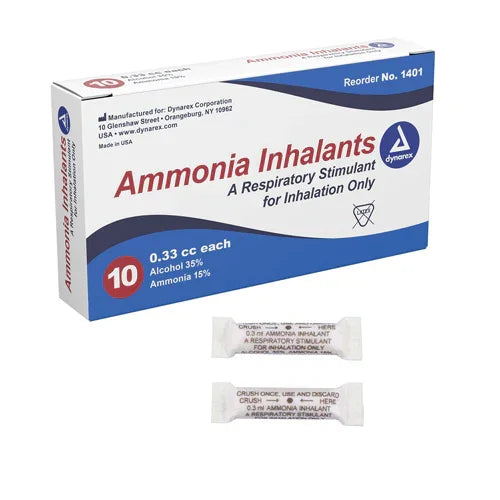
Ask most people where they have seen an ammonia inhalant and they will describe a powerlifter shaking one under their nose before a heavy attempt. That image has done the product a disservice. It has turned a plain first aid item into gym theatre, and it has left a lot of people believing things about smelling salts that are not true.

This article looks at both halves of the picture: what these products realistically do in an athletic setting, and the far less dramatic role they play in ordinary first aid kits, care settings, and response bags.
Where the Sports Reputation Came From
Ammonia inhalants long predate their gym popularity. They sat in boxing corners and hospital wards for generations as a way of rousing someone who had fainted. Strength sport adopted them because the reflex they produce — a sharp gasp, a jolt of alertness — feels like readiness. Social media did the rest.

What They Actually Do for an Athlete — and What They Don't
The honest summary is narrow. Inhaling ammonia vapour irritates the nasal lining and triggers a reflex: a deeper breath, a brief spike in arousal, a few seconds of heightened attention. That is the whole effect, and it fades quickly.
What that means in practice:
- They do not make you stronger. There is no change to muscle force, technique, or capacity. Arousal is not power.
- They do not replace a warm-up. Nothing about the reflex prepares tissue or joints for load.
- They do not remove pain or injury risk. Feeling switched on is not the same as being protected, and pushing through pain because you feel alert is how people get hurt.
- They are not a supplement. There is no cumulative benefit to routine use, and repeated exposure irritates the nasal passages.
If an athlete is relying on one before every set, the useful question is about sleep, fuelling, and programming — not about the vial.
The Sideline Rule That Matters Most
One use case deserves to be stated plainly: never use an ammonia inhalant on an athlete who has taken a blow to the head.
An athlete who looks dazed, glassy, slow to answer, or unsteady after contact needs assessment by qualified medical staff and removal from play. Making someone appear alert enough to continue is not first aid — it hides the exact signs that the assessment depends on. The same applies to any suspected neck or spinal injury, where the priority is not moving the person and calling for help.

Any gym or club keeping inhalants on hand should pair them with a written rule about head injuries and a clear instruction that only trained staff clear an athlete to return.
Beyond the Arena: The Everyday Version
Strip away the gym context and ammonia inhalants go back to being a modest, useful item. The situations they were originally kept for are far more common than heavy singles:
- Someone who feels faint after standing up too quickly, after a blood draw, or in a hot, crowded room
- Brief lightheadedness during a long queue, a religious service, a fast, or a warm commute
- A simple faint witnessed by someone with no medical training who wants a way to help
Even here, the inhalant is a supporting act. Getting the person flat with their legs raised, giving them air, and keeping them down for a few minutes afterwards does more than any vial. And if someone faints repeatedly, that pattern belongs in front of a doctor, not managed at home.

Where a Small Supply Genuinely Earns Its Place
- Home first aid kits — particularly in households where someone is prone to simple fainting and has discussed it with their doctor
- Workplace first aid stations — hot environments, standing work, and shift work all produce their share of lightheaded staff
- Event and response bags — small, light, and sealed until needed
- Care and community settings — where staff may be first on the scene and are waiting on clinical support
For guidance on which format suits which of these, see our stocking and format guide.
Practical Handling Notes
- Hold the inhalant several inches from the nose and pass it briefly beneath — never hold it against the skin
- Remove it the moment the person responds; a longer exposure adds irritation, not effect
- Avoid direct skin and eye contact, and dispose of a crushed ampoule immediately
- Store cool and dry, sealed in the original packaging, out of reach of children
- Do not use on anyone with asthma, COPD, or another respiratory condition
- Check expiry dates on a schedule — ammonia is volatile and product degrades unused
Our safety and correct-technique guide covers contraindications and common misuse in full, and the background explainer covers the mechanism.
Talk To Your Doctor
Ammonia inhalants are a general consumer first aid item, not a treatment. If you or an athlete you train faints, feels faint during exertion, or experiences dizziness that keeps recurring, that is worth a medical opinion. The same goes for anyone with a respiratory or cardiac condition, or anyone who is pregnant, before keeping inhalants for personal use.
You can browse related supplies in Respiratory Care & Oxygen Management and First Aid.
This article is general information and is not medical advice.