Medical Disclaimer: This article is for educational purposes only and does not constitute medical advice. Always consult a physician or wound care specialist for serious, infected, or non-healing wounds. Seek emergency care for deep lacerations, wounds with heavy bleeding, or any wound that shows signs of serious infection.
The Wrong Dressing Can Make a Wound Worse
When David's 78-year-old father developed a pressure ulcer on his heel after a hospital stay, the family picked up a box of standard adhesive bandages from the drugstore — the same ones they'd always used for cuts and scrapes. Within a week, the wound had worsened. The skin around it was macerated and irritated. A visiting wound care nurse took one look and explained the problem: a pressure ulcer needs a moisture-retaining dressing that protects fragile tissue, not a traditional gauze bandage that dries the wound bed and sticks to healing tissue.
Switching to a hydrocolloid dressing changed the trajectory of healing almost immediately. The wound began to close over the following weeks.
This story plays out more often than most people realize. The wound dressing market has expanded dramatically over the past two decades. There are now more than a dozen distinct categories of dressings, each engineered for specific wound characteristics. Choosing the right one isn't just helpful — it's a meaningful part of how quickly and cleanly a wound heals.
This guide explains the main types of wound dressings, what each one is designed to do, and how to match dressing to wound type. You can browse AllCare Store's wound care collection for a full range of dressings and first aid supplies.
Why Wound Dressing Type Matters
A wound heals best in a moist environment — not wet, not dry, but balanced. Research going back to the 1960s (George Winter's landmark 1962 study) established that moist wound healing is significantly faster than healing under dry conditions. Modern wound dressings are engineered around this principle, but the ideal moisture level varies depending on the wound type, depth, and amount of fluid (exudate) it produces.
The wrong dressing can:
- Dry out the wound bed and slow healing
- Cause maceration (over-softening of surrounding skin from excess moisture)
- Stick to healing tissue and damage it when removed
- Introduce or harbor bacteria
- Cause pain during dressing changes
The right dressing creates an optimal healing environment, manages fluid, protects from contamination, and can be removed without trauma.
The Main Types of Wound Dressings
1. Hydrocolloid Dressings
Best for: Minor to moderate wounds, pressure ulcers (Stage 1–2), leg ulcers, minor burns, blisters, post-surgical wounds with minimal exudate
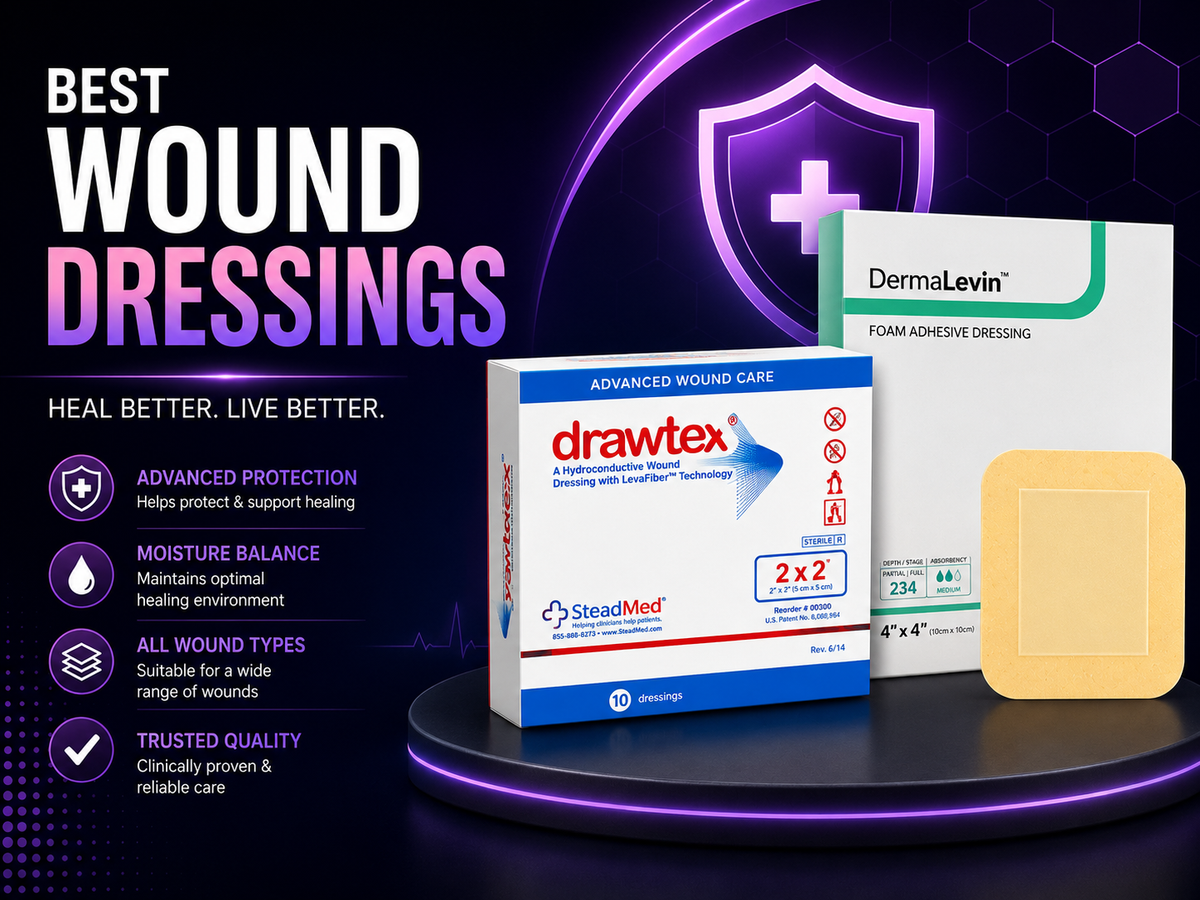
Hydrocolloid dressings contain gel-forming agents (typically carboxymethylcellulose) embedded in a flexible, waterproof outer layer. When they contact wound fluid, they form a soft gel that maintains a moist environment. They're self-adhesive, conformable, and — crucially — waterproof, so patients can shower without the dressing being disturbed.
One of their best features is their ability to stay in place for several days (typically 3–7 days), which reduces the number of painful dressing changes. They also provide some cushioning, which helps protect pressure points.
Limitations: Not suitable for heavily draining wounds (the gel can't absorb large volumes of exudate), infected wounds, or wounds where daily assessment is needed.
Tip: When you remove a hydrocolloid dressing, you'll often see a yellowish-brown gel — this is normal and does not indicate infection. It's simply the dressing doing its job.
2. Foam Dressings
Best for: Moderate to heavily draining wounds, pressure ulcers (Stage 2–4), venous leg ulcers, diabetic foot ulcers, wounds around tubes or drains
Foam dressings are made from polyurethane foam and are among the most versatile dressings available. Their highly absorbent structure handles moderate to heavy exudate without leaking, while still maintaining the moisture the wound needs. Many foam dressings have a silicone wound contact layer that prevents sticking and allows atraumatic removal.
They come in a wide range of sizes and shapes — including cavity-filling foam ropes and shaped pieces designed for heels, sacral areas, and tube sites. Border foam dressings (foam with an adhesive frame) can be changed every 3–5 days depending on drainage volume.
Limitations: Not ideal for dry wounds or wounds with minimal exudate, as they may dry out the wound bed.
3. Alginate Dressings
Best for: Heavily exuding wounds, deep or cavity wounds, pressure ulcers, venous ulcers, surgical wounds, wounds with tunneling
Alginate dressings are derived from seaweed and come in the form of flat sheets or rope-like fillers for cavities. When they absorb wound fluid, they convert to a soft gel that maintains moisture while managing even very heavy drainage. They can absorb up to 20 times their weight in fluid — far more than gauze or foam.
Alginate ropes are especially useful for packing deep wounds or tunnels that need to be filled to prevent dead space. They are secured with a secondary dressing (a foam pad or transparent film) and typically changed every 1–3 days depending on drainage level.
Limitations: Not suitable for dry wounds or wounds with minimal exudate. Require a secondary cover dressing.
4. Transparent Film Dressings
Best for: Superficial abrasions, IV and catheter sites, donor sites, protection of at-risk skin, covering primary dressings
Transparent film dressings are thin, clear, semi-permeable membranes. They keep bacteria and water out while allowing the wound to breathe. Because they're see-through, you can monitor the wound without removing the dressing — which makes them popular for IV site care and superficial wounds.
They don't absorb any fluid, so they're only appropriate for wounds with little to no exudate. On dry or healing wounds, they create a sealed protective environment that promotes re-epithelialization (the regrowth of surface skin cells).
Limitations: Will not work on wounds producing any meaningful fluid — the exudate has nowhere to go and will pool under the film. Also difficult to apply wrinkle-free on curved areas.
5. Silicone (Soft Silicone / Atraumatic) Dressings
Best for: Fragile skin, elderly patients, patients on blood thinners, skin tears, wounds where minimizing dressing-change trauma is a priority
Silicone dressings have a wound contact layer coated in soft silicone. This coating allows the dressing to adhere lightly to intact surrounding skin while not bonding to the moist wound bed — meaning removal is gentle and atraumatic, even after several days in place.
For elderly patients whose skin can tear easily, or for anyone who dreads painful dressing changes, silicone-interface dressings are a significant quality-of-life improvement. They're available in multiple formats — silicone contact layers alone, or combined with foam or other absorbent layers.
Limitations: Generally more expensive than non-silicone alternatives. Not designed for infected wounds requiring antimicrobial action.
6. Antimicrobial Dressings (Silver and Iodine)
Best for: Infected wounds, wounds at high risk of infection, wounds that have been slow to heal, diabetic foot ulcers with bacterial biofilm
Antimicrobial dressings incorporate agents like silver, cadexomer iodine, or honey to combat bacterial load in a wound. Silver dressings, the most widely used type, release silver ions that are toxic to a broad spectrum of bacteria — including MRSA — without systemic side effects.
These dressings are typically used when there are signs of local infection (increased pain, warmth, redness, purulent discharge) or when a chronic wound has stalled because of bacterial biofilm. They shouldn't be used indefinitely — once infection is controlled, switching back to a standard dressing is appropriate.
Limitations: Not for routine wound management — overuse can potentially select for resistant organisms. Not appropriate for wounds without infection concerns.
7. Gauze Dressings
Best for: Wound packing, absorbing heavy bleeding, covering primary dressings, general first aid
Traditional woven gauze remains one of the most versatile materials in wound care, despite being one of the oldest. It's inexpensive, widely available, and useful for many purposes — including packing deep wounds, absorbing initial heavy bleeding, and serving as a secondary cover for other dressings.
However, plain dry gauze has significant downsides for wound healing: it can dry out the wound bed, stick to healing tissue, and cause pain and re-injury on removal. For wounds that will benefit from moist healing, plain gauze should either be moistened with saline before use (wet-to-moist technique, under clinical supervision) or replaced with a more modern dressing for multi-day wear.
Non-adherent gauze alternatives — such as petrolatum-impregnated gauze or silicone-coated gauze — address the sticking problem and are appropriate for burns, skin grafts, and abrasions.
8. Collagen Dressings
Best for: Chronic non-healing wounds, diabetic ulcers, pressure ulcers, venous ulcers, wounds that have stalled in a prolonged inflammatory phase
Collagen dressings provide an exogenous source of collagen — a key structural protein in connective tissue — to support and stimulate the wound healing process. They're used when a wound has been present for weeks or months without making meaningful progress.
Available as pads, gels, particles, or strips, collagen dressings are changed every 3–7 days. They're rarely a first-line choice for acute wounds but can be a meaningful intervention for chronic wounds that have failed to respond to other approaches.
Quick Reference: Matching Dressing to Wound
| Wound Type | Recommended Dressing(s) |
|---|---|
| Minor cut / abrasion (dry) | Transparent film, non-adherent gauze, adhesive bandage |
| Blister | Hydrocolloid |
| Superficial burn (first degree) | Non-adherent gauze, hydrocolloid |
| Pressure ulcer Stage 1–2 | Hydrocolloid, thin foam, transparent film |
| Pressure ulcer Stage 3–4 (cavity) | Alginate rope or foam cavity filler + cover dressing |
| Venous leg ulcer (heavy drainage) | Alginate or foam + compression |
| Diabetic foot ulcer | Foam, alginate, collagen, or antimicrobial (if infected) |
| Skin tear (fragile/elderly skin) | Silicone contact layer, non-adherent dressing |
| Infected wound | Silver or iodine antimicrobial dressing |
| Surgical incision (closed) | Transparent film or border foam |
| IV or catheter site | Transparent film |
General Wound Care Tips
Clean Before You Dress
Gently rinse acute wounds with clean running water or saline. Avoid hydrogen peroxide and alcohol on open wounds — both damage healing tissue and slow recovery. Antiseptic wipes are appropriate for surrounding intact skin but not the wound bed itself.
Change Frequency Depends on the Dressing
Modern dressings are not bandages to be changed daily out of habit. Many advanced dressings are designed to stay in place for 3–7 days. Frequent unnecessary changes disturb healing tissue, increase infection risk, and waste product. Follow the dressing manufacturer's guidance and change when the dressing is saturated, lifting, or when there are signs of infection.
Watch for Signs of Infection
Seek medical attention if you notice: increasing pain or swelling, expanding redness, warm skin around the wound, purulent (pus-like) discharge, foul odor, or fever. These suggest infection that requires evaluation and possibly antibiotic treatment.
Protect the Periwound Skin
The skin around the wound is vulnerable. Use a barrier cream or skin protectant on surrounding skin — especially with heavily draining wounds — to prevent maceration and breakdown. See AllCare Store's skin care collection for barrier creams and protective products.
Where to Find Wound Dressings
AllCare Store carries a broad selection of wound care and first aid products, including hydrocolloid pads, foam dressings, alginate dressings, transparent films, and non-adherent gauze. You can browse the full wound care collection and first aid supplies for home wound management products.
If you care for someone with a chronic wound — a pressure ulcer, diabetic foot ulcer, or venous leg ulcer — a home care supply setup can help you maintain consistent dressing changes between clinic visits. Wound care nurses can also recommend the right dressing protocol and teach application technique.
When to See a Doctor
Home wound management is appropriate for most minor acute wounds. But some wounds require professional evaluation:
- Any wound that is deep, gaping, or won't stop bleeding after 10–15 minutes of direct pressure
- Animal or human bites
- Puncture wounds (especially in the foot)
- Any wound on a person with diabetes, peripheral vascular disease, or immune suppression
- Wounds that show no improvement after 2 weeks of proper home care
- Any wound with signs of infection
- Wounds in children's faces (which may benefit from wound closure strips or sutures for cosmetic outcomes)
Summary
The right wound dressing depends on the wound — its depth, how much it drains, whether it's infected, and how fragile the surrounding skin is. Hydrocolloids work well for minor wounds and early-stage pressure ulcers. Foam and alginate dressings handle heavier drainage. Silicone dressings protect fragile skin. Antimicrobial dressings address infection. And traditional gauze — while still useful in many situations — is no longer the default for multi-day wound coverage.
Understanding these distinctions means better healing and fewer complications. Browse AllCare Store's wound care products to find the dressings, gauze, bandages, and skin care supplies you need for home wound management in 2026.