Note: Bathroom modifications are a significant home improvement project. Consult a licensed contractor familiar with ADA guidelines and local building codes before beginning any remodel. Costs, dimensions, and code requirements vary by location.
A roll-in shower is a curbless, barrier-free shower designed so a wheelchair or shower wheelchair can roll directly onto the shower floor without stepping over a threshold. For wheelchair users, people recovering from surgery, and older adults who find stepping into a tub or shower stall difficult or dangerous, a roll-in shower can be the difference between bathing independently and needing assistance. Explore bathroom safety products at AllCare Store to complement any accessible shower setup.
What Is a Roll-In Shower?
A roll-in shower has no curb, lip, or step at the entry. The floor is continuous with the surrounding bathroom floor and slopes gently toward the drain — typically a 1/4-inch drop per foot — to direct water away without pooling. The opening is wide enough for a standard wheelchair (at least 36 inches, ideally 60 inches or more for a fully accessible layout). The result is a shower a person can wheel directly into, transfer onto a shower bench or seat inside, or use while remaining in a shower-safe wheelchair.
Roll-in showers differ from walk-in showers primarily by their wheelchair accessibility. A walk-in shower may still have a small lip or curb that prevents wheelchair entry; a true roll-in shower has none.
Who Benefits from a Roll-In Shower?
Roll-in showers are most commonly installed for wheelchair users who cannot safely transfer in and out of a conventional shower stall or bathtub. They are also appropriate for people with Parkinson's disease, multiple sclerosis, ALS, or other conditions affecting balance and mobility; older adults at high fall risk who need a grab-bar-equipped, curbless space; post-surgical patients recovering from hip replacement, knee replacement, or spinal surgery; and caregivers who need to assist someone with bathing and require enough space to safely help without the constraint of a curb or narrow entry.
Roll-In Shower Dimensions
ADA Minimum Requirements
The Americans with Disabilities Act (ADA) sets minimum accessibility standards for roll-in showers used in commercial and public buildings. For residential home modifications, ADA guidelines are the best reference point even when not legally required:
Standard roll-in shower: 36 inches wide × 60 inches deep minimum, with a 60-inch clear entry. This is the smallest configuration that accommodates most standard wheelchairs with room to maneuver.
Alternate roll-in shower with seat: 36 inches × 36 inches minimum, but only when a fixed fold-down seat is installed and the adjacent area provides turning space. This compact layout is less common and less functional for chair users who need to remain in their chair while bathing.
Recommended residential size: For home use, a 36 × 60 inch shower is the practical minimum. A 60 × 60 inch or larger shower is strongly preferred — it allows a caregiver to stand comfortably alongside, gives room to turn a wheelchair, and provides space for a shower seat without feeling cramped.
Entry Width
The entry opening should be at least 36 inches wide to accommodate a standard wheelchair (typically 24–26 inches wide). A 36-inch entry is workable; 42 to 60 inches is more comfortable and allows an attendant to enter alongside the wheelchair. Sliding doors or a simple curtain are the most common entry solutions — hinged doors can block the entry path when open and are generally avoided in roll-in shower designs.
Essential Features of an Accessible Roll-In Shower
Sloped, Non-Slip Floor
The shower floor must slope toward the drain — ADA recommends no more than 1:48 (roughly 1/4 inch per foot) in any direction. A cross-slope of more than 1:48 makes it difficult to keep a wheelchair stable on the wet floor. The floor surface must be non-slip; textured tile, pebble stone, or anti-slip coatings all reduce the risk of slipping for people who transfer out of their chair within the shower. Avoid highly polished tile on the shower floor.
Grab Bars
Grab bars are essential in any accessible shower and should be installed on at least two walls — the back wall and the side wall adjacent to any seat. ADA specifies grab bar heights and locations for commercial use; for residential showers, bars are typically mounted 33 to 36 inches from the floor. All grab bars must be mounted into wall studs or blocking (a solid wood backer board installed behind the tile during construction) — grab bars mounted only into drywall will fail under load. Bars should support a minimum of 250 pounds. Stainless steel or brushed nickel bars in 1.25 to 1.5-inch diameter are standard. Angled bars near the seat help with transfers; horizontal bars along the back wall give support while seated.
Shower Seat or Bench
A shower seat allows a person to transfer from their wheelchair onto a stable seat inside the shower, then bathe without remaining in the chair. Options include fold-down wall-mounted seats (flip up when not in use, saving floor space), fixed wall-mounted seats (permanent, no moving parts), and freestanding shower chairs or benches (portable, no installation required but may move). For a roll-in shower used by a wheelchair user who bathes while seated in a shower wheelchair, a fixed seat may not be needed — the shower wheelchair serves as the seat.
Handheld Showerhead
A handheld showerhead on a flexible hose is essential for a roll-in shower. It allows a seated bather or caregiver to direct the spray anywhere needed, rinse without twisting, and control water temperature and direction safely. Look for a slide bar mount so the showerhead height can be adjusted, a hose at least 60 inches long for maximum reach, and a pause or flow-control button on the head to reduce water waste when repositioning. The showerhead holder should also be usable as a fixed wall mount for those who prefer it.
Thermostatic or Pressure-Balancing Valve
A pressure-balancing valve prevents sudden scalding when another fixture elsewhere in the home draws cold water (flushing a toilet, for example). A thermostatic mixing valve goes further — it maintains the water temperature precisely regardless of supply pressure changes. Either type is highly recommended in a shower used by people who may have reduced sensation or slower reaction time. Set the hot water temperature at the valve to no more than 120°F.
Low or No Threshold Entry
A true roll-in shower has zero threshold — the bathroom floor transitions directly to the shower floor. To contain water, the floor slope and drain placement direct all water toward the drain, and a linear drain along the entry or back wall is often used rather than a center drain. A linear drain (a long, narrow drain running the width of the shower) allows the floor to slope in one direction only, which is easier to navigate in a wheelchair than a floor that slopes from all sides toward a center drain. If a small threshold is unavoidable (due to existing plumbing or subfloor constraints), a maximum of 1/2-inch is the ADA allowance for accessible showers, though zero is strongly preferred.
Types of Roll-In Shower Configurations
Transfer Shower
A transfer shower is a compact accessible shower (typically 36 × 36 inches) designed for people who can transfer from a wheelchair to a fixed shower seat — they move from the chair, pivot onto the seat, and bathe seated. The wheelchair remains outside the shower. A transfer shower is smaller and easier to retrofit into an existing bathroom than a full roll-in shower but does not accommodate a person who cannot transfer or who needs to remain in their chair.
Full Roll-In Shower
A full roll-in shower (36 × 60 inches or larger) allows a wheelchair or shower wheelchair to enter the shower fully. The person can bathe while remaining in the shower chair, or transfer to a fixed seat inside. This is the most accessible option and the right choice for people who cannot safely transfer.
Wet Room
A wet room makes the entire bathroom floor waterproof and drainable, effectively turning the whole room into a shower. There is no defined shower area — the drain is in the floor, typically in one corner or along one wall, and the entire floor slopes gently toward it. A wet room provides maximum space and zero barriers; it is the most accessible bathroom layout but also the most expensive to build. It is common in European accessible design and increasingly popular in U.S. accessible home builds.
Converting a Bathroom to a Roll-In Shower
What to Expect
Converting a bathtub alcove or standard shower stall to a roll-in shower is a significant renovation. The process typically involves removing the existing tub or shower, opening the walls to the studs to install water-resistant backer board and blocking for grab bars, re-plumbing the drain (a roll-in shower drain is positioned differently than a tub drain), building up or cutting down the subfloor to create the proper slope, installing waterproof membrane and tile or a prefabricated roll-in shower base, and finishing with new walls, fixtures, and a handheld showerhead.
Budget $3,000–$15,000 for a standard roll-in shower conversion depending on bathroom size, tile choice, fixture quality, and local labor rates. Prefabricated roll-in shower bases reduce cost and installation time versus custom tile work. A wet room conversion will cost more.
Prefabricated vs. Custom Tile
Prefabricated roll-in shower bases are molded acrylic or fiberglass units with the floor slope already built in. They are less expensive, faster to install, and consistent in quality — but available in limited sizes and configurations. Custom tile roll-in showers can be built to any dimension and look however the homeowner wishes, but require skilled tile work to achieve the correct slope and watertight finish. Both can be excellent; the choice depends on budget, available space, and aesthetic preference.
Funding and Financial Assistance
Roll-in shower conversions may be covered or partially covered by Medicaid Home and Community Based Services waivers (varies by state), Veterans Affairs (VA) Home Improvement and Structural Alterations grants, state and local aging-in-place or disability housing programs, some long-term care insurance policies, and income tax deductions as a medical expense (consult a tax professional). A certified aging-in-place specialist (CAPS) contractor, available through the National Association of Home Builders, can help navigate funding options and design an appropriate bathroom layout.
Shower Wheelchairs and Shower Chairs
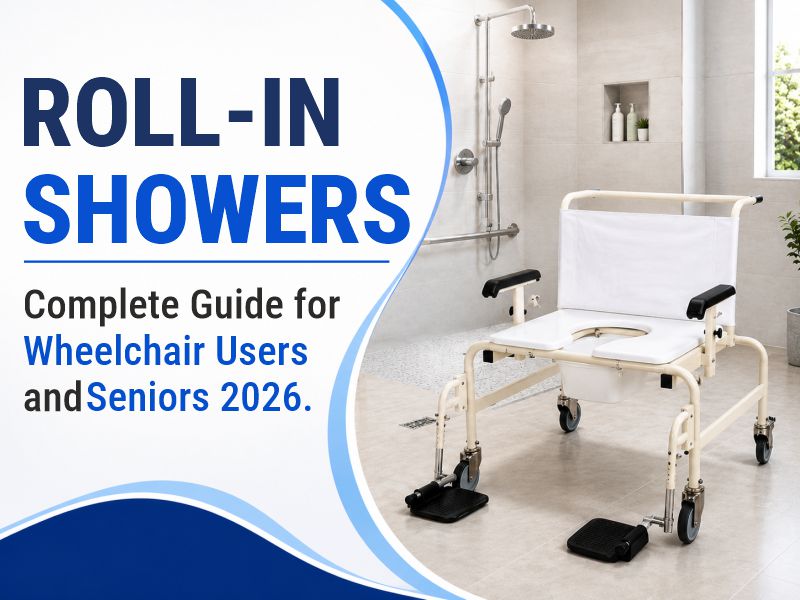
A shower wheelchair (also called a shower commode wheelchair or tilt-in-space shower chair) is a specialized wheelchair built with a plastic or aluminum frame, open seat, and rust-resistant materials designed to be used in water. The user transfers from their regular wheelchair to the shower wheelchair, rolls into the shower, and bathes without leaving the chair. Shower wheelchairs are available with or without a commode opening, reclining backs, and headrests.
Freestanding shower chairs and benches (without wheels) are used by people who can step or transfer into a roll-in shower and want a stable seat while bathing. These are less expensive and require no installation. Look for chairs with non-slip rubber feet, a weight capacity appropriate for the user, drainage holes in the seat, and a height that allows for safe transfers.
Bathroom Safety Products from AllCare Store
AllCare Store carries shower chairs, bath benches, grab bars, handheld showerheads, and a range of bathroom safety products to support accessible bathing. All orders ship free. Our team is available at 1-888-889-6260 to answer questions about bathroom safety products or help identify the right equipment for your situation.
Bathroom Safety Products | Mobility Aids | AllCare Store
Frequently Asked Questions: Roll-In Showers
What is the minimum size for a roll-in shower?
The ADA minimum for a standard roll-in shower is 36 inches wide by 60 inches deep with a 60-inch clear opening. For home use, this is the practical minimum that can accommodate most standard manual wheelchairs. A 60 × 60 inch or larger shower is preferred — it allows more comfortable maneuvering and room for a caregiver to assist. If you use a power wheelchair, measure your chair's turning radius and work with your contractor to ensure sufficient interior space.
How much does it cost to convert a bathroom to a roll-in shower?
A roll-in shower conversion typically costs between $3,000 and $15,000 depending on bathroom size, materials, and local labor rates. A basic prefabricated roll-in base with standard fixtures and minimal tile work is at the lower end; a fully custom tile roll-in shower with premium fixtures, linear drain, and a wet-room style floor is at the higher end. Grab bar installation, a handheld showerhead, and a shower seat add modest additional cost but are essential for accessibility. Financial assistance may be available through Medicaid waivers, VA grants, or state aging-in-place programs.
Can I install a roll-in shower in an existing bathroom?
Yes, but the feasibility depends on the bathroom's size, plumbing layout, and subfloor construction. Converting a bathtub alcove is the most common roll-in shower retrofit — the tub is removed, and the alcove is rebuilt as a curbless shower with the drain repositioned. A standard 30 × 60 inch tub alcove gives approximately the minimum 36 × 60 inch roll-in shower size. Wider bathrooms that can remove a wall or expand the shower footprint produce better results. Work with a licensed contractor who has accessible bathroom experience; they can assess what is structurally possible and how to meet local code requirements.
How do roll-in showers keep water from spreading into the rest of the bathroom?
Roll-in showers rely on floor slope and drain placement rather than a curb to contain water. The shower floor slopes toward the drain at approximately 1/4 inch per foot, directing water away from the entry. A linear drain along the entry edge or back wall is particularly effective — it catches water before it reaches the bathroom floor. A shower curtain hung from a ceiling track or U-shaped rod at the entry also contains water spray. Proper slope, a well-positioned drain, and a curtain together are highly effective; water intrusion into the bathroom is minimal when these elements are correctly designed and installed.