Travel Tip: Always contact your airline in advance about wheelchair policies. Most airlines allow manual wheelchairs as gate-checked items at no extra charge, but procedures vary. Request an aisle chair (narrow wheelchair for the aircraft cabin) when booking if needed.
Standard wheelchairs are engineered for durability and daily use — not for fitting into the overhead compartment, lifting into a car trunk, or rolling through a crowded airport terminal. If you or a loved one uses a wheelchair and wants to travel, a dedicated travel wheelchair makes an enormous difference in comfort, logistics, and independence.
This guide explains what separates a travel wheelchair from a standard chair, what to look for when comparing models, and how to navigate airports, cruise ships, and other travel environments with a wheelchair. Browse our full selection at Wheelchairs & Transport Chairs at AllCare Store.
What Makes a Wheelchair a "Travel" Wheelchair?
The term "travel wheelchair" doesn't have a strict industry definition, but it generally refers to chairs that combine some or all of the following characteristics:
- Low weight: Under 20 lbs for ultra-lightweight models; 20–30 lbs for standard lightweight. Standard wheelchairs often weigh 35–50 lbs.
- Compact folded dimensions: Small enough to fit in a car trunk, airline overhead bin (for the smallest models), or beneath an aircraft seat.
- Quick-release or removable footrests and armrests: Reduces size further when folded and makes loading into a vehicle easier.
- Durable, travel-appropriate frame material: Aluminum alloy or carbon fiber rather than steel — lighter and corrosion-resistant for varying weather conditions.
Types of Travel Wheelchairs
Ultra-Lightweight Manual Transport Chairs
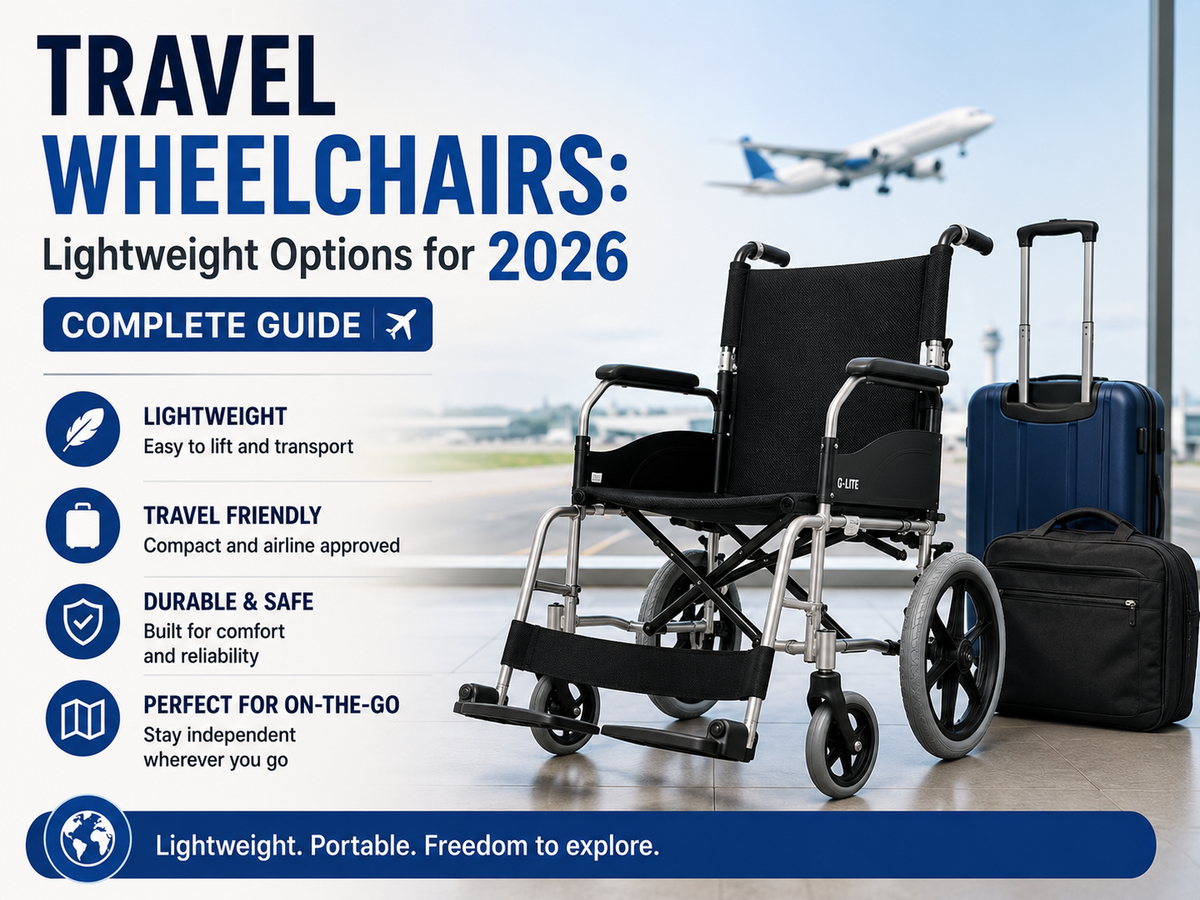
A transport chair (also called a companion chair) is the most common type of travel wheelchair. Transport chairs have four small wheels — no large rear wheels for self-propulsion. They are designed to be pushed by a companion or caregiver. This design eliminates the heavy steel wheel hubs and spokes that make standard wheelchairs bulky, bringing total weight down to as low as 13–18 lbs in the lightest aluminum models.
Transport chairs fold flat (cross-brace fold) in seconds and fit in almost any car trunk. Their narrow width (typically 21–24 inches overall) fits through most standard doorways and through the tight aisles of museums, airports, and cruise ships.
Best for: Travelers who will have a companion to push them throughout the trip; airport mobility; tours and sightseeing; people who only occasionally need a wheelchair and don't need to self-propel
Not suitable for: Independent self-propellers; users who need full-time wheelchair use without a companion
Lightweight Self-Propelled Wheelchairs
For travelers who need to propel themselves, lightweight self-propelled wheelchairs offer large rear wheels and a design optimized for reduced weight. Aluminum frames, lightweight spoke wheels, and removable components bring weight down to 20–28 lbs — significantly less than standard chairs while still allowing independent mobility. The trade-off versus transport chairs is higher folded bulk and weight.
Best for: Independent travelers; longer travel periods where self-propulsion is needed for portions of the trip; urban travel with varied terrain
Not suitable for: Travelers who cannot self-propel
Power Travel Wheelchairs / Portable Power Chairs
Portable power wheelchairs combine the independence of powered mobility with a design meant for transport. Most feature a lightweight frame (often aluminum or magnesium) that folds or disassembles into pieces for loading into a car trunk or checking at the airline gate. Batteries are typically lithium-ion (lighter than traditional gel/lead-acid) and may be approved for airline carry-on or gate-check depending on watt-hour rating.
Portable power chairs weigh 40–70 lbs in most cases — much lighter than standard power chairs (100–300 lbs), but still significantly heavier than manual travel chairs. They are best for users who cannot self-propel manually at all and need powered mobility during travel.
Best for: Full-time power chair users traveling by car, train, or cruise; users who need independent powered mobility in destinations
Airline considerations: Check battery watt-hour rating against airline policies (FAA limits apply); many portable power chair batteries qualify as airline-approved
Carbon Fiber Ultra-Light Wheelchairs
The premium tier of travel wheelchairs uses carbon fiber frames instead of aluminum, bringing weight down to as little as 9–14 lbs. Carbon fiber is exceptionally strong per unit weight, allowing a full-size wheelchair to weigh less than a carry-on bag. These chairs are correspondingly expensive — often $1,500–$4,000+ — but for frequent travelers or users who need to independently manage their chair, the weight savings are transformative. Loading a 12-lb chair into a car trunk or overhead bin requires a fraction of the effort of a 30-lb aluminum model.
Best for: Frequent travelers; users who must independently manage their own chair; anyone for whom chair weight significantly limits travel capability
Key Specs to Compare
Weight
This is the defining spec of a travel wheelchair. Consider not just the chair's weight but who will be lifting it — the user, a companion, or airline staff. A 20-lb chair that a spouse can lift into a trunk is far more practical than a 30-lb chair that requires two people. For self-managing travelers, every pound saved is meaningful.
Folded Dimensions
A chair can be light but still fold to an awkward size. Check the folded width, height, and depth and compare against your vehicle trunk, the storage area under your airline seat (some compact transport chairs fit, though this is rare), or the cruise ship cabin space. Many manufacturers list folded dimensions — take them seriously.
Seat Width and Weight Capacity
Travel wheelchairs are often designed in standard widths (16", 18", 20") and with weight capacities of 250–300 lbs. Bariatric travel options exist but are heavier. Choose the right seat width — the user should have 1–2 inches of clearance on each side, no more. A seat that is too wide is harder to self-propel and fits through fewer doorways.
Seat Height and Footrest Adjustability
Seat height affects the user's ability to self-propel using their feet (for some users) and overall comfort during long periods of sitting. Adjustable footrests accommodate different leg lengths. Swing-away or detachable footrests simplify car transfers.
Armrest Type
Fixed armrests provide the most support but limit lateral transfers. Flip-up or removable armrests make it easier to slide from the wheelchair to a car seat or airplane seat. For travel, removable or flip-up armrests are strongly preferred.
Traveling by Air with a Wheelchair
Booking and Preparation
Notify the airline of your wheelchair at booking — not at check-in. Request any assistance you need: wheelchair pushers through the airport, an aisle chair for boarding, and pre-boarding time. In the US, the Air Carrier Access Act requires airlines to provide these services at no charge.
Gate-Checking Your Wheelchair
Manual wheelchairs are almost universally gate-checked — meaning you use the chair up to the jet bridge door, then it is stored in the cargo hold and returned to you at the jet bridge door at your destination. This differs from checking a bag: your chair should come back to you as you deplane, not at baggage claim (though delays happen; always ask the gate agent where to retrieve it).
Use a bright luggage tag on your chair and take photos of it before gate-checking. Airline chair damage during gate-checking is unfortunately common — having photos simplifies any damage claim. Consider a lightweight travel bag or case for additional protection.
Wheelchair Damage and Airlines
If your wheelchair is damaged by the airline, report it immediately at the jet bridge before leaving the aircraft area. Airlines are required by law to repair or replace a damaged wheelchair. Document damage with photos and get a claim reference number before leaving the airport.
Traveling by Cruise Ship
Cruise ships vary significantly in accessibility. When booking, request an accessible cabin — standard cabins often have thresholds, narrow bathroom doors, and bathtubs that are impossible to use from a wheelchair. Accessible cabins have roll-in showers, wider doorways, and lower furniture. Availability is limited, so book early.
Ship corridors and elevators can be crowded on large ships. A narrow travel chair (under 24 inches wide) navigates these spaces more easily than a full-size chair. Shore excursions vary enormously in accessibility — research specific ports and excursions before booking, as many historic sites and small-town ports are challenging for wheelchair users.
Traveling by Car and Train
For car travel, the primary concern is loading and unloading the chair. A lightweight transport chair can typically be lifted into a trunk by one person. Self-propelled chairs are heavier and may require a hitch-mounted wheelchair carrier for vehicles where the chair does not fit in the trunk. Power chairs almost always require a vehicle ramp, lift, or carrier.
Amtrak and major train systems in the US and Europe have accessible cars with designated wheelchair spaces. Book accessibility seating at time of reservation — it is limited. Arrival 30+ minutes before departure is advisable to ensure the boarding lift or ramp is available.
Accessories for Wheelchair Travel
- Wheelchair travel bag or case: Protects the chair during gate-check and cargo holds
- Anti-tip straps: Keep the chair from tipping if loaded in a cargo area or tied in a van
- Cushion: Long travel days in an airport or on a plane mean extended sitting — a quality pressure-relief cushion prevents discomfort and pressure injury
- Wheelchair bag or backpack attachment: Allows the companion or user to carry personal items without filling their lap
- Compact rain cover: Essential for outdoor touring in variable weather
Shop Travel Wheelchairs at AllCare Store
AllCare Store carries a range of lightweight and travel wheelchairs, transport chairs, and travel accessories, all with free shipping. Whether you need a 15-lb folding transport chair for airport travel or a lightweight self-propelled chair for an extended trip, we have options at multiple price points. Questions? Call us at 1-888-889-6260.
Wheelchairs & Transport Chairs | Wheelchair Cushions & Accessories | Mobility Scooters | AllCare Store
Frequently Asked Questions: Travel Wheelchairs
What is the lightest travel wheelchair available?
The lightest travel wheelchairs are carbon fiber ultra-light models, which can weigh as little as 9–14 lbs. Standard aluminum transport chairs typically weigh 15–22 lbs. For most travelers, an aluminum transport chair in the 15–19 lb range provides a practical balance of weight, durability, and cost. Carbon fiber models cost significantly more ($1,500–$4,000+) but are appropriate for frequent travelers or users who must independently lift and manage their own chair.
Can I take my manual wheelchair on an airplane?
Yes. Under the Air Carrier Access Act in the United States, airlines must accept manual wheelchairs as gate-checked items at no charge. You use the chair through the airport and to the jet bridge door, where it is taken and stored in the cargo hold. It should be returned to you at the jet bridge door when you land — not at baggage claim. Notify the airline about your wheelchair when booking your ticket, and request any additional assistance you need (airport wheelchair assistance, aisle chair for boarding). Take photos of your chair before gate-checking in case of damage.
What is the difference between a transport wheelchair and a standard wheelchair?
A transport wheelchair (also called a companion chair) has four small wheels — it must be pushed by a companion and cannot be self-propelled. This design is lighter and more compact than a standard wheelchair, which has two large rear wheels for self-propulsion. Transport chairs are ideal for travel because they fold smaller, weigh less (often 13–22 lbs vs. 30–50 lbs for standard chairs), and are easier to load into vehicles. The trade-off is that the user cannot independently move themselves — they require a companion to push them at all times.