MEDICAL DISCLAIMER: This article is for informational and educational purposes only. It does not constitute medical advice, diagnosis, or treatment. Always consult a qualified healthcare provider before starting, stopping, or changing any medication — especially if you have kidney disease, liver disease, heart disease, gastrointestinal issues, or are pregnant, nursing, or taking prescription medications.
Back Pain by the Numbers — and Why Medication Choices Matter
Back pain is one of the leading causes of disability worldwide, affecting an estimated 619 million people globally. In the United States alone, it accounts for more than 264 million lost workdays per year and is one of the top reasons people visit their doctor or emergency room. Chances are you've had it, or you're dealing with it right now.
The medication aisle can be bewildering. Ibuprofen, acetaminophen, naproxen, topical creams, muscle relaxants, nerve pain drugs — all are used for back pain, and all work differently. Choosing the wrong one doesn't just mean less relief; it can mean real risks to your stomach, kidneys, liver, or cardiovascular system.
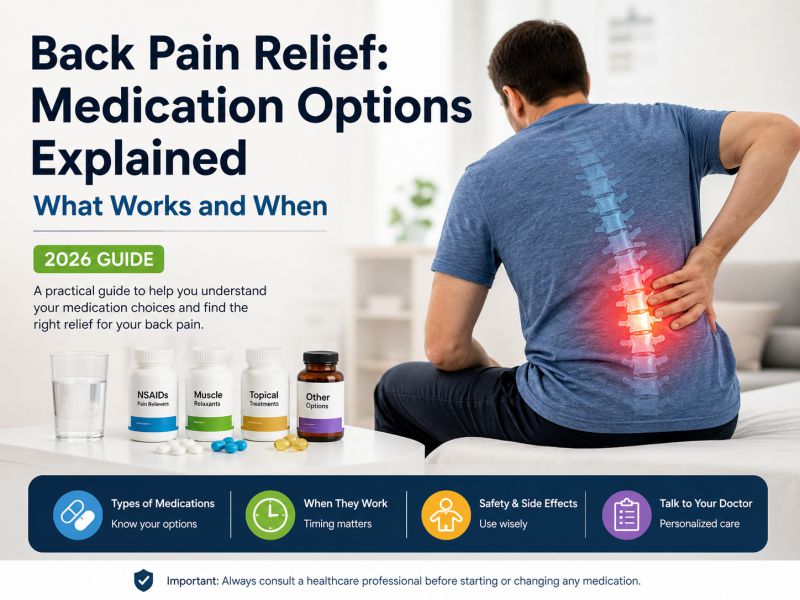
This guide walks through every major category of back pain medication available in 2026 — over-the-counter and prescription — so you can have an informed conversation with your doctor and understand exactly what you're taking and why.
Understanding Your Back Pain First
Before reaching for any medication, it helps to understand what's actually causing your pain. Back pain is not one condition — it's a symptom with many possible origins, and the best medication depends heavily on the underlying cause.
Acute vs. Chronic Back Pain
| Type | Duration | Common Causes | First-Line Medication |
|---|---|---|---|
| Acute | Less than 6 weeks | Muscle strain, ligament sprain, sudden injury | NSAIDs (ibuprofen, naproxen), acetaminophen |
| Subacute | 6–12 weeks | Ongoing strain, minor disc involvement | NSAIDs, topical agents, possible muscle relaxants |
| Chronic | More than 12 weeks | Disc herniation, arthritis, stenosis, nerve pain | Combination approach; specialist evaluation recommended |
The Type of Pain Changes the Treatment
Musculoskeletal back pain — the kind caused by strained muscles or ligaments — responds well to NSAIDs and acetaminophen. Nerve pain (sciatica, radiculopathy) often responds poorly to these medications and may require nerve-specific drugs. Inflammatory back pain from conditions like ankylosing spondylitis responds best to NSAIDs. Knowing your pain type helps your doctor choose correctly — and helps you ask better questions.
Category 1: NSAIDs — The Workhorses of Back Pain Relief
Non-steroidal anti-inflammatory drugs (NSAIDs) are consistently ranked as the most effective class of OTC medication for acute back pain in clinical guidelines. They work by blocking cyclooxygenase (COX) enzymes, which reduces the production of prostaglandins — the compounds that drive inflammation, swelling, and pain signaling.
Ibuprofen (Advil, Motrin)
Ibuprofen is the most widely used OTC pain reliever for back pain. It relieves pain and reduces inflammation simultaneously, making it especially effective for back pain caused by muscle strain, disc inflammation, or arthritis. A 2017 Cochrane review found NSAIDs significantly more effective than placebo for acute low back pain, with ibuprofen among the top performers.
Standard OTC dose: 200–400 mg every 4–6 hours as needed, not exceeding 1,200 mg per day without medical supervision. Prescription-strength doses can go up to 3,200 mg/day under a doctor's care.
Take with food to reduce stomach irritation. Ibuprofen is generally not recommended for extended use without medical oversight due to risks of GI irritation, ulcers, kidney stress, and cardiovascular effects with long-term use.
Who should be cautious: People with chronic kidney disease, peptic ulcer disease, heart failure, or those over age 65 should use NSAIDs only under physician guidance.
Naproxen Sodium (Aleve)
Naproxen has a longer half-life than ibuprofen — it lasts 8–12 hours, compared to ibuprofen's 4–6 hours. This makes it more convenient for sustained back pain relief throughout the day. Some patients find naproxen more effective for their particular pain profile.
Standard OTC dose: 220 mg every 8–12 hours as needed, not exceeding 440 mg per day for OTC use. Take with food. The cardiovascular and renal precautions are similar to ibuprofen.
Aspirin
Aspirin is an older NSAID that is less commonly used for back pain now due to its stronger GI side effect profile compared to ibuprofen and naproxen. It remains effective as a pain reliever but is not a first-choice option for back pain specifically. People already taking low-dose aspirin for cardiovascular protection should not add full-dose aspirin for pain without consulting their doctor.
Category 2: Acetaminophen — When NSAIDs Aren't Right for You
Acetaminophen (Tylenol) is the most widely recommended alternative to NSAIDs for back pain when NSAIDs are contraindicated. It works differently — it reduces pain and fever through central nervous system mechanisms but has no meaningful anti-inflammatory effect.
This distinction matters: if inflammation is driving your back pain (acute muscle strain with swelling, disc herniation, arthritis), acetaminophen will be less effective than NSAIDs. However, it is a critical option for people who cannot tolerate NSAIDs due to kidney issues, GI problems, or cardiovascular risk.
Standard dose: 325–650 mg every 4–6 hours as needed, not exceeding 3,000 mg per day (some guidelines say 4,000 mg/day for healthy adults, but 3,000 mg is the safer upper limit to prevent liver stress). People who drink alcohol regularly or have liver disease should use acetaminophen with great caution and consult their doctor.
Important: Acetaminophen is present in many combination cold, flu, and sleep medicines. Accidentally taking multiple products containing acetaminophen is a leading cause of accidental overdose — always read all labels carefully.
Category 3: Topical Pain Relievers — Targeted Relief Without Systemic Risks
Topical analgesics are applied directly to the skin over the painful area. Because they work locally, they deliver pain relief with significantly less systemic absorption — meaning far fewer stomach, kidney, and cardiovascular concerns than oral NSAIDs. For many patients with back pain, especially older adults who are more vulnerable to systemic NSAID side effects, topical agents are an excellent first or add-on option.
Topical Diclofenac (Voltaren Arthritis Pain Gel)
Diclofenac gel is a topical NSAID that became available over-the-counter in 2020. It is clinically proven effective for musculoskeletal pain, including back pain, with much lower systemic exposure than oral NSAIDs. Multiple randomized trials have confirmed topical diclofenac achieves equivalent or near-equivalent pain relief to oral NSAIDs for localized pain, with significantly fewer GI side effects.
Apply to the painful area up to 4 times daily. Wash hands thoroughly after application. Do not apply to broken skin or use with a heating pad, as heat increases absorption.
Lidocaine Patches
Lidocaine patches (available OTC as Salonpas Lidocaine and others, or by prescription as Lidoderm) numb the local area by blocking sodium channels in nerve endings. They are particularly useful for localized, sharp, or nerve-adjacent back pain and can provide several hours of relief.
Counterirritants: Menthol, Camphor, Capsaicin
Products like Biofreeze, Icy Hot, Tiger Balm, and Bengay use counterirritant mechanisms — they create cooling (menthol) or heating (capsaicin, camphor) sensations that compete with and partially override pain signals. While they don't treat the underlying cause of pain, they provide meaningful temporary comfort and are very safe for most people. Capsaicin, in particular, has evidence for helping with chronic back pain over extended use by depleting substance P (a pain neurotransmitter) in local nerve endings.
Category 4: Muscle Relaxants — For Spasm-Driven Back Pain
Muscle relaxants are prescription medications used for back pain that involves significant muscle spasm. They are not appropriate for all back pain — they specifically address the spasm component and are generally prescribed for short-term use (2–4 weeks).
Common Muscle Relaxants Used for Back Pain
| Medication | Brand Name | Key Notes | Main Side Effect |
|---|---|---|---|
| Cyclobenzaprine | Flexeril | Most commonly prescribed; structurally similar to tricyclic antidepressants | Drowsiness, dry mouth |
| Methocarbamol | Robaxin | Generally less sedating than cyclobenzaprine | Dizziness, lightheadedness |
| Tizanidine | Zanaflex | Often used for spasticity; requires dose titration | Drowsiness, low blood pressure |
| Baclofen | Lioresal | More commonly used for spasticity from neurological conditions | Drowsiness, weakness |
| Carisoprodol | Soma | Metabolizes to meprobamate (controlled substance); abuse potential | Sedation; not recommended for long-term use |
Important warnings: All muscle relaxants cause CNS depression — drowsiness, impaired coordination, and slowed reaction time. Never drive or operate heavy machinery while taking them. Combining muscle relaxants with alcohol, benzodiazepines, or opioids significantly increases the risk of respiratory depression. Muscle relaxants are generally not recommended for older adults due to fall risk.
Category 5: Nerve Pain Medications — For Radiculopathy and Sciatica
When back pain involves nerve irritation or damage — such as sciatica from a herniated disc compressing the sciatic nerve — standard analgesics often provide inadequate relief. Nerve pain has a distinct quality (burning, electric, shooting, or tingling sensations) and typically requires medications that modulate nerve signaling specifically.
Gabapentin and Pregabalin
Gabapentin (Neurontin) and pregabalin (Lyrica) are anticonvulsants that reduce nerve excitability by binding to calcium channels in the nervous system. They are widely used off-label for nerve-related back pain. Evidence for their use in radiculopathy is mixed — some patients respond very well, others experience little benefit. Side effects include dizziness, sedation, and weight gain. Pregabalin is a controlled substance (Schedule V); both require careful dose titration under physician supervision.
Tricyclic Antidepressants (Low-Dose)
Low-dose tricyclic antidepressants such as amitriptyline and nortriptyline have long been used for chronic back pain with a nerve component. At the low doses used for pain (well below antidepressant doses), they modulate pain signaling pathways and can also improve sleep quality — a significant benefit for people whose pain disrupts rest. They require a prescription and have anticholinergic side effects (dry mouth, constipation, urinary retention) that can be problematic in older adults.
SNRIs: Duloxetine (Cymbalta)
Duloxetine is FDA-approved for chronic musculoskeletal pain and is the best-evidenced antidepressant for chronic low back pain specifically. A 2021 systematic review confirmed duloxetine reduces chronic low back pain intensity compared to placebo. It's typically started at 30 mg daily and increased to 60 mg. Side effects include nausea, insomnia, and dry mouth, which often improve after the first few weeks.
Category 6: Short-Term Oral Corticosteroids
For severe acute back pain — particularly when caused by disc herniation with significant nerve compression — doctors sometimes prescribe a short course of oral corticosteroids such as prednisone or methylprednisolone (Medrol Dosepak). These powerfully reduce inflammation and can provide meaningful short-term relief for radicular pain.
They are not appropriate for chronic use due to serious side effects with prolonged use (bone density loss, blood sugar elevation, immune suppression, adrenal suppression). Short courses of 5–7 days are generally safe for most adults without contraindications, though blood sugar monitoring is important for diabetic patients.
What Clinical Guidelines Say: The Evidence Summary
The American College of Physicians (ACP), one of the most authoritative bodies on back pain management, published landmark guidelines that are important to understand:
For acute and subacute low back pain, the ACP guidelines recommend starting with non-pharmacological treatments (heat, massage, spinal manipulation, exercise) first, before medications. When medication is needed, the guidelines recommend NSAIDs as first-line over acetaminophen for most people, with muscle relaxants as an additional option for spasm-dominant pain.
For chronic low back pain, the guidelines note that all medication options have modest efficacy, and non-pharmacological approaches should remain central to management. The ACP recommends against opioids as a first-line treatment for either acute or chronic back pain.
Choosing the Right Medication: A Practical Decision Tree
| Your Situation | Consider Starting With | Avoid or Use Caution |
|---|---|---|
| Acute muscle strain, generally healthy adult | Ibuprofen or naproxen (with food) | Long-term NSAID use without medical oversight |
| Back pain + significant muscle spasm | NSAID + short-term muscle relaxant (Rx) | Driving or alcohol while on muscle relaxants |
| Kidney disease or GI ulcer history | Acetaminophen or topical diclofenac | Oral NSAIDs (ibuprofen, naproxen) |
| Sciatica / shooting nerve pain | NSAIDs + gabapentin or duloxetine (Rx) | Expecting OTC meds alone to resolve nerve pain |
| Older adult (65+) | Topical diclofenac or acetaminophen | Muscle relaxants, benzodiazepines, high-dose NSAIDs |
| Chronic low back pain (>12 weeks) | Duloxetine, topical agents, non-drug therapies | Long-term opioid use without specialist oversight |
| Pregnancy | Acetaminophen (consult OB first) | NSAIDs especially in 3rd trimester; muscle relaxants |
Non-Medication Approaches That Work Alongside Medication
Back pain research consistently shows that medications work best as part of a broader approach. The most evidence-backed non-drug interventions include:
Heat therapy: Applying a heating pad or heat wrap to the lower back increases blood flow, relaxes tight muscles, and significantly reduces acute back pain. Clinical trials have shown heat wraps to be as effective as ibuprofen for acute low back pain. AllCare Store carries a range of pain relief products including heating pads and pain relief devices.
Movement and activity: Rest was once the standard advice for back pain; current evidence strongly favors gentle continued activity. Extended bed rest actually worsens outcomes for most types of back pain. Walking, gentle stretching, and physical therapy are all recommended.
Physical therapy: For subacute and chronic back pain, physical therapy consistently outperforms medication alone in long-term outcomes. A PT can identify muscular imbalances, teach proper movement patterns, and guide an exercise program tailored to your specific back problem.
Lumbar support: Proper lumbar support during prolonged sitting or driving reduces stress on the lower spine. Visit our pain relief devices collection to browse back supports and bracing options.
When to See a Doctor Urgently
Most acute back pain resolves within 4–6 weeks with conservative management. However, seek immediate medical attention if you experience any of the following — these can signal serious underlying conditions:
- Back pain after significant trauma (car accident, fall from height)
- Pain accompanied by loss of bladder or bowel control (possible cauda equina syndrome — a medical emergency)
- Progressive leg weakness or numbness that is getting worse
- Back pain with unexplained fever, chills, or night sweats (possible infection or tumor)
- Back pain in someone with a history of cancer, immunosuppression, or IV drug use
- Pain that is constant, unrelenting, and not improved by any position or rest
- Back pain that is not improving at all after 4–6 weeks of conservative treatment
Shop Back Pain Relief at AllCare Store
AllCare Store carries a wide selection of products to help you manage back pain — from OTC pain relievers and topical analgesics to heating pads, back supports, and braces. Explore our pain relief collection and our pain relief devices for tools that can help you stay active and comfortable during recovery.
Our medicine and health monitors collection includes everything from OTC analgesics to tools for tracking your health. Shop at AllCare Store with free shipping on qualifying orders, or call our team at 1-888-889-6260, Monday–Friday, 7:00 AM–4:00 PM CST.
Frequently Asked Questions: Back Pain Medications
What is the best OTC medicine for back pain?
For most healthy adults with acute back pain, ibuprofen (Advil, Motrin) or naproxen sodium (Aleve) are the most effective OTC options because they address both pain and inflammation. Naproxen lasts longer (8–12 hours vs. 4–6 for ibuprofen), which is convenient for sustained relief. If NSAIDs are contraindicated due to kidney issues, stomach problems, or cardiovascular risk, acetaminophen (Tylenol) is the best OTC alternative. For localized back pain, topical diclofenac gel (Voltaren) is an excellent option with fewer systemic side effects.
Is ibuprofen or acetaminophen better for back pain?
Ibuprofen is generally more effective for back pain that has an inflammatory component (most acute muscle strain, disc problems, and arthritis-related pain), because it reduces inflammation in addition to blocking pain signals. Acetaminophen relieves pain but has no anti-inflammatory effect. Clinical guidelines recommend NSAIDs like ibuprofen as first-line for acute low back pain in people without contraindications. However, acetaminophen is the preferred option for people with kidney disease, peptic ulcers, heart failure, or those who cannot tolerate NSAIDs.
How long can I take ibuprofen for back pain?
OTC ibuprofen labels recommend use for no more than 10 consecutive days for pain without consulting a doctor. Extended use increases the risk of GI ulcers, kidney strain, and cardiovascular effects. If your back pain persists beyond 10 days and requires ongoing medication, see a doctor. They may prescribe a higher dose under monitoring, add a stomach-protecting medication (proton pump inhibitor), or recommend an alternative approach such as topical therapy or physical therapy.
What muscle relaxant is best for back pain?
Cyclobenzaprine (Flexeril) is the most commonly prescribed muscle relaxant for acute back pain with spasm and has the most evidence behind it. Methocarbamol (Robaxin) is a reasonable alternative that may cause less sedation for some patients. All muscle relaxants require a prescription, cause drowsiness, and are typically only appropriate for short-term use (2–4 weeks). Your doctor will choose based on your specific situation, other medications, and medical history.
Can I use a heating pad and ibuprofen together for back pain?
Yes — combining a heating pad with oral ibuprofen is a common and effective approach for acute muscle-related back pain. Heat increases blood flow and relaxes muscle spasm while ibuprofen addresses inflammation and pain signaling. The two mechanisms are complementary. One caution: do not apply heat directly over a topical NSAID like diclofenac gel, as heat increases skin absorption and can raise the amount absorbed systemically. Keep the heat away from areas where you've applied topical medication.
For back pain relief products including heating pads, back supports, and OTC pain relievers, visit AllCare Store. Browse our pain relief collection and pain relief devices. Free shipping on qualifying orders. Call 1-888-889-6260 for personalized assistance, Monday–Friday 7 AM–4 PM CST.