When Silence Isn't Quiet Enough
The bedroom was supposed to be quiet. But for Rachel, a 38-year-old nurse working rotating shifts in a busy Chicago neighborhood, "quiet" was relative. The garbage truck at 6 AM. Her partner coming home from night shifts. The upstairs neighbors. Her own mind, still wired from a 12-hour stretch in the ICU. She'd tried earplugs. She'd tried blackout curtains. She'd tried melatonin. Nothing quite worked.
Then a colleague mentioned her white noise machine. Rachel was skeptical — wasn't it just noise? But within a week of her first night sleeping with it running, the difference was striking. She was falling asleep faster and sleeping through disruptions she'd previously woken to. "It felt like the machine created a bubble," she says. "Everything outside it just... stopped mattering."
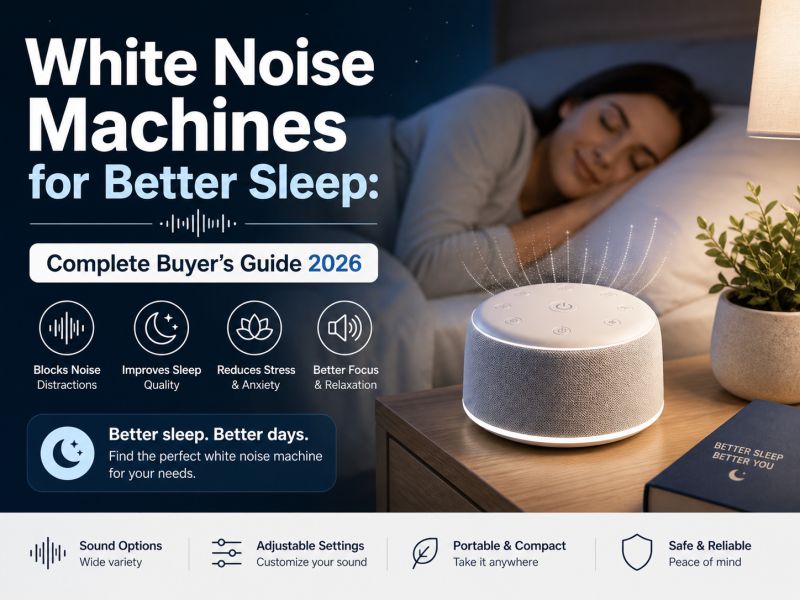
White noise machines have become one of the most popular sleep aids on the market, and for good reason. Unlike sedative sleep aids, they carry no side effects, no dependency risk, no morning grogginess. But the market has expanded dramatically — from simple white noise devices to sophisticated sound machines offering dozens of audio environments. How do you know which one is right for you? This guide explains exactly how they work, what to look for, and how to choose the best option for your specific sleep situation.
How White Noise Machines Improve Sleep: The Science
To understand why white noise works, it helps to understand why sound disrupts sleep. When you're sleeping, your brain doesn't fully disengage from the auditory environment — it continues monitoring for sounds that might signal threat or danger. Sudden sounds, particularly those that contrast sharply with background silence, are especially likely to trigger a partial or full awakening. The contrast is the problem: a sound at 60 dB in a 30 dB environment is far more disruptive than the same sound in a 50 dB environment.
White noise works by raising the ambient sound floor — the baseline noise level in your room. By doing so, it reduces the contrast between background and disruptive sounds. A dog barking, a truck outside, or a partner getting up becomes proportionally less jarring relative to the constant, neutral sound field you've established. This is called auditory masking, and it's a well-documented acoustic phenomenon.
The research supports real benefits. A 2021 review in Sleep Medicine Reviews found that sound masking improved sleep in noisy environments across multiple studies. A classic study in intensive care units found white noise significantly reduced the number of patient awakenings from environmental noise. Studies on infant sleep consistently show that white noise helps babies fall asleep faster and stay asleep longer by masking household sounds that would otherwise startle them.
Beyond masking, continuous neutral sound may also be intrinsically calming for some people — the steady, non-threatening audio creates a kind of sensory routine that the brain associates with sleep over time, much like how some people find rain sounds inherently relaxing.
White Noise vs. Pink Noise vs. Brown Noise: What's the Difference?
Not all sleep sound machines produce identical audio. The differences between noise types are real and can matter for individual preference and effectiveness.
| Noise Type | Sound Character | Frequency Profile | Best For |
|---|---|---|---|
| White noise | Hissing, like static or a fan | Equal energy across all frequencies | General masking; light sleepers; offices |
| Pink noise | Softer, more balanced; like steady rainfall | More energy in lower frequencies; gentler treble | Most people find this more pleasant than white; good for sleep and focus |
| Brown noise | Deep, rumbling; like distant thunder or ocean | Heaviest in low frequencies | People who find white noise too harsh; good for deep relaxation |
| Nature sounds | Rain, ocean, forest, stream | Variable; generally similar to pink noise | People who prefer organic, non-mechanical sounds |
| Fan sounds | Mechanical fan noise | Mid-range dominant | People who already sleep with a fan; familiar masking |
Pink noise has attracted particular scientific interest in recent years. A 2017 study in Frontiers in Human Neuroscience found that acoustic stimulation with pink noise synchronized to slow-wave brain oscillations during sleep enhanced deep sleep and improved memory consolidation in older adults. A 2019 follow-up study confirmed these effects. While more research is needed, pink noise may offer not just masking benefits but potential enhancement of sleep quality itself.
The practical takeaway: there's no universally "best" noise color. Most people prefer pink or brown noise over white noise for long-term sleep use (white noise's equal-frequency distribution can sound harsh or fatiguing), but personal preference varies considerably. The best machine for you offers multiple options so you can find what works for your ears and your sleep environment.
Key Features to Look for in a White Noise Machine
Sound Quality and Speaker Quality
Speaker quality matters more than most buyers anticipate. A white noise machine with poor speakers will produce audio that sounds tinny, distorted at higher volumes, or has an irritating mechanical quality. Look for machines with a looping mechanism that is truly seamless (no audible click or reset point in the loop), and listen — if possible — before buying. Fan-based white noise machines produce sound mechanically and therefore have no loop at all, which many people prefer for its authenticity.
Volume Range
The machine needs to be loud enough to actually mask disruptive sounds in your environment. Recommended safe listening levels for sleep are under 65 dB at the listener's ear — but if you live in a very noisy environment (urban apartment, near a highway, in a house with children or pets), you'll need a machine that can reach sufficient volume without distorting. Check maximum volume specifications. A machine that tops out at 60 dB in a 55 dB environment won't provide meaningful masking.
Sound Options and Variety
Single-sound machines (pure white noise only) are simpler and often more affordable, but they don't let you experiment. If you're new to sleep sound machines, a model with at least several options — white noise, pink noise, brown noise, and a few nature sounds — gives you the flexibility to find what works best for you personally.
Timer vs. Continuous Play
Some machines offer a timer that shuts off the sound after 30, 60, or 90 minutes. Others play continuously all night. For sleep use, continuous play is generally recommended — the masking benefit only works while the machine is running, and turning off mid-night can disrupt sleep at the transition. Timer mode may be useful for helping children fall asleep when you don't want the machine running all night.
Portability
If you travel frequently or want to use your machine in multiple locations (office, bedroom, nursery), portability matters. Look for rechargeable battery operation, compact size, and a travel pouch. Some machines are specifically designed as travel companions — smaller, lighter, and optimized for USB charging.
Auto-Off or Timer Settings
For children's rooms or partner situations where one person needs the sound and the other doesn't, auto-off timers add useful flexibility. Some machines also offer auto-on at a set time, which can be convenient for establishing consistent sleep routines.
Display Brightness
Many sleep sound machines have LED displays, volume indicators, or status lights that can be surprisingly bright in a dark room. Look for machines with adjustable display brightness or the ability to turn lights off entirely. Even a small LED in a dark room can be enough to disturb sensitive sleepers.
Price Range and Value
White noise machines range from under $30 to over $100. Budget models (under $40) typically offer fewer sounds, lower maximum volume, and simpler builds — acceptable for occasional use or light sleepers. Mid-range models ($40-$75) offer better speaker quality, more sound options, and features like timers and USB charging. Premium machines ($75+) typically offer the best audio quality, most sound variety, and most sophisticated features. For most adults, a solid mid-range machine delivers the best value.
White Noise Machines for Specific Situations
For Adults with Insomnia or Light Sleep
Adults struggling with insomnia or light sleep typically benefit most from consistent, high-quality masking throughout the night. Prioritize machines with excellent speaker quality, high maximum volume, seamless audio looping, and continuous-play mode. Pink or brown noise tends to be easier to tolerate all night than white noise for adults. If you've used a phone app for white noise, a dedicated machine will generally produce significantly better audio quality and won't drain your phone battery or be interrupted by notifications.
Consider placing the machine closer to the door or window (the source of disruptive sounds) rather than directly beside your head. This positions the machine between you and the noise source for maximum masking effectiveness. A distance of 6-7 feet from your head is typically optimal — close enough for good masking, far enough that the sound itself isn't an irritant.
For Babies and Infants
White noise is extraordinarily popular for infant sleep, and the science supports it. Babies in the womb experience constant sound — the whooshing of blood flow, the rhythmic sounds of the mother's heartbeat — at roughly 80-90 dB. The relative quiet of a bedroom can actually feel disconcerting to a newborn. White noise (at an appropriate, safe volume) mimics the familiar sound environment of the womb and is highly effective for helping babies settle and sleep longer stretches.
For infant use, safety guidelines are critical. The American Academy of Pediatrics recommends keeping white noise machines at least 7 feet from the baby and keeping volume at or below 65 dB (roughly the volume of a normal conversation). Avoid placing the machine inside or directly on the crib. Many infant-focused machines have built-in volume limiters to prevent unsafe levels. Some also respond to the baby's cries (cry-activated sound), turning on automatically when crying is detected and off when the baby settles.
For Office and Focus Use
White noise machines aren't just for bedrooms. Open office environments, home offices, and study spaces benefit enormously from sound masking. Speech privacy — preventing colleagues from hearing your conversations and preventing you from being distracted by theirs — is one of the primary use cases in professional settings. For office use, prioritize compact size, moderate (not extremely high) maximum volume, and sounds that aren't conspicuous to others (pure white or pink noise rather than ocean or rain sounds that might draw attention).
For Tinnitus Relief
People with tinnitus (ringing, buzzing, or hissing sounds in the ears) often find white noise machines extremely helpful. The masking effect of ambient sound can reduce the perceived intensity of tinnitus, making it less bothersome during sleep and quiet activities. For tinnitus use, choose a machine that can produce sound across a wide frequency range — this helps mask tinnitus regardless of its particular pitch. Some audiologists recommend specifically calibrated tinnitus masking devices; for general relief, however, a quality pink or white noise machine is a reasonable starting point. Consult an audiologist for persistent or severe tinnitus.
For Couples with Different Sleep Preferences
When one partner needs sound masking and the other prefers silence (or prefers a different sound), finding a compromise can be challenging. Options include: using a single machine positioned closer to the light-sleeping partner at moderate volume; using headphones or earbuds designed for sleep (thin, flat, comfortable for side sleepers); or choosing a machine with sounds both partners agree on — often pink or brown noise, which tends to be more universally tolerated than sharp white noise.
How to Use Your White Noise Machine Most Effectively
Getting the best results from your machine involves more than just turning it on. Placement, volume, and consistency all matter significantly.
Volume: Set your machine loud enough to mask disruptive sounds without being so loud that it becomes a source of irritation itself. A common mistake is setting it too low — a barely audible machine provides minimal masking. A practical test: with the machine running at your chosen volume, have someone in another room clap or knock. If you can clearly hear it, turn the machine up. You're aiming for a level where the masking sound is clearly audible but not uncomfortably loud. For adults, 50-65 dB at the ear is a reasonable range; below 50 dB is unlikely to mask much; above 65 dB risks hearing impact with long-term nightly use.
Placement: Position the machine between you and the primary source of disruptive sounds. Near the door to mask hallway sounds. Near the window to mask outdoor noise. Keep it elevated slightly (on a nightstand) rather than on the floor, where sound diffuses less effectively. Avoid placing it directly beside your head or pointed at your face at close range.
Consistency: The sleep-promoting benefits of white noise are partly conditioned — over time, your brain associates the sound with sleep onset, making it easier to fall asleep when the machine is running. Use it every night rather than only on noisy nights; the consistency itself becomes part of your sleep routine.
Combine with good sleep hygiene: White noise is most effective as part of a broader sleep hygiene approach. Consistent sleep and wake times, a cool and dark bedroom, limiting screens before bed, and avoiding caffeine in the evening all compound the benefits of sound masking. No machine can fully compensate for a disrupted sleep schedule or an uncomfortable sleep environment.
White Noise Machine Safety: What You Need to Know
White noise machines are extremely safe for most users, but a few considerations are worth knowing.
Volume and hearing safety: The primary risk with any sound device is prolonged exposure to excessive volume. The National Institute for Occupational Safety and Health (NIOSH) guidelines suggest that continuous exposure above 85 dB can damage hearing over time. For sleep use — where you're exposed for 7-9 hours nightly, every night — keeping the level at or below 65 dB at the listener's ear is recommended. Most quality machines have volume controls; don't run them at maximum volume continuously.
For infants, extra care is warranted: As noted above, keep infant machines at least 7 feet away from the baby and at or below 65 dB. Infants' hearing is more sensitive than adults', and their cochleae are still developing. Multiple studies have found that commonly sold infant sound machines can exceed safe volumes when placed close to or in the crib — always position them at safe distances and use volume settings conservatively.
Dependency: Some users worry about becoming "addicted" to white noise — unable to sleep without it. While this is a real phenomenon for some people, it's generally a benign one. Unlike pharmaceutical sleep aids, there are no withdrawal symptoms and no physiological dependency. If you find you need the machine to sleep in all situations, it may be worth occasionally sleeping without it to maintain flexibility — but for most people, this is not a significant concern.
Shop AllCare Store for Sleep Aids and Rest & Comfort Products
Getting quality sleep is fundamental to physical and mental health — and the right tools make a significant difference. AllCare Store's sleep aids collection includes sound machines, white noise devices, sleep masks, earplugs, and other products designed to help you get the restorative rest your body needs.
Our rest and comfort collection features weighted blankets, pillows, mattress toppers, and accessories that complement sound masking for a fully optimized sleep environment. For families with infants, our baby health collection includes infant-safe sound machines and other products to support healthy infant sleep.
Shop at AllCare Store with free shipping on qualifying orders and our 30-day return policy. Our team is available to help you find the right sleep solution at 1-888-889-6260, Monday through Friday, 7:00 AM to 4:00 PM CST.
Frequently Asked Questions: White Noise Machines
Do white noise machines actually help you sleep better?
Yes, for many people — particularly those whose sleep is disrupted by environmental noise. The scientific mechanism is well-established: white noise raises the ambient sound level in your room, which reduces the contrast between background and disruptive sounds. This auditory masking makes sudden sounds (traffic, a partner snoring, neighbors) less likely to cause awakenings. Multiple studies have confirmed this effect, particularly in noisy environments. White noise machines work best when used consistently as part of a good overall sleep hygiene routine.
What is the difference between white noise and pink noise for sleep?
White noise contains equal energy across all sound frequencies — it sounds like static or a hissing fan, and some people find it harsh over a full night. Pink noise has more energy in lower frequencies and less in higher ones, giving it a softer, more natural sound similar to steady rainfall or gentle wind. Most people find pink noise more pleasant for extended sleep use. Research has also suggested pink noise may enhance slow-wave (deep) sleep and memory consolidation. For practical sleep use, pink noise or brown noise (even deeper and more rumbling) tends to be easier on the ears than white noise.
Is it safe to use a white noise machine every night?
Yes, provided you use it at a safe volume. Nightly use of a white noise machine at a moderate volume (50-65 dB at the listener's ear) is considered safe for most adults. The key is not running the machine at excessive volumes for extended periods — prolonged exposure above 85 dB can damage hearing over time. For adults sleeping 7-9 hours with the machine running, staying at or below 65 dB is recommended. There are no physiological withdrawal effects from using a white noise machine, though some regular users find they prefer to have it on when sleeping in noisy environments.
Where should I place a white noise machine in my bedroom?
For best results, place your white noise machine between you and the primary source of disruptive sounds — near the bedroom door to mask hallway noise, or near the window for outdoor noise masking. Elevate it slightly (on a nightstand) rather than placing it on the floor, where sound diffuses less efficiently. A distance of 6-7 feet from your head is generally recommended — close enough to provide effective masking, far enough that the machine's sound itself isn't uncomfortable. Avoid pointing it directly at your face from close range, especially at higher volumes.
Are white noise machines safe for babies?
White noise machines are safe for babies when used correctly. The American Academy of Pediatrics recommends keeping the machine at least 7 feet from the infant and limiting volume to 65 dB or less — roughly the volume of a normal conversation. Never place the machine inside or directly on the crib. Research consistently shows white noise helps infants fall asleep faster and sleep in longer stretches by masking household sounds that would otherwise startle them. Look for infant-specific machines that have built-in volume limiters to prevent accidental unsafe levels.
Can I use a phone app instead of a white noise machine?
Phone apps are a reasonable way to try white noise before investing in a dedicated machine. However, dedicated machines have meaningful advantages: superior speaker quality (phone speakers are optimized for voice, not ambient sound), no interruptions from notifications or calls, no battery drain on your phone, and purpose-built audio that is truly seamless without looping artifacts. If you find you're consistently using a phone app for sleep sound, upgrading to a dedicated machine will typically deliver a noticeably better experience and is a worthwhile investment for long-term sleep quality.
What's the best white noise machine for a noisy apartment?
For a noisy urban apartment, prioritize a machine with high maximum volume, excellent speaker quality, and a truly seamless audio loop. You'll likely need more masking power than lighter sleepers in quieter environments. Look for a machine that reaches at least 75-80 dB maximum output (so you have headroom without running at maximum continuously). Pink or brown noise tends to be more tolerable than white noise for extended use in high-volume environments. Position the machine as close to the noise source as practical — near the window for street noise, near the door for hallway and neighbor noise.
Explore sleep aids and rest & comfort products at AllCare Store. Browse our sleep aids collection and rest and comfort products for everything you need to sleep better tonight. Free shipping on qualifying orders — call 1-888-889-6260 for assistance, Monday-Friday 7 AM-4 PM CST.