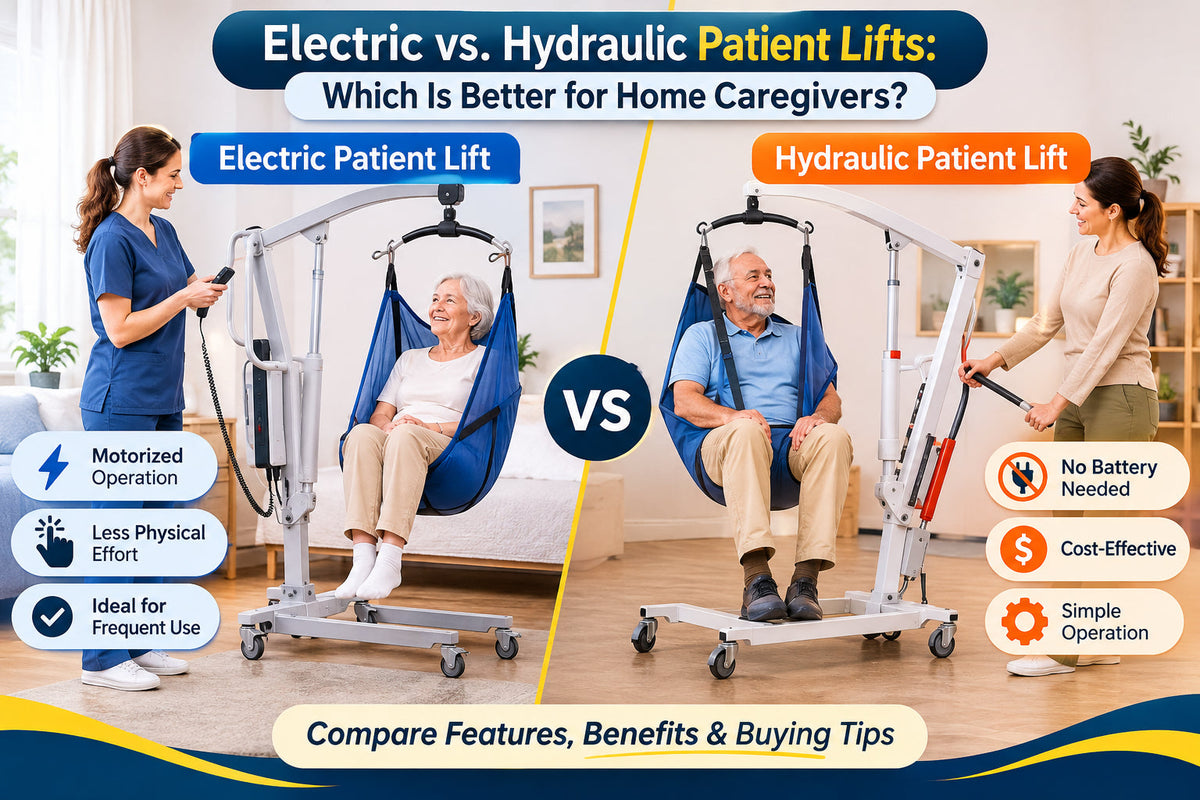
Choosing between an electric patient lift and a hydraulic patient lift can make a significant difference in daily home care. Both types of patient lifting devices help caregivers transfer individuals between beds, wheelchairs, and chairs.
However, they operate differently and offer distinct advantages. Electric lifts use battery-powered motors, while hydraulic lifts use manually operated pumps.
This guide compares electric vs. hydraulic patient lifts, including their features, benefits, limitations, weight capacity, ease of use, maintenance, and cost considerations. It will help families and caregivers choose the right patient lift for home use based on individual mobility needs and home-care requirements.
1. Electric vs. Hydraulic Patient Lifts: Quick Comparison
|
Feature |
Electric Patient Lift |
Hydraulic Patient Lift |
|---|---|---|
|
Operating system |
Battery-powered motor |
Manual hydraulic pump |
|
Lifting effort |
Push-button operation |
Manual pumping |
|
Caregiver effort |
Less physical effort during lifting |
Requires repeated pumping |
|
Power requirement |
Requires battery charging |
No electricity required |
|
Maintenance |
Battery and electrical component checks |
Hydraulic system and mechanical checks |
|
Best suited for |
Frequent transfers |
Occasional transfers |
|
Initial cost |
Generally higher |
Generally lower |
|
Operation |
Handheld controls |
Manual pump |
The main difference is the lifting mechanism. Both types can provide full-body transfer assistance when appropriately selected and used with compatible slings.
2. What Is an Electric Patient Lift?
An electric patient lift is a motorized medical lifting device designed to help caregivers transfer individuals who need assistance moving between different surfaces.
It uses a rechargeable battery and an electric motor to raise and lower the lifting arm. Caregivers typically operate the device through a handheld control.
These powered patient lifts for home care are commonly considered when individuals require frequent transfers or when caregivers want to reduce the physical effort involved in lifting.
Key Features of Electric Patient Lifts
-
Battery-powered operation: Uses a rechargeable battery to operate the lifting mechanism.
-
Push-button controls: Allows caregivers to raise and lower the patient using a handset.
-
Full-body sling support: Supports the individual during compatible seated or lying transfers.
-
Adjustable base: Many models have adjustable legs to accommodate different wheelchair and furniture widths.
-
Emergency lowering: Some models include an emergency lowering mechanism.
-
Different weight capacities: Available in different capacities depending on the manufacturer and model.
Benefits of Electric Patient Lifts
1. Reduced physical effort
Electric lifts eliminate the need for repeated manual pumping during normal lifting operations. This can make routine transfers easier for caregivers.
2. Convenient daily operation
The handheld control allows caregivers to adjust lifting and lowering without manually operating a hydraulic pump.
3. Useful for frequent transfers
Families caring for individuals who require multiple transfers throughout the day may find powered patient lifts more convenient.
4. Controlled lifting and lowering
The motorized mechanism allows caregivers to operate the lifting function through the manufacturer's controls.
Potential Limitations
-
Electric patient lifts generally cost more than comparable manual hydraulic models.
-
Batteries require regular charging and maintenance.
-
Electrical components may require servicing.
-
Caregivers must understand the emergency lowering procedure.
3. What Is a Hydraulic Patient Lift?
A hydraulic patient lift is a manual lifting device that uses hydraulic pressure to raise and lower an individual.
Instead of relying on an electric motor, the caregiver operates a hand pump to move the lifting arm. This mechanism provides lifting assistance without requiring an electrical power source.
A manual hydraulic patient lift for home use can be an option for families who prefer a simpler operating system and want to avoid battery charging.
Key Features of Hydraulic Patient Lifts
-
Manual pumping system: Uses a hand-operated hydraulic pump.
-
No battery requirement: Does not require electrical power for its lifting mechanism.
-
Full-body sling compatibility: Supports transfers using manufacturer-approved slings.
-
Mobile frame: Many models include wheels for movement across suitable indoor surfaces.
-
Mechanical operation: Uses hydraulic components to raise and lower the lifting arm.
Benefits of Hydraulic Patient Lifts
1. No battery charging
Manual hydraulic lifts do not depend on rechargeable batteries for normal lifting operations.
2. Straightforward operation
The lifting mechanism uses a manual pump rather than electrical controls.
3. Potentially lower purchase cost
Hydraulic models are often less expensive than comparable powered lifts, although actual prices vary by brand and specifications.
4. Useful for suitable home-care environments
They can be considered for households where transfers are less frequent and the caregiver can operate the pump comfortably.
Potential Limitations
-
Requires repeated manual pumping.
-
Can increase caregiver effort during frequent transfers.
-
May be difficult for caregivers with limited strength or physical limitations.
-
Lowering and lifting procedures require proper training.
4. Electric vs. Hydraulic Patient Lifts: Which Is Better for Caregivers?
The right choice depends on transfer frequency, caregiver capabilities, patient mobility, available space, and budget.
A. Based on Caregiver Physical Effort
An electric patient lift generally requires less physical effort during the lifting process because the motor operates the lifting mechanism.
A hydraulic patient lift requires the caregiver to operate a manual pump repeatedly.
For caregivers managing several transfers daily, an electric model may offer greater convenience.
B. Based on Daily Transfer Frequency
Consider how often the equipment will be used.
-
Frequent transfers: An electric patient lift may be more convenient for repeated daily use.
-
Occasional transfers: A hydraulic patient lift may be suitable if the caregiver can operate it safely.
-
Multiple caregivers: Electric controls may make operation more manageable for caregivers with different physical capabilities.
C. Based on Home Environment
Before purchasing a patient lift for home use, measure the available space.
Check:
-
Bedroom and bathroom door widths.
-
Space around the bed.
-
Wheelchair turning clearance.
-
Furniture placement.
-
Floor surface and thresholds.
-
Storage space when the lift is not in use.
Both electric and hydraulic floor lifts require sufficient clearance to position and maneuver the equipment.
D. Based on Purchase Budget
Hydraulic patient lifts generally have a lower initial purchase price than comparable electric models.
Electric patient lifts may cost more because of their motor, battery, and electrical controls.
However, the total cost should also include compatible slings, maintenance, replacement parts, and additional accessories.
5. Which Patient Lift Is Best for Different Home-Care Needs?
Different individuals require different types of transfer assistance. Consider the following situations when comparing electric and hydraulic patient lifts.
|
Home-Care Requirement |
Option to Consider |
|---|---|
|
Frequent daily transfers |
Electric patient lift |
|
Reduced manual pumping |
Electric patient lift |
|
No battery charging preference |
Hydraulic patient lift |
|
Lower initial purchase budget |
Hydraulic patient lift |
|
Bed-to-wheelchair transfers |
Compatible full-body patient lift |
|
Caregiver has limited physical strength |
Electric patient lift may be easier to operate |
These are general selection considerations, not universal recommendations. A healthcare professional or trained equipment specialist can help determine which device is appropriate.
6. Important Features to Check Before Buying a Patient Lift
Whether you choose an electric or hydraulic model, compare these specifications before purchasing.
1. Weight Capacity
Every patient lift has a specified maximum weight capacity. Choose a model that safely accommodates the individual's current weight.
Remember that the working capacity of the complete lifting system is limited by its lowest-rated component, including the lift and compatible sling.
2. Sling Compatibility
A patient lift sling supports the individual during transfers. Different sling designs are available for different positioning and support requirements.
Common options include:
-
Full-body patient lift slings.
-
U-shaped or divided-leg slings.
-
Toileting slings.
-
Positioning slings.
Not every sling is compatible with every lift. Always confirm manufacturer approval, attachment style, size, and weight rating.
3. Adjustable Base Width
An adjustable base allows caregivers to position the lift around certain beds, chairs, and wheelchairs.
Check the minimum and maximum base width to ensure the equipment fits your home environment.
4. Lifting Range
The lifting range determines how high and low the device can position the individual.
Compare the manufacturer's specifications with the height of the bed, wheelchair, and other transfer surfaces.
5. Wheels and Maneuverability
Check wheel size, locking mechanisms, and turning clearance.
The lift should be suitable for the flooring and available space in your home.
6. Emergency Lowering Mechanism
For electric patient lifts, check whether the model includes an emergency lowering feature and understand how it operates.
For hydraulic lifts, follow the manufacturer's instructions for controlled lowering.
7. Maintenance and Warranty
Review warranty coverage, replacement battery availability, hydraulic component servicing, and access to manufacturer support.
These factors can influence the long-term ownership experience.
7. How to Use a Patient Lift for Bed-to-Wheelchair Transfers
A patient lift for bed-to-wheelchair transfers can assist caregivers when an individual cannot safely complete the transfer independently.
However, the process requires proper training and the correct equipment.
General preparation considerations include:
-
Review the manufacturer's instructions for the specific patient lift.
-
Confirm that the sling is compatible with the lift and appropriate for the individual.
-
Inspect the sling, straps, clips, and lifting components for visible damage.
-
Position the receiving wheelchair appropriately and lock its brakes.
-
Check the lift's base position and stability.
-
Attach the sling according to the manufacturer's instructions.
-
Operate the lifting mechanism using the approved procedure.
-
Lower the individual carefully onto the receiving surface.
Important safety note: This is a general overview, not a substitute for hands-on training. Transfer procedures differ by lift and sling design. Follow the manufacturer's instructions and obtain guidance from a qualified healthcare professional or trained equipment specialist before performing transfers.
8. Electric vs. Hydraulic Patient Lift: Final Buying Recommendation
There is no single best patient lift for every household. The right equipment depends on the patient's mobility, caregiver capabilities, transfer frequency, and home environment.
Choose an Electric Patient Lift If:
-
You need frequent daily transfers.
-
You want to reduce manual pumping.
-
Caregivers prefer push-button controls.
-
Battery charging and maintenance are manageable.
Consider a Hydraulic Patient Lift If:
-
You prefer a manual lifting mechanism.
-
You want to avoid battery charging.
-
Transfers are less frequent.
-
The caregiver can comfortably operate the manual pump.
Before purchasing, compare product dimensions, weight capacity, sling compatibility, warranty, and manufacturer operating instructions.
You can explore different patient lifting devices for home use by comparing available lifting mechanisms and product specifications at AllCareStore.
Frequently Asked Questions About Electric and Hydraulic Patient Lifts
1. Is an electric patient lift better than a hydraulic patient lift for home use?
An electric patient lift for home use may be more convenient for frequent transfers because it uses a motorized lifting mechanism. A hydraulic patient lift operates through manual pumping and does not require battery charging. The better option depends on caregiver strength, transfer frequency, patient mobility, and budget.
2. How much does an electric or hydraulic patient lift cost?
The cost of a home patient lift varies depending on its lifting mechanism, weight capacity, brand, and included accessories. Electric patient lifts generally have a higher initial price than comparable hydraulic models. Compare product specifications, sling compatibility, warranty, and maintenance requirements before purchasing.
3. Can one caregiver operate an electric patient lift at home?
Some electric patient lifts for home care are designed for operation by one trained caregiver. However, the number of caregivers required depends on the patient's condition, transfer procedure, equipment instructions, and home environment. Always follow the manufacturer's staffing recommendations and obtain proper training.
4. What is the difference between a hydraulic Hoyer lift and an electric Hoyer lift?
A hydraulic Hoyer lift uses a manual pump to raise and lower the lifting arm, while an electric Hoyer lift uses a battery-powered motor and handheld controls. Both can support full-body patient transfers with compatible slings. Hoyer is a brand name commonly used to describe patient lifts, so compare the actual product specifications rather than relying on the name alone.
5. What should I consider when buying a patient lift for a bedridden patient?
When choosing a patient lift for a bedridden patient, consider weight capacity, sling compatibility, lifting range, adjustable base width, and available room space. Both electric and hydraulic patient lifts can assist with bed-to-wheelchair transfers. A healthcare professional or trained equipment specialist can help identify the appropriate lifting equipment.