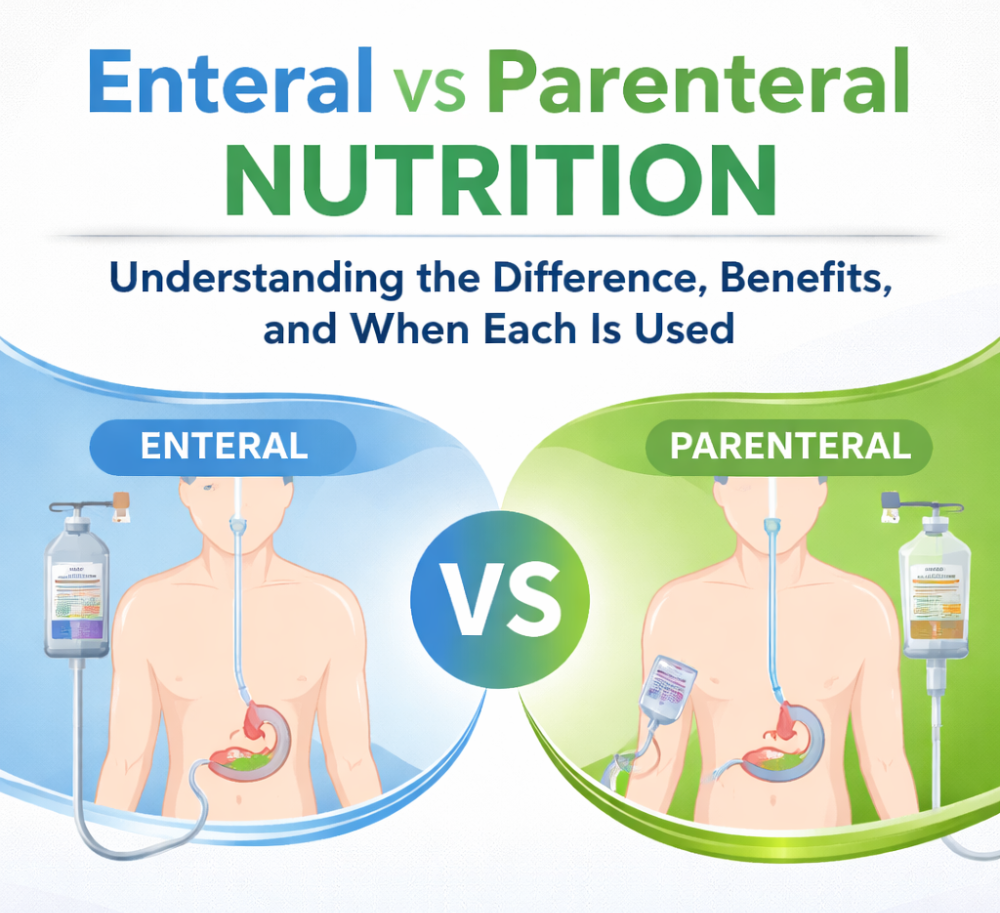
When someone is unable to eat, getting proper nutrition will become an important part of their care. In scientific settings throughout the USA, two primary techniques are used to offer nutrition: enteral feeding and parenteral nutrients.
If you’ve encountered terms like enteral vs parenteral feeding, enteral nutrition vs parenteral vitamins, you're probably wondering what they truly mean and how they differ. While each strategies are designed to assist patients who cannot eat by mouth, they work in very different ways.
This guide explains the difference between enteral feeding and parenteral nutrition in simple, clear language so patients and caregivers can better understand which option may be right in different situations. By the end, you’ll understand:
- The difference between enteral and parenteral feeding
- When each method is recommended
- Types of enteral and parenteral feeding
- When nutrition support is started after surgery
- Safety considerations
- Practical home care guidance
What Is Enteral Nutrition?
Enteral nutrition means delivering liquid nutrition directly into the digestive tract using a feeding tube. The stomach or small intestine still functions, but the person cannot eat as much by mouth.
Instead of swallowing food, a feeding tube delivers formula that contains calories, protein, vitamins, minerals, and liquid.
Common Situations Where Enteral Feeding Is Used
- Stroke patients who cannot swallow safely
- Cancer patients undergoing treatment
- Neurological disorders (ALS, Parkinson’s disease)
- Severe swallowing disorders (dysphagia)
- Post-surgical recovery when oral intake is limited
The key point: The digestive system works; we’re just bypassing the mouth.
What Is Parenteral Nutrition?
Parenteral nutrition is completely different. It delivers nutrients directly into the bloodstream through an intravenous (IV) line.
This method is used when the digestive system is not functioning properly or cannot safely absorb nutrients.
Parenteral Nutrition Definition (Simple Explanation)
Parenteral nutrition is a medical method of providing calories, protein, fats, vitamins, and minerals through a vein, bypassing the digestive system entirely.
It is sometimes called:
- Total Parenteral Nutrition (TPN)
- Peripheral Parenteral Nutrition (PPN)
The key point: The digestive system is not being used at all.
The Difference Between Enteral and Parenteral Feeding
Understanding the difference between enteral feeding and parenteral nutrition is easier when we break it down simply
| Feature | Enteral Feeding | Parenteral Nutrition |
|---|---|---|
| Route | Through the digestive tract (tube) | Through the bloodstream (IV) |
| Uses stomach/intestines? | Yes | No |
| Infection risk | Lower | Higher |
| Cost | Generally lower | More expensive |
| Preferred when possible? | Yes | Only when necessary |
The Golden Rule in U.S. Healthcare:
If the gut works, use it.
Doctors typically choose enteral nutrition over parenteral nutrition whenever possible because:
- It supports normal gut function
- It reduces infection risk
- It’s more cost-effective
- It maintains digestive integrity
Enteral vs Parenteral Feedings: When Is Each Used?
When Enteral Feeding Is Preferred
Enteral feeding is recommended when:
- The patient cannot eat enough by mouth
- Swallowing is unsafe
- Calorie intake is insufficient
- Long-term nutrition support is required
As long as the intestines can absorb nutrients, enteral feeding is usually the first option.
When Parenteral Feeding Is Necessary
Parenteral nutrition may be used if a patient has:
- Severe bowel obstruction
- Short bowel syndrome
- Severe pancreatitis
- Intestinal failure
- Post-surgical complications affecting absorption
In these cases, the digestive tract cannot safely process nutrition.
Types of Enteral and Parenteral Feeding
Understanding the types of enteral and parenteral feeding helps clarify treatment decisions.
Types of Enteral Feeding
- Nasogastric (NG) Tube: Inserted through the nose into the stomach. Usually short-term.
- Gastrostomy Tube (G-Tube): Surgically placed directly into the stomach for long-term use.
- Jejunostomy Tube (J-Tube): Inserted into the small intestine when stomach feeding is not ideal.
- Bolus Feeding: Formula delivered in portions using a syringe.
- Continuous Feeding: Delivered slowly over several hours using a pump.
Types of Parenteral Nutrition
- Total Parenteral Nutrition (TPN): Provides complete nutrition through a central vein.
- Peripheral Parenteral Nutrition (PPN): Used for short-term support through smaller veins.
Enteral and Parenteral Nutrition After Surgery
One of the most common questions is:
When should enteral and/or parenteral feeding be initiated after surgery?
The answer depends on the patient’s condition.
General U.S. Medical Guidelines:
- Enteral nutrition is often started within 24–48 hours after surgery if the gut is functional.
- Early enteral feeding supports healing and reduces complications.
- Parenteral nutrition is considered if enteral feeding cannot meet nutritional needs within 5–7 days.
Doctors evaluate:
- Bowel function
- Risk of aspiration
- Surgical recovery
- Overall stability
Early nutrition support has been shown to improve recovery outcomes.
Enteral Nutrition vs Parenteral Nutrition: Safety Comparison
Infection Risk
Parenteral nutrition carries a higher risk of infection because IV lines provide direct access to the bloodstream.
Enteral feeding has a lower risk of infection but still requires proper hygiene and tube care.
Cost Consideration in the USA
Parenteral nutrition is significantly more expensive due to:
- Specialized compounding
- Central line placement
- Monitoring requirements
Enteral feeding is generally more affordable and widely supported by insurance providers.
Long-Term Sustainability
For long-term care, enteral feeding is typically more sustainable and easier to manage at home.
Parenteral nutrition requires:
- Regular lab monitoring
- Strict sterile technique
- Skilled medical oversight
Enteral and Parenteral Feeding: Meaning in Simple Terms
Let’s simplify it:
- Enteral feeding = Nutrition through the digestive system using a tube.
- Parenteral nutrition = Nutrition through the bloodstream using an IV.
One uses the gut. The other bypasses it.
Why Doctors Prefer Enteral Over Parenteral (When Possible)
Medical professionals in the U.S. often follow this approach:
- Try oral feeding first.
- If oral isn’t enough, use enteral feeding.
- Use parenteral nutrition only if the gut cannot be used safely.
This approach protects digestive health and lowers complications.
Home Care Considerations for Enteral Feeding
If a patient is receiving enteral feeding at home, caregivers should focus on:
- Proper tube flushing
- Clean handling of supplies
- Monitoring for redness or leakage
- Maintaining upright positioning during feeding
- Checking expiration dates on the formula
Routine care reduces complications significantly.
FAQs: Enteral vs Parenteral Nutrition
What is the main difference between enteral feeding and parenteral nutrition?
Enteral feeding gives you nutrition via the digestive tract, while parenteral nutrition delivers nutrients directly into the bloodstream through IV.
Are parenteral nutrients riskier than enteral feeding?
Parenteral nutrition carries a higher risk of infection because it requires central IV access. However, it is safe when properly monitored.
Can a person acquire both enteral and parenteral nutrition?
Yes. In some cases, sufferers acquire both briefly until full enteral feeding is tolerated.
Which is higher: enteral or parenteral nutrition?
Enteral nutrients are preferred on every occasion the digestive system is functional. Parenteral nutrition is used best when necessary.
When should nutrients start helping after a surgical procedure?
Enteral feeding is often initiated within 24–48 hours if possible. Parenteral nutrition may be considered if enteral feeding cannot meet needs within days.
What is parenteral nutrition used for?
It is used when the digestive tract can't competently digest or absorb nutrients.
Is enteral feeding suitable for long-term use?
Yes. Many sufferers properly use enteral feeding long-term with proper medical supervision.
Final Thoughts
Understanding the difference between enteral and parenteral nutrition helps sufferers and caregivers make knowledgeable selections. While both methods provide life-sustaining support, they serve different medical purposes.
In most instances, if the digestive device is running, enteral feeding is the preferred choice due to safety, cost-effectiveness, and long-term practicality. Parenteral nutrients play an important role when the intestine can't function properly.
For patients and caregivers within the United States who need exquisite enteral feeding supplies, All Care Store offers a dependable source for:
Choosing the right medical supplies and working closely with healthcare carriers ensures safe, powerful nutrients are available at home.