Harold Grabbed the Towel Bar. The Towel Bar Lost.
Harold is 81, sharp as ever, and until last winter he would have told you the bathroom was the one room in the house he had completely figured out. He had lived with the same tub, the same tile, and the same slightly worn bath mat for thirty-one years. He knew where everything was.
What he did not know was that the chrome towel bar next to the tub was screwed into drywall with two plastic anchors rated, generously, for a folded towel. On a January morning he stepped out of the shower onto wet tile, felt his left foot slide, and did what almost everyone does in that half-second of panic: he reached for the nearest thing at hand and pulled. The towel bar came off the wall in his fist. He went down between the tub and the toilet and lay there for close to an hour before his daughter, who called every morning, got worried enough to drive over.
Harold was lucky. A bruised hip, a cracked pride, no fracture. But the X-ray waiting room gave his family a lot of time to ask the obvious question: how had a careful, independent man ended up on the floor over something as ordinary as stepping out of the shower? The answer is that the most dangerous room in most homes is disguised as the safest, and the single most protective thing you can put in it costs less than dinner for two.
A grab bar would not have made Harold younger or steadier. It would have given his hand something that was actually bolted to the structure of the house to hold onto in the exact moment he needed it. That is the entire promise of this humble piece of stainless steel, and it is worth stating plainly before we get into placement and specifications: a grab bar does not prevent every fall, but it turns the reach-and-grab reflex you already have into something that holds instead of something that fails.
Why the Bathroom, Specifically
The bathroom concentrates every ingredient of a fall into one small, hard-surfaced room. Water makes tile and porcelain slick. Getting on and off a low toilet, and in and out of a tub, both demand exactly the kind of sit-to-stand and step-over movements that challenge aging knees, hips, and balance. Bare feet, poor lighting, and the tight quarters between fixtures finish the picture.
An often-cited study from the U.S. Centers for Disease Control and Prevention estimated that roughly 234,000 people aged 15 and older are treated in emergency departments for injuries that happen in and around the bathroom each year, and that injury rates climb steeply with age. The two riskiest activities are, unsurprisingly, bathing or showering and getting on or off the toilet. Those are precisely the two places a grab bar belongs.
Grab bars rarely work alone. They are one layer of a safer bathroom that usually also includes a non-slip mat, a shower chair or transfer bench, a raised toilet seat, and good lighting. But of all of them, the grab bar is the cheapest, the most versatile, and the one that pays off in the specific instant a slip is already underway.
The One Thing to Understand First: A Towel Bar Is Not a Grab Bar
This is the mistake that put Harold on the floor, and it is astonishingly common. Towel bars, soap dishes, shower-door frames, and decorative rails are not designed or anchored to hold body weight. Neither is a standard toilet-paper holder. In a real fall, people grab whatever is closest, and if the closest thing is decorative hardware, it will come off in their hand.
A true grab bar is engineered to a very specific standard. Under the Americans with Disabilities Act and the related ANSI/ICC A117.1 building standard, a grab bar and its mounting must withstand 250 pounds of force applied in any direction. That number is not about the weight of the person; it is about the sudden, dynamic load of someone catching a fall. Meeting it depends as much on how the bar is anchored as on the bar itself. This is the through-line of the entire guide: the wall behind the bar matters as much as the bar.
The Types of Grab Bars
Grab bars fall into a handful of categories, and choosing among them is mostly a question of two things: whether you can drill into the wall, and whether you need the bar to bear full weight or only steady your balance.
1. Permanent Wall-Mounted Grab Bars
The gold standard. A metal bar bolted through the wall surface into wood studs or solid blocking, or into special heavy-duty anchors rated for grab bars. Installed correctly, these meet the full 250-pound requirement and are what a therapist means when they recommend a grab bar. They come in stainless steel, chrome, and coated or colored finishes, in lengths from about 12 to 42 inches. The Knurled Chrome Grab Bar (from about $20 for the 12-inch up to roughly $31 for the 32-inch) is a straightforward, textured-grip example, and the concealed-screw Moen 36-inch SecureMount Grab Bar (about $84) shows the cleaner, hardware-hidden look many buyers prefer.
Best for: anyone who owns their home and needs a bar they can trust with full body weight.
Watch out for: placement is permanent, so measure and plan before you drill; and the anchoring is everything.
2. Suction (Removable) Grab Bars
These clamp to smooth, non-porous surfaces with vacuum cups and install in seconds with no tools. They are genuinely useful, but you must understand what they are for. A suction grab bar is a balance aid, not a fall-arrest device. It is meant to steady you as you shift weight, not to catch you if you go down. Better models, like the Suction Grab Bar with Safety Indicator (about $19 to $26), have a colored window that turns red when the suction is failing, so you check it before every use. Never mount one on tile grout lines, textured surfaces, or anywhere the seal cannot be perfect.
Best for: renters, travel, and people who need light steadying rather than weight-bearing support.
Watch out for: suction fails without warning if you skip the pre-use check; not appropriate for anyone at high risk of a real fall.
3. Clamp-On Tub Rails
These grip the wall of the bathtub itself with a tightening clamp, giving you a solid handhold right at the point where stepping over the tub wall is hardest. The Moen Dual Tub Grip with Locking (about $164) is a sturdier, weight-bearing example of this style. Because they mount to the structural rim of the tub, good ones bear far more load than a suction cup, and they still require no drilling.
Best for: tub entry and exit, especially in rentals, and as a first upgrade over reaching for the tub edge.
Watch out for: fits standard tub walls only; check your tub-wall thickness against the clamp range.
4. Tension-Mounted Floor-to-Ceiling Poles
A vertical pole wedged tightly between floor and ceiling by internal tension, often with a pivoting horizontal arm. The Bathtub Security Pole and Curved Grab Bar (about $277) is a three-in-one version that combines a floor-to-ceiling pole with a curved grab bar for the tub. Poles give a tall, full-height handhold for pulling up to standing and are popular next to beds and tubs, with no wall drilling required.
Best for: a strong vertical handhold for standing up, in homes where drilling is not an option.
Watch out for: needs a solid, load-bearing ceiling; not suitable under drop ceilings or on very high ceilings without an extension.
5. Angled, Curved, and Specialty Bars
Some bars are curved or ladder-shaped to serve more than one grip position at once. The Curve Grab Bar by Stander (about $254) uses a ladder-style design that gives multiple gripping heights from a single bar, which helps when the same person needs one height to steady themselves and another to pull up. Angled bars mounted diagonally on the tub wall combine horizontal and vertical support in one piece.
6. Fold-Down (Flip-Up) Grab Bars
Mounted beside the toilet where there is no adjacent wall, these swing up out of the way when not needed. They are the standard solution for a toilet that sits in the open rather than in a corner, and many include a leg that transfers load to the floor.
7. Toilet Safety Frames and Rails
Not grab bars in the strict sense, but they solve the same problem where wall mounting is impractical. These free-standing or toilet-mounted frames put a rail on each side of the toilet. Browse the toilet safety rails collection when there is no good wall to anchor to.
Comparison at a Glance
| Type | Weight-bearing? | Drilling? | Best use |
|---|---|---|---|
| Permanent wall-mounted | Yes - full 250 lb | Yes | The primary, trustworthy handhold |
| Suction (removable) | No - balance only | No | Light steadying, travel, renters |
| Clamp-on tub rail | Yes - moderate | No | Stepping over the tub wall |
| Tension floor-to-ceiling pole | Yes - vertical support | No | Pulling up to standing |
| Fold-down (flip-up) | Yes - when anchored | Yes | Toilet with no adjacent wall |
| Toilet safety frame/rail | Yes - free-standing | No | Support around the toilet |
Where to Put Them: Placement That Actually Helps
The right bar in the wrong place is almost useless. Placement should follow how the person actually moves, which is why an occupational therapist earns their fee here. As a starting framework, think in terms of the two danger zones.
At the Toilet
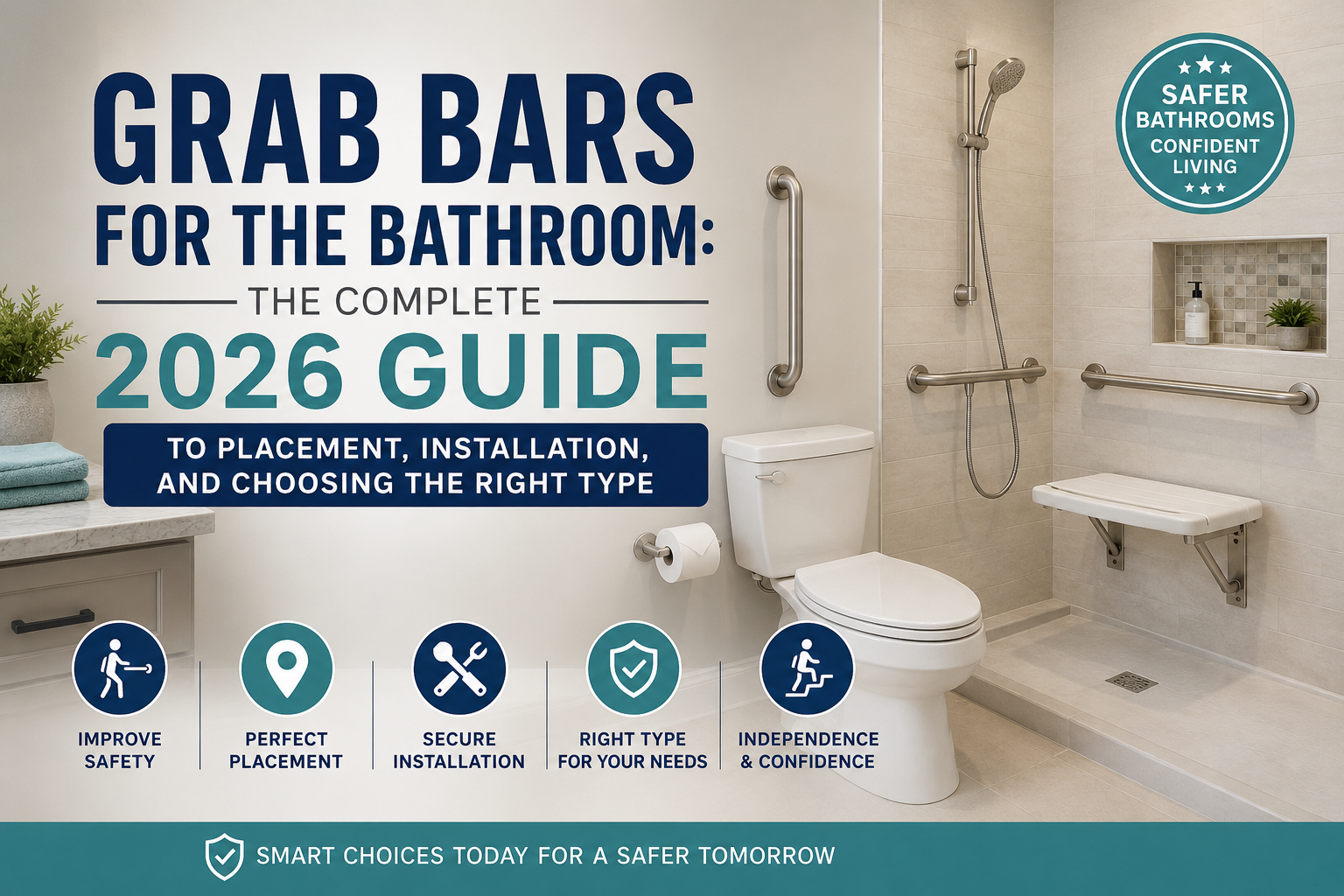
The task at the toilet is sitting down and standing up under control. The most useful support is a horizontal bar on the wall nearest the toilet, positioned so the person can push down and pull up as they rise. Where the toilet sits against a side wall, a bar there is ideal; where it sits in the open, a fold-down bar or a free-standing toilet safety rail does the job.
Accessibility guidelines for public restrooms call for a side-wall bar at least 42 inches long mounted with its near end no more than 12 inches from the back wall, plus a rear bar at least 36 inches long, both set 33 to 36 inches above the floor. A home bathroom does not have to meet the letter of the code, but those numbers are a sound guide: a bar roughly 24 to 32 inches long, set around 33 to 36 inches high, on the wall the person naturally leans toward.
At the Tub or Shower
Here you often want two bars doing two different jobs. A vertical bar near the outer edge of the tub or the shower entrance gives a firm handhold for the risky step over the tub wall or across the threshold, where balance is most precarious. A horizontal bar on the long wall gives steadying support while standing and washing, and something to hold while lowering onto or rising from a shower chair or bench. Some people add an angled bar that blends both functions.
For showers used with a bench, place a bar within easy reach of the seated position. For a walk-in or curbless shower, a vertical bar at the entry plus a horizontal run along the wall covers most needs.
The Universal Rule
Have the person stand and sit in each spot and reach naturally, then mark where their hand lands. A bar an inch or two off from the instinctive grab point is a bar they will not use in an emergency. Placement is personal; the code numbers are a floor, not a substitute for watching how someone actually moves.
The Numbers That Matter
| Specification | Guideline | Why it matters |
|---|---|---|
| Mounting height | 33 to 36 in. above floor to top of bar | The reach range that suits most standing and seated transfers |
| Bar diameter | 1.25 to 1.5 in. | Thick enough to be strong, thin enough to wrap a hand fully around |
| Wall clearance | 1.5 in. between bar and wall | Room for the hand without letting a slipping arm get trapped behind the bar |
| Load rating | 250 lb of force, any direction | The dynamic load of catching a fall, not just body weight |
| Grip texture | Knurled, peened, or grip-pad surface | Traction for a wet hand, which is when you need it most |
On finishes: a smooth polished bar looks elegant and is fine as a light steadying rail, but for a wet, weight-bearing grip, a textured surface such as the knurled or peened bars above is safer. Designer options like the Moen Elegance 24-inch Brushed Nickel bar with grip pads (about $126) split the difference, pairing a decorative finish with textured contact zones so the bathroom does not have to look institutional.
Installation: Where Safety Is Won or Lost
A grab bar is only as strong as what it is bolted to. This is the part people underestimate, and it is the part that failed Harold. You have three legitimate ways to anchor a permanent bar, and one way that is not acceptable.
- Into wood studs. The traditional method. Locate the studs (usually 16 inches apart, center to center), and drive the bar screws through the wall surface into solid wood. At least one flange should catch a stud; ideally both, which is why bar length is sometimes chosen to match stud spacing.
- Into solid blocking. In new construction or a remodel, a board installed behind the tile between the studs lets you place a bar anywhere on the wall, not just where a stud happens to be. This is the best-case setup and worth requesting during any bathroom renovation.
- Into heavy-duty grab-bar anchors. Where you cannot hit a stud, purpose-made toggle-style anchors rated specifically for grab bars can achieve the required strength in a tile-and-drywall wall. Ordinary plastic drywall anchors do not qualify. Use only anchors the bar manufacturer rates for grab-bar loads, and follow the torque and spacing instructions exactly.
- Never into drywall alone. A bar screwed only into drywall, or into decorative anchors, will pull free under a fall load. This is not a maybe. It is the single most common and most dangerous installation error.
Whichever method, seal around the flanges with silicone in a wet area so water cannot get behind the tile, and test the finished bar hard with your full weight before anyone relies on it. If you are not confident locating studs or assessing the wall, hire a handyman or contractor; it is an hour of labor against the cost of a fall. Concealed-screw designs such as the SecureMount bars hide the mounting hardware behind a snap-on cover for a cleaner finished look, but the anchoring underneath still has to be done right.
Renting? You Still Have Good Options
If you cannot drill, you are not out of luck, but you do have to be honest about what each option can and cannot do. A quality clamp-on tub rail mounts to the tub itself and bears real load. A tension pole gives a strong vertical handhold between floor and ceiling. A toilet safety frame surrounds the toilet without touching the wall. And a suction bar can steady balance, as long as everyone using it understands it is for light support and gets checked before every use. What none of these replaces is a properly anchored wall bar for someone at genuine risk of a hard fall. If that describes the person, it is worth a conversation with the landlord about installing real bars; many will allow it, and some are required to make reasonable accommodations.
Choosing the Right Bar: A Quick Decision Guide
- You own your home and want the safest handhold: a permanent wall-mounted bar into studs or blocking. Start with the knurled chrome bar for value or a concealed-screw SecureMount bar for looks.
- You rent or cannot drill: a clamp-on tub rail like the Moen Dual Tub Grip, a tension pole such as the 3-in-1 security pole, or a toilet safety frame.
- You need light balance help and portability: a suction grab bar with a safety indicator, used strictly as a steadying aid.
- The same person needs several grip heights: a ladder-style bar like the Curve Grab Bar.
- The toilet sits in the open with no side wall: a fold-down bar or a free-standing toilet safety rail.
You can compare finishes, lengths, and mounting styles across the full grab bars collection and the wider bedroom and bathroom safety collection at AllCare Store.
Using and Maintaining Grab Bars Safely
- Grip, don't lunge. A grab bar rewards a controlled hold and steady pull, not a desperate grab. Reach with intention as you move, rather than treating the bar as a last resort.
- Keep hands and bar dry-ish. Textured bars help, but soap film is slippery. Rinse soap off the bar and consider keeping a small towel within reach.
- Check suction and clamp bars before every use. Look at the indicator window on a suction bar, and give a clamp rail a firm wiggle. If in doubt, do not trust it.
- Re-test permanent bars periodically. A few times a year, pull hard on each bar to confirm nothing has loosened, and reseal the silicone if it has cracked.
- Pair bars with the rest of the system. A grab bar plus a non-slip mat, a shower chair, a raised toilet seat, and good lighting is far safer than any one of them alone.
- Consider a medical alert device. Even the best-equipped bathroom cannot promise no fall ever. A medical alert system worn on the body means help can be summoned if a fall does happen.
Why Shop Bathroom Safety at AllCare Store
AllCare Store carries grab bars in every style and finish, plus the shower chairs, transfer benches, raised toilet seats, toilet safety rails, non-slip mats, and bed rails that make up a complete home-safety setup. Everything ships free within the U.S. with 30-day returns, and our team can help you match bar length, mounting style, and placement to the person and the bathroom.
Bathroom safety is one of the categories where a short phone call saves a lot of second-guessing. Whether a wall can take a permanent bar, which no-drill option is strong enough for a given person, and where exactly the bar should sit are all easier to sort out with someone who does it every day. Start with the grab bars collection, the bedroom and bathroom safety collection, or the broader fall prevention and home management collection.
The Takeaway: Cheap Insurance for the Riskiest Room
A grab bar will not make anyone younger or steadier, and it cannot promise that no fall will ever happen. What it does is turn the instinctive reach-and-grab of a slip into something that holds - which, in the bathroom, is often the difference between a stumble and a hospital stay. Buy the right type for the wall and the person, place it where the hand naturally lands, anchor it into something solid, and test it hard before anyone leans on it.
Harold has three bars now: a vertical one at the tub, a horizontal one on the shower wall, and one beside the toilet, all bolted into studs. He still calls his daughter every morning. But these days it is just to talk.
Not Sure Which Grab Bars You Need? Let's Talk It Through.
AllCare Store stocks permanent wall-mounted grab bars, suction and clamp-on bars, tension poles, fold-down bars, and toilet safety rails, in finishes from budget chrome to designer brushed nickel - plus the shower chairs, raised toilet seats, mats, and bed rails that complete a safer bathroom. Browse the grab bars collection and the bedroom and bathroom safety collection to compare options.
Call 1-888-889-6260 to talk with a specialist about bar type, length, placement, and no-drill options, or visit AllCareStore.com to browse the full range. Free U.S. shipping, discreet packaging, and 30-day returns on every order.
This guide was written and reviewed by the AllCare Store editorial team. Building codes, coverage rules, and product pricing change and vary by location - verify current details with your installer, your plan, and the product page. For placement tailored to a specific person, consult an occupational or physical therapist.
SAFETY DISCLAIMER: This article is for general information only and is not medical advice or a substitute for a professional home-safety or occupational-therapy assessment. A grab bar is a fall-prevention device, and it only protects you if it is the right type, in the right place, and anchored correctly. An improperly installed grab bar can pull out of the wall under load and cause serious injury. Where the location matters for someone at real risk of falling, have an occupational or physical therapist assess placement and have a qualified installer confirm the wall structure. If you have had recent surgery, a new diagnosis, dizziness, or a recent fall, talk to your clinician before relying on any bathroom aid.
Explore Our Complete Mobility & Daily Living Collection
Take safety beyond the shower. Browse our curated selection of bedside commodes, walk-in bath accessories, transfer tools, and daily living aids designed for comfort and ease.
Explore All Mobility Equipment