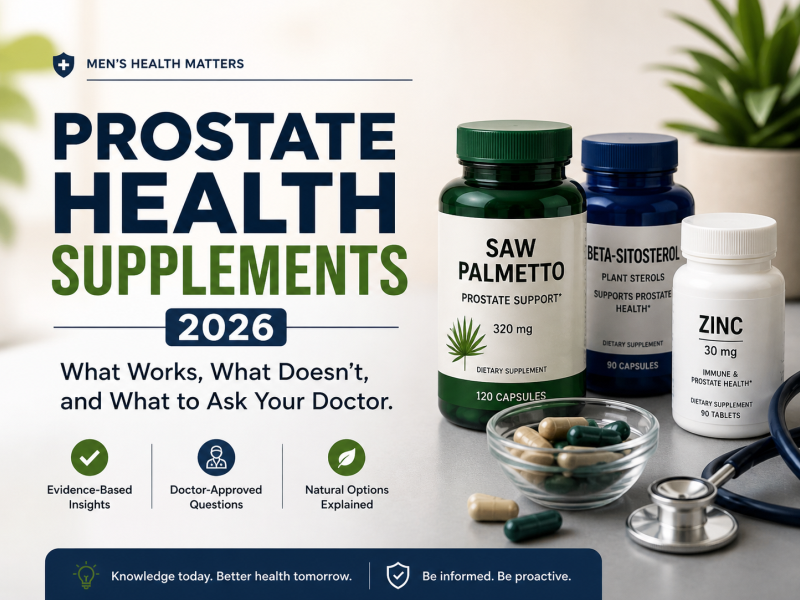
MEDICAL DISCLAIMER: This article is for informational and educational purposes only. It does not constitute medical advice, diagnosis, or treatment. Prostate conditions — including BPH (benign prostatic hyperplasia), prostatitis, and prostate cancer — require proper medical diagnosis and management. Never use supplements as a substitute for medical evaluation, especially if you have urinary symptoms, pain, or a family history of prostate cancer. Always discuss supplements with your doctor or urologist before starting them, as they can interact with medications including blood thinners, hormone therapies, and alpha-blockers.
Prostate Health: Why It Matters, Especially After 50
The prostate is a walnut-sized gland located just below the bladder that plays a central role in male reproductive function. It's also one of the most health-challenged organs in men as they age. By age 60, more than half of men have some degree of benign prostatic hyperplasia (BPH) — non-cancerous prostate enlargement. By age 85, the figure climbs to over 90%.
BPH doesn't always cause symptoms, but when it does, the effects on daily life can be significant: frequent urination (especially at night — a condition called nocturia), weak or interrupted urine stream, difficulty starting urination, the feeling of incomplete bladder emptying, and urgency. These symptoms — collectively called lower urinary tract symptoms (LUTS) — are among the most common reasons men over 50 visit a urologist.
The supplement market for prostate health is enormous. Americans spend hundreds of millions of dollars annually on prostate supplements. But the evidence behind these products varies enormously — some have real clinical data, others are supported mainly by tradition and marketing. This guide cuts through the noise.
The Top Prostate Health Supplements: Evidence Review
1. Saw Palmetto (Serenoa repens)
Saw palmetto is the most widely studied and most popular prostate supplement in the United States and Europe. It comes from the berries of the Serenoa repens palm, native to the southeastern United States. Extracts are believed to work by inhibiting 5-alpha reductase — the enzyme that converts testosterone to dihydrotestosterone (DHT), which is the hormone primarily responsible for prostate cell proliferation. The prescription drug finasteride (Proscar) works by the same mechanism, which is why saw palmetto's action has attracted so much interest.
What the evidence says: The evidence for saw palmetto is genuinely mixed. Several earlier European studies (many with a standardized extract called Permixon, not available in the US) showed meaningful improvements in LUTS. However, a landmark 2006 New England Journal of Medicine double-blind trial found that 320 mg/day of saw palmetto extract was no better than placebo for BPH symptoms over one year. A subsequent 2011 JAMA dose-escalation trial reached the same conclusion.
Importantly, most US supplement products use different extracts than the European formulations studied in positive trials, and standardization varies widely between brands. The quality of evidence overall is mixed, but saw palmetto appears safe for most men, with a side effect profile similar to placebo.
Typical dose: 160 mg twice daily (320 mg/day) of a lipophilic extract standardized to 85–95% fatty acids and sterols.
Side effects: Generally mild — occasional GI upset, headache. Rare reports of decreased libido. Because it may weakly affect testosterone/DHT levels, men on hormone therapy should use with caution. May have mild blood-thinning effects — use cautiously if taking warfarin or other anticoagulants.
2. Beta-Sitosterol
Beta-sitosterol is a plant sterol found naturally in saw palmetto, pygeum, pumpkin seed, and many foods (nuts, seeds, vegetables). It can also be taken as a standalone supplement. Unlike saw palmetto, which is the whole botanical extract, beta-sitosterol isolates the specific compound believed to be responsible for much of the urological benefit.
What the evidence says: Beta-sitosterol actually has some of the stronger clinical evidence in the prostate supplement category. A 1999 Lancet meta-analysis of four placebo-controlled trials found that beta-sitosterol significantly improved urinary flow rate and reduced symptom scores compared to placebo. A 2007 Cochrane systematic review affirmed that beta-sitosterol improves urinary symptom scores and peak urinary flow in men with BPH, though it noted the studies were short-term and used variable formulations.
Typical dose: 60–130 mg/day, divided doses. Look for products standardized to actual beta-sitosterol content.
Side effects: Very well tolerated. Occasional mild GI effects. Beta-sitosterol and related sterols can mildly reduce cholesterol absorption — this is generally beneficial but worth noting if you're monitoring lipid levels.
3. Pygeum (Prunus africana)
Pygeum is an extract from the bark of the African cherry tree, used for centuries in traditional African medicine for urinary complaints. Its proposed mechanisms include anti-inflammatory effects, reduction of prolactin levels (which drives prostate cell growth), and inhibition of prostatic growth factors.
What the evidence says: A 2002 Cochrane review of 18 randomized trials involving nearly 1,600 men found that pygeum produced modest but statistically significant improvements in urinary symptom scores, nocturia, and peak urinary flow compared to placebo. The review noted the trials were mostly short-term and used varying formulations, but the consistency of effect across studies was encouraging. Pygeum is more widely prescribed in France and Germany than it is used as a supplement in the US.
Typical dose: 100–200 mg/day of standardized bark extract (standardized to 12–13% total sterols).
Side effects: Generally well tolerated. Occasional mild GI upset (nausea, diarrhea, constipation). Rare reports of headache.
4. Pumpkin Seed Extract
Pumpkin seeds (Cucurbita pepo) have long been used in Eastern European folk medicine for urinary complaints, and pumpkin seed oil is a popular supplement for prostate and bladder health. Pumpkin seeds are rich in zinc, beta-sitosterol, and cucurbitin — compounds that may support prostate and bladder function.
What the evidence says: Evidence is more limited but promising. A 2014 pilot study in the Journal of Medicinal Food found that pumpkin seed extract significantly improved LUTS scores in men with BPH over 12 months. Pumpkin seed may also benefit overactive bladder symptoms — a 2014 randomized trial published in the Journal of Traditional and Complementary Medicine found pumpkin seed oil improved bladder function and reduced nocturia in both men and women. Larger trials are needed, but the safety profile is excellent.
Typical dose: 500 mg–1,000 mg of pumpkin seed oil or extract per day.
5. Zinc
The prostate gland accumulates zinc at concentrations higher than virtually any other organ in the body — approximately 10 times the serum concentration. Zinc is believed to play a role in regulating prostate cell growth and inhibiting 5-alpha reductase activity. Studies have found that prostate zinc levels are significantly lower in prostate cancer tissue than in normal prostate tissue, which has generated interest in zinc supplementation for prostate health.
What the evidence says: Clinical evidence for zinc supplementation improving BPH symptoms or prostate cancer risk in men with normal zinc levels is limited and inconsistent. However, zinc deficiency is associated with increased prostate cancer risk in some epidemiological studies. The more important point: high-dose zinc supplementation has been associated in some studies with increased prostate cancer risk. A large study from the Health Professionals Follow-up Study found that men taking more than 100 mg/day of supplemental zinc had nearly twice the risk of advanced prostate cancer compared to non-users.
Recommendation: Maintain adequate zinc through diet (oysters, beef, pumpkin seeds, nuts) and a standard multivitamin (8–11 mg/day). High-dose zinc supplementation for prostate health is not recommended without specific medical indication and monitoring.
6. Lycopene
Lycopene is a carotenoid antioxidant found primarily in tomatoes and tomato-based products. It accumulates in prostate tissue and has attracted attention based on epidemiological data suggesting that men who eat diets high in cooked tomatoes have lower rates of prostate cancer. The proposed mechanism involves reduction of oxidative damage to prostate DNA.
What the evidence says: Observational evidence linking dietary lycopene to prostate cancer protection is moderately strong, but randomized controlled trials of lycopene supplements have not consistently demonstrated a reduction in PSA or prostate cancer risk. The 2009 SELECT trial (Selenium and Vitamin E Cancer Prevention Trial) demonstrated that vitamin E supplementation actually increased prostate cancer risk — a cautionary note for antioxidant supplementation in general.
The most prudent approach: eat more tomato-based foods (especially cooked tomatoes, which increase lycopene bioavailability) rather than relying on supplements.
7. Stinging Nettle Root (Urtica dioica)
Stinging nettle root (different from the leaf) has been used in European herbal medicine for BPH. It is believed to inhibit sex hormone-binding globulin (SHBG), which can affect how testosterone and DHT interact with prostate cells. It's often combined with saw palmetto in multi-ingredient prostate formulas.
What the evidence says: Several European randomized trials have found nettle root comparable to the prescription alpha-blocker tamsulosin for mild-to-moderate BPH symptoms, with fewer sexual side effects. However, many of these studies are from the 1990s–2000s, are relatively small, and some used combination products with other herbs. Evidence is promising but not conclusive.
Multi-Ingredient Prostate Supplements: What to Look For
The majority of prostate supplements sold in the US are multi-ingredient formulas combining several of the above ingredients. Common combinations include saw palmetto + beta-sitosterol, saw palmetto + pygeum + zinc, or saw palmetto + nettle root + pumpkin seed.
| Ingredient | Evidence Level | Best Supported Use | Key Caution |
|---|---|---|---|
| Beta-sitosterol | Moderate (Cochrane-reviewed) | BPH symptom relief, urinary flow | Ensure standardized dosage (60–130 mg/day) |
| Pygeum | Moderate (Cochrane-reviewed) | BPH symptoms, nocturia | Check standardization (12–13% sterols) |
| Saw palmetto | Mixed (major RCTs negative) | Symptom management; safety profile strong | Quality and standardization vary widely |
| Pumpkin seed extract | Early/limited | BPH, bladder symptoms, nocturia | More data needed |
| Stinging nettle root | Limited/promising | BPH in combination with saw palmetto | Product quality varies |
| Zinc | Mixed/risk concerns | Dietary sufficiency (not megadosing) | High-dose may increase prostate cancer risk |
| Lycopene | Observational only | Better via diet (cooked tomatoes) | Supplement trials not convincingly positive |
When evaluating a multi-ingredient product, check that the label lists specific amounts of each ingredient (not hidden in a "proprietary blend") and that key ingredients like beta-sitosterol and pygeum are standardized to their active components. Third-party tested products (USP Verified, NSF Certified, ConsumerLab approved) provide the highest assurance of ingredient accuracy.
Prostate Supplements vs. Prescription Medications
It's important to understand that supplements are not substitutes for prescription treatments when BPH is moderate to severe. Prescription options that have strong clinical evidence include:
Alpha-blockers (tamsulosin/Flomax, alfuzosin, silodosin) relax the smooth muscle in the prostate and bladder neck, improving urine flow quickly — often within days. They are the most commonly prescribed first-line BPH medication.
5-alpha reductase inhibitors (finasteride/Proscar, dutasteride/Avodart) shrink the prostate over 6–12 months by blocking DHT production. They are most beneficial for significantly enlarged prostates (greater than 40 grams) and reduce the risk of BPH progression and acute urinary retention over time.
For mild BPH with bothersome but not severe symptoms, supplements may be a reasonable discussion point with your urologist. For moderate or severe BPH, prescription medications are significantly more effective.
Prostate Supplements and PSA Testing
An important practical consideration: both saw palmetto and 5-alpha reductase inhibitors (finasteride, dutasteride) can lower PSA (prostate-specific antigen) levels. PSA is a standard screening tool for prostate cancer. If you take saw palmetto or finasteride and your PSA appears normal, your actual underlying PSA may be higher than the test reflects — potentially masking a prostate cancer signal.
Always tell your doctor about any prostate supplements you're taking before PSA testing. Your doctor may need to adjust the interpretation of your PSA result or ask you to stop the supplement before testing.
Lifestyle Factors That Genuinely Support Prostate Health
Beyond supplements, several lifestyle interventions have strong evidence for prostate health and BPH symptom management:
Reduce fluid intake in the evening: Cutting back on beverages 2–3 hours before bedtime significantly reduces nocturia and nighttime urination episodes.
Limit alcohol and caffeine: Both are bladder irritants that worsen LUTS. Reducing or eliminating them often produces noticeable symptom improvement.
Stay active: Regular moderate aerobic exercise has been associated with reduced BPH symptom severity in multiple studies. Sedentary lifestyle is an independent risk factor for symptomatic BPH.
Maintain healthy weight: Obesity increases risk of symptomatic BPH and is associated with higher circulating estrogen levels, which can contribute to prostate enlargement. Weight loss in overweight men often significantly improves LUTS.
Dietary patterns: The Mediterranean diet — high in vegetables, fruits, whole grains, fish, and olive oil — is associated with better prostate health outcomes in observational studies. Diets high in red meat and saturated fat are associated with higher risk.
Shop Men's Health Supplements at AllCare Store
AllCare Store carries a wide selection of men's health supplements, vitamins, and personal care products. Explore our personal care collection and our vitamins and supplements for prostate support supplements, multivitamins, and men's health essentials.
Shop at AllCare Store with free shipping on qualifying orders, or call our team at 1-888-889-6260, Monday–Friday, 7:00 AM–4:00 PM CST.
Frequently Asked Questions: Prostate Health Supplements
Do prostate supplements actually work?
Some prostate supplements have moderate clinical evidence supporting modest symptom relief for BPH (benign prostatic hyperplasia). Beta-sitosterol and pygeum have the strongest and most consistent evidence from randomized controlled trials and Cochrane reviews, showing improvements in urinary flow rate and symptom scores. Saw palmetto's evidence is mixed — major NIH-funded trials showed no benefit over placebo, though some European formulations have shown positive results. No prostate supplement is as effective as prescription medications like tamsulosin or finasteride for moderate-to-severe BPH. Supplements may be a reasonable complement to lifestyle changes for mild symptoms, but should never replace medical evaluation.
What is the best supplement for prostate enlargement (BPH)?
Based on the available clinical evidence, beta-sitosterol and pygeum have the strongest track record for modest improvement of BPH symptoms. Beta-sitosterol, supported by a Cochrane meta-analysis, has shown significant improvements in urinary flow rate and symptom scores compared to placebo. Pygeum, also reviewed by Cochrane, showed consistent improvements across 18 trials. Look for products that specify the actual milligram amounts of standardized extracts, not just a proprietary blend. Always discuss any supplement with your urologist, especially if you're already taking prescription BPH medications.
Can saw palmetto shrink the prostate?
The evidence that saw palmetto actually shrinks prostate tissue is limited. It is theorized to inhibit 5-alpha reductase (reducing DHT production, which drives prostate cell growth), but major clinical trials including the 2006 NEJM study and 2011 JAMA dose-escalation trial found no significant difference compared to placebo in symptom scores, prostate volume, or urinary flow. Some men report subjective improvement, and the safety profile is good, but clinical evidence for prostate volume reduction is not strong. Prescription 5-alpha reductase inhibitors like finasteride and dutasteride have been proven to reduce prostate volume and are far more effective if that is the goal.
Does saw palmetto affect PSA levels or prostate cancer screening?
Saw palmetto may lower PSA (prostate-specific antigen) levels, similar to the effect of prescription 5-alpha reductase inhibitors. Because PSA is a key screening marker for prostate cancer, artificially lowering it can potentially mask an elevated PSA that would otherwise prompt further investigation. If you take saw palmetto, always inform your doctor before PSA testing so they can appropriately interpret your results. Some urologists recommend stopping saw palmetto for a period before PSA testing or doubling the PSA result to estimate the true level. This is an important patient safety consideration that is often underappreciated.
Are prostate supplements safe to take with other medications?
Prostate supplements can interact with several medications. Saw palmetto and other herbs with mild 5-alpha reductase or anti-androgenic activity can interact with hormone therapies, blood thinners (saw palmetto may have mild antiplatelet effects), and other BPH medications. Beta-sitosterol can mildly reduce cholesterol absorption and may interact with statins or cholesterol-binding medications. Always disclose all supplements to your doctor and pharmacist, especially if you take warfarin (Coumadin), prescription alpha-blockers (tamsulosin, alfuzosin), 5-alpha reductase inhibitors (finasteride, dutasteride), or prostate cancer medications. Never stop prescribed prostate medications in favor of supplements without consulting your doctor.
For prostate health supplements, men's vitamins, and personal care products, visit AllCare Store. Browse our personal care collection. Free shipping on qualifying orders. Call 1-888-889-6260 for personalized assistance, Monday–Friday 7 AM–4 PM CST.