Medical Note: This article is for informational purposes only and does not replace medical advice. Always follow your surgeon's or physician's specific instructions regarding brace type, immobilization duration, and activity restrictions. Using the wrong brace or wearing it incorrectly can impede healing.
The shoulder is the most mobile joint in the human body — and that mobility comes at a cost. It is also the most commonly dislocated large joint, and one of the most frequently injured by both acute trauma and repetitive overhead activity. When the shoulder needs support, protection, or post-surgical immobilization, choosing the right brace or immobilizer is critical. The wrong device does not just fail to help — it can allow unwanted movement that delays healing or causes reinjury. Browse our full selection of shoulder braces and supports at AllCare Store.
Anatomy of a Shoulder Injury: Why Support Matters
The glenohumeral joint (the ball-and-socket of the shoulder) is stabilized by four rotator cuff muscles and tendons, the labrum (a ring of cartilage that deepens the socket), the joint capsule, and multiple surrounding ligaments. When any of these structures is torn, strained, or surgically repaired, the joint must be protected from movements that place stress on the healing tissue.
For example: a repaired rotator cuff must be kept from active internal and external rotation while the tendon reattaches to bone. A reduced (relocated) shoulder dislocation must be held in a neutral position to allow the stretched capsule and ligaments to tighten. A fractured clavicle or proximal humerus must be stabilized so bone ends do not shift. Each scenario calls for a different level of immobilization and a different device.
Types of Shoulder Braces and Immobilizers
Standard Arm Slings
A basic arm sling cradles the forearm and suspends the arm from the neck with a strap, holding the elbow at roughly 90 degrees. Standard slings restrict active shoulder movement by keeping the arm resting against the body, but they do not prevent all motion — the arm can still swing outward if the patient moves suddenly or reaches across the body. Standard slings are appropriate for mild soft tissue injuries, minor fractures not requiring rigid stabilization, or post-procedure comfort during the initial days after minimally invasive procedures.
Best for: Mild sprains, bruised clavicle, immediate post-injury comfort, short-term use after minor procedures
Not suitable for: Rotator cuff repairs, shoulder dislocations requiring positional immobilization, surgical recoveries with specific positioning requirements
Shoulder Immobilizers (Sling and Swathe)
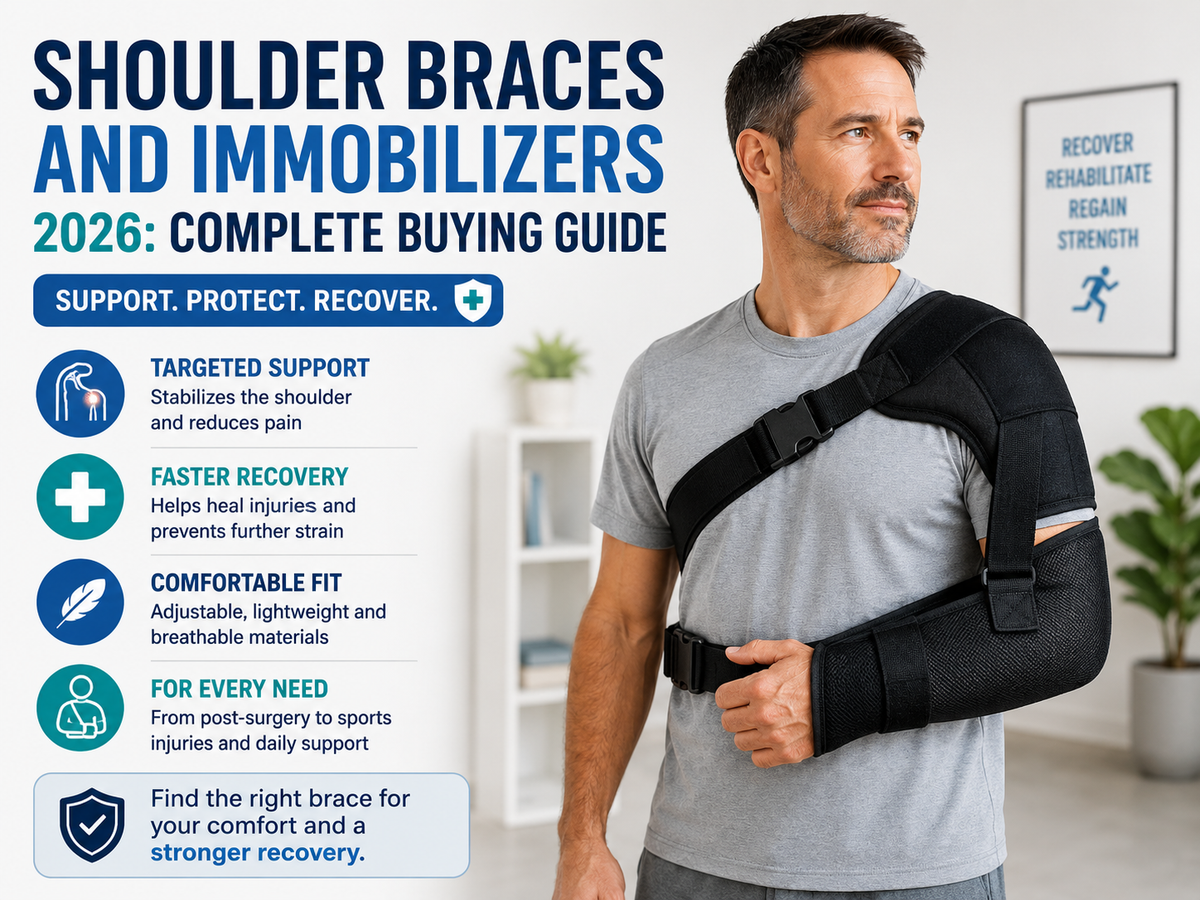
A shoulder immobilizer adds a swathe band that wraps around the torso and fastens to the sling, binding the upper arm against the body. This two-part system prevents the arm from swinging away from the body and restricts both abduction (raising the arm outward) and external rotation significantly more than a sling alone. This is the standard device prescribed after shoulder dislocation reduction and is commonly used following proximal humerus fractures and soft tissue repairs that require neutral positioning.
Best for: Shoulder dislocation (post-reduction); proximal humerus fractures; labrum repairs requiring neutral positioning; rotator cuff repairs in the early post-surgical phase (depending on surgeon protocol)
Not suitable for: Situations requiring the arm to be held in abduction
Abduction Shoulder Braces (Airplane Splints)
An abduction shoulder brace holds the arm in a specific degree of abduction — typically 15°, 30°, or 45° away from the body — using a rigid foam or plastic wedge strapped between the arm and the torso. These braces are commonly prescribed after rotator cuff repair surgery, particularly for larger tears, because holding the arm slightly away from the body reduces tension on the repaired tendon while it heals. They are also used after certain labrum repairs and shoulder replacement surgeries per surgeon protocol.
Abduction braces are more cumbersome than standard immobilizers and require a fitting period for comfort. Most patients use them 24 hours per day for the first 4–6 weeks after surgery, removing them only for prescribed physical therapy exercises and hygiene. Sleeping in an abduction brace is uncomfortable but necessary — a recliner chair is often easier than lying flat.
Best for: Rotator cuff repair (especially large or massive tears); certain shoulder replacement protocols; labrum repair with surgeon-specified abduction position
Not suitable for: General shoulder injuries not requiring abduction positioning; use without a surgeon's specific prescription
Shoulder Stability Braces
Shoulder stability braces are designed for use during activity — not full immobilization. They compress the shoulder joint, limit excessive external rotation, and reduce the risk of dislocation in patients with chronic instability or after the acute healing phase of a dislocation. Unlike immobilizers, they allow functional range of motion while providing a proprioceptive reminder and mechanical limit at end-range positions that are at risk for dislocation.
These braces are popular among athletes returning to contact sports after shoulder dislocation or surgery, and among patients with multidirectional instability who are not surgical candidates. They are not appropriate as a substitute for proper immobilization in the acute phase of injury.
Best for: Chronic shoulder instability; dislocation prevention during athletic activity; return-to-sport phase after healing; patients with recurrent dislocations managing conservatively
Not suitable for: Acute injuries requiring immobilization; replacing an immobilizer prescribed by a surgeon
Rotator Cuff Support Braces
Rotator cuff support braces are compression garments that wrap around the shoulder and upper arm, providing mild support and warmth to the rotator cuff tendons. They do not immobilize the joint but may reduce pain during activity in patients with rotator cuff tendinitis, partial tears being managed conservatively, or subacromial impingement. They are a comfort aid, not a therapeutic immobilizer.
Best for: Rotator cuff tendinitis; subacromial impingement; mild partial tears managed conservatively; post-physical therapy maintenance
Not suitable for: Full-thickness rotator cuff tears; post-surgical immobilization; acute dislocations
Choosing the Right Brace: Key Decisions
Follow Your Surgeon's or Physician's Protocol First
For any post-surgical or acute injury situation, the brace type should be specified by the treating physician or surgeon. Surgeons often have strong preferences based on their repair technique — a rotator cuff surgeon who performs a specific repair may require a particular abduction angle. Never substitute one brace type for another without confirming it is appropriate for your specific diagnosis and procedure.
Fit and Adjustability
A shoulder brace must fit correctly to function. An immobilizer that is too large allows the arm to shift inside the device. An abduction brace that is set to the wrong angle places the repaired tendon under incorrect tension. Most braces are sized by chest circumference or arm circumference and come in small, medium, large, and extra-large. Measure carefully against the manufacturer's sizing chart. For abduction braces, the wedge angle is often adjustable and will be set per the surgeon's order at fitting.
Wearing Schedule
Most immobilizers must be worn continuously — including during sleep — for the prescribed period, except during physical therapy sessions and carefully controlled hygiene. Wearing the brace inconsistently during the immobilization phase is a common cause of inadequate healing and repeat injury. Ask your surgeon exactly when you may remove the brace and for what activities.
Skin and Hygiene Under the Brace
Wearing a shoulder brace continuously for weeks creates conditions for skin irritation, particularly in the axilla (armpit). Wearing a moisture-wicking cotton undershirt beneath the brace significantly reduces friction and perspiration buildup. Inspect the skin daily for any pressure sores or rash, and contact your provider if skin breakdown occurs.
Physical Therapy and the Role of the Brace
A shoulder brace is a temporary protective device — it is not treatment in itself. Healing of the underlying structure (tendon, ligament, bone) is the goal, and physical therapy directed by a qualified therapist is what restores strength, range of motion, and function after the protected phase ends. Most shoulder surgeries involve a defined period of brace immobilization followed by progressive physical therapy exercises. Skipping or delaying physical therapy after the immobilization phase significantly worsens long-term outcomes.
Begin searching for a physical therapist familiar with shoulder rehabilitation before your surgery if possible — the PT relationship that begins pre-surgery (prehabilitation) typically produces better post-surgical outcomes than starting PT cold after the operation.
Shop Shoulder Braces at AllCare Store
AllCare Store carries standard arm slings, shoulder immobilizers, abduction braces, and shoulder stability supports for every stage of recovery. Free shipping on every order. Our team is available at 1-888-889-6260 to help match you with the right device.
Braces & Supports | Arm Slings | Physical Therapy & Recovery | AllCare Store
Frequently Asked Questions: Shoulder Braces and Immobilizers
What is the difference between a shoulder sling and a shoulder immobilizer?
A standard arm sling cradles the forearm and suspends the arm from the neck at roughly 90 degrees of elbow flexion. It reduces active shoulder motion but does not prevent the arm from swinging away from the body. A shoulder immobilizer adds a swathe band — a strap that wraps around the torso and binds the upper arm against it — preventing abduction and external rotation much more effectively. Immobilizers are used for shoulder dislocations, certain fractures, and post-surgical situations where the arm must stay in a neutral position against the body. Slings are used for milder injuries where full immobilization is not required.
How long do I need to wear a shoulder brace after rotator cuff surgery?
Immobilization duration after rotator cuff repair depends on the size of the tear and the surgeon's protocol. For small and medium tears, many surgeons prescribe 4–6 weeks of continuous immobilization (sling or abduction brace). For large or massive tears, 6–8 weeks is common. Larger repairs require longer protection because the tendon-to-bone healing process (tendon-to-bone healing is slower than tendon-to-tendon) takes a minimum of 6–8 weeks to establish a strong initial attachment, even longer to fully mature. Always follow your specific surgeon's instructions — protocols vary by surgeon and repair technique.
Do I need an abduction brace after rotator cuff surgery?
Whether you need an abduction (airplane) brace depends on the specific rotator cuff repair performed. For small tears repaired with minimal tissue tension, a standard sling or immobilizer is often sufficient. For medium to large tears — particularly repairs of the supraspinatus tendon — many surgeons prefer an abduction brace because holding the arm slightly away from the body reduces tension on the repair site and may improve healing rates. Rotator cuff repair is the primary indication for shoulder abduction braces. Your surgeon will specify whether an abduction brace is needed and at what angle (typically 15°–45°).
Can I sleep with a shoulder immobilizer on?
Yes — and for most shoulder surgeries and acute dislocations, you must wear the immobilizer while sleeping. This is one of the more uncomfortable aspects of shoulder recovery. Many patients find sleeping in a recliner or propped up with pillows significantly more comfortable than lying flat, as lying flat can put unexpected pressure on the shoulder and cause pain that disrupts sleep. Placing a pillow under the elbow of the braced arm while reclined can reduce pressure and improve comfort. If your surgeon has specified that you may remove the brace during sleep, follow that instruction — but do not assume you can without asking first.