Note: This article is for informational and educational purposes only. Home blood pressure monitoring is a valuable health tool, but does not replace regular clinical evaluation. If you have high blood pressure or cardiovascular disease, consult your physician for guidance on monitoring frequency, target ranges, and when readings require urgent attention.
Upper Arm vs Wrist Blood Pressure Monitors: Which Is More Accurate?
The Monitor on the Counter vs the One in the Drawer
Raymond, 68, had two blood pressure monitors at home. His physician had recommended the upper arm model sitting on the bathroom counter, but Raymond used the wrist monitor in the bedroom drawer because it was smaller and easier to put on. At his next appointment, his doctor noticed his home readings were consistently 8–12 mmHg lower than the clinic measurements. When the office nurse checked his wrist monitor against a validated arm cuff in the same sitting, the wrist monitor read significantly lower — a common finding when wrist monitors are used without proper technique.
The monitor Raymond was relying on wasn't defective. It was a well-reviewed device used incorrectly, producing readings that were systematically inaccurate. Understanding why this happens — and how to prevent it — is the central practical question in the upper arm vs wrist debate.
How Blood Pressure Monitors Work
Both upper arm and wrist monitors use oscillometric measurement: the cuff inflates, compresses the artery beneath it, then slowly deflates while a pressure sensor detects the oscillations (vibrations) in the arterial wall caused by each heartbeat. The monitor's algorithm converts these oscillation patterns into systolic and diastolic pressure readings.
The key difference is where the cuff is placed and which artery is measured:
- Upper arm cuffs compress the brachial artery at the level of the heart (when the arm is positioned correctly)
- Wrist cuffs compress the radial and ulnar arteries at the wrist, a position typically 10–15 cm below the heart level when the arm rests naturally
Blood pressure is not the same throughout the body — it varies with distance from the heart and the diameter and elasticity of the vessels being measured. This positional difference is the root cause of most accuracy discrepancies between the two monitor types.
Accuracy: What the Research Shows
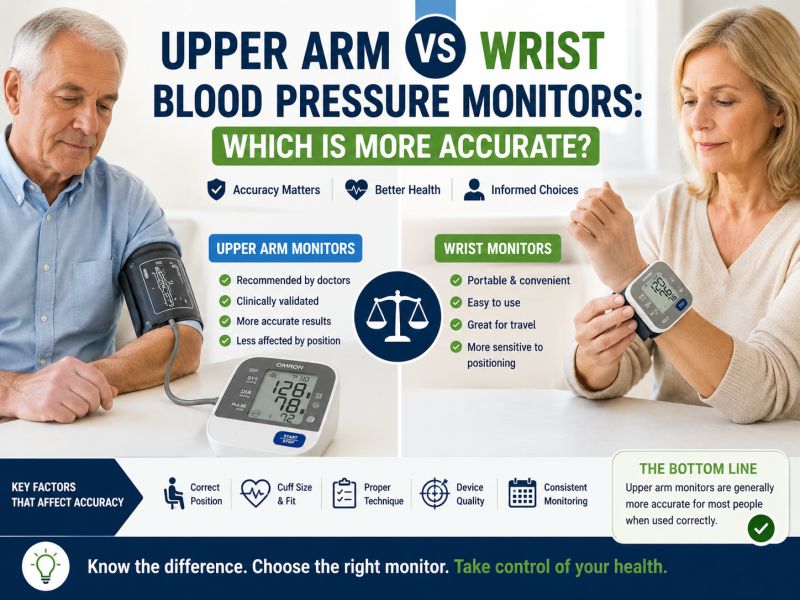
The clinical consensus among cardiologists and hypertension specialists is consistent: upper arm monitors are more accurate than wrist monitors, and upper arm devices are the preferred option for routine home blood pressure monitoring.
The American Heart Association (AHA), the European Society of Hypertension (ESH), and the British Hypertension Society all recommend upper arm monitors as the standard for home blood pressure measurement. Wrist monitors are considered acceptable alternatives when arm monitors cannot be used, not equivalent first-line devices.
The primary reasons for this accuracy gap:
Position sensitivity: Wrist monitor accuracy is highly dependent on wrist position relative to the heart. If the wrist is even a few centimeters below heart level, pressure readings will be falsely elevated; above heart level, readings will be falsely low. Studies show that small deviations in wrist position (5 cm above or below heart level) can change readings by 5–10 mmHg — a clinically significant error. Upper arm cuffs, positioned at heart level with the arm supported, are much more forgiving of minor positioning variations.
Peripheral artery variability: The radial arteries at the wrist are smaller and more peripheral than the brachial artery in the upper arm. In certain populations — particularly older adults and people with atherosclerosis, peripheral vascular disease, or diabetes — peripheral artery stiffness can affect the oscillometric signal and increase measurement variability. The brachial artery is larger, closer to the heart, and produces a more reliable oscillometric signal.
Validated device availability: Many more upper arm monitors have been validated through rigorous independent testing (using standardized protocols from the AHA, ESH, or British Hypertension Society) than wrist monitors. Device validation — meaning the device has been independently tested against mercury sphygmomanometry and shown to meet accuracy standards — matters significantly for clinical reliability.
When Upper Arm Monitors Are the Clear Choice
For most people monitoring blood pressure at home, an upper arm monitor is the right choice:
- If you have hypertension and are tracking blood pressure as part of medical management
- If your readings will be shared with your physician for treatment decisions
- If you have any cardiovascular disease, diabetes, or kidney disease (conditions where accurate BP monitoring is particularly important)
- If you are monitoring blood pressure in older adults (where peripheral vascular changes make wrist monitors less reliable)
- If your arm circumference is within the standard range (typically 9–13 inches for a standard adult cuff)
Browse our blood pressure monitor collection for validated upper arm devices for home use.
When Wrist Monitors May Be Appropriate
Despite their accuracy limitations, wrist monitors have legitimate use cases:
- Very large arm circumferences: Standard adult arm cuffs fit arms up to approximately 13–16 inches in circumference, with large adult cuffs extending to 17 inches. For individuals with arm circumferences exceeding available cuff sizes, wrist monitors may be the only practical option. (It's worth noting that most manufacturers also make extra-large cuffs; check before defaulting to a wrist monitor.)
- Arm conditions that prevent cuffing: Lymphedema, dialysis access (AV fistulas), severe arm wounds, post-mastectomy lymph node removal, or severe pain with arm compression.
- Travel and portability: Wrist monitors are significantly more compact and easier to carry than upper arm monitors with their larger cuffs and cases. For occasional travel use (not primary monitoring), a validated wrist monitor with careful technique can be practical.
- Supplemental check-in monitoring: For individuals who are monitoring frequently throughout the day (e.g., tracking white coat hypertension or orthostatic hypotension patterns) and who understand the technique requirements, wrist monitors can provide additional data points.
Getting Accurate Readings from Either Monitor
Technique matters at least as much as device selection. The most common errors in home blood pressure measurement apply regardless of monitor type:
For Upper Arm Monitors
Cuff positioning: The cuff's artery marker (usually indicated on the cuff) should be positioned over the brachial artery on the inner arm. The cuff's lower edge should be approximately 1 inch (2–3 cm) above the elbow crease. The cuff should be snug but not tight — you should be able to slide two fingers under it.
Arm position: Support the arm so the cuff sits at heart level — roughly at the level of the mid-sternum (the middle of the chest). Resting the arm on a table at the right height achieves this. An arm hanging at the side reads falsely high; an arm raised above the heart reads falsely low.
Cuff size: Using the wrong cuff size is a major source of error. A cuff that's too small for the arm reads falsely high; too large reads falsely low. Measure your mid-upper arm circumference (midway between shoulder and elbow) and match to the manufacturer's sizing chart. Most adults with arms over 13 inches need a large adult cuff; a standard adult cuff underestimates pressure in larger arms.
For Wrist Monitors
Heart-level positioning is critical: Place the wrist monitor cuff 1 cm above the wrist bone (styloid process). Then, while the cuff is on, bring your wrist to heart level — position your forearm across your chest, with the monitor at the level of your sternum. Hold this position throughout the measurement. This single step accounts for the majority of wrist monitor accuracy issues.
Use the designated wrist: Most wrist monitors are designed for the left wrist. Check your device manual.
Wrist position: Keep the wrist straight (not bent up or down) during measurement.
General Best Practices for Both Monitor Types
Rest first: Sit quietly for 5 minutes before measuring. Physical activity, emotional stress, smoking, or caffeine in the preceding 30 minutes can elevate readings.
Sit correctly: Sit in a chair with back support, feet flat on the floor, legs uncrossed. Do not measure from a couch, bed, or with legs dangling.
Don't talk: Talking during measurement increases systolic pressure by 10–15 mmHg.
Take multiple readings: Blood pressure fluctuates minute to minute. The AHA recommends taking 2–3 readings, 1 minute apart, and recording the average. Discard the first reading if it's significantly higher than subsequent ones (first-measurement anxiety effect).
Measure at consistent times: Blood pressure follows a daily rhythm (diurnal variation), peaking in the morning and early evening. Take readings at consistent times — most commonly morning before medications and evening — for meaningful trend data.
Keep a log: Record each reading with the date, time, and any relevant notes (medication taken, recent exercise, unusual stress). Share the log with your physician at appointments. Most home monitors have memory functions that store readings automatically.
Choosing a Validated Monitor
Not all blood pressure monitors are equally accurate — device quality matters. Look for monitors that have been validated through independent testing:
- The validateBP.org website (maintained by the Stride BP consortium) maintains a publicly searchable database of validated blood pressure monitors for both home and clinical use
- Look for devices that have passed AHA, ESH, AAMI, or BHS validation protocols — this information is usually in the product specifications or the manufacturer's clinical data section
- Avoid devices validated only by manufacturer-conducted studies without independent verification
For the monitoring of blood pressure in patients with atrial fibrillation (AFib), oscillometric monitors can produce unreliable readings because the irregular heartbeat disrupts the oscillometric algorithm. Special monitors designed for AFib detection are available and are recommended for this population — ask your cardiologist.
Comparing Your Home Monitor to Your Doctor's Readings
A 5–10 mmHg difference between home and clinic readings is common and doesn't necessarily mean your monitor is inaccurate. White coat hypertension (elevated readings in clinical settings due to anxiety) is extremely common — affecting 15–30% of hypertension patients — and means home readings are often genuinely lower than clinic readings, not a sign of monitor error.
To verify your home monitor against your physician's device, bring your home monitor to an appointment and take readings back-to-back on both devices. A difference of 5 mmHg or less between validated devices is acceptable. Larger differences warrant investigation into technique or device calibration.
Shop Blood Pressure Monitors at AllCare Store
AllCare Store carries a wide selection of validated home blood pressure monitors, including upper arm and wrist models, large-cuff options, and monitors with advanced features like multi-user memory and app connectivity. Browse our blood pressure monitor collection to find the right device for your home monitoring needs.
- Free Shipping on every order — no minimum required
- Discreet Packaging — all orders arrive in plain, unmarked packaging
- 30-Day Returns — shop with confidence
- Expert Help — reach our team at 1-888-889-6260, Monday–Friday 7 AM–4 PM CST
Frequently Asked Questions: Upper Arm vs Wrist Blood Pressure Monitors
Are wrist blood pressure monitors accurate enough for home use?
Validated wrist monitors can provide clinically acceptable accuracy when used with proper technique — specifically, when the wrist is positioned at heart level during measurement. Without this positioning, wrist monitors are prone to significant errors (5–15 mmHg) due to the hydrostatic effect of measuring below heart level. For most people monitoring blood pressure for hypertension management, upper arm monitors are recommended as the first-line choice because they are less sensitive to positioning errors. Wrist monitors are a reasonable alternative for people with large arms, arm conditions preventing cuffing, or specific practical needs — but require more careful technique to produce reliable readings.
Why is my wrist blood pressure reading different from the doctor's office?
Several factors can explain differences between home wrist readings and clinic arm readings: (1) White coat hypertension — readings in clinical settings are genuinely higher in many people due to stress/anxiety, meaning home readings are correctly lower; (2) Positioning error — the wrist monitor may not be at heart level during home use, producing falsely low readings; (3) Device validation differences — clinic equipment is regularly calibrated; (4) Timing — morning vs. afternoon readings differ due to normal diurnal variation. Bring your wrist monitor to your next appointment for a side-by-side comparison with clinic equipment to determine if the device is reading accurately.
Which arm should I use for blood pressure monitoring?
At your initial home monitoring setup, measure both arms and compare readings. A difference of up to 10 mmHg between arms is normal; consistently larger differences may be worth discussing with your physician (they can indicate subclavian artery stenosis or other vascular issues). After comparing, use the arm that gives the higher reading consistently — guidelines recommend using the arm with the higher pressure for ongoing monitoring, as this is the more conservative (safer) approach. Most people measure the left arm for convenience, but this isn't universal.
What is a normal blood pressure reading at home?
Home blood pressure targets are slightly lower than clinic targets because home environments eliminate white coat effect. The AHA and most major cardiology guidelines consider home readings of less than 130/80 mmHg optimal, with 135/85 mmHg as the threshold above which hypertension is diagnosed based on home monitoring alone. These numbers may be lower for specific populations (diabetics, chronic kidney disease patients) and the appropriate target for your situation should be discussed with your physician. Single elevated readings are not diagnostic — pattern matters, which is why consistent logging over multiple days provides more useful information than individual measurements.
How often should I check my blood pressure at home?
For people with hypertension, the standard recommendation is twice daily — morning (before taking blood pressure medications, before eating or exercising) and evening — with 2–3 readings taken at each session and the average recorded. This pattern should be maintained for at least 7 days before a physician appointment for the most clinically useful data. For people who have been stable on treatment for years, once daily or a few times per week may be sufficient — your physician can guide the appropriate frequency for your situation. People with newly diagnosed hypertension, those adjusting medications, or those with particularly variable readings may benefit from more frequent monitoring until their situation stabilizes.