Medical Disclaimer: This article is for informational purposes only. Urinary catheter use should be supervised by a licensed healthcare provider. Always follow your clinician's instructions for catheter care, insertion, and maintenance.
Margaret had managed her husband's post-surgery recovery at home for three weeks before the catheter confusion nearly broke her. Which supplies did she actually need? How often did the drainage bag need changing? What was normal — and what was a warning sign? By the time she called the visiting nurse, she had a kitchen counter full of products she wasn't sure how to use and a husband who was uncomfortable but too proud to say so.
Margaret's experience is common. Urinary catheters are essential medical devices for millions of Americans recovering from surgery, managing spinal cord injuries, dealing with urinary retention, or living with conditions that affect bladder control. But the supply landscape is confusing, and proper care makes an enormous difference in both comfort and preventing serious infections.
This guide covers everything: catheter types, essential supplies, proper care routines, and how to shop smart. Browse our full Urological Care and Incontinence Supplies collections at AllCare Store.
Understanding Catheter Types
The right catheter depends entirely on the medical situation. Your healthcare provider prescribes the type, but understanding the options helps you ask better questions and manage care more confidently.
Indwelling (Foley) Catheters
An indwelling catheter remains in the bladder continuously, held in place by a small inflatable balloon. It drains urine continuously into a collection bag. Foley catheters are used after surgery, for urinary retention, when patients cannot void independently, or during hospitalization and recovery. They come in silicone or latex (always specify if there's a latex allergy). Sizes are measured in French (Fr) units; most adults use 14–18 Fr.
Intermittent (In-and-Out) Catheters
Intermittent catheters are inserted to drain the bladder, then removed — typically several times per day. They're the standard for people with spinal cord injuries, neurogenic bladder, or those who can manage self-catheterization (CIC — clean intermittent catheterization). Intermittent catheters carry lower infection risk than indwelling catheters and are strongly preferred for long-term management when medically appropriate. Available as straight-tip, coude-tip (angled, for men with enlarged prostates), and pre-lubricated (hydrophilic) varieties.
External (Condom) Catheters
For men, external catheters fit over the penis like a condom and connect to a drainage bag. They avoid internal insertion entirely, dramatically reducing infection risk. They require intact skin and proper fit to prevent leaks and skin breakdown. A good option for men with urinary incontinence who do not have urinary retention.
Suprapubic Catheters
Inserted surgically through the abdomen directly into the bladder. Used when urethral access is not possible. Requires surgical placement and specific care instructions from the surgeon.
Essential Catheter Supplies Checklist
Whether you're managing a Foley catheter at home or doing intermittent self-catheterization, these are the core supplies:
For Indwelling (Foley) Catheter Users
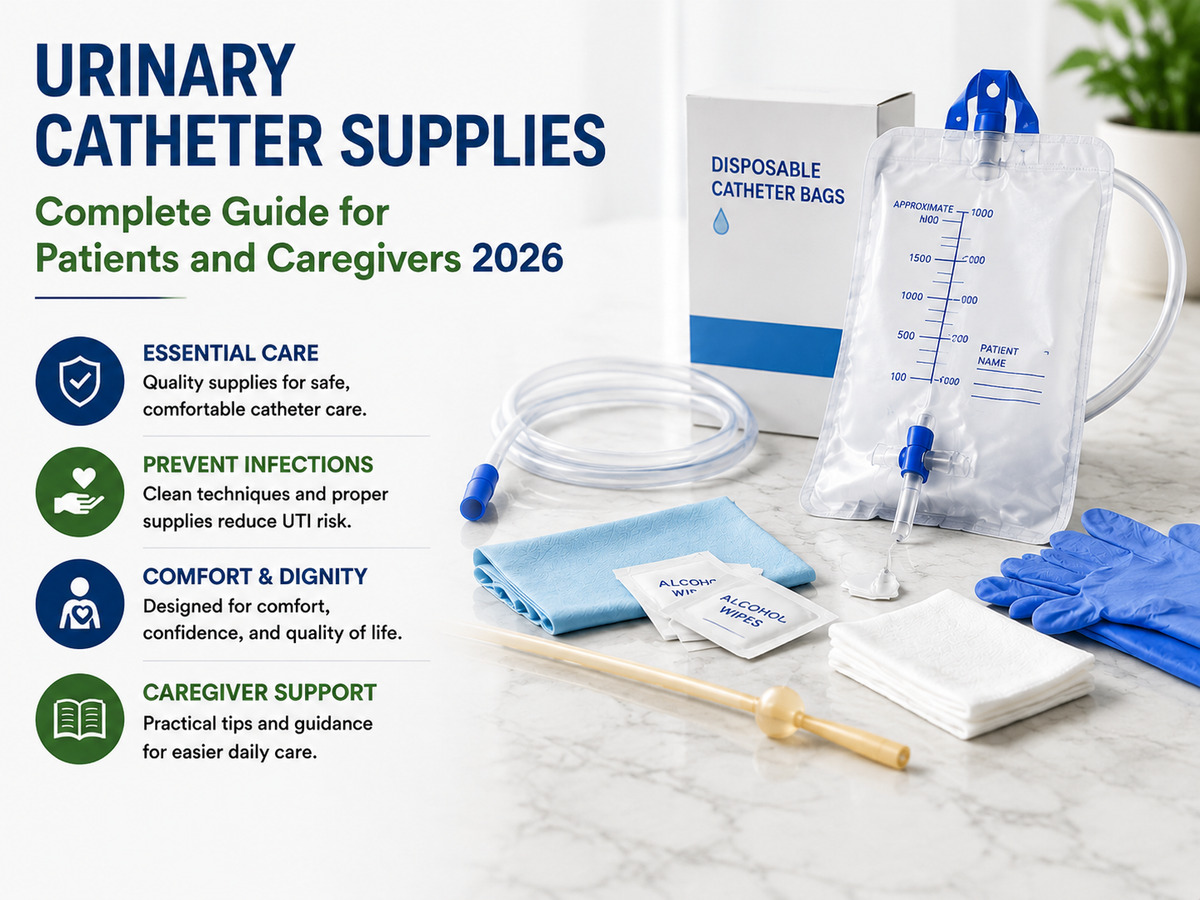
- Drainage bags — standard leg bag (worn during the day, strapped to leg) and larger overnight drainage bag
- Catheter securement device — prevents traction on the catheter (StatLock or similar)
- Catheter care kit — sterile swabs, antiseptic solution, or gentle soap for daily cleaning around the insertion site
- Sterile irrigation kit — only if prescribed for blockage prevention
- Waterproof bed pads — for nighttime drainage bag use
- Nitrile gloves — for caregiver use during care routines
- pH-balanced cleansing wipes — for perineal hygiene
For Intermittent Catheter Users
- Intermittent catheters — in correct size and type (quantity depends on frequency; typically 4–6 per day)
- Sterile lubricant (if using non-pre-lubricated catheters)
- Sterile or clean gloves
- Collection container for catheterizing away from toilet
- Disposal bags — for discreet disposal of used catheters in public
- Hand sanitizer and soap
For External Catheter Users
- External catheters in correct size (measure circumference; critical for leak prevention)
- Skin prep wipe — improves adhesion and protects skin
- Drainage bags — leg bag for daytime, larger overnight bag
- Skin barrier cream — for perianal and genital skin protection
Drainage Bags: Choosing the Right Type
Leg bags strap to the thigh or calf and hold 500–1,000 mL. They allow freedom of movement and are hidden under clothing. Must be emptied when 2/3 full (every 2–4 hours for most people). Look for anti-reflux valves that prevent backflow. Nylon or cloth backing is more comfortable than rubber against skin.
Overnight/bedside bags hold 2,000 mL and hang from a bed frame stand. The larger capacity allows uninterrupted sleep without emptying. Connect via tubing to the leg bag port (never disconnect the catheter itself) or directly to the catheter in some systems.
Closed system catheter kits include catheter, collection bag, antiseptic, and supplies in one sterile package — ideal for intermittent catheterization on-the-go.
Catheter Care: Daily Routine That Prevents Infection
Catheter-associated urinary tract infections (CAUTIs) are the most common healthcare-associated infections. For home users, a consistent hygiene routine is the best prevention:
Daily cleaning (Foley users): Wash the area where the catheter enters the body (meatus) with soap and water once or twice daily. Clean from clean to dirty — away from the body. Do not use antiseptic sprays unless directed by your physician. Pat dry. Do not apply talcum powder.
Bag hygiene: Empty drainage bags when 2/3 full or at least every 8 hours. When emptying, do not let the drain spout touch the floor or collection container. Wipe the spout with an alcohol swab after draining. Do not detach the catheter from the drainage bag; keep the system closed. Leg bags should be rinsed with vinegar solution or sterile water and allowed to air-dry before reuse if reusable models are used.
Positioning: Keep drainage bags below bladder level at all times — gravity drainage prevents reflux. Never place the bag on the bed or floor when the patient is lying down; use a bed hanger or stand. Secure the catheter tubing with tape or a securement device so there's no pulling.
Fluid intake: Unless fluid-restricted by a physician, catheter users should aim for 6–8 glasses of water daily. Good hydration flushes the bladder and dilutes bacteria.
Recognizing Catheter Problems
Contact your healthcare provider promptly for any of these signs:
- No urine output for 2+ hours despite adequate fluid intake (possible blockage)
- Urine leaking around the catheter
- Blood in the urine (more than just slight pinkness after insertion)
- Cloudy, foul-smelling, or unusually dark urine
- Fever (temperature above 100.4°F / 38°C)
- Chills, back pain, or flank pain
- Burning, pain, or discomfort at the catheter site
- Catheter appears to have moved or is pulling
Tips for Catheter Comfort
Living with a catheter — whether temporarily or long-term — is more manageable with the right strategies:
Clothing: Loose-fitting pants and underwear are most comfortable. Men using leg bags often prefer boxer-style underwear. Women may find skirts and loose trousers easiest. Adaptive clothing designed for medical needs is available at AllCare Store.
Activity: Catheter users can typically shower (keep the bag below bladder level; a shower hook works well), do gentle exercise, and resume most daily activities. Confirm activity levels with your provider, especially after recent surgery.
Travel: Pre-packed sterile catheter kits and portable collection bags make travel manageable. Carry a doctor's letter explaining the medical equipment if flying. Empty the drainage bag before travel and always carry backup supplies.
Sleep: Use the larger overnight bag hung from a bed frame bracket or stand. Some patients find catheter straps uncomfortable at night; removal at bedtime (for leg bags) and connection directly to overnight bag is a common solution.
How to Order Catheter Supplies
Most insurance plans, including Medicare Part B, cover intermittent catheters and related supplies when medically necessary. A physician's prescription and certificate of medical necessity (CMN) are typically required. Coverage limits vary — Medicare generally covers a set number of catheters per month based on frequency of use. Contact your insurer before ordering to confirm coverage and quantities.
AllCare Store carries a full range of urological and catheter supplies. Browse our Urological Care collection for drainage bags, leg bag straps, catheter care kits, and related products. For questions about specific products or compatibility, call us at 1-888-889-6260 — our team is trained to help.
Shop Catheter Supplies at AllCare Store
AllCare Store carries the urological care supplies that patients and caregivers depend on — from drainage bags and catheter securement devices to pH-balanced cleansing wipes and incontinence skin care. Free shipping on every order.
Browse Urological Care Supplies | Incontinence Supplies | AllCare Store Home
Questions? Call us: 1-888-889-6260
Frequently Asked Questions: Urinary Catheters
How often should a Foley catheter be changed?
Foley catheters are typically changed every 4 weeks for long-term users, though some silicone catheters are approved for up to 12 weeks. Your healthcare provider determines the change schedule based on your specific situation. Leg bags are typically changed weekly, or sooner if leaking or contaminated. Drainage bags should not be reused once they show signs of contamination or odor.
How many intermittent catheters does Medicare cover per month?
Medicare Part B covers up to 200 intermittent catheters per month for most patients performing clean intermittent catheterization (CIC). This allows for catheterization up to 6–7 times per day. If sterile technique is medically required rather than clean technique, higher quantities may be covered. A physician's prescription is required. Coverage also includes a limited number of sterile draping supplies and insertion supplies. Contact Medicare or your supplemental insurer to confirm your specific benefit.
What is a hydrophilic catheter and do I need one?
Hydrophilic catheters have a slippery coating that activates with water or saline, providing lubrication without a separate lubricant. Research shows hydrophilic catheters reduce urethral trauma and may reduce UTI risk compared to uncoated catheters requiring separate lubricant. They cost more per unit and may require a physician's note for insurance coverage. Many people who catheterize multiple times daily find them significantly more comfortable. Ask your urologist whether hydrophilic catheters are appropriate for your situation.