Note: This article provides general consumer information about wheelchair accessible van conversions. Vehicle configurations, pricing, and availability vary widely. Always consult a certified mobility equipment dealer (NMEDA-member dealers are a good starting point) for an assessment tailored to your specific wheelchair, vehicle, and physical requirements.
Wheelchair Accessible Van Conversions: What You Need to Know Before You Buy
When Susan came home from the rehabilitation hospital after her spinal cord injury, her family had a van waiting. They'd had it converted in the three weeks she was inpatient — lowered floor, fold-out ramp, a tie-down system for her power chair. The first time she drove it herself, using hand controls and a spinner knob, she cried. "It sounds small," she said later. "But that van was independence. I could go to the grocery store. I could drive to work. I could pick up my kids from school. That van was everything."
For wheelchair users and their families, accessible transportation is not a convenience — it is a prerequisite for full participation in daily life. A wheelchair accessible vehicle (WAV) makes the difference between independence and dependence, between staying home and staying connected. Yet the world of van conversions is complex: different types, different manufacturers, significant costs, and decisions that interact with the specific wheelchair being used and the driver's physical abilities.
This guide explains the major types of conversion, the key features to evaluate, how to finance an accessible vehicle, and what to expect from the process. For mobility aids and accessories to complement your accessible vehicle, browse our mobility and transportation products at AllCare Store.
The Two Main Types of Wheelchair Van Conversion
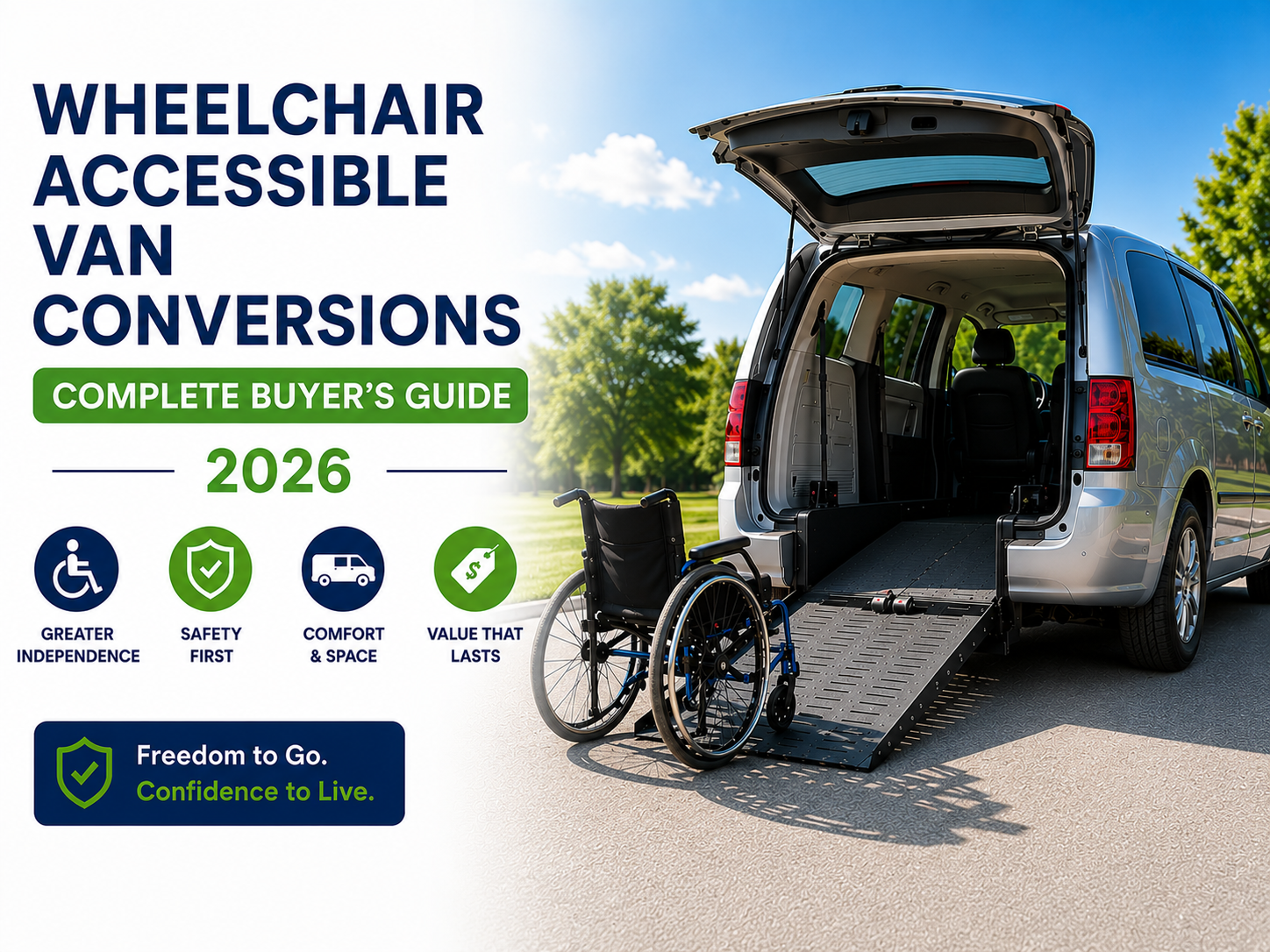
Lowered-floor minivan conversions are the most popular choice for power wheelchair users in the United States. The floor of the rear cargo area and passenger section is lowered — typically by 10–14 inches — creating sufficient ceiling clearance for most power wheelchair users to enter and remain seated comfortably inside the van at full height. Entry is via a fold-out or fold-up ramp that deploys from either the side door (side-entry) or rear (rear-entry). Most lowered-floor conversions are based on the Honda Odyssey, Chrysler Pacifica, or Toyota Sienna, though other models are used as well. The lowered floor is a structural modification that must be performed by a certified converter — it is not a dealer add-on. Leading conversion companies include BraunAbility, VMI (Vantage Mobility International), and Rollx Vans.
Full-size van conversions — typically based on Ford Transit or Ram ProMaster platforms — offer more interior space, higher weight capacity, and the ability to transport multiple wheelchair users at once, making them the standard for commercial medical transport and group settings. For personal use, full-size vans offer more room to maneuver large power chairs and can accommodate taller users or those who cannot lower their headrests. They do not typically require a lowered floor because the standard cargo van floor height, combined with a ramp, provides adequate entry for most wheelchairs. Full-size van conversions are popular with families who need to transport a wheelchair user regularly, medical transport services, and users of very large or heavy-duty power chairs.
Side-Entry vs. Rear-Entry Conversions
Within lowered-floor minivan conversions, the entry point — side or rear — is the most consequential choice for daily usability.
Side-entry conversions have the ramp at the sliding door, typically on the passenger side (though driver-side and in-floor versions exist). The wheelchair user enters and positions to the side of the driver seat — in the first or second row of passenger seating. Side-entry is strongly preferred for independent drivers: it allows the wheelchair to be positioned directly in the driving position, which is easier to access with hand controls and steering adaptations. Side-entry also allows the van to be parked against a curb without blocking ramp deployment, since the ramp extends to the side. The tradeoff is that a full side-entry deployment requires several feet of clearance to the side — something to consider in tight parking garages or narrow lots.
Rear-entry conversions have the ramp at the tailgate, allowing the wheelchair to be driven straight in from behind the vehicle. Rear-entry requires less side clearance to deploy but does require open space behind the vehicle — the rear ramp can block traffic in some situations. Rear-entry is generally better suited to passengers (not drivers), as the wheelchair parks further from the driver's seat. It is the typical configuration for caregiver-operated vehicles where the wheelchair user is not driving.
Ramp Types: In-Floor vs. Fold-Out
The ramp itself comes in two main configurations, each with advantages.
In-floor (under-floor) ramps retract into a compartment beneath the floor when not in use, leaving a flat floor surface in the van. This design offers the cleanest interior, better protection from weather when not deployed, and easy entry for ambulatory passengers as well as wheelchair users. In-floor ramps are available in power-operated versions that deploy and retract automatically with a remote or button. They are the premium option on most minivan conversions.
Fold-out ramps fold and unfold from inside the door opening, either in a two-fold or three-fold configuration. They are generally lighter than full in-floor systems, less mechanically complex, and easier to repair. Power fold-out ramps are also available. Some users prefer fold-out ramps for their simplicity and the slightly greater ground clearance at the top of the ramp.
Either type can be operated manually or via power drive. For users who will deploy the ramp themselves — particularly those with limited hand function — a power-operated ramp is strongly recommended.
Wheelchair Securement Systems
Once inside the vehicle, the wheelchair must be secured to prevent movement during driving or in the event of sudden stops or collisions. This is not optional — an unsecured wheelchair becomes a dangerous projectile in an accident.
The most common system is the four-point L-track tie-down: four heavy-duty straps attach to dedicated anchor points on the wheelchair frame and to L-track rails bolted to the van floor, holding the chair firmly in position. The occupant is secured separately by a shoulder-and-lap belt system attached to the vehicle or to a rear-facing anchor.
Docking or locking systems (such as the Q'Straint Q-Lock or Sure-Lock) offer a faster, one-step securement where the wheelchair rolls into a floor-mounted dock that automatically locks the chair with a single front connection. They are popular with users who transfer independently and need to secure or release the chair without assistance. However, they are wheelchair-specific — the docking bracket must be fitted to the chair — and work only on chairs with compatible frames.
Ensure that any securement system used meets WC19 (ANSI/RESNA) crash-test standards for wheelchair transportation. Your mobility dealer can advise on the appropriate system for your specific chair.
Adaptive Driving Equipment
For wheelchair users who wish to drive independently, adaptive driving equipment enables safe vehicle operation without the use of foot pedals or standard hand controls.
Hand controls — mechanical linkages that connect to the gas and brake pedals — allow the driver to accelerate and brake using hand movements. Push-pull controls (push forward to brake, pull back to accelerate) are the most common type. Electronic and servo-assisted controls exist for drivers with limited hand strength.
Spinner knobs and steering devices attach to the steering wheel and allow single-handed steering, essential for drivers who operate hand controls with the other hand.
Transfer seats rotate and extend outside the vehicle, allowing some wheelchair users to transfer into the driver seat and stow the wheelchair in the back, rather than driving from the wheelchair itself.
Reduced-effort steering and braking modifications lower the force required to steer and brake, making driving accessible to people with reduced upper body strength.
Adaptive driving equipment must be professionally fitted and adjusted, and drivers using it are typically required to complete a driving evaluation with a certified driver rehabilitation specialist (CDRS) before returning to independent driving. Your physiatrist or occupational therapist can provide a referral.
Cost and Financing
Wheelchair accessible van conversions represent a significant investment. A used converted minivan typically starts around $25,000–$35,000; a new conversion from a major manufacturer generally runs $50,000–$80,000 or more depending on features and the base vehicle. Full-size van conversions vary widely by purpose and configuration.
Several funding sources can offset the cost. Medicaid waiver programs in many states cover or contribute to accessible vehicle costs for eligible individuals. State vocational rehabilitation agencies may fund or partially fund conversions that enable a person with a disability to work. The U.S. Department of Veterans Affairs covers accessible vehicles and adaptive equipment for eligible veterans. Nonprofit organizations including the Automotive X PRIZE, Disabled American Veterans, and many local foundations offer grants. Some states have vehicle modification programs through their departments of health or disability services. Manufacturer programs — BraunAbility, VMI, and others operate financing and grant-referral programs — are also worth exploring.
The federal tax credit for automobile modifications (as a medical expense) may apply to some conversion costs; consult a tax professional for guidance specific to your situation.
Choosing a Dealer: Why NMEDA Membership Matters
The National Mobility Equipment Dealers Association (NMEDA) is the industry association for adaptive vehicle dealers and converters. NMEDA's Quality Assurance Program (QAP) sets safety and installation standards that member dealers must meet and maintain through audits. Choosing an NMEDA QAP-certified dealer provides meaningful assurance that the conversion will be installed correctly, that the equipment meets published safety standards, and that the dealer has the training and support infrastructure to stand behind the product. Use the NMEDA dealer locator at nmeda.com to find certified dealers in your region.
A reputable dealer will conduct an in-person assessment with the wheelchair user before recommending a conversion. This assessment evaluates the wheelchair type and dimensions, the user's physical abilities and transfer needs, intended use (driver or passenger), and budget. A conversion that is not matched to the specific user and wheelchair may be unsafe or unusable — in-person assessment is essential.
Maintenance and Long-Term Costs
Accessible vehicle conversions require regular maintenance beyond standard vehicle service. Ramp mechanisms, securement systems, hand controls, and other adaptive equipment should be inspected annually (or per the manufacturer's recommendation) by a certified mobility dealer. Ramp mechanisms in particular — exposed to the elements with every deployment — are subject to wear on cables, rollers, and motors. Preventive maintenance is far less costly than emergency repair.
Extended warranties on the conversion components (separate from the vehicle manufacturer's warranty) are offered by most major conversion companies and are generally worth the cost given the expense of the equipment.
Mobility Accessories and Aids at AllCare Store
Accessible transportation is one piece of the mobility picture. At AllCare Store, we carry a full range of mobility aids and accessories to support independent living: wheelchairs and wheelchair accessories, wheelchair cushions, mobility scooters, walkers and rollators, and a wide selection of mobility and transportation products. Free shipping on every order. Call us at 1-888-889-6260 for personalized guidance.
Frequently Asked Questions: Wheelchair Accessible Van Conversions
What is the difference between a side-entry and rear-entry wheelchair van?
In a side-entry conversion, the ramp deploys from the sliding side door, and the wheelchair user enters from the side. This configuration is strongly preferred for independent drivers because the chair can be positioned directly in the driving position. It requires side clearance for ramp deployment but can be parked at a curb without issue. In a rear-entry conversion, the ramp deploys from the tailgate and the chair enters from behind the vehicle. Rear-entry works well for passengers and caregiver-operated vehicles and requires less side clearance, but needs open space behind the van when loading and unloading.
Can I get a wheelchair accessible van through insurance or government programs?
Funding sources vary by state and individual eligibility. Medicaid waiver programs in many states cover or contribute to accessible vehicles for eligible individuals. State vocational rehabilitation agencies may fund conversions that enable employment. The VA covers accessible vehicles and adaptive equipment for qualifying veterans. Various nonprofit foundations offer grants. Auto manufacturer programs (BraunAbility, VMI) have their own financing and grant-referral services. Consult a certified mobility dealer, your state's vocational rehabilitation office, or a social worker specializing in disability services to identify funding options for your specific situation.
How do I know if a van conversion is safe?
Work with an NMEDA QAP-certified dealer — NMEDA's Quality Assurance Program requires members to meet and maintain specific installation and safety standards, verified through audits. Confirm that any ramp and securement equipment meets published ANSI/RESNA or relevant federal safety standards. Ensure the wheelchair itself is certified to WC19 (ANSI/RESNA) transportation standards if you will be riding in it while the vehicle is moving — not all wheelchairs are crash-tested for vehicle transport. Have adaptive driving equipment professionally fitted and complete a formal driving evaluation with a certified driver rehabilitation specialist before driving independently.
What is the average cost of a wheelchair accessible van?
Costs vary significantly based on the vehicle, conversion type, and features. Used converted minivans typically start around $25,000–$35,000. New lowered-floor minivan conversions from major manufacturers generally run $50,000–$80,000 or more. Full-size van conversions vary widely. Additional adaptive driving equipment (hand controls, steering aids) adds to the total. Many buyers use a combination of personal funds, financing, and funding programs to manage the cost. Getting quotes from multiple NMEDA-certified dealers and asking specifically about available funding assistance is the best approach.