Note: This article is for informational and educational purposes only. It does not constitute medical advice. If you have wrist pain, numbness, or tingling, consult your physician or a hand specialist for proper diagnosis and a personalized treatment plan before self-treating.
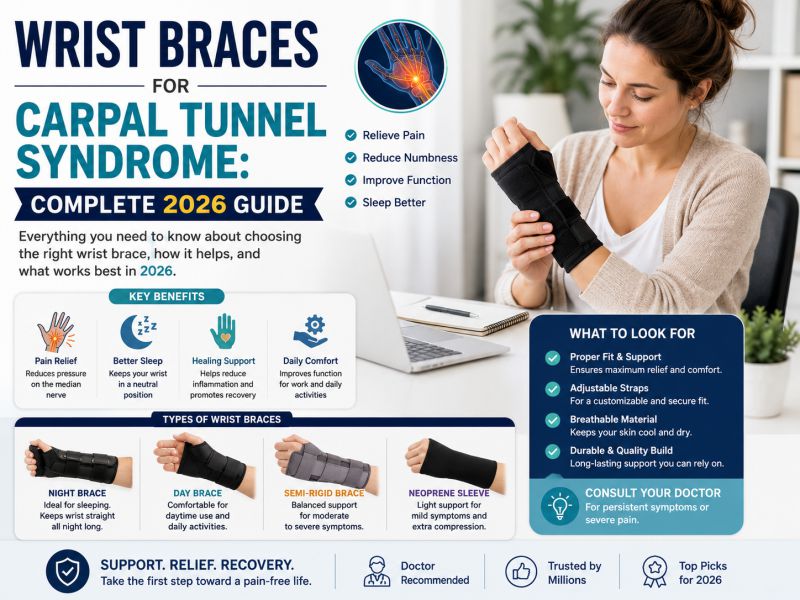
Wrist Braces for Carpal Tunnel Syndrome: Complete 2026 Guide
The Numbness That Woke Her Up
Sandra, 54, noticed it first as tingling in her thumb and index finger during her morning drive to work. Within a month she was waking at 2 AM with her entire hand numb, shaking it out over the side of the bed until the sensation returned. Her primary care physician diagnosed carpal tunnel syndrome and suggested she start with nighttime wrist splinting before considering corticosteroid injections or surgery. Three weeks into wearing a wrist brace at night, Sandra slept through the night for the first time in months.
Her experience reflects the research: wrist braces are among the most effective conservative treatments for mild to moderate carpal tunnel syndrome, and nighttime bracing is often the first and most impactful intervention. Understanding why braces work, which design to choose, and how to use them correctly makes the difference between meaningful relief and a brace that sits unused in a drawer.
What Is Carpal Tunnel Syndrome?
The carpal tunnel is a narrow passageway in the wrist formed by eight small carpal bones on three sides and the transverse carpal ligament (flexor retinaculum) on the palm side. Through this tunnel pass the median nerve and nine flexor tendons that control finger movement.
Carpal tunnel syndrome (CTS) occurs when the median nerve is compressed within this passageway. The compression reduces nerve conduction velocity, producing the characteristic symptoms: tingling and numbness in the thumb, index, middle, and radial half of the ring finger (the area served by the median nerve); a deep aching pain in the wrist and forearm; and in more advanced cases, weakness of the thenar muscles at the base of the thumb, leading to difficulty with fine motor tasks like buttoning shirts or picking up small objects.
Symptoms are often worse at night because lying down causes fluid redistribution toward the extremities, and because most people unknowingly sleep with their wrists flexed — both factors increase carpal tunnel pressure and worsen nerve compression. This is why nighttime bracing is so effective: it prevents the wrist positions that are most damaging to the compressed nerve during the hours when you have no conscious control over your wrist position.
CTS is the most common peripheral nerve compression disorder, affecting approximately 3–6% of adults. It is more common in women, people with diabetes, thyroid disorders, rheumatoid arthritis, and those whose work involves prolonged wrist flexion, repetitive hand motions, or vibrating tools.
How Wrist Braces Work for Carpal Tunnel
Wrist braces for carpal tunnel work through one primary mechanism: maintaining the wrist in a neutral position (approximately 0–10 degrees of extension) that minimizes pressure within the carpal tunnel.
Research using carpal tunnel pressure measurement devices shows that pressure within the tunnel varies dramatically with wrist position:
- Neutral wrist position: approximately 2–10 mmHg (baseline)
- Full wrist flexion (bent downward): 47–90 mmHg
- Full wrist extension (bent upward): 30–52 mmHg
The pressure at full flexion can exceed 90 mmHg — higher than diastolic blood pressure and sufficient to significantly impair nerve blood flow and conduction. A properly fitted wrist brace prevents both extremes and keeps pressure near the minimum. Over time, this reduced pressure allows the inflamed median nerve sheath to recover, nerve conduction velocity to improve, and symptoms to diminish.
Bracing also provides a secondary benefit during daytime use: it reduces the range of motion available for repetitive wrist movements that may aggravate the condition, and reminds the wearer to modify activities that worsen symptoms.
Types of Wrist Braces for Carpal Tunnel
Nighttime Wrist Splints
The workhorse of CTS conservative treatment. These braces feature a palmar stay — a rigid metal or plastic rod that runs along the inner wrist — that maintains neutral wrist position and prevents the unconscious flexion that occurs during sleep. They typically extend from mid-forearm to just below the knuckles, leaving the fingers free.
Best for: Nighttime use, early-to-moderate CTS, the primary evidence-backed first-line conservative treatment.
What to look for: Moldable metal palmar stay (can be shaped to your exact wrist contour), breathable fabric (cotton-lined or moisture-wicking — you'll be wearing this for 6–8 hours), adjustable straps that allow a firm but not constricting fit, and a size that keeps your wrist neutral without forcing it into extension. A neutral position feels natural; if the brace holds your wrist bent backward, the stay needs adjustment.
Daytime Functional Wrist Braces
Designed for daytime wear during activities that aggravate CTS. These typically have a lower-profile palmar stay or a softer semi-rigid support, allowing greater functional use of the hand while still limiting extreme wrist positions. Some are designed specifically for computer use or for particular occupational tasks.
Best for: Workers whose job requires hand use but whose wrist position can be moderated, people with moderate CTS who need support during the day as well as at night, activities that provoke symptoms (driving, typing, prolonged gripping).
What to look for: Low-profile design that doesn't interfere with work tasks, breathable or moisture-wicking materials for extended wear, strapping that can be adjusted as the day progresses and swelling changes.
Compression Wrist Wraps
Elastic wraps or pull-on sleeves that provide compression without a rigid stay. These are not specifically designed for CTS — they lack the neutral positioning mechanism that makes splints effective for carpal tunnel. However, they may provide some benefit for associated wrist pain and are better tolerated for activities where a rigid stay is too restrictive.
Best for: Mild wrist pain and swelling, activities where a rigid stay isn't feasible, use alongside a proper CTS splint (not as a replacement for nighttime splinting).
Custom-Fabricated Orthoses
Made by occupational therapists or hand therapists using low-temperature thermoplastic materials, custom orthoses are molded directly to your wrist for a precise fit. They are significantly more expensive than prefabricated braces but offer better fit for unusual wrist anatomy, better compliance in patients who find prefabricated braces uncomfortable, and can be adjusted over time as the clinical picture changes.
Best for: Patients who have not responded to prefabricated braces, post-surgical bracing, severe or complex CTS, patients with rheumatoid arthritis or other conditions affecting wrist anatomy.
The Evidence Base: What Research Says
Wrist splinting for carpal tunnel has been extensively studied. Key findings from published research:
A Cochrane systematic review of conservative treatments for CTS found that short-term splinting significantly improves symptoms and nerve conduction compared to no treatment or placebo, particularly for mild to moderate disease. A 2023 meta-analysis in the Journal of Hand Surgery confirmed that full-time splinting produces greater symptom improvement than nighttime-only splinting in the short term, though nighttime-only splinting showed better long-term compliance.
Comparison to surgery: for mild to moderate CTS, conservative treatment including splinting produces results comparable to surgery at one-year follow-up, though surgery is more durable for severe disease with significant muscle wasting. The 2002 CTSG Randomized Trial and subsequent studies confirm that a trial of conservative management is appropriate before surgical referral for most patients.
Key practical implication: splints work best for mild to moderate CTS. Severe disease with thenar muscle wasting (weakness and atrophy of the thumb base muscles) generally requires surgical decompression, as the nerve damage is too advanced for conservative measures to reverse.
How to Fit and Wear Your Wrist Brace Correctly
Correct fit is essential for both effectiveness and comfort. A brace worn incorrectly provides inadequate therapeutic benefit and is more likely to be abandoned.
Sizing: Most wrist braces are sized by wrist circumference, measured at the narrowest point just below the wrist bones (styloid processes). Measure with a tape measure and compare against the manufacturer's size chart — sizing varies significantly between brands. If between sizes, choose the larger size for more adjustability.
Left vs. right: Most wrist braces are side-specific. Make sure you order the correct side — wearing the wrong side rotates the palmar stay to an incorrect position.
Palmar stay adjustment: Metal palmar stays can be bent by hand to conform to your exact wrist contour. The stay should support the wrist in a neutral position — your wrist should feel straight, not bent in either direction. If the stay is pressing uncomfortably against your wrist, bend it slightly to match your anatomy.
Strap tightness: The brace should be firm but not compressive. You should be able to slip one finger under each strap. Straps that are too tight can actually increase carpal tunnel pressure by compressing superficial structures. If your fingers become more numb or tingling worsens after putting the brace on, loosen the straps or check the palmar stay position.
Wearing schedule: For nighttime bracing, wear the brace every night consistently. For daytime use, wear it during activities that provoke symptoms. Most hand therapists recommend a minimum 6–8 week trial before assessing effectiveness — CTS improvements develop gradually as nerve inflammation resolves.
Complementary Treatments to Use Alongside Bracing
Bracing is most effective as part of a broader management strategy:
Activity modification: Identify and reduce activities that worsen symptoms — prolonged wrist flexion (including sleeping with hands under your face), repetitive gripping, and vibrating tools. Ergonomic keyboard trays that allow neutral wrist positioning during computer work, and split keyboards that reduce ulnar deviation, can meaningfully reduce cumulative CTS aggravation.
Nerve gliding exercises: Specific hand and wrist exercises designed to mobilize the median nerve within the carpal tunnel and reduce adherence of the nerve sheath to surrounding tissue. Research suggests nerve gliding exercises combined with bracing produce better outcomes than bracing alone. A hand therapist can teach these exercises, or a physical therapist specializing in upper extremity conditions can provide a guided program.
Corticosteroid injections: For moderate CTS not responding to bracing, a corticosteroid injection into the carpal tunnel provides rapid symptom relief in most patients. Relief typically lasts 3–6 months and can be repeated; injections are often used as a bridge to surgery or to confirm the CTS diagnosis (if an injection provides complete relief, it confirms median nerve compression is the source of symptoms).
Physical therapy and occupational therapy: An occupational therapist specializing in hand therapy can provide custom orthoses, ergonomic assessment, nerve mobilization, and a structured conservative treatment program. This is particularly valuable for occupational CTS where workplace factors are a primary contributor.
Browse our physical therapy and recovery collection for wrist braces and upper extremity support products.
When to Seek Medical Evaluation
A wrist brace is an appropriate first step for suspected mild CTS. However, you should see a physician if:
- You haven't yet received a formal CTS diagnosis — other conditions (thoracic outlet syndrome, cervical radiculopathy, pronator teres syndrome) can cause similar symptoms
- Symptoms are severe — significant weakness, inability to grip, or constant (not just nighttime) numbness
- Thenar muscle wasting is visible (flattening at the base of the thumb) — this indicates advanced nerve damage requiring prompt evaluation
- Symptoms don't improve after 6–8 weeks of consistent bracing
- Symptoms are worsening despite treatment
- You have diabetes or thyroid disease and new hand/wrist symptoms (these conditions increase CTS risk and alter treatment considerations)
Shop Wrist Braces and Physical Therapy Supplies at AllCare Store
AllCare Store carries a comprehensive selection of wrist braces, splints, and physical therapy supplies for carpal tunnel management and upper extremity recovery. Browse our physical therapy and recovery collection and our pain relief collection to find the right support for your needs.
- Free Shipping on every order — no minimum required
- Discreet Packaging — all orders arrive in plain, unmarked packaging
- 30-Day Returns — shop with confidence
- Expert Help — reach our team at 1-888-889-6260, Monday–Friday 7 AM–4 PM CST
Frequently Asked Questions: Wrist Braces for Carpal Tunnel
Do wrist braces actually help carpal tunnel syndrome?
Yes — wrist splinting is one of the most evidence-backed conservative treatments for mild to moderate carpal tunnel syndrome. Multiple randomized controlled trials and systematic reviews confirm that nighttime wrist splinting significantly improves CTS symptoms compared to no treatment. The mechanism is straightforward: the brace maintains the wrist in a neutral position that minimizes pressure within the carpal tunnel, reducing compression on the median nerve. This allows nerve inflammation to resolve and conduction to improve. Results require consistent use for 6–8 weeks before full benefit is seen.
Should I wear a wrist brace for carpal tunnel all day or just at night?
Nighttime-only splinting is the standard first approach and is effective for most patients with mild to moderate CTS. The rationale is that wrist flexion during sleep is a primary CTS aggravator and the time when you have no conscious control over wrist position. Research shows full-time splinting (day and night) produces faster symptom improvement in the short term, but nighttime-only splinting has better long-term compliance — a brace worn consistently at night outperforms a brace worn inconsistently all day. For patients with occupational CTS or severe daytime symptoms, adding daytime bracing during aggravating activities provides additional benefit. Your physician or hand therapist can guide the appropriate schedule for your severity.
How long does it take for a wrist brace to help carpal tunnel?
Many people notice reduction in nighttime symptoms (the waking with numbness) within the first 2–3 weeks of consistent nighttime bracing. Improvement in daytime tingling and overall nerve function typically develops over 6–12 weeks of sustained use. Give a wrist brace a full 6–8 week trial before concluding it isn't working — nerve recovery is gradual. If there's no improvement after 8 weeks of consistent use, this is an indication to return to your physician for further evaluation and consideration of corticosteroid injection or surgical consultation.
What is the correct wrist position for a carpal tunnel brace?
The correct position is neutral — approximately 0–10 degrees of wrist extension, meaning the wrist is in line with the forearm or very slightly extended. This is the position that minimizes pressure within the carpal tunnel. A common mistake is wearing a brace that holds the wrist in too much extension (bent backward), which actually increases carpal tunnel pressure rather than reducing it. If your brace has a moldable metal palmar stay, bend it to conform precisely to your wrist in a neutral, comfortable position. The wrist should feel straight, not forced in any direction.
Can carpal tunnel be treated without surgery?
Yes — for mild to moderate CTS, conservative treatment is the appropriate first-line approach. This includes wrist splinting (especially nighttime), activity modification to reduce aggravating wrist positions, nerve gliding exercises, and when needed, corticosteroid injections into the carpal tunnel. Research shows that conservative management produces outcomes comparable to surgery at one-year follow-up for mild to moderate disease. Surgery (carpal tunnel release) is generally recommended for severe CTS with significant muscle wasting and weakness, for patients who have failed adequate conservative treatment over 3–6 months, or when nerve conduction studies show severe median nerve damage. A hand surgeon can help you determine where your condition falls on this spectrum.