Note: This article is for informational and educational purposes only. It does not constitute medical advice. If you have specific skin conditions such as rosacea, eczema, or a history of skin cancer, consult your dermatologist before changing your skincare routine.
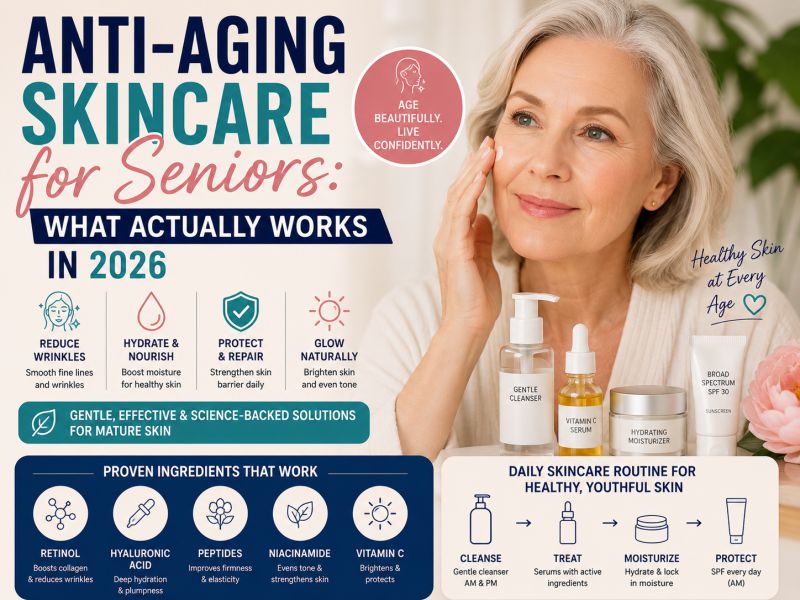
Anti-Aging Skincare for Seniors: What Actually Works in 2026
Why Skincare Needs Change After 60
Margaret, 72, had used the same moisturizer for twenty years. When her granddaughter suggested she try the anti-aging serum she'd seen advertised, Margaret tried it — and her face turned red and peeled for a week. The serum was formulated with a high concentration of glycolic acid, appropriate for someone in their 40s with oil-prone skin, but far too aggressive for skin that had thinned and lost much of its lipid barrier over the decades.
This story captures the central challenge of anti-aging skincare for older adults: most products marketed as anti-aging are designed for people trying to prevent aging signs, not manage skin that has undergone decades of structural change. Understanding how skin actually changes with age — and what ingredients work with those changes rather than against them — is the foundation of an effective routine after 60.
How Skin Changes with Age
Several physiological changes alter how older skin looks, feels, and responds to products:
Reduced collagen and elastin production: Collagen production declines by approximately 1% per year after age 20. By the 60s and 70s, the dermis (the skin's structural layer) has lost significant volume and elasticity, leading to visible wrinkles, sagging along the jawline and neck, and a loss of the plumpness that gives younger skin its appearance. Elastin degradation contributes to skin that doesn't spring back when pressed.
Thinning epidermis: The outermost skin layer becomes thinner with age, making capillaries more visible, bruising easier, and skin more fragile. Cell turnover slows from approximately 28 days in youth to 45–60 days by the 60s, meaning dead cells accumulate on the surface longer, contributing to a dull complexion.
Reduced oil and lipid production: Sebaceous glands produce less oil, and the skin's natural lipid barrier weakens. This causes increased transepidermal water loss (TEWL) — the skin can't retain moisture as effectively, leading to chronic dryness, flakiness, and a tight or itchy feeling that worsens in winter or low-humidity environments.
Decreased moisture retention: Hyaluronic acid levels in the dermis decline significantly with age. Since hyaluronic acid can hold up to 1,000 times its weight in water, this decline directly reduces the skin's ability to stay plump and hydrated regardless of how much water you drink.
Accumulated UV damage: Decades of sun exposure cause the majority of the visible aging signs most people notice — dark spots (hyperpigmentation), uneven texture, and a leathery appearance. This photoaging accumulates over a lifetime and is the primary driver of premature aging in most adults.
Hormonal changes: Menopause causes a significant drop in estrogen, which further accelerates collagen loss, reduces skin thickness, and decreases moisture. Many postmenopausal women notice accelerated skin changes in the years following menopause.
The Ingredients That Actually Work
Dermatology research has identified a relatively small set of ingredients with genuine, evidence-backed benefits for aging skin. For seniors, the key is choosing these ingredients in formulations and concentrations appropriate for mature, sensitive skin.
Retinoids (Retinol, Retinaldehyde)
Retinoids remain the most extensively studied topical anti-aging ingredients. Derived from vitamin A, they work by binding to retinoic acid receptors in skin cells, stimulating collagen production, accelerating cell turnover, and reducing the appearance of fine lines, wrinkles, and age spots. Decades of peer-reviewed research support their efficacy.
For seniors, the key consideration is starting low and going slow. Older skin is more prone to retinoid irritation — redness, peeling, and sensitivity — especially with high-percentage formulations. Begin with 0.025% to 0.05% retinol, applied every third night, and gradually increase frequency over several months as tolerance builds. Encapsulated retinol formulations release the active ingredient more slowly and are significantly gentler. Prescription tretinoin (the most potent form) is effective but requires dermatologist supervision for older adults, who are more likely to experience irritation.
Always apply retinol at night and use broad-spectrum SPF the following morning — retinoids increase photosensitivity. And expect a 3–6 month commitment before seeing results; retinoids require sustained use to produce visible collagen changes.
SPF (Sun Protection Factor)
Sunscreen is the most impactful anti-aging product available at any age. For seniors, daily SPF use serves two critical purposes: preventing further photoaging from ongoing UV exposure, and protecting skin that is now more vulnerable to UV-induced damage including skin cancer. People over 65 have the highest rates of melanoma of any age group.
Use a broad-spectrum SPF 30 or higher every morning, year-round, regardless of cloud cover. Mineral sunscreens (zinc oxide, titanium dioxide) are generally better tolerated by sensitive older skin than chemical UV filters and are less likely to cause irritation or clog pores. Apply sunscreen as the last step of your morning routine, after moisturizer.
Look for our personal care collection for sun protection and skincare products appropriate for mature skin.
Hyaluronic Acid
Hyaluronic acid (HA) is a humectant — it draws moisture from the environment and deeper skin layers to the surface, providing immediate plumping and hydration. Applied topically in serum form, it temporarily reduces the appearance of fine lines by filling them with water, and improves overall skin texture and suppleness.
Importantly, HA is one of the gentlest active ingredients available. It causes virtually no irritation, is appropriate for all skin types including rosacea-prone and extremely sensitive skin, and can be layered with other actives like retinol. For seniors who find retinoids irritating, hyaluronic acid provides meaningful visible improvement with essentially no downside.
Apply HA serum to slightly damp skin (spritz your face with water first, or apply immediately after cleansing) to maximize its moisture-drawing capacity, then seal it in with a moisturizer.
Niacinamide (Vitamin B3)
Niacinamide has become one of dermatology's most recommended multi-tasking ingredients. For aging skin, it reduces the appearance of dark spots and hyperpigmentation by inhibiting melanosome transfer, strengthens the skin's lipid barrier (addressing the dryness and sensitivity common in older skin), minimizes the appearance of enlarged pores, and has mild anti-inflammatory properties that calm irritated skin.
It is also exceptionally well-tolerated — gentler than retinol, vitamin C, or AHAs. Concentrations of 5–10% are effective without causing irritation, and niacinamide layers well with nearly every other skincare ingredient. For seniors looking for a simple, low-irritation routine, a niacinamide serum addresses multiple aging concerns simultaneously.
Vitamin C (Ascorbic Acid)
Vitamin C is a potent antioxidant that neutralizes free radicals from UV exposure and pollution, stimulates collagen synthesis, and brightens uneven skin tone and hyperpigmentation. When applied in the morning under sunscreen, it provides an additional layer of photoprotection and helps prevent the further accumulation of UV damage.
The challenge with vitamin C is stability and tolerance. Pure ascorbic acid formulations (the most effective form) are unstable and can oxidize quickly, becoming ineffective — a vitamin C serum that has turned yellow or orange has largely lost its potency. For sensitive older skin, look for formulations at 10–15% ascorbic acid with a pH of 3–3.5, or consider more stable derivatives such as ascorbyl glucoside, which is gentler and remains effective over a longer shelf life. Refrigerating opened vitamin C serums extends their shelf life.
Peptides
Peptides are short chains of amino acids that signal skin cells to produce more collagen and other structural proteins. While their effects are more modest than retinoids, they are significantly gentler — making them an excellent choice for seniors who cannot tolerate retinol, or as a complementary ingredient used alongside retinol on alternate nights.
Look for formulations containing palmitoyl pentapeptide-4 (Matrixyl), copper peptides, or argireline (acetyl hexapeptide-3), which have the most published research support. Peptide serums and creams are well-tolerated across all skin types and cause virtually no irritation.
Ceramides
Ceramides are lipid molecules that make up a large portion of the skin's natural barrier. Their concentration decreases significantly with age, contributing to dryness, sensitivity, and increased permeability that allows irritants to penetrate more easily. Moisturizers containing ceramides help restore this barrier, reducing moisture loss, calming sensitive or reactive skin, and improving the skin's resilience to external irritants.
Ceramide-rich moisturizers are particularly important for seniors, whose compromised lipid barrier is the underlying cause of much of the dryness and sensitivity they experience. They can be used morning and night and are appropriate even for the most sensitive skin.
What to Avoid for Aging Skin
Just as important as what to use is understanding what tends to cause more harm than benefit for older skin:
High-concentration AHAs/BHAs: Glycolic acid, lactic acid, and salicylic acid are effective exfoliants, but concentrations above 5–10% can be too aggressive for mature, thin skin. If you use acids, start with low concentrations (5% lactic acid is gentler than 10% glycolic acid) and use them no more than twice weekly.
Fragranced products: Fragrance is the leading cause of contact dermatitis in skincare. As skin becomes more permeable with age, sensitivity to fragrance (both synthetic and natural botanical extracts) increases. Opt for fragrance-free formulations for all core products — cleanser, moisturizer, and sunscreen at minimum.
Alcohol-heavy toners and astringents: Products with denatured alcohol (often listed as alcohol denat. or SD alcohol) as a primary ingredient strip the skin's natural oils, worsening the dryness and barrier disruption that's already a concern in older skin. Avoid these entirely.
Multiple new products at once: Introducing several new products simultaneously makes it impossible to identify which one caused a reaction. Introduce one new product at a time, waiting 2–3 weeks before adding another.
A Simple, Effective Routine for Seniors
The most effective routine is one simple enough to follow consistently. For most seniors, a streamlined routine beats a complex one:
| Step | Morning | Evening |
|---|---|---|
| 1. Cleanse | Gentle, fragrance-free cream or gel cleanser | Same cleanser (or micellar water if skin is very dry) |
| 2. Treat | Vitamin C serum (10–15%) or niacinamide serum | Retinol (start 0.025–0.05%, 2–3 nights/week) or peptide serum |
| 3. Hydrate | Hyaluronic acid serum on damp skin | Hyaluronic acid serum on damp skin |
| 4. Moisturize | Ceramide-rich moisturizer | Richer ceramide cream (a heavier texture is fine at night) |
| 5. Protect | Mineral SPF 30+ (last step, every day) | — |
If this feels like too many steps, a minimum effective routine is: gentle cleanser + ceramide moisturizer + SPF 30 in the morning, and gentle cleanser + ceramide moisturizer (+ retinol a few nights per week when tolerated) in the evening. Consistency with a simple routine beats occasional use of a complex one.
Addressing Specific Concerns
Dark spots and hyperpigmentation: The most effective combination is daily SPF (prevents new spots forming), niacinamide (fades existing spots), and retinol (accelerates cell turnover, helping the discolored cells shed faster). Vitamin C adds additional brightening. Patience is essential — fading established dark spots takes 3–6 months of consistent treatment.
Deep wrinkles and volume loss: Topical products can reduce fine lines meaningfully but cannot restore lost volume. For significant volume loss, sagging, or deep wrinkles, dermatological procedures (fillers, laser, radiofrequency treatments) are more effective than any topical product. If wrinkles are a primary concern, a consultation with a board-certified dermatologist is worthwhile.
Extreme dryness and flakiness: Focus on barrier repair first — ceramide moisturizers, gentle cleansers, and avoiding hot water (which strips natural oils). Consider adding a few drops of facial oil (squalane or rosehip seed oil are non-comedogenic options) on top of moisturizer on the driest days. Use a humidifier in winter to counteract indoor heating dryness.
Neck and décolletage: These areas age faster than the face and are often neglected. Extend your entire routine — cleanser, serums, moisturizer, and SPF — down to the neck and chest. The skin here is thinner and more fragile, so be especially gentle with actives.
When to See a Dermatologist
While a good at-home routine makes a meaningful difference, some concerns warrant professional evaluation:
- Any new or changing moles, spots, or lesions (annual skin cancer screenings are recommended for all adults over 50)
- Severe dryness or itching that doesn't respond to moisturizers (may indicate eczema, psoriasis, or a systemic condition)
- Persistent redness or flushing (may indicate rosacea, which responds well to prescription treatments)
- Significant cosmetic concerns (deep wrinkles, volume loss, laxity) that topical products cannot adequately address
Shop Skincare and Personal Care at AllCare Store
AllCare Store carries a wide range of personal care and wellness products to support healthy aging. Browse our personal care collection and health and wellness collection for products suited to your needs.
- Free Shipping on every order — no minimum required
- Discreet Packaging — all orders arrive in plain, unmarked packaging
- 30-Day Returns — shop with confidence
- Expert Help — reach our team at 1-888-889-6260, Monday–Friday 7 AM–4 PM CST
Frequently Asked Questions: Anti-Aging Skincare for Seniors
What is the most effective anti-aging ingredient for seniors?
Retinoids (retinol and prescription tretinoin) have the strongest evidence base for reducing wrinkles, improving skin texture, and stimulating collagen production. Sunscreen (SPF 30+) is arguably even more important because it prevents further photoaging, which is the primary driver of visible skin aging. For seniors who cannot tolerate retinoids due to irritation, niacinamide and hyaluronic acid provide meaningful benefits with essentially no side effects. A combination of daily SPF, a gentle retinol used a few nights per week, and a ceramide moisturizer covers the most evidence-backed bases for aging skin.
Is retinol safe for seniors with sensitive skin?
Yes, with appropriate precautions. The key for seniors is starting with a very low concentration (0.025–0.05%) and using it only 2–3 nights per week initially, increasing frequency gradually over several months as tolerance builds. Encapsulated retinol formulations release the active ingredient more slowly and cause significantly less irritation than standard retinol. Always apply retinol to clean, dry skin, and follow with a ceramide moisturizer. If irritation persists, try applying moisturizer first and then retinol on top (the "buffering" technique), or switch to retinaldehyde, which is gentler. Most seniors can eventually tolerate retinol with a careful introduction protocol.
Do I really need to wear sunscreen every day as a senior?
Yes — this matters even more as you get older, not less. Adults over 65 have the highest rates of skin cancer of any age group. Ongoing UV exposure continues to cause photoaging and skin damage regardless of what damage has already accumulated. Daily SPF 30+ prevents new dark spots, reduces continued collagen degradation from UV, and is the most important thing you can do to protect skin health in later life. Apply it every morning, year-round, even on cloudy days and even if you spend most of your time indoors — windows do not block all UV radiation.
How can seniors treat dark spots on the face?
The most effective over-the-counter approach combines: daily broad-spectrum SPF (to prevent new spots), niacinamide serum at 5–10% (to fade existing spots by reducing pigment transfer), and retinol used a few nights per week (to accelerate turnover of the discolored cells). Vitamin C serum in the morning adds additional brightening and pairs well with SPF. Results require 3–6 months of consistent use. For stubborn or extensive hyperpigmentation, dermatological treatments (chemical peels, laser, prescription hydroquinone) are more effective and faster than topical OTC products alone.
What moisturizer ingredients are best for very dry aging skin?
For severely dry aging skin, look for moisturizers that combine all three types of moisturizing agents: humectants (hyaluronic acid, glycerin) to draw water into the skin, emollients (squalane, shea butter, jojoba oil) to smooth the skin surface and fill in the cracks between cells, and occlusives (petrolatum, dimethicone) to form a barrier that prevents moisture from evaporating. Ceramides are particularly important for restoring the lipid barrier in older skin, which is a primary cause of the dryness many seniors experience. Apply moisturizer immediately after cleansing while skin is still slightly damp to maximize absorption.