In This Article
Most people who switch to a rollator hit the same wall within a week. The frame that felt so stable in the store suddenly feels like a shopping cart in a narrow kitchen. It catches on door frames, needs a three-point turn in the bathroom, and takes up half the car boot. The support is there, but the freedom is not.
A 3 wheel rollator is built for exactly that problem. By trading the fourth wheel and the seat for a narrow, triangular frame, it becomes lighter, turns in its own footprint, and slips through spaces a standard rollator cannot. This guide explains how the design works, where it performs best, which models are worth considering, and who should honestly stick with four wheels instead.
1. What Is a 3 Wheel Rollator?
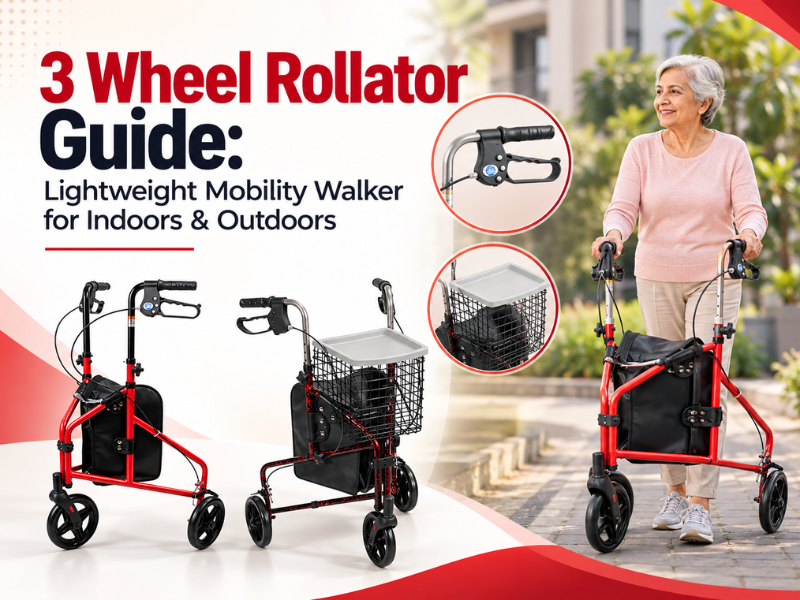
A 3 wheel rollator, sometimes called a tri-walker or trio rollator, is a wheeled walking aid with one swiveling wheel at the front and two fixed wheels at the back. The frame forms a triangle when viewed from above, with handles and hand brakes on each rear leg. Most models fold flat, carry a small bag, basket, or tray, and are made from lightweight aluminum.
Quick distinction: a 3 wheel rollator is a walking aid, not a resting aid. Almost none of them have a seat. If you need to sit down regularly while you are out, a 4 wheel rollator is the better match.
2. Why Three Wheels Move Better
A turning circle that fits real homes
With a single front wheel doing all the steering, the frame pivots almost on the spot. Turning around in a hallway, lining up with a toilet, or reversing out of a tight kitchen corner takes one smooth motion instead of a shuffle of small corrections.
A narrow nose for doorways and aisles
The triangular shape tapers at the front, so the part that leads you through a doorway is only as wide as one wheel. Older homes with narrow interior doors, crowded pharmacy aisles, and restaurant tables are all far easier to navigate.
Less weight to push, lift, and pack
No seat, no fourth leg, and no heavy crossbar means a lighter frame overall. That matters every time you lift it over a curb, load it into the car, or carry it up the two steps at your front door.
You walk inside the frame, not behind it
Because there is no seat or crossbar at the back, you can step right into the frame. This keeps the rollator close to your body, encourages a more upright stride, and stops the frame from rolling away ahead of you.
3. Indoors and Outdoors: Where It Shines
Indoors, a 3 wheel rollator handles the problem spaces: galley kitchens, bathrooms, bedroom corners, and the gap between the sofa and the coffee table. A basket or tray also turns it into a carrier, so you can move a mug of tea or a plate from room to room without letting go of your support.
Outdoors, it is at its best on pavements, parking lots, shopping malls, and park paths. Larger wheels, around 8 inches, roll over sidewalk cracks, doormats, and small thresholds much more smoothly than the small casters found on basic walkers. The folding frame is quick to pack for trips to the doctor or the grocery store.
Terrain note: a single front wheel carries more of the load on rough ground. On gravel, deep grass, steep slopes, or broken paving, take it slowly and keep both hands on the brakes. If most of your walking is on this kind of surface, a 4 wheel all-terrain model is the safer choice.
4. 3 Wheel Rollators Worth a Look
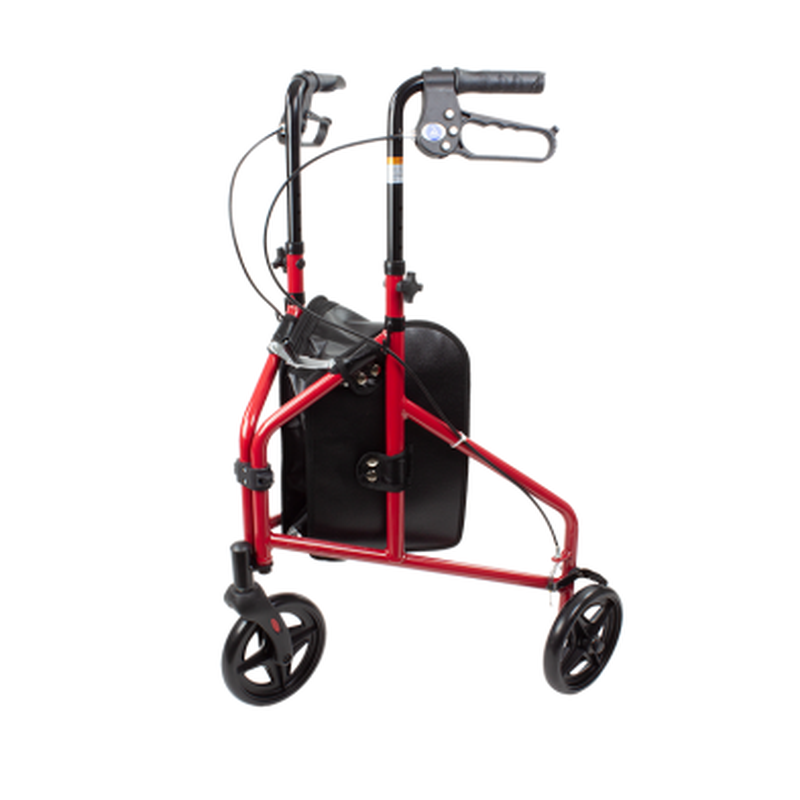
The Dynarex DynaGo Zoom 3-Wheel Rollator is the pick for people whose main struggle is space. Its lightweight aluminum frame and compact three-wheel layout give it a tight turning radius built for doorways, hallways, and shopping aisles. Ergonomic hand brakes keep you in control, a removable storage pouch holds your phone, keys, and wallet, and the frame folds down for travel and storage. It supports up to 250 pounds and is designed for smooth rolling on indoor floors and paved outdoor surfaces, which makes it a strong everyday choice for apartment living and town errands.
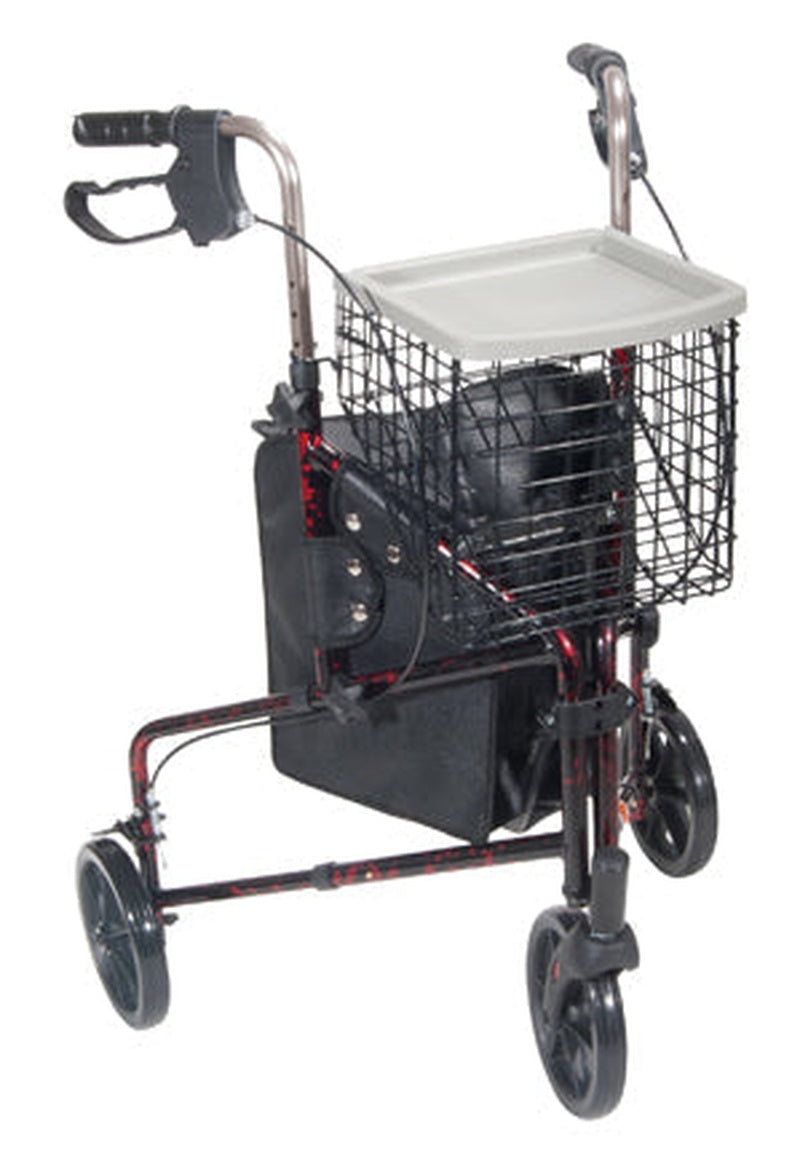
If you want more carrying capacity and a sturdier build, look at the Drive Medical 3-Wheeled Aluminum Rollator. It comes with three storage options at once: a wire basket rated to 10 pounds, a removable accessory tray, and a zippered pouch. The 8-inch soft-grip wheels roll across tile, carpet, concrete, and uneven outdoor surfaces, and the loop-lock brakes use an internal aluminum casting for a simple squeeze-to-stop action. Handles adjust for users roughly 5 feet 2 inches to 6 feet 3 inches tall, the frame supports 300 pounds, and it folds with one hand to about 10 inches wide. Drive backs the frame with a limited lifetime warranty and the brake cables with a lifetime warranty. It is available in Flame Red and Flame Blue.
5. 3 Wheel vs 4 Wheel: Which Fits You?
| Feature | 3 Wheel Rollator | 4 Wheel Rollator | Standard Walker |
|---|---|---|---|
| Turning in tight spaces | Excellent | Fair | Poor, must be lifted |
| Frame weight | Light | Moderate | Light |
| Built-in seat | No | Yes | No |
| Stability at rest | Good | Very good | Very good |
| Rough terrain | Fair | Good | Poor |
| Walking speed | Natural, continuous | Natural, continuous | Slow, step and lift |
| Best for | Small homes, errands, active users | Long outings, users who need rest | Heavy weight bearing, poor balance |
The short version: choose a 3-wheel rollator when your balance is reasonable, your home or routine involves tight spaces, and you want the lightest, most nimble option. Choose a 4-wheel rollator when you need to sit and rest, walk on rougher ground, or lean more heavily on the frame. Compare both styles side by side in our rollator collection.
6. Who Should (and Should Not) Choose One
A 3-wheel rollator is a great fit for:
- Active older adults who walk well but want steady support and less fatigue on errands
- People in small apartments or older homes with narrow doorways and tight bathrooms
- Mild arthritis in the hips or knees where a little support takes the edge off each step
- Recovery after surgery or illness once a therapist has cleared you to move beyond a standard walker
- Frequent travelers and drivers who fold and lift the frame in and out of a car several times a day
It is not the right choice for:
- Significant balance problems or frequent falls, where a wider four-point base is safer
- Heavy weight bearing through the arms, where a standard walker gives more support
- Anyone who needs to sit down often, since most 3-wheel models have no seat
- Users above the weight rating, where a bariatric rollator is required
If you are unsure, browse the full walkers and rollators range, or look at our standard walkers if you need maximum stability.
7. Fitting and Using It Safely
Set the handle height correctly
Stand upright inside the frame with your arms relaxed at your sides. The handgrips should line up with the crease of your wrist. When you hold them, your elbows should bend slightly, at around 15 to 20 degrees. Too high and your shoulders hunch; too low and you lean forward over the frame.
Test the brakes before every outing
Squeeze both brakes and push gently. The rollator should not roll. If one side slips, tighten the brake cable adjuster or ask the seller for help before you head out.
Walk inside the frame
Keep your body between the rear wheels rather than pushing the rollator out in front of you. Short, natural steps with the frame close to you keep your weight centered and reduce the chance of tipping.
Never sit or lean on it
A 3 wheel rollator is not designed to take your weight while stationary. Do not sit on it, stand on it, or use it to pull yourself up from a chair. Lock the brakes and use a solid piece of furniture instead.
Keep the load light and low
Stick to the basket or pouch rating, and never hang heavy shopping bags from the handles. Extra weight up high makes any three-point frame easier to tip.
Bottom line: if you can walk steadily and mostly want a lighter, more nimble partner for daily life, a 3 wheel rollator gives you more freedom than almost any other walking aid. If you need a seat or maximum stability, go with four wheels. And when in doubt, ask your doctor or physical therapist to watch you try one before you buy.