The 3 A.M. Problem Nobody Talks About
When people picture what changes after a hip replacement, a stroke, or the slow arrival of frailty, they usually picture the daytime: the walker in the hallway, the grab bars, the ramp at the front door. What almost nobody pictures is 3 a.m.
Consider Eleanor, 79, home four days after a hip replacement. Her bathroom is nineteen steps down a dark hallway. The urge to go wakes her at 3 a.m., and now she faces a genuinely dangerous decision: navigate nineteen steps in the dark on a new hip and heavy pain medication, or wait and risk an accident that costs her dignity. On night two she tried to make the walk, caught her foot on the rug, and grabbed the doorframe just in time. Her daughter found her the next morning shaking, having decided the safest plan was simply not to drink water after dinner — which is its own dangerous idea.
A bedside commode placed next to Eleanor's bed solved the 3 a.m. problem in a single afternoon. The nineteen-step gamble became a two-step transfer. That is the entire point of this category of equipment: it shrinks the most dangerous trip in the house down to something a recovering or aging body can do safely.
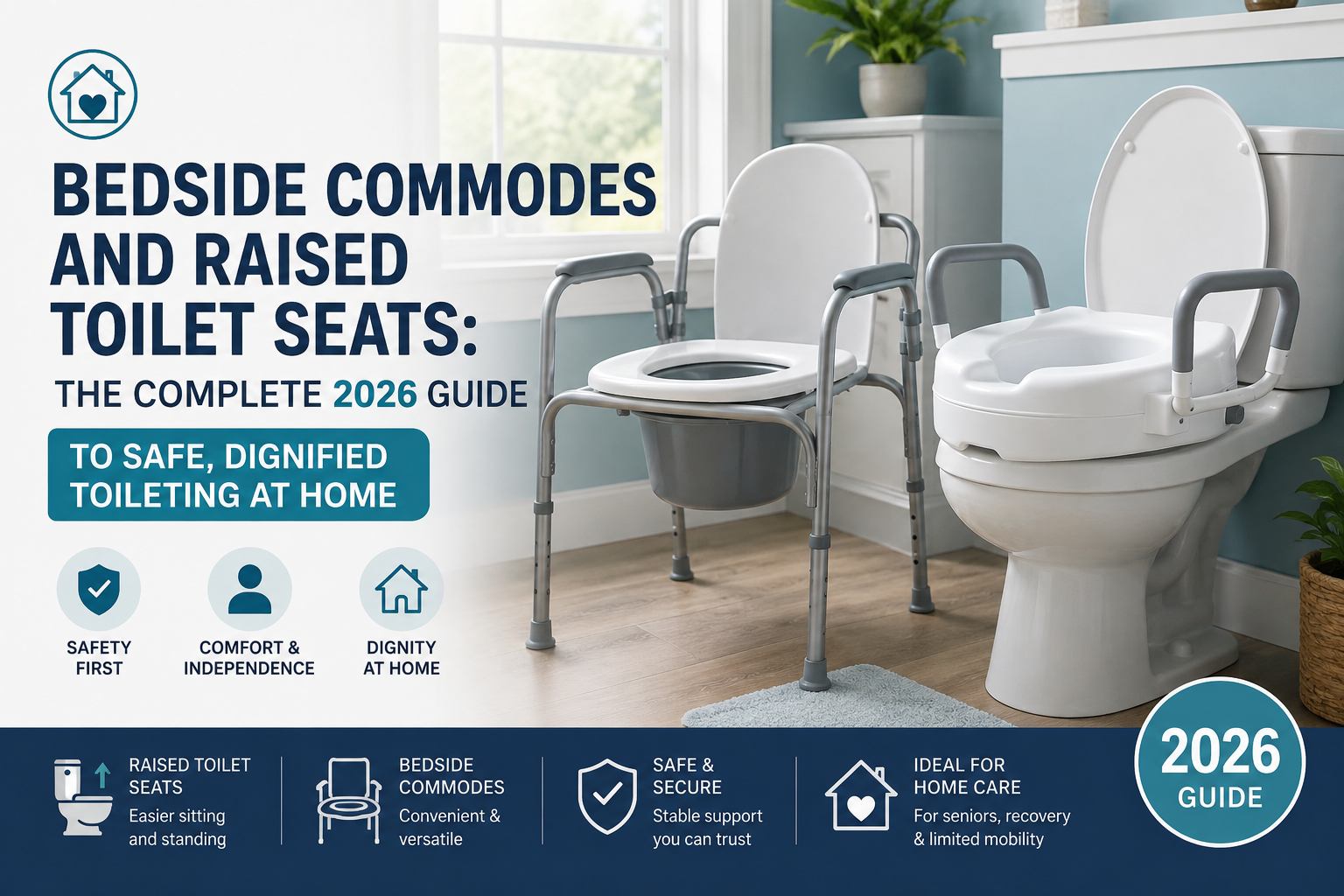
This guide covers the whole family of toileting-safety products — bedside commodes, raised toilet seats, toilet safety frames, and the versatile 3-in-1 units that do all three jobs — so you can match the right tool to the right person and set it up correctly the first time.
The Four Products, and What Each One Actually Does
These items are often lumped together, but they solve different problems. Getting the match right is most of the battle.
1. The Bedside Commode
A freestanding chair with a toilet seat, a removable bucket underneath, and armrests. It sits wherever you need it — beside the bed, in the living room during the day, or over an existing toilet. It is the answer when the real bathroom is too far, too small, or too hard to reach at night. The classic budget-friendly option is a folding steel model like the Drive Folding Steel 3-in-1 Commode, which folds flat for storage and travel. For a model-by-model comparison, see our best bedside commodes for seniors guide.
2. The Raised Toilet Seat
A seat that clamps or sits on top of your existing toilet to add roughly 3 to 6 inches of height. Standard toilets are about 15 inches tall; getting up from that low is exactly the motion that strains a new hip, a bad knee, or weak quadriceps. Adding height turns a deep, painful squat into a shallow, controllable sit-to-stand. Many raised seats include their own armrests. Our raised toilet seats buying guide compares locking, hinged, and padded options in detail.
3. The Toilet Safety Frame
A lightweight metal frame that surrounds the existing toilet to give two sturdy armrests to push up from. It adds no height on its own, so it suits someone who can lower and rise from a normal seat but needs something solid to hold instead of grabbing a towel bar or the sink — two of the most common causes of bathroom falls.
4. The 3-in-1 Commode
The Swiss Army knife of the category, and usually the smartest first purchase. The same frame works three ways: as a standalone bedside commode with the bucket; as a raised toilet seat when you remove the bucket and roll it over the real toilet; and as a toilet safety frame using its built-in armrests. Because needs change quickly during a recovery, a 3-in-1 adapts instead of being outgrown. Browse the full range in the commodes collection.
Which One Is Right? A Quick Decision Guide
| The Situation | Best Starting Point |
|---|---|
| Bathroom is far from the bed, or nighttime trips feel risky | Bedside commode (or 3-in-1) |
| Can reach the toilet but struggles to stand back up | Raised toilet seat with arms |
| Sits and rises okay but needs something sturdy to hold | Toilet safety frame |
| Needs are changing week to week during recovery | 3-in-1 commode |
| User is over 300 lbs or needs a wider seat | Bariatric commode |
| Transfers happen sideways from a wheelchair | Drop-arm commode |
Who Benefits Most
Bedside commodes and raised seats are among the highest-value, lowest-cost pieces of home medical equipment because they prevent the specific falls that send older adults back to the hospital. They are commonly recommended for:
- Post-surgical recovery — especially after hip replacement and knee replacement, where a low toilet forces exactly the joint angles surgeons tell you to avoid.
- Limited mobility and weakness from arthritis, Parkinson's, multiple sclerosis, or general deconditioning.
- Stroke recovery, where one-sided weakness makes long walks and low seats unsafe.
- Advanced age and fall risk — nighttime bathroom trips are one of the leading causes of falls in older adults.
- Heart or lung conditions where walking to a distant bathroom is exhausting.
- Hospice and end-of-life care, where comfort and dignity close to the bed matter enormously.
If falling is the underlying worry, a commode rarely stands alone. It usually pairs with grab bars and safety rails, a shower chair, and often a medical alert system for the moments no one is home.
Getting the Height Right — The Single Most Important Step
A commode or raised seat that is the wrong height is not just uncomfortable; it can be more dangerous than no equipment at all. Here is how to set it correctly.
When the person sits on the commode or raised seat, aim for this posture:
- Feet flat on the floor, not dangling and not tucked back under the frame.
- Knees roughly level with, or slightly below, the hips. If knees ride high above the hips, the seat is too low and standing will be hard.
- Thighs supported without pressure behind the knees.
- Armrests at a height that lets the elbows bend gently while pushing up — usually a little below shoulder level when seated.
Most bedside commodes adjust in 1-inch steps over a range of about 16 to 23 inches to the seat. Post-hip-replacement patients are frequently told to keep the hips higher than the knees, which means setting the seat toward the taller end. When in doubt, have the person's physical or occupational therapist confirm the setting — it takes two minutes and prevents weeks of strain.
The Five Types, and How to Choose Between Them
Standard Fixed-Arm Commode
The most common and affordable design, with armrests fixed to the frame. Excellent for someone who stands up and sits down straight, using the arms to push. The folding versions are ideal for small homes and travel because they collapse flat.
Drop-Arm Commode
The armrest on one side folds down out of the way, so a person can slide sideways onto the seat from a wheelchair, a hospital bed, or a transfer board without lifting up and over the arm. This is the right choice whenever transfers are sideways rather than straight up, and it saves caregivers' backs. Pair it with a proper gait belt or transfer board and review safe technique in our patient transfer equipment guide.
Bariatric Commode
Reinforced frames rated to 400, 500, or even 650 lbs, with a wider seat and stronger welds. If the user is anywhere near the 300-lb limit of a standard model, size up. An overloaded frame flexes and tips at the worst possible moment. The commodes collection includes heavy-duty and extra-wide options.
Shower Commode Chair
A waterproof, rust-resistant commode on wheels that rolls directly into a roll-in shower and doubles as a toileting chair. For someone who cannot stand for a shower and cannot easily transfer, a shower-commode combination like the Dual Commode Shower Transfer Chair removes several risky transfers from the daily routine.
Folding and Travel Commode
Lightweight steel or aluminum frames that fold flat and often come with a carry bag. Useful for RVs, visiting family, camping, or any home short on floor space. The Drive Folding Steel 3-in-1 Commode is a popular, budget-friendly example at around 74 dollars, and because it is a 3-in-1 it covers most needs a recovering person will run into.
What It Costs — and Whether Medicare Helps
| Product | Typical 2026 Price | Best For |
|---|---|---|
| Toilet safety frame | 25 to 60 dollars | Sturdy arms only, no added height |
| Raised toilet seat | 30 to 90 dollars | Adds 3 to 6 inches of height |
| Standard or folding 3-in-1 commode | 70 to 150 dollars | Most versatile first purchase |
| Drop-arm commode | 110 to 250 dollars | Sideways and wheelchair transfers |
| Bariatric commode | 150 to 400 dollars | Higher weight capacity, wider seat |
On coverage: unlike knee scooters, a bedside commode is generally classified by Medicare as durable medical equipment. Medicare Part B typically covers a commode chair when a doctor certifies it is medically necessary because the person is confined to a room or a floor without a toilet, or otherwise cannot safely reach the bathroom. When covered, you usually pay the 20 percent coinsurance after the deductible, and the equipment must come from a Medicare-enrolled supplier with a physician's order. Coverage rules and product categories change and vary by plan, so call the number on the insurance card and ask specifically about a commode chair before assuming either way. Commodes and raised seats are also normally eligible expenses under an HSA or FSA — keep the receipt and the doctor's note.
Safe Use: The Habits That Prevent Falls
- Lock the wheels, every time. If the commode or shower-commode has casters, confirm the brakes are set before anyone sits or stands. This is the single most common cause of commode falls.
- Push up with the arms, not with a walker. Never pull up on a rollator or a nearby towel bar; they move. Use the commode's own armrests.
- Feet flat and slightly back before standing, then lean forward over the toes — nose over knees — before rising.
- Keep a clear, lit path. Remove throw rugs and cords between the bed and the commode. A small nightlight or motion light pays for itself.
- Position it on the person's stronger side so they transfer toward their good leg.
- Empty and clean the bucket promptly to protect skin and dignity and to keep the caregiver willing to keep using it.
- Consider a call button or medical alert pendant within reach of the commode for anyone who uses it alone.
Balance and leg strength make every one of these habits easier. Simple seated and standing exercises, covered in our fall-prevention and balance guide, meaningfully reduce transfer risk over a few weeks.
Keeping It Clean Without Losing Your Mind
The part caregivers dread is the part that determines whether the equipment actually gets used. A workable routine:
- Add a small amount of water or a commode deodorizer to the empty bucket before use so nothing sticks.
- Consider disposable commode liners with absorbent pads — you lift out a sealed bag rather than cleaning the bucket every time.
- Empty promptly, rinse, and wipe the seat with a disinfectant wipe after each use.
- Protect the floor and bedding underneath with a washable or disposable underpad.
- Once a day, wash the bucket and seat thoroughly and let them air dry.
Liners and deodorizers cost little and remove most of the unpleasantness, which is exactly why they are worth buying at the same time as the commode.
Setting Up the Room Before Day One
If a surgery or discharge is on the calendar, prepare the space in advance rather than improvising afterward.
- Placement: beside the bed on the stronger side for nighttime, and ideally a second option near the daytime living area if stairs are involved.
- Clearance: leave room to approach and turn, especially if a walker or wheelchair is in the picture.
- Lighting: a motion-activated nightlight on the path from bed to commode.
- Nearby supplies: toilet paper, wipes, hand sanitizer, liners, and a lined waste bin within arm's reach so no one has to get up again.
- The bigger picture: if the person also needs help bathing, dressing, or getting out of bed, plan the bath-safety and mobility equipment together rather than one crisis at a time.
Preserving Dignity — The Part That Matters Most
It is easy to treat this as a plumbing problem. It is not. Needing help with toileting is, for many people, the hardest loss of independence they will face, and resistance to a commode is almost never about the equipment. It is about what the equipment represents.
A few things genuinely help. Choose a model that looks less clinical — wood-tone frames and padded seats feel less like a hospital. Frame it as temporary when it honestly is (most post-surgical needs are). Give the person as much privacy and control as safety allows: let them manage what they can, and step in only where you must. And talk about it plainly and kindly, the same way you would want someone to talk to you. The goal is not just fewer falls. It is a person who still feels like themselves.
Frequently Asked Questions
What is the difference between a bedside commode and a 3-in-1 commode?
A bedside commode is a standalone toileting chair. A 3-in-1 commode is a bedside commode whose frame also converts into a raised toilet seat and a toilet safety frame over your existing toilet. The 3-in-1 is usually the better first buy because it adapts as needs change.
How much height should a raised toilet seat add?
Most add 3 to 6 inches. The right amount is whatever lets the person sit with feet flat and knees roughly level with the hips, making it easy to stand. After hip surgery, surgeons often want the hips kept higher than the knees, which favors a taller seat.
Does Medicare pay for a bedside commode?
Often yes. Medicare Part B generally treats a commode chair as durable medical equipment and may cover it when a doctor certifies it is medically necessary and you cannot safely reach a bathroom. You typically pay 20 percent after the deductible, and it must come from a Medicare-enrolled supplier with a physician's order. Confirm the details with your plan.
What weight can a commode hold?
Standard commodes are usually rated to about 300 lbs. Bariatric models support 400 to 650 lbs with wider seats and reinforced frames. Always choose one with margin above the user's weight rather than one right at the limit.
Can a commode be used over an existing toilet?
Yes. Remove the bucket and place a 3-in-1 or a suitable commode over the toilet so it works as a raised seat with armrests. Check that the frame straddles your toilet bowl and that the wheels, if any, are locked.
What is a drop-arm commode for?
The arm on one side lowers so a person can slide sideways onto the seat from a wheelchair or bed instead of stepping up and over a fixed arm. It is the right choice for sideways transfers and is much easier on caregivers.
How do I keep the commode from smelling?
Add water or a deodorizer to the bucket before use, use disposable liners with absorbent pads, empty and rinse promptly, and do a full daily cleaning. Liners and deodorizers handle most of the problem.
Where should I place a bedside commode?
Beside the bed on the person's stronger side, on a clear, well-lit path with no rugs or cords, and close enough that the transfer from bed to commode is only a step or two.
The Bottom Line
A bedside commode does not look like much. But for the person facing nineteen dark steps at 3 a.m., it is the difference between a safe two-step transfer and a fall that changes everything. Match the type to the need, set the height correctly, place it on the stronger side, keep the path clear, and buy the liners at the same time. Done right, this is one of the highest-value safety upgrades a home can have — and one of the quietest ways to protect someone's independence and dignity at once.
Shop Toileting Safety at AllCare Store
AllCare Store carries bedside commodes, 3-in-1 commodes, raised toilet seats, drop-arm and bariatric models, shower-commode chairs, and the liners, buckets, and parts that keep them working. Start with the commodes collection, and round out the bathroom with the bath care collection and mobility products collection.
Call 1-888-889-6260 to speak with a specialist about which commode fits the person's weight, height, and bathroom, or visit AllCareStore.com to browse the full line. Free U.S. shipping, discreet packaging, and 30-day returns on every order.
This guide was written and reviewed by the AllCare Store editorial team. For personalized medical advice, always follow the instructions of your physician, physical therapist, or occupational therapist.
MEDICAL DISCLAIMER: This article is for general information only and is not a substitute for professional medical advice, a home safety evaluation, or the instructions of your physician, physical therapist, or occupational therapist. Whether a particular commode or raised toilet seat is safe for a specific person depends on their weight, balance, strength, height, and diagnosis. If a loved one has had a recent fall, new weakness or confusion, chest pain, or a sudden change in their ability to stand or transfer, seek medical attention rather than relying on any equipment.