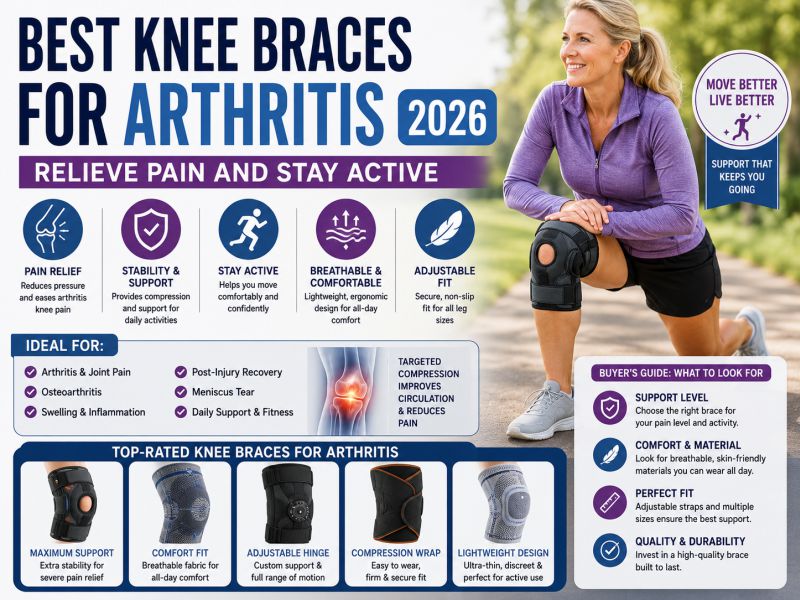
Best Knee Braces for Arthritis 2026: Relieve Pain and Stay Active

Note: This article is for informational and educational purposes only. It does not constitute medical advice. If you have significant knee pain, swelling, instability, or a recent injury, consult your physician or orthopedic specialist before selecting a brace. Knee braces manage symptoms — they do not treat the underlying cause of arthritis.

Best Knee Braces for Arthritis 2026: Relieve Pain and Stay Active

When Your Knees Start Saying No

Patricia had been an avid morning walker for thirty years. At 67, she noticed it first going down the stairs — a deep, grinding ache in her left knee that lingered for an hour after waking. Her orthopedist confirmed moderate medial compartment osteoarthritis: the cartilage on the inner side of her knee had worn down enough to cause bone-on-bone pressure with every step. Surgery wasn't yet indicated, and her doctor suggested a combination of physical therapy and a properly fitted offloader brace as a first-line conservative approach.

Within three weeks of wearing a valgus offloader brace on her morning walks, Patricia had returned to her full route. The brace didn't rebuild her cartilage. It shifted mechanical load away from the damaged compartment and gave her nervous system enough structural feedback that her gait normalized and the surrounding muscles stopped guarding. That, her physical therapist explained, was exactly what knee braces do when matched correctly to the patient's anatomy and arthritis pattern.

Understanding those mechanics — what braces do, which types work for which conditions, and what to look for in 2026 — is the foundation of making a choice that genuinely helps.

How Arthritis Affects the Knee

The knee is the largest joint in the body and among the most mechanically complex. It bears roughly 1.5 times your body weight during walking and up to 3–4 times your body weight during stair climbing or squatting. Three bones form the joint: the femur (thigh), tibia (shin), and patella (kneecap). The medial and lateral compartments of the tibiofemoral joint and the patellofemoral compartment (behind the kneecap) are the three areas most commonly affected by arthritis.

Osteoarthritis (OA) is the most common type — a degenerative condition in which articular cartilage progressively breaks down, narrowing the joint space, causing bone-on-bone friction, pain, inflammation, and eventually structural changes including bone spurs (osteophytes) and joint deformity. OA most commonly affects the medial (inner) compartment first, which is why many arthritis sufferers find their knees gradually bowing outward (genu varum or "bowlegged" alignment).

Rheumatoid arthritis (RA) is an autoimmune disease causing systemic inflammation that targets joint lining (synovium). RA can affect both knees simultaneously and tends to cause more swelling, warmth, and stiffness — particularly morning stiffness lasting more than 30 minutes — than OA. Brace selection for RA differs slightly from OA, as compression and warmth management are more central concerns.

Post-traumatic arthritis develops after a prior knee injury — ACL tear, meniscus damage, fracture — and may appear earlier in life than typical OA. Brace needs depend on whether instability from the original injury is still present alongside arthritis symptoms.

What Knee Braces Actually Do

Knee braces work through several overlapping mechanisms:

Load redistribution (offloading): Offloader or unloader braces apply a three-point force system that shifts mechanical load away from a damaged compartment and onto the healthier side. This directly reduces bone-on-bone pressure in the affected area and is the mechanism with the strongest evidence base for medial or lateral compartment OA.

Compression and proprioception: Compression sleeves and mild support braces increase sensory feedback from the knee joint to the nervous system. This improved proprioception (the body's sense of joint position) helps the surrounding muscles stabilize the joint more effectively, reducing the sensation of instability and often reducing pain even in the absence of significant structural support.

Warmth: Neoprene and other insulating materials increase local tissue temperature, which improves blood flow, reduces stiffness, and can blunt pain signaling. This is particularly helpful for RA and for morning stiffness from OA.

Structural stabilization: Hinged and ligament-support braces limit abnormal movement — hyperextension, side-to-side instability — and protect against further injury. These are more relevant for arthritis combined with ligament laxity than for mild OA alone.

Alignment correction: Patellofemoral braces use tracking pads, cut-out designs, or straps to guide the kneecap into proper alignment in its groove, reducing the pain associated with patellofemoral syndrome and anterior knee OA.

Types of Knee Braces for Arthritis

Compression Sleeves

The most accessible entry point for knee arthritis management. Compression sleeves are typically made from neoprene, knit fabric, or a blend, and pull on over the knee like a sock. They provide consistent circumferential compression (usually 15–25 mmHg), warmth, and proprioceptive feedback.

Best for: Mild OA, early-stage arthritis, general aching and stiffness, everyday wear, exercise and low-impact activity, RA swelling management, patients who want something easy to put on and remove.

Limitations: Minimal structural support; no offloading effect; not appropriate for significant instability or advanced compartment OA.

What to look for: Medical-grade compression (look for mmHg ratings rather than vague "firm" descriptors), moisture-wicking or perforated fabric for all-day wear, and a non-slip top edge to prevent migration during activity.

Hinged Knee Braces (Mild to Moderate Support)

Hinged braces add polycentric (multi-axis) hinges on both sides of the knee, connected by rigid or semi-rigid uprights. They provide medial-lateral stability while allowing controlled flexion and extension. Most consumer-grade hinged braces are prefabricated and adjustable.

Best for: Moderate OA with mild instability, post-recovery activity support, patients who have experienced the knee "giving way," hiking and uneven terrain, sports participation with arthritis.

Limitations: Bulkier than sleeves; may be uncomfortable under pants; some take practice to don correctly; not a substitute for offloading in advanced compartmental OA.

What to look for: Dual-axis or polycentric hinges (mimicking natural knee motion better than single-axis designs), breathable materials between the uprights, adjustable strapping for a secure fit across varying thigh and calf circumferences, and an open or closed patella design based on your kneecap sensitivity.

Offloader / Unloader Braces (OA Specialty Braces)

The most clinically studied brace type for compartmental OA. Offloader braces use a three-point lever arm system — a padded cuff above the knee, a hinge on the affected side, and a padded cuff below — to create a valgus (for medial OA) or varus (for lateral OA) force that shifts load away from the damaged compartment. Research published in peer-reviewed journals including the Journal of Orthopaedic Research consistently shows 30–50% reduction in medial compartment loading during walking with properly fitted valgus offloader braces.

Best for: Medial or lateral compartment OA (not whole-joint OA), patients with measurable joint space narrowing on X-ray, those who want to delay or avoid knee replacement, active patients who need to maintain mobility.

Limitations: Bulkier and more expensive than sleeves or standard hinged braces; fitting requires careful measurement; not effective for patellofemoral OA; may require a prescription for insurance coverage; less effective for whole-joint arthritis where both compartments are involved.

What to look for: Proper measurement is critical — measure thigh circumference 6 inches above the knee, mid-patella circumference, and calf circumference 6 inches below. A brace that fits poorly not only fails to offload effectively but can cause skin irritation, pressure sores, or compensatory muscle strain. Many orthopedic offices will fit these for you.

Patellofemoral Braces

Designed specifically for kneecap-related pain, including patellofemoral OA and patellofemoral pain syndrome. Most feature a circular or horseshoe-shaped cutout over the kneecap combined with lateral buttress padding to guide the patella medially, correcting the lateral tracking pattern that causes pain in this area.

Best for: Anterior knee pain, pain during stair climbing and squatting, kneecap grinding or clicking, patellofemoral OA.

Limitations: Does not address tibiofemoral (main joint) OA; requires accurate identification of the pain source; improper sizing can worsen patellar tracking.

Wraparound / Adjustable Braces

A practical middle ground: these braces use hook-and-loop (Velcro) strapping systems rather than a pull-on sleeve design, making them easier to don for those with limited hand strength or reduced range of motion — common in arthritis patients. Many include hinges and can be adjusted throughout the day as swelling fluctuates.

Best for: Patients with RA or hand arthritis (difficult to pull on a sleeve), those with fluctuating swelling, elderly patients who need adjustability, post-surgical recovery alongside arthritis management.

Choosing the Right Brace: A Framework

Arthritis Type / Symptom Pattern Recommended Brace Type Key Feature to Prioritize
Mild OA, general aching, stiffness Compression sleeve Consistent compression, warmth, breathability
Medial compartment OA (inner knee pain, bowlegged) Valgus offloader brace Three-point offloading, precise fit measurement
Lateral compartment OA (outer knee pain, knock-kneed) Varus offloader brace Corrects in opposite direction from valgus offloader
Anterior/kneecap pain, pain on stairs Patellofemoral brace Lateral buttress pad, patellar cutout
OA + instability or giving way Hinged brace (moderate support) Polycentric hinges, rigid uprights, adjustable straps
Rheumatoid arthritis, swelling dominant Wraparound adjustable sleeve or hinged brace Adjustability for swelling, easy application without grip strength
Whole-joint advanced OA (awaiting surgery) Hinged brace with compression + PT consultation Pain management; brace unlikely to significantly offload whole joint

Fit and Sizing: The Most Important Factor

No brace type matters if the fit is wrong. A knee brace that is too loose migrates downward during activity, provides inconsistent compression, and loses its structural support effect entirely. A brace that is too tight can impede circulation, cause pressure sores, and worsen rather than relieve pain.

For compression sleeves, measure the circumference at mid-patella (the center of the kneecap). Most manufacturers size their sleeves on this measurement. A well-fitted sleeve should feel snug but not constrictive — you should be able to slip two fingers underneath at any point.

For hinged and offloader braces, you'll typically need three measurements: thigh circumference (6 inches above the center of the kneecap), knee circumference (at the center of the kneecap), and calf circumference (6 inches below the center of the kneecap). Some manufacturers also ask for inseam or leg length measurements to ensure proper hinge positioning. If a brace's hinges don't sit at or near the center of your knee's natural pivot point, the brace will bind during movement and may actually increase stress on the joint.

When in doubt, sizing up is generally safer than sizing down for hinged braces, but for compression sleeves, a size that's too large will migrate and lose compression. Take careful measurements and compare against the specific size chart for the brace you're considering — sizing varies significantly between brands.

Materials and Durability

Neoprene: The classic brace material — excellent warmth retention, good compression, durable, and widely available. Neoprene is less breathable than fabric options, which can cause sweating during extended wear. Perforated neoprene improves airflow significantly. Not appropriate for latex allergies (neoprene is rubber-based).

Knitted fabric (polyester/spandex blends): Much more breathable than neoprene, making these better for all-day wear and warm climates. Generally provides less warmth than neoprene and slightly less compression, but modern technical knit braces can achieve excellent compression and are significantly more comfortable for 8+ hour wear.

Rigid plastic uprights: Used in hinged and offloader braces for structural support. Lightweight thermoplastic options have largely replaced heavier materials. Look for uprights with adjustable flexion/extension stops on higher-end braces — these allow you to limit range of motion during recovery periods.

Aluminum frames: Used in offloader braces. More durable and adjustable than plastic; often allow for fine-tuning of the offloading angle. More expensive but appropriate for daily long-term wear.

Most knee braces should be hand-washed or gentle cycle machine-washed at cool temperatures and air-dried. Avoid heat drying, which degrades neoprene, elastic, and adhesive strapping over time. With proper care, a quality hinged brace or sleeve should last 12–24 months of regular use before the materials lose their structural integrity.

Using Your Knee Brace Effectively

A brace is a tool, not a cure. Getting the most benefit requires using it correctly:

Wear it during activity, not just at rest. Braces provide their greatest benefit during the activities that load the joint — walking, climbing stairs, exercise. Wearing a brace while sedentary provides warmth and some proprioceptive benefit but misses the primary pain-reduction mechanism.

Don't use a brace as a substitute for strengthening. Research consistently shows that quadriceps and hip abductor strengthening reduces knee OA pain as effectively as, and sometimes more than, bracing alone. The best outcomes combine both: a brace for activity-related pain management alongside a supervised exercise program that strengthens the muscles that absorb load the joint cannot. Ask your physical therapist for a home program to complement your brace use.

Give it time. Most patients need 2–4 weeks of consistent brace use before accurately assessing its benefit. Initial discomfort from straps and unfamiliar sensations is common and usually resolves within the first week as your body adapts to the altered mechanics.

Check fit regularly. Body weight fluctuations, muscle changes from exercise, and seasonal swelling (heat increases joint swelling in many arthritis patients) can affect how a brace fits over time. Re-check fit every few months and adjust accordingly.

Rotate if wearing daily. Having two braces (or two sleeves) allows for washing and drying between uses, which maintains hygiene and extends the life of each brace.

When to See a Doctor or Physical Therapist

A knee brace is an appropriate self-management tool for mild to moderate known arthritis. Seek professional evaluation if:

  • You haven't yet received a diagnosis and are experiencing new knee pain
  • Pain is severe (7/10 or above) or significantly limiting daily activities
  • You have significant swelling, redness, or warmth in the joint (could indicate infection, gout, or RA flare)
  • The knee is visibly deformed or unstable
  • Pain is waking you at night
  • You've tried conservative measures (bracing, exercise, weight management, NSAIDs) for 3–6 months without improvement

Physical therapists specializing in orthopedics can perform gait analysis to determine whether your alignment would benefit from offloading, recommend specific exercises for your arthritis pattern, and assist with brace fitting to ensure you get the maximum benefit from your investment.

Complementary Pain Management for Arthritis

Knee bracing works best as part of a comprehensive arthritis management strategy. Other evidence-based approaches include:

  • Weight management: Every 1 lb lost reduces knee joint load by approximately 4 lbs. For patients who are overweight, weight loss is among the most effective interventions available for knee OA pain.
  • Exercise: Low-impact activity (swimming, cycling, elliptical) maintains cartilage nutrition, strengthens supporting muscles, and reduces pain. Inactivity worsens OA.
  • Heat therapy: Heating pads applied before activity reduce stiffness and improve range of motion. Browse our pain relief collection for heating pads and thermal wraps.
  • Topical pain relief: Topical NSAIDs (diclofenac gel) and capsaicin creams are effective for localized knee OA pain with fewer systemic side effects than oral NSAIDs.
  • Walking aids: For advanced arthritis, a properly fitted cane (used in the hand opposite the affected knee) can meaningfully reduce knee joint loading. See our mobility aids collection.

Shop Knee Braces and Joint Support at AllCare Store

AllCare Store carries a comprehensive selection of knee braces, compression sleeves, and joint support products for arthritis management and physical therapy recovery. Browse our physical therapy and recovery collection and our pain relief collection to find the right support for your needs.

  • Free Shipping on every order — no minimum required
  • Discreet Packaging — all orders arrive in plain, unmarked packaging
  • 30-Day Returns — shop with confidence
  • Expert Help — reach our team at 1-888-889-6260, Monday–Friday 7 AM–4 PM CST

Frequently Asked Questions: Knee Braces for Arthritis

Do knee braces actually help arthritis pain?

Yes — for the right patient with the right brace type. Multiple randomized controlled trials have demonstrated that offloader braces meaningfully reduce pain and improve function in medial compartment knee OA. Compression sleeves show consistent pain reduction benefits across multiple studies, likely through improved proprioception and warmth. The key is matching the brace type to the specific arthritis pattern: a valgus offloader for medial OA, a patellofemoral brace for kneecap pain, a hinged brace for instability alongside arthritis. A brace mismatched to the patient's anatomy or arthritis type provides little benefit and may cause discomfort.

What is the best knee brace for bone-on-bone arthritis?

For medial compartment bone-on-bone OA (the most common pattern), a valgus offloader brace is the evidence-based first choice. These braces apply a three-point force system that shifts load away from the bone-on-bone contact area and onto the healthier compartment. Studies show 30–50% reduction in medial compartment forces during walking with properly fitted offloaders, which directly reduces the pain stimulus at the site of cartilage loss. Proper fit is critical — offloaders should ideally be measured by an orthotist or physical therapist familiar with knee OA bracing.

Should I wear a knee brace all day with arthritis?

For most arthritis patients, wearing a knee brace during activity (walking, stair climbing, exercise) provides the greatest benefit. You do not need to wear a brace while sleeping or during extended sedentary periods — the mechanical offloading and stabilization effects are most valuable when the joint is under load. Some patients benefit from wearing a compression sleeve throughout the day for warmth and proprioceptive benefit, especially during RA flares or periods of increased stiffness. Listen to your body: if wearing a brace during a specific activity reliably reduces pain, that's a good indicator to continue. If it causes new discomfort, pressure points, or skin irritation, adjust the fit or type.

What is the difference between a knee sleeve and a knee brace?

Knee sleeves are compression-focused garments without rigid structural components — they provide warmth, consistent circumferential compression, and proprioceptive feedback. Knee braces typically include rigid components (hinges, uprights, offloading frames) that provide structural support, movement control, or targeted load redistribution beyond what compression alone can offer. For mild arthritis and general pain management, a quality sleeve is often sufficient. For instability, significant compartmental OA, or more advanced structural involvement, a brace with rigid components provides meaningful additional benefit. Both are generally available over-the-counter; offloader braces may require a prescription for insurance coverage.

Can a knee brace delay or prevent knee replacement surgery?

For appropriate candidates with medial compartment OA, offloader bracing is a recognized conservative treatment that can delay the need for surgical intervention, sometimes by years. Research following patients with moderate medial OA who use offloader braces consistently shows maintained or improved function, and some studies suggest slower radiographic (X-ray) progression in braced vs. unbraced groups. Bracing works best when combined with physical therapy, weight management, and appropriate activity modification. It is not a cure and cannot reverse cartilage loss — but for patients who are not yet at the severity level where surgery is indicated, it can be a highly effective bridge.

Newsletter

A short sentence describing what someone will receive by subscribing