MEDICAL DISCLAIMER: This article is for informational purposes only and does not constitute medical advice. Always consult your healthcare provider about your individual oxygen levels and health needs. If you experience sudden shortness of breath, chest pain, confusion, or other serious symptoms, seek emergency care immediately.
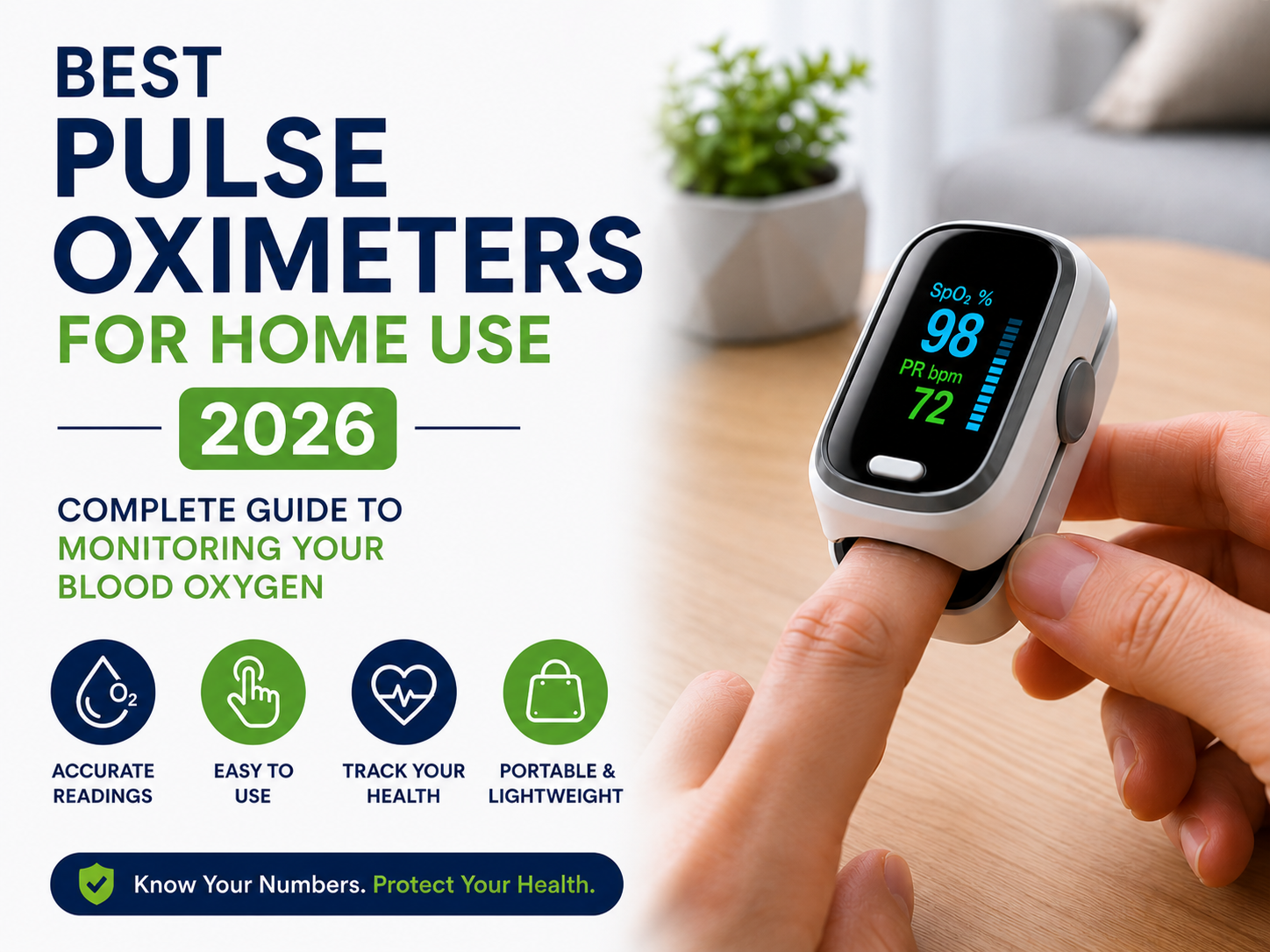
Best Pulse Oximeters for Home Use 2026: Your Complete Guide to Blood Oxygen Monitoring
Robert's Wake-Up Call: Why a $30 Device Changed Everything
Robert was 71 years old and had lived with COPD for six years. He thought he knew his body well enough — if he was short of breath, he rested. If he felt okay, he kept going. But after a particularly rough winter week where he ended up in the emergency room twice, his pulmonologist said something that stopped him cold: "Robert, by the time you feel breathless, your oxygen has already dropped dangerously low. You need to catch this earlier."
His doctor recommended a pulse oximeter for home use — a small device that clips to his fingertip and reads his blood oxygen level in seconds. Robert was skeptical at first. He couldn't believe something so simple could be so important. But the first week of monitoring opened his eyes. He discovered that during certain activities he thought were fine — walking to the kitchen, climbing stairs — his oxygen saturation was dropping into ranges that needed attention. His doctor adjusted his oxygen therapy based on those readings. That winter was his best in four years.
Robert's story isn't unusual. Since the COVID-19 pandemic, pulse oximeters have moved from hospital supply rooms into millions of homes. Doctors routinely recommend them now for patients with respiratory conditions, heart disease, sleep apnea, and even healthy individuals who want a complete picture of their wellness. Athletes use them to track performance at altitude. Caregivers use them to monitor elderly parents between doctor visits. Parents use them for children with asthma.
Whatever brought you here, this guide will help you understand exactly how pulse oximeters work, what your blood oxygen level numbers mean, and how to choose the best fingertip pulse oximeter for your specific situation. We'll walk through five excellent options available at AllCare Store, compare them side by side, and give you a simple action plan to start monitoring with confidence.
How Pulse Oximeters Work: The Science Behind the Clip
A pulse oximeter — also called a SpO2 monitor or oxygen saturation monitor — uses a technology called photoplethysmography (try saying that three times fast). Here's the simple version:
The device emits two beams of light — one red, one infrared — through your fingertip. Oxygenated blood absorbs these wavelengths differently than deoxygenated blood. The sensor on the other side of the clip measures how much light passes through and calculates the ratio, giving you your blood oxygen saturation (SpO2) as a percentage. At the same time, it detects the pulse of blood through your fingertip and gives you your heart rate.
The whole process takes between 10 and 30 seconds. It's painless, non-invasive, and completely accurate for most people in most situations. That's why pulse oximetry is standard monitoring in virtually every healthcare setting — and why it's increasingly essential at home.
Understanding Your SpO2 Readings: What the Numbers Mean
Your blood oxygen level — measured as SpO2 — tells you what percentage of your hemoglobin (the protein in red blood cells that carries oxygen) is saturated with oxygen. Here's what the ranges typically mean:
| SpO2 Level | Category | What It Means | Recommended Action |
|---|---|---|---|
| 95–100% | Normal | Healthy oxygen saturation for most people | Continue normal activity |
| 92–94% | Below Normal | May indicate mild hypoxemia | Contact your healthcare provider |
| 88–91% | Low | Potential for hypoxia; supplemental oxygen may be needed | Contact your doctor promptly |
| Below 88% | Dangerously Low | Significant hypoxemia requiring immediate attention | Seek emergency care |
Important note: These ranges are general guidelines. Your doctor may give you different target ranges based on your specific condition. For example, some people with chronic COPD have baseline SpO2 levels of 88–92% and that may be normal for them. Always discuss your personal target range with your healthcare provider.
When Should You Check Your Oxygen Levels?
The frequency and timing of monitoring depends on your health status:
- Chronic respiratory conditions (COPD, asthma, emphysema): Check at rest, after activity, and whenever you feel worse than usual. Your doctor may recommend specific monitoring schedules.
- Heart failure or cardiac conditions: Monitor as directed by your cardiologist, especially if you're adjusting medications.
- Sleep apnea: Your doctor may recommend overnight monitoring to understand how sleep affects your oxygen levels.
- Post-COVID recovery: Regular monitoring can help you and your doctor track your recovery progress.
- General wellness monitoring: Checking a few times per week gives you useful baseline data that can be helpful if you become ill.
- Athletes: Pre- and post-workout monitoring can track how your body responds to exercise.
Who Benefits Most From a Home Pulse Oximeter?
While anyone can benefit from owning a fingertip pulse oximeter, these groups have the most to gain:
People with Respiratory Conditions
If you have COPD, asthma, pulmonary fibrosis, or any condition affecting your breathing, a pulse oximeter is one of the most important tools you can have at home. It gives you and your doctor objective data about how your lungs are functioning day to day, helps you recognize early deterioration before symptoms become severe, and guides decisions about when to seek care.
Heart Disease and Heart Failure Patients
Cardiovascular conditions often affect how well oxygen is delivered throughout the body. Regular monitoring helps you track changes and provides valuable data for your cardiologist.
Seniors and Elderly Individuals
As we age, our cardiovascular and respiratory systems naturally become less efficient. Seniors — particularly those living alone or with limited access to frequent medical care — benefit enormously from having a way to check their own vital signs between appointments. A pulse oximeter gives peace of mind and provides early warning of problems that might otherwise go undetected.
Caregivers Monitoring Loved Ones
If you're caring for an elderly parent, a spouse with a chronic illness, or anyone with respiratory or cardiac concerns, a home SpO2 monitor is invaluable. It lets you make informed decisions about when to call the doctor versus when to take someone to the ER — potentially saving both distress and unnecessary trips.
Post-Surgery Recovery Patients
After surgeries involving anesthesia, monitoring oxygen saturation during recovery can be helpful, especially for patients who snore or have sleep apnea and may be more susceptible to low oxygen during sleep.
Athletes and Fitness Enthusiasts
Serious athletes — especially those doing high-altitude training, endurance sports, or recovering from injury — use pulse oximeters to understand how their body responds to exertion and track cardiovascular fitness over time.
The Five Best Pulse Oximeters for Home Use in 2026
After reviewing what's available for home use, here are five outstanding options across different price points and use cases, all available at AllCare Store.
1. Nonin Onyx Vantage 9590 Fingertip Pulse Oximeter
The Nonin Onyx Vantage 9590 represents the gold standard in home pulse oximetry. Nonin Medical is the company that invented the modern pulse oximeter, and their Onyx line has been the reference standard in clinical research for decades. When doctors in ICUs need accurate data, Nonin is often their choice — and now that same technology is available for home use.
Key Features:
- True clinical-grade accuracy validated in over 100 published studies
- PureSAT technology — accurate even on patients with poor circulation or dark nail polish
- Bi-directional display (readable from above or below)
- Single AAA battery with exceptional battery life (up to 1,500 readings)
- Durable, scratch-resistant case built to last years
- FDA cleared and CE marked
- Works reliably at SpO2 levels as low as 70% — critical for medical use
The Nonin Onyx Vantage 9590 is the right choice when accuracy is non-negotiable. If you have a serious respiratory condition, your doctor wants to review your readings, or you simply want the most trustworthy device available, this is it.
2. Nonin GO2 Achieve Fingertip Pulse Oximeter
The Nonin GO2 Achieve brings Nonin's clinical reliability to a more affordable, everyday-use format. It's an excellent entry point into professional-grade monitoring without the premium price of the Onyx Vantage.
Key Features:
- Nonin's trusted measurement technology at a lower price point
- Easy-to-read LED display showing SpO2 and pulse rate
- Compact and lightweight for travel and daily use
- Works reliably for spot-checking and routine monitoring
- Finger opening accommodates a wide range of finger sizes
- FDA cleared
The Nonin GO2 Achieve is perfect for someone who wants the Nonin name and reliability but needs an economical daily-use option. It's also a great choice to keep in a travel bag or as a backup device.
3. Nonin 9570 WristOx₂ Wrist-Worn Pulse Oximeter with Bluetooth
For continuous or overnight monitoring, the Nonin 9570 WristOx₂ is in a different class entirely. This wrist-worn device provides extended monitoring that a fingertip clip simply cannot — because nobody can sleep comfortably with a clip on their finger all night.
Key Features:
- Wrist unit stores data for hours of continuous monitoring
- Bluetooth connectivity transmits data to compatible apps and systems
- Designed for sleep studies and extended monitoring protocols
- Small, lightweight fingertip sensor attaches to wrist unit with comfortable cable
- Clinically validated for use in sleep studies and overnight monitoring
- Rechargeable for convenience
- Used by healthcare professionals and sleep clinics
The Nonin 9570 WristOx₂ is the right choice for patients whose doctors have recommended overnight oxygen monitoring, people with known or suspected sleep apnea wanting to track nighttime oxygen levels, and anyone who needs extended continuous monitoring for clinical purposes. This is a professional-grade tool.
4. Nonin Onyx II 9550 Fingertip Pulse Oximeter
The Nonin Onyx II 9550 offers an excellent balance between clinical accuracy and user-friendly design, specifically optimized for patients using supplemental oxygen or those with reduced peripheral circulation — common in the elderly and in people with COPD or diabetes.
Key Features:
- Proven performance in low-perfusion states (when circulation is compromised)
- Bright, easy-to-read LED display with large digits
- Spot-check or continuous monitoring capability
- Dual-display showing SpO2 and pulse rate simultaneously
- Works with all finger sizes; wide finger opening for arthritic fingers
- Long battery life suitable for frequent monitoring
- Clinically validated; widely used in home care settings
The Nonin Onyx II 9550 is particularly recommended for older adults, patients with diabetes-related circulation issues, and anyone using supplemental oxygen therapy at home. Its reliability in challenging monitoring conditions makes it a standout choice for medical-grade home use.
5. Nonin 2500A Portable Hand-Held Pulse Oximeter
For caregivers and healthcare providers who monitor multiple patients, the Nonin 2500A Portable Pulse Oximeter is a handheld device that brings clinical workflow to the home setting. It's the type of device home health nurses carry.
Key Features:
- Handheld format ideal for caregiver or home health use
- Durable construction for regular professional use
- Large, clear display for easy reading
- Accurate across a wide range of patient types and perfusion levels
- Reusable sensor probe — more economical for frequent use
- Alarm capabilities for clinical monitoring scenarios
- Trusted by home health agencies nationwide
The Nonin 2500A is the right choice for professional caregivers, home health aides, family members managing multiple patients, or anyone who needs a durable device built for intensive use. It's also an excellent option for adult day care programs and assisted living settings.
Pulse Oximeter Comparison Table
| Model | Type | Best For | Monitoring Duration | Bluetooth | Clinical Grade |
|---|---|---|---|---|---|
| Nonin Onyx Vantage 9590 | Fingertip | Maximum accuracy, medical monitoring | Spot-check | No | Yes — top tier |
| Nonin GO2 Achieve | Fingertip | Everyday home monitoring, travel | Spot-check | No | Yes |
| Nonin 9570 WristOx₂ | Wrist + fingertip sensor | Overnight & continuous monitoring | Extended / overnight | Yes | Yes — clinical |
| Nonin Onyx II 9550 | Fingertip | Low-perfusion, elderly, O₂ therapy patients | Spot-check | No | Yes |
| Nonin 2500A | Handheld | Caregivers, home health, multi-patient use | Spot-check | No | Yes — professional |
How to Get Accurate Readings: Tips for Better Results
Even the best pulse oximeter can give misleading results if used incorrectly. Follow these guidelines to ensure accurate readings every time:
Proper Placement
- Use the index or middle finger: These typically give the most consistent readings
- Insert finger fully: Make sure the fingertip reaches the back of the sensor
- Remove nail polish: Dark polish, especially blue, green, or black, can interfere with readings — clear polish is usually fine
- Remove artificial nails: Acrylic or gel nails may reduce accuracy
- Clip the device gently: It shouldn't be so tight that it restricts circulation
Before You Measure
- Warm your hands: Cold fingers cause poor circulation, which reduces accuracy. Warm your hands under warm water or rub them together before measuring
- Rest for 5 minutes: Exercise temporarily affects oxygen readings. Wait 5 minutes after activity for a resting reading
- Stay still: Movement causes significant reading errors. Keep your hand and body as still as possible during measurement
- Avoid bright light: Strong direct sunlight or bright examination lights can interfere with some devices. Shield the sensor if needed
Interpreting Your Results
- Look for a stable reading: The number should stabilize within 10-30 seconds. If it's fluctuating wildly, take a new reading after repositioning your finger
- Check the pulse rate too: Your heart rate should be in a plausible range. If it shows 30 or 250 BPM while you feel fine, the reading is likely inaccurate
- Take multiple readings: For important medical monitoring, take 2-3 readings and use the consistent ones
- Know your baseline: Establish your normal range when healthy, so you know what's typical for you personally
Limitations of Pulse Oximeters: What They Can't Tell You
A pulse oximeter is a powerful tool, but it has important limitations you should understand:
- Carbon monoxide poisoning: Pulse oximeters cannot distinguish between hemoglobin carrying oxygen and hemoglobin carrying carbon monoxide. In CO poisoning, readings may appear normal while you're actually being deprived of oxygen. If you suspect CO exposure, don't rely on an oximeter — get to fresh air and call 911.
- Anemia: If you have severe anemia, you can have "normal" SpO2 but still be oxygen-deprived because there aren't enough red blood cells carrying oxygen. Pulse oximetry measures saturation, not quantity.
- Poor peripheral circulation: Raynaud's disease, advanced diabetes, or shock can prevent the device from getting an accurate reading. Clinical-grade devices like the Nonin Onyx Vantage handle low perfusion better than budget alternatives.
- Motion artifact: Movement during measurement causes inaccurate readings, particularly in agitated patients or people with tremors.
- Skin pigmentation: Some research has shown that pulse oximeters may overestimate oxygen saturation in people with darker skin tones. This is an area of active development in the medical device industry. Clinical-grade devices generally perform better across skin tones.
None of these limitations mean you shouldn't use a pulse oximeter at home — they mean you should use one as one tool among several, and always consult your healthcare provider about your individual situation.
Frequently Asked Questions About Pulse Oximeters
What is a normal blood oxygen level?
For most healthy adults, a normal SpO2 reading is between 95% and 100%. Many healthy people measure 97–99% at rest. Readings consistently below 95% may warrant a conversation with your doctor. However, "normal" varies by individual — someone with COPD may have a baseline in the 88–92% range that is normal for them. Always discuss your target range with your healthcare provider.
When should I call a doctor about my oxygen reading?
Contact your healthcare provider if your readings are consistently below 95%, if they drop below 90% at any point, or if you experience a sudden significant drop from your personal baseline. Call 911 or go to an emergency room if your reading drops below 88%, especially if accompanied by symptoms like chest pain, confusion, rapid breathing, or blue-tinged lips.
Are cheap pulse oximeters accurate?
Budget pulse oximeters available for under $15 vary widely in accuracy. Many perform reasonably well in ideal conditions (warm fingers, no movement, normal SpO2 range) but may be unreliable when it matters most — in low perfusion states, with movement, or when readings are in the concerning range below 94%. For casual wellness monitoring by a healthy person, a budget device may suffice. For anyone with a health condition who is making medical decisions based on readings, a clinical-grade device like Nonin is strongly recommended.
Can I use a pulse oximeter on my toe or earlobe?
Standard fingertip pulse oximeters are designed for fingers only. Special probes exist for earlobes and toes, but these require specific compatible devices. The Nonin 2500A with appropriate probes can be used with alternative sites. For most home users, the fingertip is the standard and most convenient site.
Should I use a pulse oximeter while sleeping?
Overnight monitoring can be valuable for people with sleep apnea or respiratory conditions. However, standard fingertip oximeters aren't designed for sleeping — they'll fall off or give inconsistent readings due to movement. For overnight monitoring, the Nonin 9570 WristOx₂ is specifically designed for this purpose, with a wrist unit and finger sensor that can monitor comfortably through the night. If your doctor has recommended overnight oxygen monitoring, ask about this type of device.
How long does a pulse oximeter last?
Clinical-grade pulse oximeters like Nonin devices are built to last many years with proper care. Budget devices may wear out within a year or two of regular use. The sensor spring mechanism and battery contacts are the most common points of failure. Store your oximeter in a cool, dry place, avoid dropping it, and keep it clean by wiping with a soft cloth. Battery life typically ranges from 500 to 1,500+ readings depending on the model.
Does nail polish affect pulse oximeter accuracy?
Dark nail polish — especially blue, green, black, or deep red shades — can interfere with the light beams and reduce accuracy. Clear nail polish and light colors typically don't cause problems. If you regularly wear dark nail polish, use a finger without polish or check accuracy on a bare finger to compare. Some clinical-grade devices like Nonin are better at compensating for this issue than budget alternatives.
Building Your Home Vital Signs Monitoring Kit
A pulse oximeter pairs powerfully with other home monitoring tools. At AllCare Store, we help you build a complete home vital signs monitoring kit:
- Blood pressure monitor: Measure cardiovascular health alongside your oxygen levels. Browse our blood pressure monitors for Omron and ADC options.
- Digital thermometer: Fever can affect oxygen levels and is essential data when you're ill. See our thermometer selection.
- Blood glucose monitor: If you have diabetes, glucose monitoring completes the picture. Visit our glucose meter collection.
Together, these tools give you and your healthcare team a comprehensive view of your health — the kind of visibility that used to require a clinic visit and now happens right in your living room.
For Caregivers: Monitoring Someone Else's Oxygen Levels
If you're caring for an elderly parent, a spouse with COPD, or anyone with chronic respiratory or cardiac disease, a pulse oximeter becomes one of your most important caregiving tools. Here's how to make the most of it:
- Establish a baseline: Start monitoring when your loved one is well and comfortable. Know what their normal range looks like so you can recognize deviations.
- Create a monitoring schedule: Work with their doctor to determine how often to check — daily, after meals, after activity, or at specific times based on their condition.
- Keep a log: Record readings with date, time, and any relevant notes (activity level, medications taken, how they felt). Share this log at medical appointments.
- Know the warning signs: Get clear guidance from their doctor about when readings should prompt a call vs. an emergency room visit. Write these numbers down and keep them somewhere visible.
- Check technique regularly: If you're getting readings that seem off, check for cold hands, dark nail polish, excessive movement, or improper placement before assuming the reading is accurate.
For professional home health settings or adult day programs, the Nonin 2500A handheld model is designed for exactly this multi-patient caregiver use case.
Ready to Start Monitoring?
Like Robert, you may discover that a pulse oximeter gives you visibility into your health you never had before. Whether you're managing a chronic condition, recovering from illness, caring for a loved one, or simply taking a more proactive approach to wellness, the right pulse oximeter puts powerful health information in your hands — literally.
Browse our complete selection of pulse oximeters and health monitors at AllCare Store. If you're not sure which model is right for your situation, our knowledgeable team is ready to help.
Call us at 1-888-889-6260 — we'll help you find the right device for your health needs and your budget. Because when it comes to monitoring what matters most, you deserve the best tools available.