
Medical Disclaimer: This article is for informational purposes only. CPAP therapy settings, equipment selection, and treatment changes should always be directed by your prescribing physician or sleep medicine specialist. CPAP equipment requires a valid prescription.
Linda had been diagnosed with obstructive sleep apnea two years before she finally admitted something was wrong with her therapy. She was still tired — not as profoundly as before treatment, but definitely not the well-rested person her sleep doctor had promised. When she brought her machine in for a review, the answer surprised her. Her mask cushion was six months old and leaking air. Her tubing had micro-cracks from improper cleaning. Her filters hadn't been replaced in eight months. Her CPAP was technically running — but silently failing her night after night. New supplies, a fresh fitting, and a cleaning routine later, she slept soundly for the first time in years.
CPAP therapy is one of the most effective treatments for obstructive sleep apnea — but it's only as good as the equipment delivering it. Worn masks leak. Dirty filters reduce airflow. Cracked tubing compromises pressure. Knowing what to replace, when, and why is the difference between effective therapy and CPAP that doesn't actually do its job.
Shop CPAP supplies and accessories at AllCare Store — free shipping on every order.
CPAP Mask Cushions and Pillows
The mask cushion (or nasal pillows, in pillow-style masks) is the part of your CPAP mask that contacts your skin and creates the seal necessary for therapy to work. It's also the component that wears out fastest. Skin oils, facial creams, and simple mechanical wear degrade the silicone over time, causing the cushion to soften, deform, and lose its ability to seal — resulting in air leaks that reduce therapy effectiveness and disrupt sleep.
Recommended replacement: Mask cushions and nasal pillows should be replaced every 2–4 weeks. If you notice increased leaking, skin irritation from a harder-than-normal fit, or visible discoloration or distortion of the silicone, replace sooner. This is the highest-turnover CPAP supply and the one most often neglected.
Cleaning: Wash daily with mild soap and warm water (not hot water, which degrades silicone). Rinse thoroughly and air-dry away from direct sunlight. Do not use alcohol-based cleaners or CPAP ozone cleaners directly on silicone components — both break down the material over time.
CPAP Mask Frames and Headgear
The mask frame (the rigid plastic structure that positions the cushion) and headgear (the straps that hold everything in place) wear more slowly than cushions but still require regular replacement.
Mask frames should be replaced every 3 months. Plastic can fatigue and crack, and clip mechanisms can weaken, causing the mask to loosen during the night.
Headgear should be replaced every 6 months. Elastic loses its stretch over time, meaning you gradually tighten the straps to compensate — until the headgear is too tight to wear comfortably and is pressing the mask into your face rather than holding it gently in place. Over-tightened headgear is a common cause of CPAP-related facial pressure marks, skin sores, and bridge-of-nose irritation.
CPAP Tubing
CPAP tubing carries pressurized air from your machine to your mask. Standard tubing is 6 feet long; heated tubing (for machines with integrated humidifiers) uses a heated wire to prevent condensation ("rainout") from forming inside the tube.
Recommended replacement: Tubing should be replaced every 3 months. Inspect regularly for micro-cracks, holes, or discoloration. Cracks are often not visible until you run the machine with the tube submerged in water and watch for air bubbles — a good monthly check. Heated tubing requires extra care as the internal wire can break if the tube is kinked repeatedly.
Cleaning: Hang tubing to air-dry completely after each wash. Moisture left inside tubing promotes mold growth. Weekly washing in warm soapy water is the minimum; many users wash tubing every 2–3 days.
CPAP Filters
CPAP machines draw room air through one or more filters before pressurizing and delivering it through the mask. Clean filters are essential for delivering clean air and for maintaining proper machine performance.
Disposable ultra-fine filters (white, paper-like) capture very fine particles and allergens. Replace every 2 weeks, or more frequently in dusty environments or homes with pets. Do not wash — they're single-use.
Reusable foam filters (gray or blue) provide the primary particulate filtration layer. Rinse with warm water every 2 weeks and allow to dry completely before reinstalling. Replace every 3 months or when the foam appears discolored or damaged.
Using a CPAP without proper filters — or with clogged filters — can strain the machine's motor, reduce pressure accuracy, and introduce allergens, dust, and microorganisms into the pressurized airflow. Filter replacement is inexpensive insurance for both your machine and your airways.
CPAP Water Chamber (Humidifier)
Most modern CPAP machines include an integrated heated humidifier that adds moisture to the delivered airflow, significantly improving comfort and reducing nasal dryness and congestion. The humidifier chamber requires regular maintenance.
Daily: Empty any remaining water (never leave standing water in the chamber), rinse with distilled water, and refill with distilled water each night. Tap water deposits minerals that cloud the chamber, degrade the material, and can harbor bacteria.
Weekly: Wash the chamber with warm soapy water, rinse thoroughly, and air-dry.
Replacement: Replace the water chamber every 6 months, or sooner if you notice pitting, discoloration, or calcium deposits that won't clean off. A damaged chamber can harbor bacteria even with regular cleaning.
CPAP Cleaning and Sanitizing Options
The gold standard for CPAP cleaning remains daily handwashing with mild soap and water for all components, followed by complete air-drying. Automated CPAP cleaners using ozone (activated oxygen) or UV light are popular for convenience, but important caveats apply: the FDA has raised concerns about ozone cleaners, and some manufacturers void equipment warranties if ozone devices are used. If you use an automated cleaner, select a UV-based model and verify it's compatible with your specific equipment.
CPAP mask wipes are a convenient option for a quick daily wipe-down to remove skin oils between thorough soap-and-water cleanings. They should supplement, not replace, regular washing.
CPAP Comfort and Compliance Accessories
Mask liners fit between the mask cushion and your skin, reducing irritation, minimizing leaks caused by skin texture, and absorbing facial oils to extend cushion life. They're particularly helpful for users who develop red marks, sores, or skin reactions from direct mask contact.
Chinstraps keep the mouth closed during therapy for users who breathe through their mouth, preventing the air pressure from escaping and the throat from drying out. A chinstrap is often the simplest solution for users experiencing mouth dryness with nasal or nasal pillow masks before switching to a full-face mask.
CPAP pillow (therapy pillow): specially designed pillows with cutouts that accommodate mask bulk, allowing side sleepers to use CPAP without the mask being pressed into the pillow and losing its seal. A significant quality-of-life improvement for side sleepers who struggle with mask displacement.
Hose management clips and holders keep the tubing routed away from the user's head, reducing the chance of getting tangled and dislodging the mask during sleep.
CPAP Replacement Schedule at a Glance
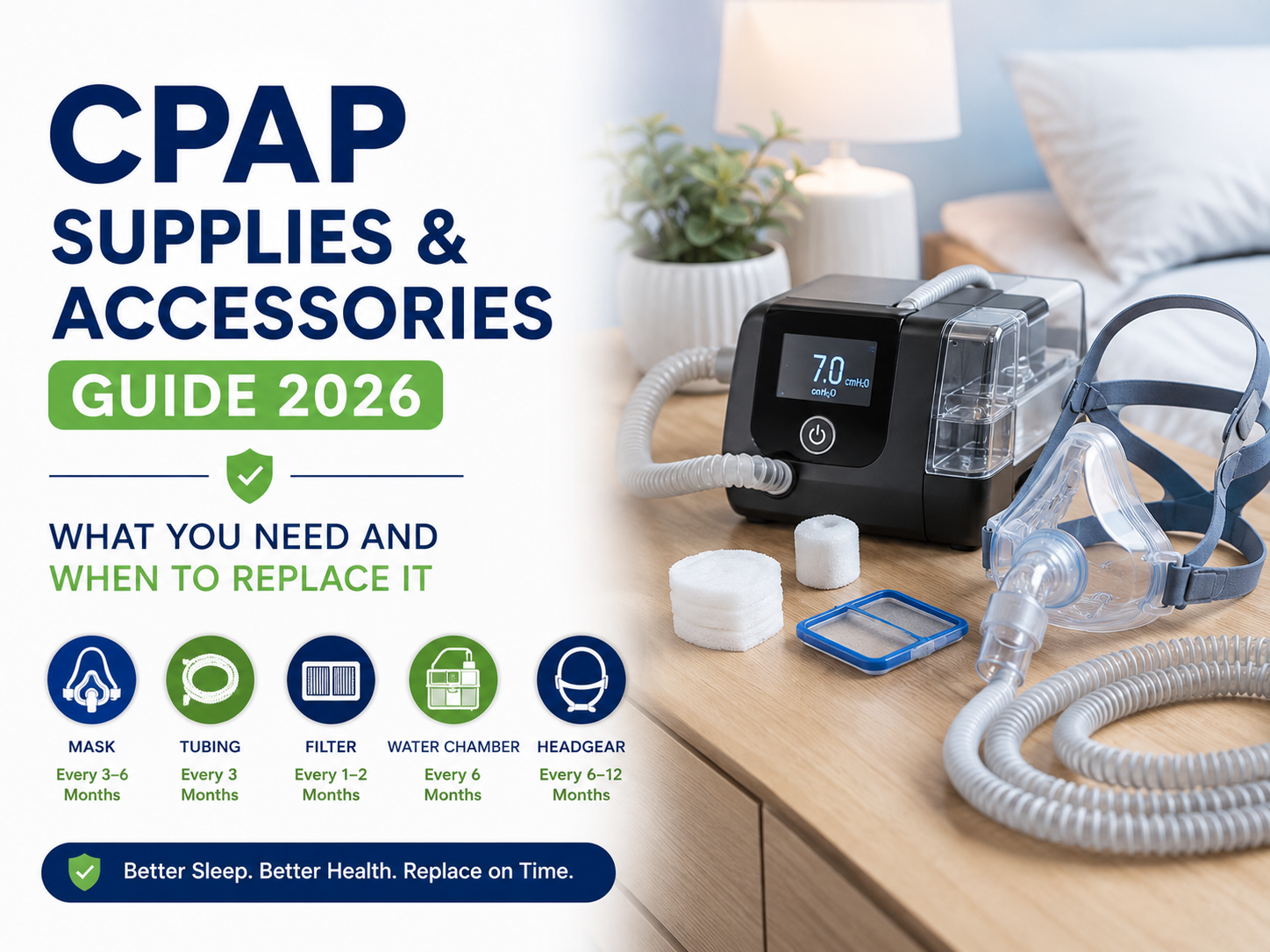
A simple schedule to bookmark: mask cushions/nasal pillows — every 2 weeks; disposable filters — every 2 weeks; reusable foam filters — rinse biweekly, replace every 3 months; tubing — every 3 months; mask frame — every 3 months; water chamber — every 6 months; headgear — every 6 months; full mask assembly — every 12 months. Most insurance plans and Medicare cover CPAP supplies on a regular replacement schedule — check with your provider about your benefits.
Shop CPAP Supplies at AllCare Store
Keep your CPAP therapy effective with fresh supplies from AllCare Store. We carry CPAP masks, cushions, tubing, filters, water chambers, and comfort accessories for all major CPAP brands. Browse our full CPAP Supplies collection — free shipping on every order. Questions? Our team is available at 1-888-889-6260.
Frequently Asked Questions: CPAP Supplies
How often should I replace my CPAP mask?
CPAP replacement schedules vary by component. The mask cushion (the silicone part touching your face) should be replaced every 2–4 weeks. The mask frame replaces every 3 months. The headgear replaces every 6 months. Most insurance plans, including Medicare, cover CPAP mask replacement on these intervals — contact your insurer for specific coverage details. Replacing on schedule maintains the seal quality that makes therapy effective.
Can I use tap water in my CPAP humidifier?
No — only distilled water should be used in a CPAP humidifier. Tap water contains minerals that form deposits (scale) inside the water chamber, reducing its lifespan and potentially harboring bacteria. Distilled water is inexpensive, widely available, and is the unanimous recommendation of CPAP manufacturers. In a pinch while traveling, bottled drinking water is acceptable for short-term use, but distilled water is preferred for regular use.
Why is there water in my CPAP tube in the morning?
Condensation inside the CPAP tubing (called "rainout") occurs when warm humid air from the humidifier cools as it travels through the tube and water droplets form. Solutions include: using a heated tube (which maintains air temperature along its length), lowering the humidifier setting slightly, wrapping the tubing with a tubing wrap or sleeve to insulate it, routing the tube under the covers to keep it warmer, or repositioning the machine lower than the mask so any condensation drains back toward the machine rather than into the mask.
Does insurance cover CPAP supplies?
Yes — most insurance plans, including Medicare Part B, cover CPAP supplies on a regular replacement schedule. Medicare covers CPAP equipment and supplies for beneficiaries with a qualifying sleep apnea diagnosis and a valid prescription. Coverage typically requires compliance documentation (using your machine at least 4 hours per night for 70% of nights in a 30-day period for the first 90 days). Coverage schedules and copays vary by plan. Contact your insurer or a CPAP supplier who accepts your insurance for specific details.



