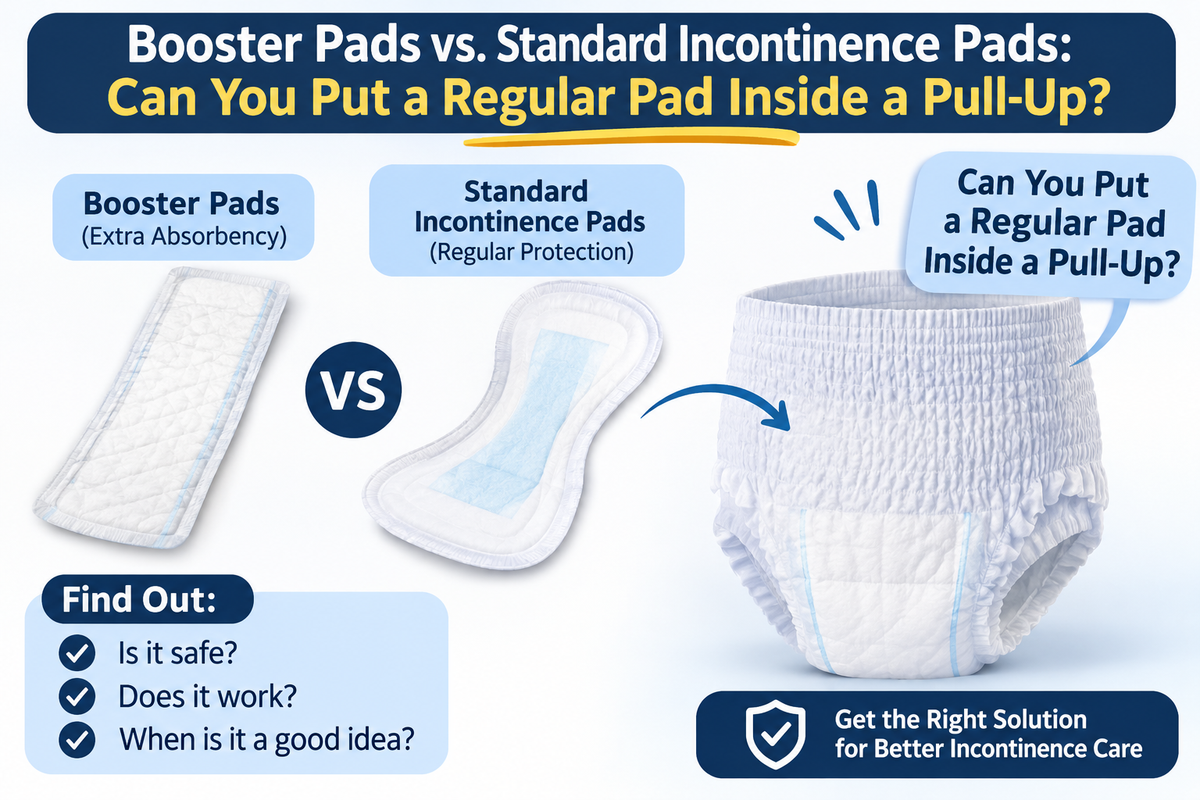
When managing incontinence for yourself or a loved one, preventing embarrassing leaks and keeping bedding dry are top priorities. Many adults and caregivers naturally try to increase absorbency by placing a pad inside a pair of pull-up absorbent underwear.
However, one common mistake often leads to sudden side leaks and blowout frustration: using a standard, plastic-backed incontinence pad instead of a true flow-through booster pad.
Understanding the crucial difference between booster pads (diaper doublers) and standard incontinence pads (bladder control pads) will help you create a leak-proof setup for travel, long outings, and heavy overnight sleep.
At-a-Glance Comparison: Booster Pads vs. Standard Pads
| Feature | Booster Pads (Diaper Doublers) | Standard Incontinence Pads |
| Backing Type | Breathable / Flow-through fabric | Waterproof plastic or poly backing |
| Primary Function | Extends capacity of primary garment | Standalone leak protection in regular underwear |
| Fluid Transfer | Passes overflow directly into pull-up core | Traps fluid; blocks liquid from passing through |
| Placement | Inside pull-up underwear or tabbed briefs | Adheres directly inside normal cotton underwear |
| Best Use Case | Heavy overnight sleep, long trips, extra surge capacity | Light-to-moderate daytime bladder leaks |
The Big Mistake: What Happens When You Put a Regular Pad in a Pull-Up?
Standard bladder control pads and feminine hygiene pads are engineered with a waterproof moisture barrier on the bottom to prevent liquid from soaking through into regular cotton underwear.
When you place a plastic-backed pad inside a pull-up or adult diaper:
-
Fluid Gets Trapped: The pad fills quickly up to its limit (usually 4 to 8 oz).
-
The Waterproof Barrier Blocks the Pull-Up: Once the pad saturates, liquid cannot pass into the highly absorbent pull-up core beneath it.
-
Liquid Spills Over the Sides: Excess urine pools on top of the plastic barrier and spills over the elastic leg cuffs, causing immediate side leaks and bed ruin.
What Is a Booster Pad (Diaper Doubler)?
A booster pad (also called an insert liner or diaper doubler) is specially designed without a waterproof outer barrier. Instead, it features a micro-porous, flow-through backing.
How Booster Pads Work:
-
Absorbs Initial Surges: Fluid strikes the booster pad first, where high-grade super-absorbent polymers (SAP) quickly trap the initial void.
-
Flows Through When Full: Once the booster pad reaches maximum capacity, excess liquid passes seamlessly through its porous backing directly into the primary pull-up core beneath it.
-
Doubles Total Capacity: By layering a booster pad inside your pull-up, you effectively double or triple your garment’s fluid retention without breaking the leg gather seal.
Step-by-Step: How to Properly Layer a Booster Pad in Pull-Up Underwear
To maximize leak protection and maintain skin health during overnight sleep or long travel:
-
Choose the Right Size: Select a flow-through booster pad that fits comfortably within the target absorbency zone of the pull-up without bunching.
-
Position Centrally: Place the booster pad flat inside the center of the pull-up core. For men, position the booster slightly higher toward the front; for women, center it directly under the perineal area.
-
Check Leg Gathers: Make sure the standing leg cuffs of the pull-up remain pulled outward around the thighs and are not tucked under the edges of the booster pad.
-
Dispose & Replace: During changes, simply lift out the saturated booster pad. If the outer pull-up core remains clean and dry, you can insert a fresh booster pad without changing the entire garment—saving time and money.
Frequently Asked Questions (FAQ)
Can you put a Poise pad inside a pull-up?
No. Poise pads, Always Discreet liners, and standard feminine or male guards feature a plastic barrier designed to prevent fluid from passing through. Layering them inside a pull-up blocks the primary garment's core and causes side leaks. Always use a dedicated flow-through booster pad for layering.
Are booster pads adhesive-backed?
Most booster pads are non-adhesive so they can lay smoothly inside the garment and be removed quickly during changes. Some contoured booster pads feature a light adhesive strip to keep them anchored during active daytime movement.
How many booster pads can you layer in one pull-up?
It is best to use only one booster pad per garment. Layering multiple booster pads adds excessive bulk, which pushes the pull-up's elastic leg gathers away from the skin, creating gaps where leaks can escape.