Medical Disclaimer: This article is for informational purposes only and does not constitute medical advice. Individuals at high risk for pressure injuries should consult a physician, occupational therapist, or certified rehabilitation engineer before selecting a wheelchair cushion.
Why the Right Cushion Is a Medical Necessity
A wheelchair cushion is not just a comfort accessory — for many users, it is a critical medical device. Sitting for extended periods concentrates body weight over a small area of bony prominences, primarily the ischial tuberosities (sitting bones). Without adequate pressure redistribution, this sustained pressure restricts blood flow, causing tissue damage known as pressure injuries (also called pressure ulcers or bedsores).
Pressure injuries can progress from mild redness to deep, life-threatening wounds within days. The right pressure relief cushion significantly reduces this risk by spreading sitting forces across a wider surface area, keeping pressure below tissue-damaging thresholds. AllCare Store carries a full range of wheelchair cushions matched to every risk level and user need.
Who Needs a Pressure Relief Cushion?
Any wheelchair user benefits from a quality cushion, but pressure relief is especially critical for users who:
- Sit in a wheelchair for more than 4 hours per day
- Have reduced or absent sensation in the buttocks or thighs
- Have diabetes, peripheral vascular disease, or circulatory conditions
- Have a history of pressure sores or skin breakdown
- Have limited ability to independently shift their weight
- Manage incontinence (moisture greatly increases pressure injury risk)
If two or more of these apply, a clinical seating assessment with a rehabilitation specialist is strongly recommended before selecting a cushion.
Types of Pressure Relief Cushions
Foam Cushions
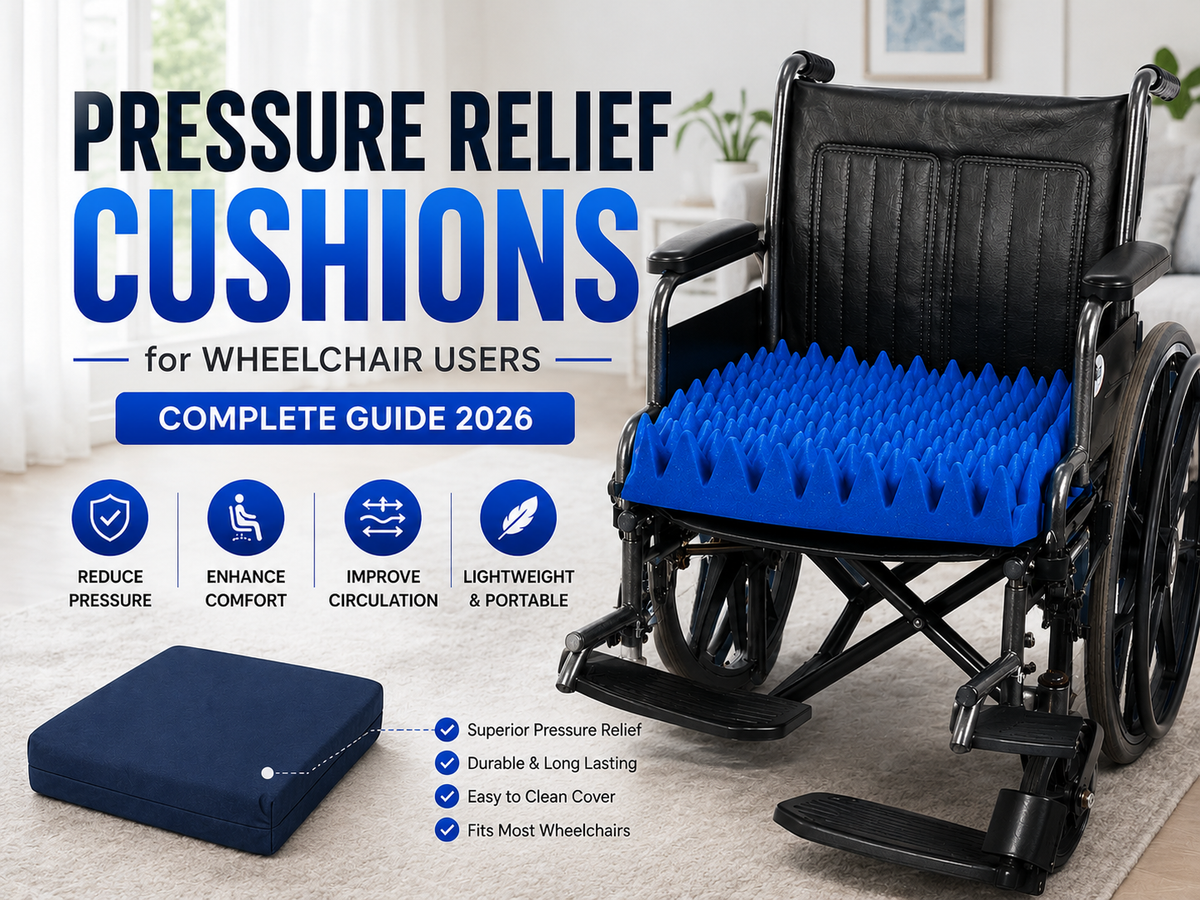
Foam cushions are the most widely used option. They work by conforming to the seated user's shape, spreading pressure over a larger contact area. Contoured and memory foam designs outperform flat foam by cradling the ischial tuberosities and distributing weight more evenly. Flat foam cushions are suitable for low-risk or part-time wheelchair users but are not adequate for moderate or high-risk users.
Best for: Part-time wheelchair users, low-risk users, everyday comfort. Replace every 12–18 months of daily use when foam no longer rebounds.
Gel Cushions
Gel cushions use a viscous gel layer that flows away from high-pressure points, redistributing forces across the seating surface. Most gel cushions combine a gel layer over a foam base for both pressure relief and structural support. They require no maintenance beyond cleaning and are a strong choice for moderate to high-risk users who sit 4–8 hours daily.
Best for: Moderate-risk users, daily wheelchair users. Replace if gel migrates or leaks (typically every 2–3 years).
Air Flotation Cushions
Air cushions use interconnected inflatable cells that equalize pressure through airflow, achieving the lowest interface pressures of any cushion type. They are the clinical gold standard for highest-risk users — full-time wheelchair users with significant sensory loss or a history of Stage 2+ pressure injuries. Air cushions require periodic inflation checks to maintain performance.
Best for: Full-time wheelchair users, users with complete sensory loss, history of pressure ulcers. Lifespan 3–5 years with proper maintenance.
Gel-Foam and Air-Foam Hybrid Cushions
Hybrid cushions combine two materials to balance pressure redistribution and structural support. A gel or air layer on top handles pressure relief; a foam base provides stability and maintains seating height. These are often the most practical choice for moderately high-risk users who need strong pressure relief without the complexity of a pure air cushion.
How to Choose the Right Cushion
Selecting the right cushion requires matching the cushion type to the user's risk level, measuring for correct size, and considering positioning needs alongside pressure relief.
Size Matters
The cushion should match the internal seat width and depth of the wheelchair precisely. A too-wide cushion forces the thighs outward; a too-narrow cushion leaves pressure concentrated at the seat edges. Measure the wheelchair's internal seat width and seat depth before ordering. Most standard manual wheelchairs use 16" or 18" wide seats. Cushion thickness (typically 2"–4") affects footrest height — adjusting footrests after changing cushion thickness is essential to keep thighs parallel to the floor.
Cover Selection
For users managing incontinence, a fluid-impermeable, two-way stretch cover is essential. Moisture dramatically softens and weakens skin, accelerating pressure injury development. Two-way stretch covers allow the cushion material to fully conform to body contours without the cover restricting pressure redistribution.
Pressure Relief Cushions at AllCare Store
Contoured Memory Foam Wheelchair Cushion
Pre-contoured viscoelastic memory foam with ischial cutout design. Spreads weight across a wider surface while relieving pressure directly over the sitting bones. Available in 16", 18", and 20" widths with 3" and 4" thickness options. Includes machine-washable stretch cover. Suitable for low to moderate risk users.
Gel-Over-Foam Pressure Relief Cushion
Dual-layer cushion with 1.5" gel layer over high-density foam base. The gel redistributes pressure dynamically; the foam provides stable seating support. Fluid-resistant, two-way stretch cover included. Appropriate for moderate-risk users sitting 4–8 hours daily.
Inflatable Air Cell Wheelchair Cushion
Interconnected air-cell system for highest-risk users. Includes calibrated hand pump, inflation guide, vapor-permeable cover, and moisture-impermeable liner. Recommended for full-time wheelchair users with significant sensory loss or history of pressure injury.
Bariatric Gel-Foam Cushion
Engineered for users over 250 lbs. High-density foam and reinforced gel layer rated to 600 lbs. Available in 20" and 22" widths. Standard cushions bottom out under bariatric loads — this cushion maintains pressure redistribution performance across the full weight range.
Browse all options at AllCare Store Wheelchair Accessories. Free shipping on all orders. Call us at 1-888-889-6260 for guidance on selecting the right cushion.
Cushion Care and Replacement
Foam: spot clean only; replace every 12–18 months or when foam no longer rebounds. Gel: store flat to prevent migration; replace if gel leaks. Air: check inflation weekly; use repair kit for minor punctures; replace if cells fail to hold air. Any cushion showing degraded pressure relief performance should be replaced immediately regardless of age.
The Limits of Cushions: Weight Shifting Still Matters
Even the best cushion does not eliminate the need for periodic pressure relief through repositioning. Clinical guidelines recommend a weight shift — leaning forward, side-to-side, or performing a push-up lift — for at least 30–60 seconds every 15–30 minutes. Cushions extend safe sitting time between repositioning events; they do not replace it.
Frequently Asked Questions
What is the best pressure relief cushion for a wheelchair?
For highest-risk users (full-time wheelchair use, significant sensory loss, history of pressure ulcers), an air flotation cushion provides the best clinically demonstrated pressure redistribution. For moderate-risk users, a gel-over-foam hybrid is the most practical high-performance choice. Low-risk or part-time users are well served by a contoured memory foam cushion. A clinical seating assessment is the most reliable starting point for anyone with significant pressure injury risk.
How often should a wheelchair cushion be replaced?
Standard foam cushions should be replaced every 12–18 months of daily use. Contoured memory foam lasts 18–24 months. Gel-foam hybrids last 2–3 years. Air flotation cushions last 3–5 years with proper maintenance. Replace any cushion that shows degraded performance — foam that won't rebound, leaking or migrated gel, or air cells that won't hold inflation — regardless of age.
Does Medicare cover wheelchair cushions?
Yes. Medicare Part B covers wheelchair cushions as durable medical equipment (DME) when prescribed by a physician and supplied by a Medicare-enrolled DME provider. Coverage level varies by cushion type and documented medical necessity. Medicare typically covers 80% of the approved amount after the deductible. Consult your physician and a Medicare DME supplier for the specific coverage pathway for your situation.
What size wheelchair cushion do I need?
Measure the internal seat width and seat depth of your wheelchair. The cushion should match these dimensions precisely. A cushion that is too wide forces the thighs outward; too narrow leaves gaps at the seat edges. Most standard manual wheelchairs use 16" or 18" wide seats. After changing cushion thickness, adjust footrest height so your thighs remain parallel to the floor with feet flat on the footrests.