Medical Disclaimer: This article is for informational purposes only and does not constitute medical advice. Consult your physician, physical therapist, or occupational therapist before selecting a walking aid to ensure it is appropriate for your specific condition and mobility needs.
The Core Question: What Do You Need From a Walking Aid?
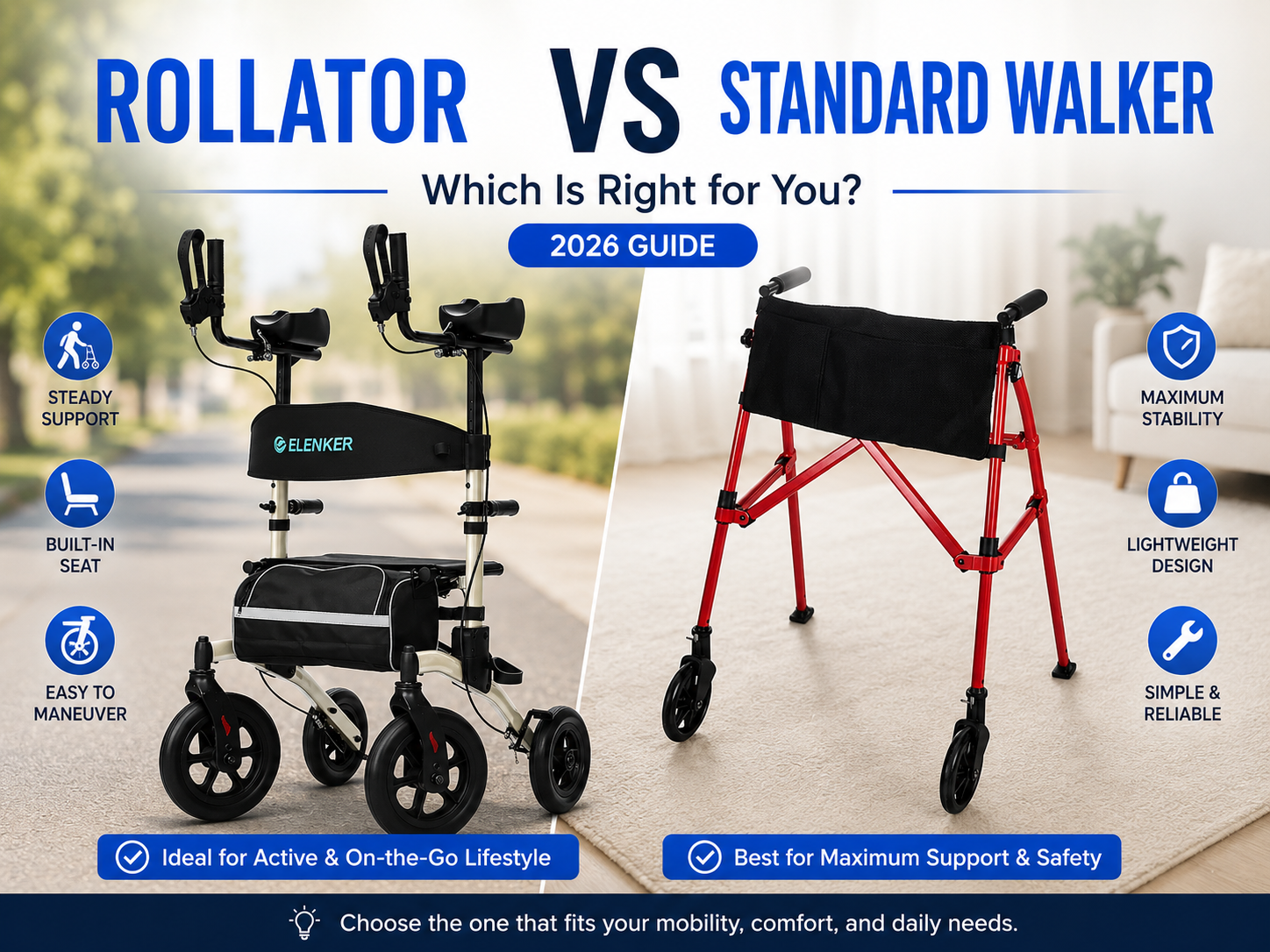
Walkers and rollators both help people with balance, stability, or strength challenges walk more safely — but they work differently and suit different users. Choosing the wrong type can actually reduce safety rather than improve it. A standard walker provides maximum stability and control; a rollator offers greater mobility and convenience. The right choice depends on your specific balance needs, strength, endurance, and daily activities.
AllCare Store carries both standard walkers and rollators across a range of designs so you can find exactly the right fit.
What Is a Standard Walker?
A standard walker is a four-legged frame — typically aluminum — that the user lifts and places forward with each step. It provides four stable contact points with the ground at all times during the standing phase of the gait cycle. Standard walkers have no wheels (though two-wheeled "front-wheeled" walkers are a common variant that glide forward rather than being fully lifted).
Types of Standard Walkers
Pick-up (lift) walker: No wheels. The user lifts the walker forward with each step, then steps into it. Provides the most stability of any walker type but requires enough upper body strength and coordination to lift it with each stride. Best for users who need maximum support and move slowly.
Two-wheeled (front-wheeled) walker: Front legs have wheels; rear legs have rubber tips that drag for resistance. The user pushes the walker forward rather than lifting it, creating a more natural gait pattern. Slightly less stable than a full lift walker but easier for users with limited arm strength or endurance. A common compromise between maximum stability and ease of movement.
What Is a Rollator?
A rollator (also called a rolling walker or wheeled walker) has three or four wheels, handlebars, and hand-operated brakes. Unlike a standard walker, a rollator rolls continuously with the user — it is never lifted. Most rollators also include a padded seat and underseat storage basket, allowing users to rest when needed. Three-wheel rollators are more maneuverable in tight spaces; four-wheel rollators are more stable and better suited for outdoor use.
Rollator vs Standard Walker: Side-by-Side Comparison
| Feature | Standard Walker | Rollator |
|---|---|---|
| Stability | Maximum — 4 stationary contact points | Moderate — requires brake use for full stability |
| Gait pattern | Interrupted (lift-step-step) | Continuous, more natural walking motion |
| Upper body strength needed | Moderate to high (lift walker) / Low (front-wheeled) | Low — push only, no lifting |
| Seated rest option | No | Yes — built-in padded seat |
| Storage | None (accessories available) | Underseat basket included on most models |
| Indoor maneuverability | Good in small spaces | Requires more turning radius (especially 4-wheel) |
| Outdoor/uneven terrain | Limited (rubber tips catch on cracks) | Better (larger wheels handle uneven surfaces) |
| Weight | Lighter (typically 5–7 lbs) | Heavier (typically 13–18 lbs) |
| Best for | Significant balance impairment, slow gait, post-surgery recovery | Better endurance, community ambulation, need for rest stops |
When to Choose a Standard Walker
A standard walker is the right choice when maximum stability is the priority. Key indicators:
- Significant balance impairment: Users who need four firm ground contact points to stand and step safely. A rollator's wheels can roll away if not braked, which is dangerous for users with poor balance control.
- Post-surgical recovery: After hip replacement, knee replacement, or lower-limb surgery, weight-bearing restrictions and balance are often severely limited. A lift walker provides the rigid, controlled support needed during early rehabilitation.
- Slow, deliberate gait: Users who move one careful step at a time benefit from the full-stop-between-steps pattern of a standard walker.
- Primarily indoor use in small spaces: Standard walkers turn easily in tight spaces — bathrooms, narrow hallways — where a four-wheeled rollator can be difficult to maneuver.
- Stroke recovery with hemiplegia: Users with significant one-sided weakness may find that a standard walker provides better support than a rollator.
When to Choose a Rollator
A rollator is the better choice when the user has adequate balance control but needs support for endurance, stability during longer distances, or the ability to rest mid-walk. Key indicators:
- Community ambulation: Shopping, errands, walking to appointments. A rollator's continuous rolling motion, storage basket, and built-in seat make it far more practical than a standard walker for longer outings.
- Fatigue and endurance limitations: Users with heart or lung conditions, Parkinson's disease, or general deconditioning who need to stop and rest frequently benefit greatly from a rollator's built-in seat.
- Parkinson's disease: Many people with Parkinson's find the continuous forward motion of a rollator easier to manage than the stop-lift-step pattern of a standard walker, which can freeze gait. A rollator supports a more natural stride rhythm.
- Outdoor use: Rollators with larger (6"–8") wheels handle sidewalk cracks, grass, and gravel far better than standard walkers with rubber tips.
- Limited arm strength: Users who cannot comfortably lift a standard walker with each step find the push-only motion of a rollator much easier to manage.
The Two-Wheeled Walker: A Middle Ground
For users who need more stability than a rollator provides but find a lift walker too tiring, a two-wheeled (front-wheeled) walker is often the ideal compromise. The front wheels glide forward; the rear rubber tips drag slightly, providing resistance that prevents the walker from rolling away. The user pushes the walker rather than lifting it, creating a smoother gait without the braking discipline required by a rollator. Physical therapists frequently recommend front-wheeled walkers as a transition between full lift walkers and rollators during rehabilitation.
Sizing: Getting the Right Fit
An improperly sized walker or rollator is uncomfortable at best and unsafe at worst. To find the correct handle height: stand upright with arms relaxed at your sides. The handle grip should align with your wrist crease. When gripping the handles, your elbows should be slightly bent — approximately 15–20 degrees of flexion. If handles are too high, you'll be hunched and bear too much weight on your wrists. Too low, and you'll lean forward unsafely.
Most standard walkers and rollators offer adjustable handle heights. Check the adjustment range before purchasing to confirm it covers your height. Rollators also require seat height to be matched — when sitting on the rollator seat, feet should rest flat on the floor with hips and knees at approximately 90 degrees.
Walking Aids at AllCare Store
Standard Aluminum Lift Walker
Lightweight aluminum frame (6 lbs) with push-button height adjustment. Folds flat for transport and storage. Non-skid rubber tips on all four legs. Available in standard and bariatric widths. Supports up to 300 lbs standard / 500 lbs bariatric.
Two-Wheeled Front-Wheeled Walker
Front wheel glide with rear rubber tip drag resistance. Height-adjustable handles. Folds for transport. A popular transition aid between full lift walkers and rollators, recommended by physical therapists for users progressing through rehabilitation.
Four-Wheel Rollator with Seat
Sturdy steel frame with 6" wheels, padded seat, backrest, and underseat storage basket. Loop-style hand brakes. Height-adjustable handles. Suitable for indoor and light outdoor use. Folds compactly for vehicle transport. Weight capacity 300 lbs.
Heavy-Duty Outdoor Rollator
Larger 8" wheels for outdoor terrain — sidewalks, grass, light gravel. Reinforced frame rated to 400 lbs. Padded seat and large underseat basket. Ergonomic handlebars with locking brakes. Available in standard and tall user configurations.
Three-Wheel Rollator
Tri-wheel design for maximum indoor maneuverability. Tighter turning radius than four-wheel models — ideal for small apartments, narrow hallways, and confined retail spaces. Does not include a seat; not suitable as primary support for users with significant balance impairment.
View the full range at AllCare Store Walkers & Rollators. Free shipping on all orders. Call 1-888-889-6260 for personalized guidance.
Tips for Using Your Walker or Rollator Safely
Regardless of which type you choose, safe use habits matter as much as the device itself. Always engage rollator brakes before sitting or standing. Never use a rollator as a wheelchair — it is not designed to be pushed while occupied. On stairs, a walker or rollator cannot be used safely; use a handrail and step carefully, or consider a stair lift for frequent stair navigation. On slopes, engage rollator brakes to prevent rolling. Check rubber tips and wheels regularly — worn tips reduce friction and increase fall risk.
Frequently Asked Questions
What is the difference between a rollator and a walker?
A standard walker is a four-legged frame that is lifted forward with each step, providing maximum stability. A rollator has wheels (usually 3 or 4), handlebars with brakes, a built-in seat, and rolls continuously with the user — it is never lifted. Standard walkers offer greater stability for users with significant balance impairment. Rollators provide easier movement, a natural gait pattern, and a built-in seat for users with adequate balance who need support over longer distances or for daily community use.
Is a rollator better than a walker for seniors?
It depends on the individual's balance, strength, and activity level. A rollator is better for seniors who are active in the community, have adequate balance control, and benefit from a built-in seat for rest stops. A standard walker is better for seniors with significant balance impairment, those recovering from surgery, or those who move slowly and need maximum stability. Many seniors transition from a standard walker during recovery to a rollator for long-term community use. A physical therapist can make the most accurate recommendation for a specific person's situation.
Can I use a rollator instead of a walker after hip replacement?
In most cases, a standard lift walker is prescribed immediately after hip replacement surgery because it provides more controlled, stable support during the early recovery phase when balance and weight-bearing are significantly limited. As recovery progresses and your physical therapist clears you for greater mobility, transitioning to a front-wheeled walker or rollator may be appropriate. Always follow your surgical team's and physical therapist's specific guidance on which walking aid to use at each stage of hip replacement recovery.
What size rollator do I need?
Handle height should align with your wrist crease when standing upright with arms relaxed, resulting in a slight elbow bend (15–20 degrees) when gripping. Seat height should allow feet to rest flat on the floor with hips and knees at approximately 90 degrees when seated. Most standard rollators accommodate users 5'0"–6'2"; tall rollators are available for users up to 6'6". Bariatric models with wider frames and higher weight capacities (400–500 lbs) are also available. Measure your wrist crease height before purchasing to confirm the model's adjustment range covers your measurement.