Medical Disclaimer: This article is for informational purposes only and does not constitute medical advice. Bed rail selection and installation for elderly individuals — especially those with cognitive impairment, high fall risk, or complex medical needs — should involve a physician, occupational therapist, or home safety specialist.
Falls from Bed: A Serious and Preventable Risk
Falls from bed are among the most common and serious home accidents for older adults. They can cause hip fractures, head injuries, and a significant loss of confidence and independence. Many bed falls occur during nighttime repositioning, when rising to use the bathroom, or during that disoriented moment of waking. A well-chosen, properly installed bed rail provides something crucial: a stable handhold and a physical boundary that reduces the risk of rolling out of bed or falling during the transition from lying to standing.
AllCare Store carries a full range of bed rails and safety aids for elderly adults and caregivers.
Who Benefits from Bed Rails?
Bed rails are most beneficial for seniors who:
- Have difficulty sitting up from lying down without assistance
- Need something to grip when getting in or out of bed
- Are at risk of rolling out of bed during sleep (due to restlessness, medication, or neurological conditions)
- Have had a recent fall or near-fall in or around the bed
- Are recovering from surgery or illness affecting mobility
- Have one-sided weakness from stroke or other conditions
Bed rails are not appropriate for every older adult. Individuals with dementia or severe cognitive impairment may attempt to climb over bed rails, creating a greater fall hazard. In these cases, a low bed or floor mat alongside the bed is often safer. An occupational therapist can conduct a home assessment to identify the most appropriate fall prevention approach.
Types of Bed Rails for Seniors
Half Bed Rails (Assist Rails)
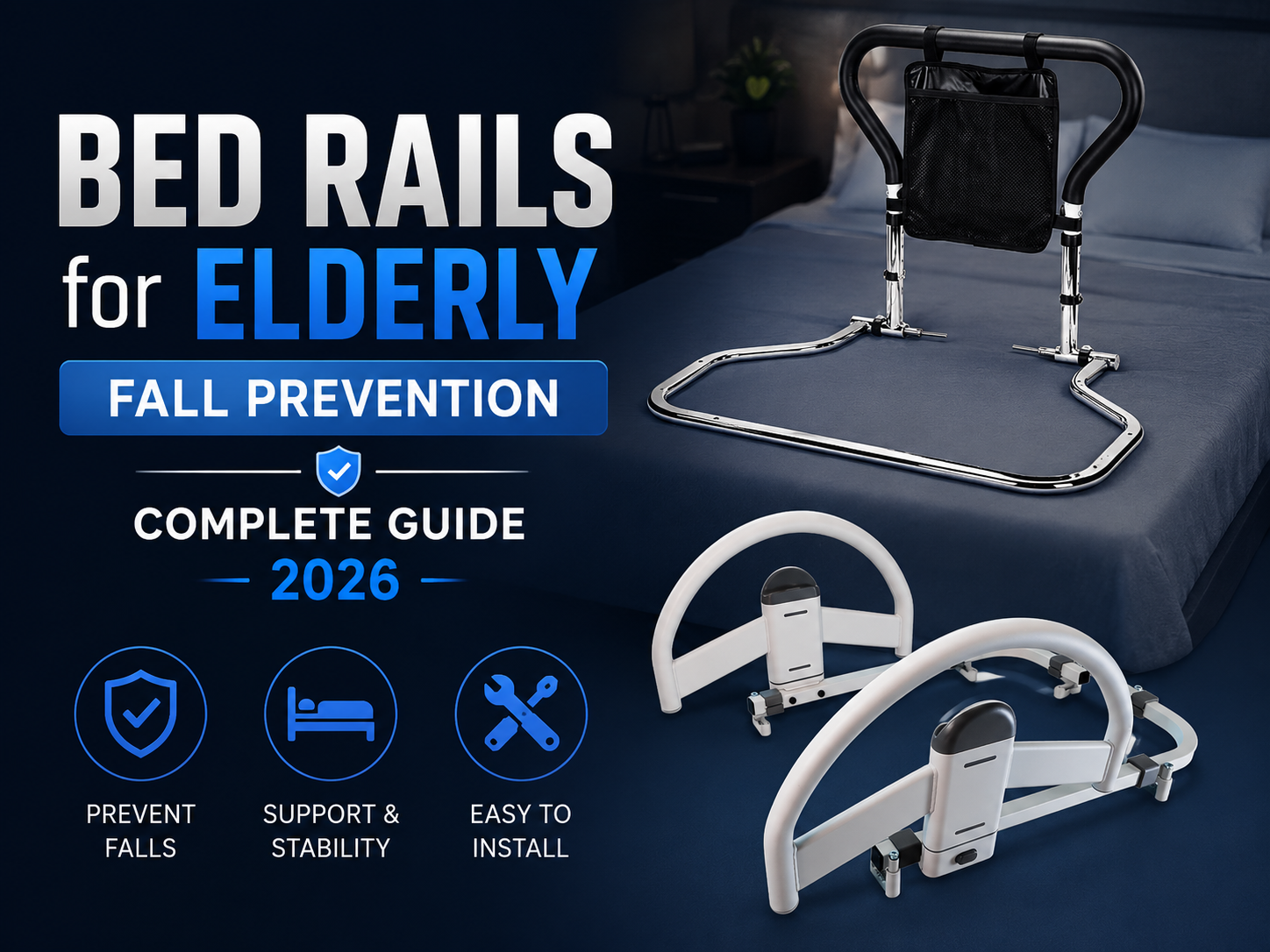
The most commonly recommended bed rail for elderly adults who live at home. Half rails extend only along the upper half of the bed, positioned at the head end. They provide a secure handhold for repositioning and for pushing up to a seated position, but do not run the full length of the bed — reducing the entrapment risk associated with full-length rails. Most half rails insert under the mattress or attach between the mattress and box spring for stability without requiring tools or bed frame modifications.
Best for: Seniors who need assistance getting in and out of bed; home use; users without cognitive impairment who won't attempt to climb the rail.
Full-Length Bed Rails
Full-length rails run along the full side of the bed and serve primarily as a containment barrier to prevent rolling out of bed. They are standard equipment on hospital beds and used in care facilities. For home use with elderly adults, full-length bed rails carry a higher entrapment and asphyxiation risk — the FDA has issued warnings about entrapment between the mattress and full-length rail — and should only be used when clearly indicated and properly fitted to the specific bed and mattress combination.
Best for: Hospital or care facility use under professional supervision; home use only with careful attention to mattress fit and entrapment risk assessment.
Folding Bed Rails
Folding bed rails hinge down during the night for easy in/out access and fold up during the day or when not needed. A convenient option for users who don't need a permanent rail but want one available for nighttime or when they're not feeling well. Most folding designs are half-rail style.
Bed Grab Bars / Bedside Handle Stands
Freestanding bedside handle stands (sometimes called bed grab bars or bed canes) do not attach to the bed frame at all — they slide under the mattress and are held in place by the mattress's weight. They provide a single sturdy post or T-bar for gripping during repositioning or transfer. Simpler than a full rail and easily repositioned, they are a popular first step in bed safety for seniors with mild difficulty transitioning. Some models include a side pocket for storing a phone, remote, or glasses within easy reach.
Best for: Mild to moderate difficulty with repositioning; users who don't need containment, just a handhold; renters who can't modify the bed frame.
Adjustable Height Bed Rails
Adjustable-height rails fit beds at different mattress heights, including the lower-profile mattresses common on adjustable bases and platform beds. They are important for users with thicker mattresses — a rail that was designed for a standard mattress height may not provide adequate above-mattress grip height on a thick pillow-top or hybrid mattress.
Key Safety Considerations
Entrapment Risk
The most serious safety concern with bed rails is entrapment — the risk that a person becomes caught between the rail and mattress, between two rails, or in gaps within the rail structure. The FDA has documented serious injuries and deaths from bed rail entrapment, primarily with full-length rails that are improperly fitted to the mattress. To minimize entrapment risk: choose rails designed for home use and half-rail style where possible; ensure there are no gaps larger than 4 inches between the rail and mattress; ensure the rail is rated for the specific mattress type and thickness; and never use a rail on a mattress that has shifted or sagged significantly.
Cognitive Impairment
Individuals with dementia, delirium, or significant cognitive impairment may attempt to climb over bed rails, dramatically increasing fall risk and injury severity. For this population, alternative fall prevention strategies — low beds (beds that adjust close to the floor), floor mats alongside the bed, and motion sensor alarms — are generally safer than raised rails. Discuss this with the person's physician or care team.
Correct Installation
A rail that shifts, tilts, or pulls out from under the mattress provides no safety benefit and creates a hazard. Follow manufacturer installation instructions precisely. Most under-mattress rails require the user to insert the anchor board fully beneath the mattress, with the mattress weight securing it. After installation, test the rail by applying body weight before the first use. Re-check stability monthly and after any mattress change.
Rail Height
The rail should extend high enough above the mattress surface to provide a firm grip for someone pushing up from a lying position. Typically, 8"–12" of above-mattress rail height is recommended. Too low and it doesn't provide adequate leverage; too high and it becomes a barrier to natural in/out transitions. Check the above-mattress height specification for the mattress thickness you're using.
Bed Rails at AllCare Store
Half-Length Bed Assist Rail
Sturdy steel half-rail designed for home use. Inserts between mattress and box spring — no tools required. Padded grip area at top for comfortable handhold. Fits standard, queen, and king mattresses. Weight capacity 250 lbs. Folds down for easy bed access. Includes under-mattress support board for added stability.
Adjustable Bed Safety Rail
Height-adjustable half-rail accommodating mattresses 6"–14" thick. Adjustable rail height above mattress (9"–11"). Angled top bar for ergonomic gripping during sit-to-stand transitions. Side storage pouch included. Weight capacity 300 lbs. Suitable for standard, pillow-top, and memory foam mattresses.
Freestanding Bed Grab Bar
T-bar style grab post that slides under the mattress — no frame attachment required. Post height adjustable from 26"–32". Side organizer pocket for phone, remote, glasses. Works on any bed without modification. A simple, non-permanent solution for users who need a handhold but not a full rail. Weight capacity 300 lbs.
Hospital-Style Folding Bed Rail
Institutional-grade folding rail for users requiring a more substantial safety barrier. Full-fold design drops completely out of the way. Reinforced hinge with locking pin at both raised and lowered positions. Compatible with adjustable bases and standard beds. Weight capacity 400 lbs. Used in both home care and facility settings.
Low Bed Mat (Non-Slip Floor Pad)
For users with dementia or high fall risk where a raised rail is contraindicated, a padded floor mat positioned alongside the bed reduces injury severity if a fall does occur. Used alongside low-profile bed settings and motion sensor alarms as part of a comprehensive fall prevention strategy.
Browse all bed safety products at AllCare Store Bedroom & Bathroom Safety. Free shipping on all orders. Call us at 1-888-889-6260 for guidance.
Beyond Bed Rails: A Complete Bedroom Fall Prevention Approach
Bed rails are one part of a broader bedroom safety strategy. Other important measures include: ensuring adequate lighting along the path from bed to bathroom (nightlights or motion-sensor lights); removing trip hazards such as loose rugs; keeping frequently needed items (phone, glasses, water) within reach so the person doesn't need to get up unexpectedly; placing a non-slip mat at the bedside for first-step traction; and considering a bed alarm that alerts caregivers when a high-risk individual attempts to get up unassisted.
For individuals with a history of falls, an occupational therapist home assessment is one of the most effective evidence-based interventions available. OTs can identify specific hazards and recommend targeted solutions — including whether a bed rail is appropriate, and which type — based on a thorough evaluation of the individual's needs, cognition, and home environment.
Frequently Asked Questions
Are bed rails safe for the elderly?
Half-length bed rails designed for home use are generally safe for elderly adults without cognitive impairment when properly installed and matched to the correct mattress. They significantly reduce bed fall risk by providing a stable handhold and physical boundary. However, full-length bed rails carry a higher entrapment risk and should be used cautiously. Bed rails are not recommended for individuals with dementia or cognitive impairment who may attempt to climb over them — alternative strategies such as low beds, floor mats, and motion alarms are safer for this population.
What is the best bed rail for elderly people at home?
For most elderly adults living at home, a half-length bed assist rail is the best choice. It provides a firm handhold for repositioning and getting in/out of bed without the entrapment risks associated with full-length rails. Look for a model that fits your specific mattress thickness, installs securely without tools, and has a padded grip area at a comfortable height above the mattress surface. An adjustable model that accommodates your mattress depth is ideal if you have a pillow-top, memory foam, or thick hybrid mattress.
How do I install a bed rail safely?
Most home bed rails install by inserting an anchor board fully under the mattress, with the mattress weight securing it in place. Follow the manufacturer's instructions exactly for your specific rail and mattress combination. After installation, test the rail by applying your full body weight in the direction you would grip it — it should not shift, tilt, or pull out. Check for any gaps between the rail and mattress larger than 4 inches (an entrapment risk). Re-test stability monthly and whenever the mattress is changed or moved.
Does Medicare cover bed rails for the elderly?
Medicare Part B may cover bed rails as durable medical equipment (DME) when they are prescribed by a physician as medically necessary, provided by a Medicare-enrolled DME supplier, and meet coverage criteria. Coverage typically applies to half-rails prescribed for a specific medical condition. Standard consumer bed rails purchased without a prescription are generally not covered. Contact your physician and a Medicare DME supplier to determine whether bed rails are covered for your specific medical situation.
What is the difference between a bed rail and a bed grab bar?
A bed rail is a frame that runs along the side of the bed, providing both a handhold and a physical barrier that prevents rolling out of bed. A bed grab bar (or bedside handle stand / bed cane) is a single post or T-bar that slides under the mattress and provides a handhold for repositioning — but does not form a containment barrier along the bed side. Grab bars are simpler, easier to reposition, and carry less entrapment risk. They are ideal for users who need a handhold for sit-to-stand transitions but do not need a full barrier.