The Room Where It Usually Happens
Frank is 76, a retired electrician, and by his own description "not the type to need a chair in the shower." He had wired half the houses on his street. He was not going to be defeated by his own bathtub.
What his daughter Renee noticed, on a visit that spring, was that her father had started taking what he called "quick washes" at the sink. The shower, it turned out, had quietly become a place he avoided. Getting over the tub wall meant balancing on one foot on a wet, slick surface with nothing solid to hold. He had done it a thousand times without thinking. Now he thought about it every time, and thinking about it was the problem.
Then one morning he slipped. He didn't fall all the way down — he caught himself hard on the towel bar, which bent, and he wrenched his shoulder badly enough that he couldn't lift his arm for a month. He was lucky, and he knew it. The towel bar was not designed to hold a grown man's weight, and the next slip might not end with a bruise.
The bathroom is, statistically, one of the most dangerous rooms in the house. Research has found that roughly 235,000 Americans are treated in emergency rooms every year for injuries that happen in the bathroom, and the area in and around the tub and shower is where the largest share of those injuries occur. Wet tile, a high tub wall, soap, a single unsteady moment — the ingredients are always present. For anyone with arthritis, a recent surgery, neuropathy, low blood pressure, or simply the balance changes that come with age, a place to sit and something solid to hold turn a genuinely hazardous activity back into an ordinary one.
The good news is that the fix is neither expensive nor complicated. A good shower chair or bench costs less than a nice pair of shoes, installs in minutes, and gives back something most people don't realize they've lost until it's gone: a real shower, taken calmly, without fear. This guide walks through the whole category — what the different seats actually do, how to pick the right one for your bathroom, and the two accessories that matter more than the seat itself.
First, the Distinction That Changes Everything: Chair vs. Bench vs. Transfer Bench
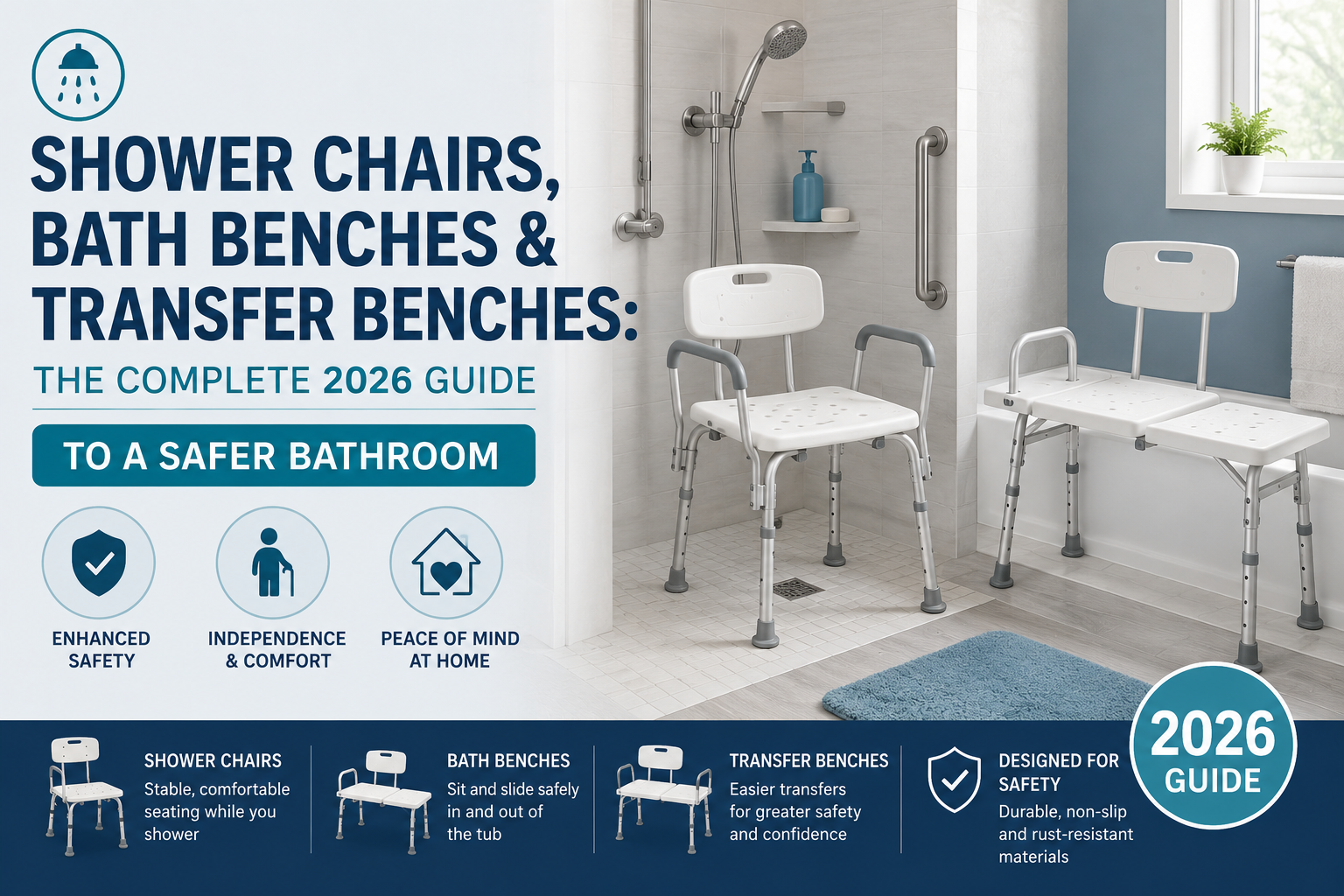
These three products look similar, cost about the same, and are constantly confused — but they solve different problems. Getting this one decision right matters more than any brand or feature.
A Shower Chair or Bath Bench sits inside the shower or tub
All four legs stand on the shower floor or inside the tub. You get to it under your own power, turn, and sit. This is the right choice when the person can already step into the shower safely — a curbless or low-threshold walk-in shower is ideal — and simply needs to sit while washing rather than stand for the whole time. It's the simplest, least expensive, most compact option.
A Transfer Bench bridges the tub wall
A tub transfer bench is longer. Two legs stand outside the tub and two stand inside, so the seat spans the tub wall. The person sits down on the outside end — on dry ground, no stepping over anything — and then slides across to the inside, lifting their legs over the wall one at a time while already seated. For anyone with a standard high-walled bathtub, this is very often the single most important piece of equipment in the house, because stepping over the tub wall is the exact moment most bathroom falls happen. A transfer bench removes that moment entirely.
A Sliding Transfer Bench does the moving for you
A step up from a standard transfer bench, the seat itself slides on a track, so the user (or a caregiver) doesn't have to scoot across the surface. These are the easiest on the hips and shoulders and the kindest to a caregiver's back, at a higher price.
The quick test: if the bathing space is a walk-in shower, you probably want a shower chair or bench. If it's a bathtub with a wall to climb over, you almost certainly want a transfer bench. You can compare both side by side in the Bath & Shower Benches collection.
The Types, One by One
Basic Shower Stool (No Back, No Arms)
A simple four-legged seat with a textured, drainage-holed top. Lightweight, inexpensive, and easy to move or store. Best for someone with good trunk control and balance who just wants to sit and conserve energy. The Carex Composite Bath Bench (around $81) is a corrosion-proof, tool-free example that assembles in minutes.
Shower Chair With a Back
Adds a backrest for support and confidence — the difference is bigger than it sounds for anyone who tires or feels unsteady sitting unsupported on a wet surface. The height-adjustable Blue Jay Shower Chair with Back (about $60) is a popular, well-stocked choice, and the ProBasics Shower Chair with a contoured seat and back (about $65) adds a shaped seat that many people find more comfortable for longer sits.
Shower Chair With Back and Arms
Armrests give you something to push against when standing back up, and a sense of security while seated. This is usually the sweet spot for older adults: back for support, arms for the sit-to-stand, adjustable legs for a proper fit.
Bath Bench With a Back (Full-Width Seat)
A wider, sturdier seat with a backrest, sized to sit inside a tub or a larger shower. The Adjustable-Height Bath Bench with backrest and removable padded arms (about $95) is a comfortable, full-featured option for daily use.
Folding & Portable Benches
If the bathroom is shared, storage is tight, or the seat needs to travel, a folding model earns its keep. The Folding Shower Chair (about $64) collapses to roughly four inches flat, and the Carex Portable Shower Bench (about $64) is built to move between bathrooms or come along on a trip.
Bariatric (Heavy-Duty) Models
Standard seats are typically rated to 250–300 pounds. For higher weights, a bariatric frame is not optional — it's a safety requirement. The Heavy-Duty Bariatric Bath Bench with Back (about $100) is rated for substantially more weight on a reinforced aluminum frame.
Tub Transfer Bench
As above — the bench that spans the tub wall. The Blue Jay line offers a transfer bench with a back (about $100) alongside its matching shower chair, so a household can standardize on one brand and look.
A Value Add-On Worth Knowing About
If a bench already at home is safe but the hard plastic seat is uncomfortable for longer bathing, a drainage-holed drop-in cushion or a shower safety bench with drainage holes and a back (about $53) can solve the comfort problem without a full replacement.
Comparison at a Glance
| Type | Best Bathing Space | Best For | Typical 2026 Price |
|---|---|---|---|
| Shower stool (no back) | Walk-in shower | Good balance, just needs to sit | $40–$85 |
| Shower chair w/ back & arms | Walk-in shower / large tub | Most older adults | $60–$130 |
| Full bath bench w/ back | Inside a bathtub | Daily seated bathing, more support | $80–$150 |
| Folding / portable | Shared or small bathrooms, travel | Storage-limited, on-the-go | $60–$110 |
| Bariatric bench | Tub or shower | Users above 300 lb | $100–$250 |
| Tub transfer bench | High-walled bathtub | Can't safely step over the tub wall | $90–$200 |
| Sliding transfer bench | High-walled bathtub | Caregiver-assisted, easiest transfer | $200–$400 |
How to Choose: A Five-Question Decision Guide
Skip the feature lists for a moment and answer these five questions honestly. They will point you to the right seat faster than any spec sheet.
1. Tub or walk-in shower? A bathtub with a wall to climb over almost always means a transfer bench. A curbless or low-threshold walk-in shower means a shower chair or bench.
2. Can the person step over the tub wall safely today — not on a good day, but on an average one? If there's any hesitation, treat the answer as no and choose a transfer bench. The tub wall is the hazard; design around it.
3. How much support does sitting require? Steady on a stool, or does the person need a back, arms, or both? When in doubt, get more support than you think you need. Nobody regrets a backrest.
4. What is the person's weight, and does it fluctuate? Match the frame to the highest realistic weight, then leave margin. An overloaded frame is exactly the wrong place to save money.
5. Is a caregiver involved? If someone is helping, a sliding transfer bench and a taller seat height save the caregiver's back and make the whole routine calmer and safer for both people.
Sizing and Weight Capacity: The Two Numbers People Skip
A seat that doesn't fit is a seat that gets used wrong, or not at all. Two measurements do most of the work.
Seat Height
Sit in a firm dining chair with feet flat and measure from the floor to the crease behind the knee. Your shower seat should match that height so the feet rest flat and the knees sit at roughly 90 degrees. Most quality chairs and benches have adjustable legs — set them so that standing up is as easy as possible, which usually means slightly higher rather than lower. A seat that's too low turns every shower into a deep squat.
Weight Capacity
Standard frames are typically rated to 250–300 pounds. If the user is anywhere near that, move up to a bariatric model rated well above their weight. Capacity ratings are not aspirational targets; they're limits, and wet plastic and aluminum are unforgiving.
Seat Width and Depth
The seat should support the hips and thighs comfortably without being so wide it won't fit the space. For a transfer bench especially, measure your tub's interior and exterior floor space so the legs land on stable, level surfaces on both sides.
Measure Your Bathroom Before You Buy
Five minutes with a tape measure prevents the most common return. Before ordering, note:
- Inside tub width (wall to wall at the floor) — a transfer bench must fit within it, with room for its inside legs to sit flat.
- Tub wall height — confirms how much of a barrier you're bridging.
- Floor space outside the tub — the bench's outside legs need a stable landing, clear of the toilet and vanity.
- Shower stall footprint — for a chair or bench that lives inside, make sure the door or curtain still closes and there's room to turn.
- Faucet and control position — you want to be able to reach the water controls and a handheld sprayer from the seated position.
The Two Accessories That Matter More Than the Seat
Grab Bars: Non-Negotiable
A place to sit solves fatigue. A place to hold solves balance — and balance is what fails during the transitions in and out of the seat. If you buy nothing else alongside the chair, buy grab bars. They are the single highest-value bathroom safety upgrade there is, and the store's Grab Bars collection covers every mounting style.
There are two families, and the difference is critical:
Screw-mounted grab bars anchor into wall studs or solid blocking and are the gold standard — strong enough to catch a real fall. A knurled chrome grab bar (from about $20, in lengths from 12 to 32 inches) gives a permanent, textured, non-slip handhold. These must be installed into structure, not just drywall; if you're unsure where the studs are or how to anchor into tile, have a handyman or contractor do it.
Suction grab bars like the suction grab bar with a safety indicator (about $19) install in seconds with no tools and include a colored window that shows green when the seal is secure. They are genuinely useful — but as balance aids and positioning handholds only, never as fall-arrest bars. Check the indicator every single time before you trust it, and re-seat it on clean, smooth, non-porous tile. For anyone at real risk of falling, a permanent screw-mounted bar is the one that saves you.
A Handheld Shower Sprayer
Once you're seated, a fixed overhead showerhead is aimed at where your head used to be. A handheld sprayer on a hose lets you direct the water while seated, rinse without standing, and wash safely without twisting or reaching. It's an inexpensive change that transforms how well a shower seat actually works in practice.
Setup and Everyday Safety
- Set the seat height with the tips level. Adjust all legs to the same height and confirm the bench doesn't rock before the first use.
- Check the rubber tips and suction feet. They are what keep the seat from sliding on wet tile. Inspect them regularly and replace worn ones — replacement tips and feet are inexpensive and sold separately.
- Add a non-slip mat inside the tub or shower floor for the moments you're standing, and a second absorbent mat outside for stepping off.
- Keep everything within reach. Soap, shampoo, and the sprayer should all be reachable from the seat so there's never a reason to stand and stretch.
- Transfer bench orientation matters. Position it so the person sits down on the outside (dry) end and slides in — never the reverse.
- Wear something on your feet in the transition. Non-slip footwear on the walk to and from the shower closes a surprising number of gaps.
- Keep a phone or a medical alert device reachable from the bathroom, ideally a waterproof pendant, so a fall doesn't become a long wait for help.
- Clean it simply. Rinse after use and periodically wash with mild soap; the drainage holes are there so water doesn't pool on the seat.
Does Medicare Pay for a Shower Chair? The Honest Answer
Mostly no — and it's better to know that going in than to be surprised.
Original Medicare (Part B) generally does not cover shower chairs, bath benches, transfer benches, or grab bars. Medicare classifies durable medical equipment as items that are "primarily medical in nature," and it treats bathroom safety equipment as convenience or self-help items rather than medical devices. It's frustrating, because these are exactly the products that prevent the falls Medicare then pays a great deal to treat — but as of 2026, that's the rule for Original Medicare.
There are, however, several real paths to help with the cost:
- Medicare Advantage (Part C) plans increasingly include over-the-counter and supplemental benefit allowances that can be used for bath safety equipment. Check your specific plan's OTC catalog and benefits — many people don't realize the allowance is there.
- Medicaid covers bath safety equipment in many states, frequently through Home and Community-Based Services (HCBS) waivers aimed at keeping people safely at home. Rules vary widely by state.
- The VA provides bathroom safety equipment to eligible veterans, often generously and as part of a home-safety evaluation.
- HSA and FSA funds can typically be used for shower chairs, transfer benches, and grab bars as qualified medical expenses — sometimes with a simple letter of medical necessity from your provider. For many buyers this is the easiest way to pay with pre-tax dollars.
- Area Agencies on Aging and local nonprofits sometimes offer grants, loan closets, or fall-prevention programs that provide equipment at no cost.
The practical takeaway: don't count on Original Medicare, do check a Medicare Advantage OTC benefit if you have one, and remember that even paying out of pocket, this is one of the least expensive pieces of safety equipment you will ever buy.
Common Mistakes to Avoid
- Buying a shower chair when the tub wall is the real problem. If stepping over the wall is the danger, an in-tub seat doesn't fix it — you need a transfer bench.
- Relying on a suction bar as a fall-arrest handle. Suction bars are for balance and positioning. Screw-mounted bars are for catching a fall. Don't confuse the two.
- Setting the seat too low. A low seat makes standing up a struggle. Use the adjustable legs and err slightly high.
- Ignoring weight capacity. Match the frame to the person with margin to spare.
- Grabbing the towel bar. Towel bars, soap dishes, and faucets are not weight-bearing. Frank's story is common. Install a real grab bar before it's needed.
- Skipping the handheld sprayer. A seated bath with a fixed overhead head is awkward at best. The sprayer is what makes the seat truly usable.
Why Shop Bath Safety at AllCare Store
AllCare Store stocks shower chairs, bath benches, tub and sliding transfer benches, bariatric models, grab bars, replacement tips and suction feet, and the rest of the bathroom safety category in one place — so a household can outfit a bathroom completely and correctly rather than piecing it together. Everything ships free within the U.S. in discreet packaging, with 30-day returns.
Bath safety is one of the categories where a two-minute phone call genuinely helps, because the right answer depends on your bathroom and your body: tub versus walk-in, who's transferring, weight, and how much support is needed. Our team helps people sort this out every day.
Start with the Bath & Shower Benches collection, add the Grab Bars collection, and browse the wider Bedroom & Bathroom Safety collection or the full Bath Care collection to complete the room.
Frequently Asked Questions
What is the difference between a shower chair and a transfer bench?
A shower chair sits entirely inside the shower or tub, so you have to get in first. A transfer bench is longer and spans the tub wall, with two legs outside and two inside, so you sit down outside the tub and slide across without ever stepping over the wall. If you have a bathtub and struggle to climb over the side, the transfer bench is usually the safer choice.
Do I need a shower chair with a back and arms?
Most older adults benefit from both. A backrest adds support and confidence when sitting on a wet surface, and armrests give you something to push against when standing back up. If balance or fatigue is a concern at all, choose back and arms.
How much weight can a shower chair hold?
Standard models are typically rated to 250–300 pounds. Bariatric models on reinforced frames hold considerably more. Always choose a capacity comfortably above the user's weight rather than right at the limit.
Are suction grab bars safe?
They're useful as balance aids and positioning handholds when installed on clean, smooth, non-porous tile and checked before every use — most include a colored indicator that shows green when the seal is secure. They should never be trusted to stop a real fall. For fall protection, use a permanent grab bar screwed into wall studs or solid blocking.
Will Medicare pay for a shower chair or transfer bench?
Original Medicare (Part B) generally does not, because it treats bathroom safety equipment as a convenience item rather than durable medical equipment. However, some Medicare Advantage plans include OTC or supplemental allowances that can cover it, many state Medicaid programs cover it through home-based waivers, the VA provides it to eligible veterans, and HSA/FSA funds usually qualify. Check your specific plan.
Can a shower chair be used in a walk-in shower with no tub?
Yes — a walk-in shower is actually the ideal setting for a standard shower chair or bench, since there's no tub wall to bridge. Just confirm the footprint fits and the door or curtain still closes.
How do I keep the chair from sliding on wet tile?
The rubber tips or suction feet on the legs provide the grip. Keep them clean and in good condition, replace them when worn, and add a non-slip mat on the shower floor for extra security.
What height should the seat be set to?
Match it to the height of a firm chair the person stands up from easily — usually so the feet rest flat and the knees are around 90 degrees. When in doubt, set it slightly higher, because a higher seat is easier to rise from.
Is a transfer bench hard to install?
No — most assemble tool-free in a few minutes and simply stand in place; no drilling required. Position it so the person sits down on the dry outside end and slides in, and confirm all four legs are level and stable before the first use.
What else should I add for a safer bathroom?
Grab bars first, then a handheld shower sprayer, non-slip mats inside and outside the tub, and a reachable phone or medical alert device. Many households also add a raised toilet seat or bedside commode and, near the bed, bed rails or a bed assist handle — the bathroom is rarely the only place that needs attention.
The Takeaway
A shower chair or bench doesn't announce itself as a big decision. It's a modest, inexpensive piece of equipment that quietly does something important: it takes the most dangerous room in the house and makes it ordinary again. Match the seat to the space — bench inside a walk-in shower, transfer bench across a tub wall — size it to the person, add a real grab bar and a handheld sprayer, and the daily shower stops being a risk to manage and goes back to being what it should be.
Frank has a transfer bench and two screw-mounted grab bars now. He still grumbles that he didn't need them. He also takes a real shower every morning, and Renee has stopped lying awake wondering about it. That trade — a little pride for a lot of safety — is one almost every family ends up glad they made.
Not Sure Which Seat Fits Your Bathroom? Let's Talk It Through.
AllCare Store stocks shower chairs, bath benches, tub and sliding transfer benches, bariatric models, grab bars, and every accessory to go with them. Browse the Bath & Shower Benches collection, the Grab Bars collection, and the Bedroom & Bathroom Safety collection to compare options.
Call 1-888-889-6260 to talk through tub-versus-shower, transfers, sizing, and weight capacity with a specialist, or visit AllCareStore.com. Free U.S. shipping, discreet packaging, and 30-day returns on every order.
This guide was written and reviewed by the AllCare Store editorial team. Product pricing and insurance rules change — verify current details with your supplier and your plan. For a personalized bathroom-safety assessment, ask your doctor for a referral to an occupational or physical therapist.
MEDICAL DISCLAIMER: This article is for general education and is not a substitute for professional medical advice or a home-safety assessment by a licensed occupational or physical therapist. Whether a shower chair, bath bench, or transfer bench is right and safe for a particular person depends on their balance, strength, skin condition, cognition, and the exact layout of the bathroom. Grab bars and any wall-mounted equipment must be anchored into studs or solid blocking by someone competent to do so; a bar that pulls out of the wall is more dangerous than no bar at all. If you have had a recent fall, new weakness, dizziness, or a change in your ability to stand or walk, talk with your doctor or therapist before relying on any bathing equipment.