Margaret's Story: The Longest Twenty Feet in the House
When Margaret came home after her hip surgery, everyone thought the hard part was over. She had her walker, her pain medication, and her daughter Susan staying in the guest room for the first two weeks. But nobody had thought about the bathroom. It was down the hall, twenty feet from the bed, and those twenty feet became the most stressful part of every day and, worse, every night.
The first night home, Margaret woke at 2 a.m. needing to use the toilet. She didn't want to wake Susan, so she gripped her walker and set off in the dark. Halfway down the hall, her legs began to tremble, the pain flared, and she had to lean against the wall and wait. By the time she reached the bathroom, she was exhausted, frightened, and close to tears. "I felt like a burden and a danger to myself at the same time," she later admitted.
The next morning, Susan ordered a bedside commode. It arrived, was assembled in minutes, and sat quietly beside the bed. That small change transformed Margaret's recovery. No more terrifying nighttime journeys. No more waking Susan. No more waiting in the hallway for her legs to cooperate. Margaret could take care of herself, on her own schedule, with dignity intact. "It gave me back a little bit of control," she said. "And when you're recovering, control is everything."
If you or someone you love is facing recovery, limited mobility, or the realities of aging in place, Margaret's story may sound familiar. A bedside commode is one of the simplest, most affordable pieces of home medical equipment you can buy, and for many families it makes the difference between anxiety and independence. This complete 2026 guide walks you through every type, how to choose and size one correctly, where to place it, how to keep it clean and odor-free, and what Medicare will and won't pay for.
What Is a Bedside Commode, and Who Needs One?
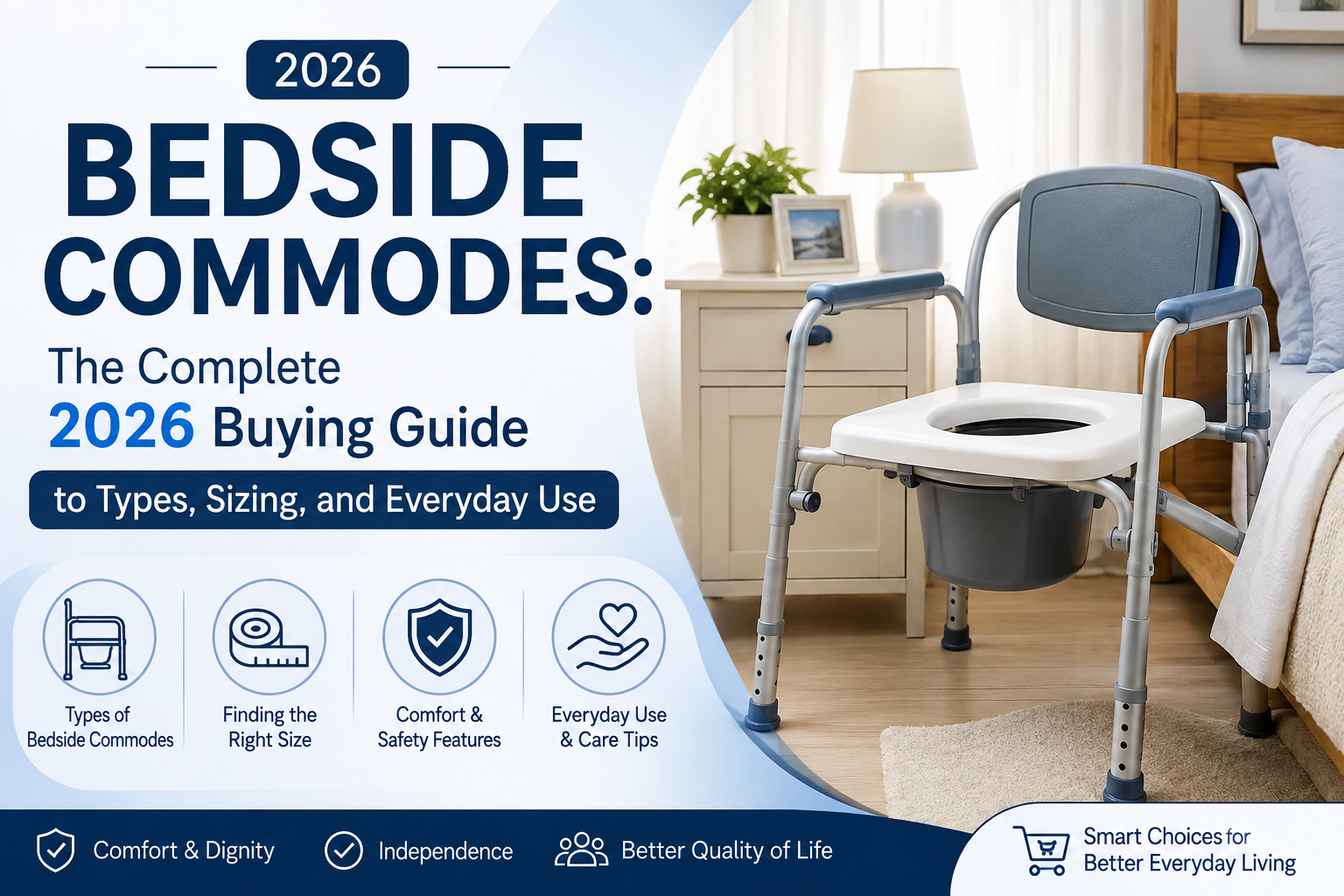
A bedside commode is a portable, chair-like toilet designed to be used next to the bed or anywhere in the home where reaching a bathroom is difficult or unsafe. Most models feature a sturdy frame, armrests for support, a toilet-style seat with a lid, and a removable bucket that can be emptied and cleaned. Many double as a toilet safety frame or a raised seat when placed directly over a standard toilet.
Commodes are commonly used by people who are:
- Recovering from surgery, especially hip, knee, back, or abdominal procedures
- Living with limited mobility due to arthritis, stroke, Parkinson's, or general frailty
- Managing incontinence or urgency that makes reaching a distant bathroom difficult in time
- At high risk of falling, particularly during nighttime bathroom trips
- Bedbound or largely confined to one room and cared for by family or professional caregivers
- Aging in place in a home where the bathroom is on a different floor or far from the bedroom
Nighttime is when a commode matters most. Studies consistently show that a large share of falls among older adults happen during trips to the bathroom after dark, when rooms are dim, the body is stiff, and balance is at its worst. Keeping a commode within arm's reach of the bed removes that risk almost entirely.
Types of Bedside Commodes: Finding the Right Match
Not all commodes are the same. The right one depends on the user's weight, strength, mobility, living space, and whether a caregiver is involved. Here are the main types.
3-in-1 Commode (The Versatile Standard)
The 3-in-1 commode is the most popular and most affordable style, and for good reason. It serves three functions: a standalone bedside toilet, a raised seat placed over an existing toilet, and a toilet safety frame with armrests. The legs are height-adjustable, and the bucket lifts out for cleaning. For most families buying their first commode, a 3-in-1 is the sensible starting point because it adapts as needs change.
Best for: General home use, recovery, first-time buyers, users who want maximum flexibility.
Drop-Arm Commode (Easiest Transfers)
A drop-arm commode has armrests that swing or lower out of the way, which makes side transfers dramatically easier and safer, especially when moving from a wheelchair or when a caregiver is assisting. Instead of lifting the user up and over a fixed arm, the arm drops so the person can slide across. The Bariatric Drop-Arm Commode Deluxe ($249.51) arrives fully assembled and combines drop-arm convenience with reinforced construction for heavier users.
Best for: Wheelchair users, caregiver-assisted transfers, anyone who cannot easily lift over a fixed armrest.
Folding Commode (Space-Saving and Travel-Friendly)
A folding commode collapses flat for storage or travel, making it ideal for small homes, guest use, or families who need to move the commode between rooms or take it on trips. Don't mistake foldability for flimsiness. The Bariatric Folding Commode ($159.99) supports up to 650 pounds while still folding down for easy storage, proving that portability and strength can coexist.
Best for: Small spaces, travel, occasional or backup use, homes where the commode must be tucked away.
Bariatric Commode (Heavy-Duty Support)
Bariatric commodes are built with reinforced frames, wider seats, and higher weight capacities, typically 500 to 650 pounds or more. They provide the stability and comfort that standard commodes cannot for larger individuals. Both the drop-arm and folding models above are engineered as bariatric units, so you don't have to sacrifice features to get the capacity you need.
Best for: Users over the weight limit of standard commodes, or anyone who wants extra stability and a wider seat.
Stationary / Fixed-Arm Commode (Budget-Friendly Simplicity)
A stationary commode has fixed arms and a simple, rugged frame. It is usually the least expensive option and works well for users who can transfer independently and don't need the arms to move. It trades flexibility for a lower price and fewer moving parts to maintain.
Best for: Independent users on a budget who don't require drop arms or over-toilet use.
Comparison Table: Commode Types at a Glance
| Type | Best Feature | Transfers | Typical Capacity | Best For |
|---|---|---|---|---|
| 3-in-1 | Versatility | Standard | 300 lbs | First-time buyers |
| Drop-Arm | Easy side transfers | Easiest | Up to 650 lbs | Wheelchair users, caregivers |
| Folding | Storage & travel | Standard | Up to 650 lbs | Small spaces, travel |
| Bariatric | Weight capacity | Varies | 500-650+ lbs | Larger users |
| Stationary | Low price | Independent only | 300 lbs | Budget, independent users |
Key Features to Consider Before You Buy
Once you know which type fits, these features separate a commode that helps from one that frustrates.
Weight Capacity
Always confirm the weight capacity before buying, and choose a model rated comfortably above the user's weight. A commode used past its limit is unstable and unsafe. Standard commodes typically hold 300 pounds; bariatric models like our 650 lb folding commode provide a wide margin of safety.
Adjustable Seat Height
Height-adjustable legs let you match the seat to the user's height so the knees sit at or slightly below hip level and the feet rest flat on the floor. This makes sitting and standing far easier and reduces strain on healing hips and knees. Look for tool-free, click-lock adjustment.
Armrests and Transfer Support
Sturdy, padded armrests give the user something to push against when standing. If the user transfers from a wheelchair or needs caregiver help, drop-arm or swing-away arms are worth the extra cost for the safety they add.
Seat Comfort and Size
A wider, contoured seat is more comfortable for extended use and for larger users. Some models offer padded or soft seats. Consider an elongated seat option ($60.53) if the user prefers the feel of a standard household toilet.
Bucket Capacity and Splash Guard
A larger bucket means fewer trips to empty it, which matters for overnight use and for caregivers. A splash guard (the plastic ring inside the bucket) improves hygiene and reduces mess. Look for a bucket with a carry handle and a lid.
Stability and Frame Construction
Non-slip rubber leg tips, a low center of gravity, and a welded steel frame keep the commode from shifting during transfers. Wobble is the enemy of confidence, so test stability before relying on any unit.
How to Size and Place a Commode Correctly
Even the best commode fails if it's the wrong height or in the wrong spot. A quick setup checklist:
- Seat height: Adjust so the user's feet rest flat on the floor and knees are level with or just below the hips. This is the safest position for sit-to-stand.
- Placement: Position the commode on the user's stronger side, within arm's reach of the bed, on a firm, level, non-carpeted surface if possible. Avoid rugs that can slide.
- Clearance: Leave room on at least one side for a caregiver to assist or for a wheelchair to pull alongside for drop-arm transfers.
- Lighting: Add a nightlight or motion light nearby so nighttime use doesn't happen in the dark.
- Support nearby: A suction grab bar ($19.10) on a nearby wall gives an extra handhold during transfers.
Cleaning, Hygiene, and Odor Control
Good hygiene keeps a commode pleasant to use and protects everyone's health. A simple daily routine makes all the difference:
- Empty promptly: Empty the bucket after each use when possible, and always before bed and in the morning. Rinse it out each time.
- Use commode liners: Disposable liners with absorbent gel pads make emptying cleaner, faster, and far less unpleasant, especially for caregivers. Browse liners in our toileting supplies collection.
- Disinfect daily: Wipe the seat, lid, and arms with a disinfectant, and wash the bucket with warm soapy water and a bathroom cleaner at least once a day.
- Control odor: A little water or an odor-neutralizing packet in the bucket reduces smell. Keep the lid closed between uses.
- Check the hardware: Periodically confirm that leg locks are tight and rubber tips aren't worn, which keeps the frame stable over time.
Commode Alternatives and Companions
A bedside commode is sometimes just one piece of a safer bathroom setup. Depending on the situation, these related products help:
- Raised toilet seats: For users who can reach the bathroom but struggle to lower onto a low toilet, a raised seat like the Carex Raised Toilet Seat ($42.99) or the Blue Jay Raised Soft Toilet Seat ($53.17) adds height without a full commode.
- Toilet safety frames and rails: A frame such as the Guardian Toilet Safety Frame ($106.41) surrounds an existing toilet with supportive armrests for users who need help standing but not a separate seat.
- Bed pans and urinals: For bedbound users, a bariatric bed pan ($55.72) handles situations where even a bedside transfer isn't possible.
- Grab bars: Wall-mounted or suction grab bars add handholds throughout the bathroom and beside the bed.
Explore the full range in our Commode Chairs & Accessories collection and our broader Bedroom & Bathroom Safety collection.
Does Medicare Cover Bedside Commodes?
In many cases, yes. Medicare Part B classifies a bedside commode as durable medical equipment (DME), which means it may be covered when your doctor certifies that it is medically necessary, typically when the user is confined to a room or cannot safely reach a bathroom. Here's what to know:
Original Medicare (Part B): After your deductible, Medicare generally pays 80% of the approved amount for a medically necessary commode, and you are responsible for the remaining 20%. A physician's order or prescription is required, and the equipment must be supplied by a Medicare-enrolled supplier.
Medicare Advantage (Part C): These plans must cover at least what Original Medicare covers, and many include additional DME benefits. Check your specific plan's rules and preferred suppliers.
Medicaid: Coverage varies by state, but many state Medicaid programs cover commodes for eligible individuals.
Because coverage rules and paperwork requirements change, always confirm details with your plan and your physician before purchasing if you intend to seek reimbursement. Many families find that the modest out-of-pocket cost of a commode is well worth buying directly for the speed and simplicity.
Why Buy Your Commode from AllCare Store
At AllCare Store, we help families set up safe, dignified home care without the stress. When it comes to commodes and bathroom safety, we make it easy to choose the right product and get it fast.
- Wide selection: From budget 3-in-1 units to heavy-duty bariatric and drop-arm models, our commode collection covers every need and budget.
- Free shipping: We offer complimentary shipping on orders, making home safety more affordable.
- Discreet packaging: We respect your privacy with plain, discreet packaging.
- 30-day returns: If a product isn't the right fit, return it within 30 days for a full refund.
- Knowledgeable support: Our team can help you match the right commode to the user's weight, mobility, and living space.
Frequently Asked Questions About Bedside Commodes
What is the difference between a bedside commode and a 3-in-1 commode?
A bedside commode is any portable toilet used next to the bed. A 3-in-1 commode is a specific, versatile type that works three ways: as a standalone bedside toilet, as a raised seat placed over an existing toilet, and as a toilet safety frame with armrests. Most 3-in-1 units are also bedside commodes, but not every bedside commode offers the over-toilet and safety-frame functions.
How do I clean a bedside commode and control odor?
Empty and rinse the bucket after each use, and disinfect the seat, lid, and arms daily. Disposable commode liners with gel pads make emptying cleaner and cut down on odor. Adding a little water or an odor-neutralizing packet to the bucket and keeping the lid closed between uses further reduces smell. Wash the bucket with warm soapy water and a bathroom cleaner at least once a day.
Does Medicare pay for a bedside commode?
Often, yes. Medicare Part B treats a bedside commode as durable medical equipment and may cover 80% of the approved amount after your deductible when a doctor certifies it is medically necessary, usually because the user cannot safely reach a bathroom. A physician's order and a Medicare-enrolled supplier are required. Medicare Advantage and Medicaid plans may offer similar or additional coverage. Confirm the details with your plan before purchasing if you plan to seek reimbursement.
What weight capacity commode do I need?
Choose a commode rated comfortably above the user's weight. Standard commodes typically support up to 300 pounds. For heavier users, or for anyone who wants extra stability and a wider seat, choose a bariatric model rated for 500 to 650 pounds or more, such as AllCare Store's bariatric folding and drop-arm commodes.
Where should I place a bedside commode?
Place the commode on the user's stronger side, within arm's reach of the bed, on a firm, level, non-slip surface. Leave clearance on at least one side for a caregiver or wheelchair, add a nightlight for safe nighttime use, and consider a nearby grab bar for an extra handhold during transfers.
Can a bedside commode be used over a regular toilet?
Yes, if you choose a 3-in-1 model. With the bucket removed, a 3-in-1 commode positions over a standard toilet to serve as a raised seat with supportive armrests, making sitting and standing easier. This flexibility is one reason the 3-in-1 style is the most popular choice for home use.
Give Your Loved One Back Their Independence
Like Margaret, thousands of people discover that a simple bedside commode removes fear from the hardest moments of recovery and daily life. It restores privacy, prevents dangerous nighttime falls, and lets caregivers rest a little easier too. Whether you need a versatile 3-in-1, an easy-transfer drop-arm model, a space-saving folding unit, or heavy-duty bariatric support, the right commode is an affordable investment in safety and dignity.
Medical Disclaimer: This article is for informational and educational purposes only and is not medical advice. Mobility limitations, incontinence, and post-surgical recovery are individual health matters. Please consult your physician, physical therapist, or occupational therapist before selecting or using a bedside commode, especially if the user has fall risk, weight-bearing restrictions, or complex care needs. If a medical emergency occurs, call your local emergency number immediately.
Take Action: Call AllCare Store Today
Ready to make home care safer and more comfortable?
Explore our full selection of commodes, raised toilet seats, and bathroom safety products, or call our knowledgeable team for help choosing the right fit.
Call us now: 1-888-889-6260
- Free shipping on all orders
- Discreet packaging for your privacy
- 30-day returns with no questions asked
- Expert advice from our knowledgeable team
- Wide selection of commodes and bathroom safety equipment
Don't let the distance to the bathroom put safety and dignity at risk. Contact AllCare Store today and take the first step toward safer, more independent living at home.