Before rollators and fancy wheeled designs came along, there was the standard walker: a simple, four-legged frame that has helped people regain their balance and independence for decades. It's still one of the most commonly recommended mobility aids today, especially for people who need maximum stability after surgery, an injury, or a fall.
In this guide, we'll cover exactly what a standard walker is, how it compares to other medical walker types, who it's best suited for, and how to choose and fit one correctly.
What Is a Standard Walker?
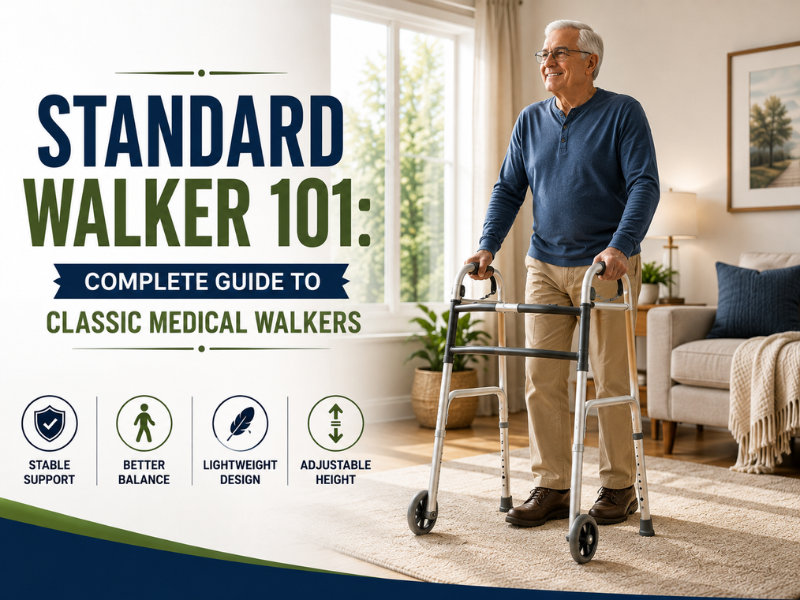
A standard walker is a lightweight metal frame with four legs, each capped with a non-skid rubber tip, and no wheels at all. To move, the user lifts the entire frame, sets it down slightly ahead of them, then steps forward into it. Because none of the legs roll, a standard walker stays exactly where you put it, which makes it the most stable type of walker with wheels alternative on the market.
This "lift and place" motion is slower than using a rolling walker, but it offers something wheeled models can't match: the frame never moves unless you move it. That predictability is exactly why doctors and physical therapists so often recommend a standard walker right after surgery or a fall.
Standard Walker vs. Other Walker Types
It helps to see where a standard walker fits among the full lineup of walking aids:
- Standard walker (no wheels): Maximum stability, requires lifting with every step, best for significant balance issues
- 2 wheel walker: Front wheels glide, rear legs stay planted, easier to push than a standard walker while still very stable
- Rollator walker (4 wheels): Rolls continuously, usually includes a seat and brakes, better for longer outdoor walks but less stable than a standard walker
If you're trying to decide between the classic no-wheel design and a wheeled option, our rollator vs. standard walker comparison breaks down the tradeoffs in more detail.
Who Should Use a Standard Walker?
A standard walker is typically the first mobility aid recommended after:
- Hip or knee replacement surgery
- A recent fall or high fall risk
- Significant balance impairment or weakness on one side of the body
- Short-term recovery from an injury, such as a broken leg or foot
Because it doesn't roll, a standard walker requires a fair amount of upper body strength to lift and reposition with each step. If lifting the frame becomes tiring, a 2 wheel walker is often the next logical step up, since it keeps most of the same stability while reducing the physical effort involved.
Types of Standard Walkers
Folding Standard Walkers
Most modern standard walkers are folding walker designs that collapse flat with a button or trigger release, making them easy to store beside a bed or chair and load into a car.
Adjustable Height Walkers
An adjustable walker lets you set the handle height to match your wrist crease while standing, which is essential for proper posture and fall prevention. Look for a model with several height settings so it can be fitted precisely.
Lightweight Aluminum Walkers
Most standard walkers today use an aluminum walker frame instead of heavier steel, which makes them easier to lift with each step and easier to carry when folded.
Narrow, Short, and Tall Walkers
Standard sizing doesn't fit everyone. A narrow walker is built for tight hallways and doorways, a short walker suits petite users, and a tall walker gives taller adults a comfortable, upright grip height without hunching over.
Bariatric Standard Walkers
For users who need more support, a bariatric walker uses a reinforced frame and wider base to safely support higher body weights, often up to 500 lbs. See our bariatric walker buying guide for heavy-duty options.
Forearm Walkers
A forearm walker supports the forearms instead of just the hands, which helps users with limited hand or wrist strength, such as those with arthritis, maintain a secure grip.
How to Fit and Use a Standard Walker Correctly
- Set the right height. Stand up straight with arms relaxed at your sides. The top of the walker's handgrips should line up with the crease of your wrist, creating a slight 15 to 20 degree bend at the elbow when gripping the handles.
- Step into the frame, not behind it. Lift the walker, place it about a step's length ahead of you, then step forward so your body stays centered inside the frame.
- Avoid overreaching. Don't move the walker too far ahead, as this can pull your balance forward and increase fall risk.
- Check the rubber tips regularly. Worn or cracked tips reduce grip on the floor and should be replaced.
- Get a professional fitting if possible. A poorly fitted walker, one that's too short, too tall, or the wrong type altogether, is one of the most common reasons people don't get the full stability benefit.
Standard Walker vs. Rolling Walker: Which Should You Choose?
If stability is your top priority, especially soon after surgery or a fall, a standard walker remains the gold standard. If you find lifting it tiring but still want strong support, a rolling walker with two wheels is a natural next step. And if you're mostly steady but want to walk longer distances outdoors with a place to rest, a full rollator with seat is usually the better fit.
Many people transition through more than one type as their strength and balance change during recovery, so it's worth talking to your doctor or physical therapist about which stage you're at.
Shop Standard Walkers at All Care Store
Whether you need a lightweight aluminum frame, a bariatric model, or a compact narrow design, you'll find a full range of standard walkers and mobility aids at All Care Store to match your recovery needs and lifestyle.
This article is for informational purposes only and is not a substitute for professional medical advice. Always consult your doctor or physical therapist before choosing a mobility aid.