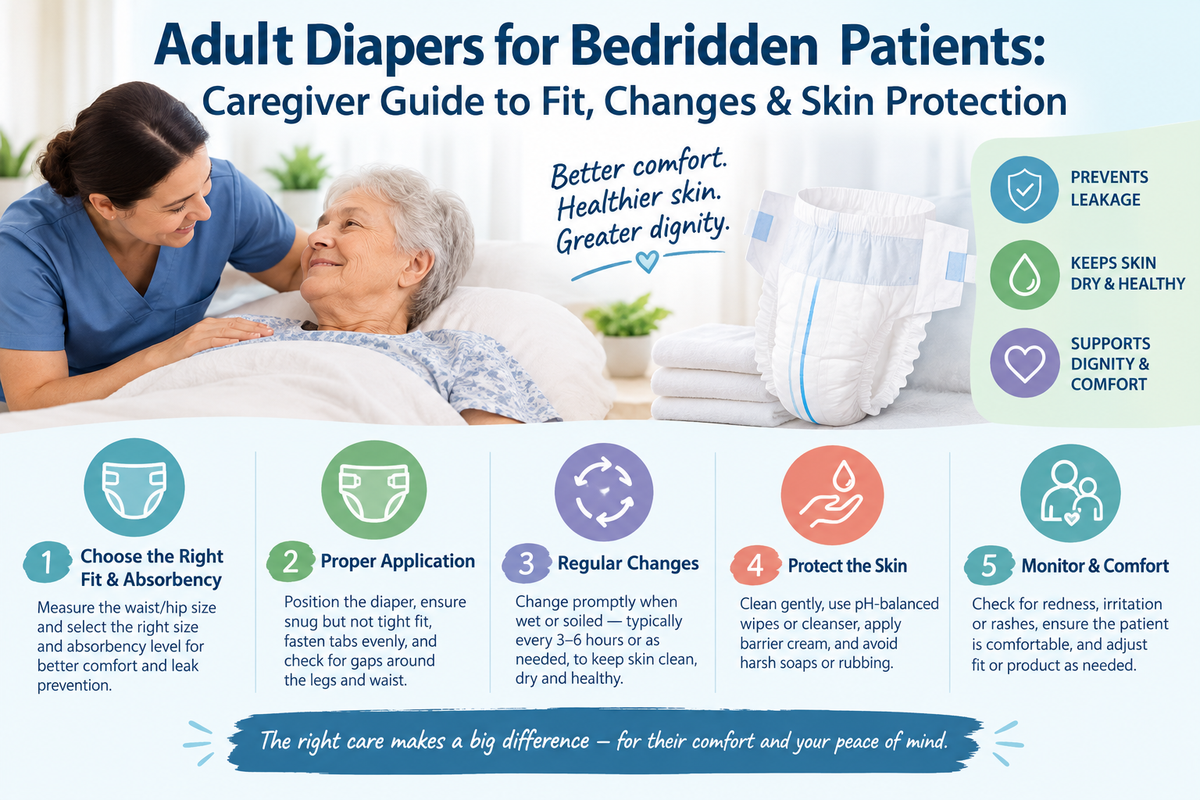
Caring for someone who spends most or all of the day in bed changes what matters in an incontinence product. For a mobile adult, discretion and easy pull-on changes may be the priority. For a bedridden patient, caregivers usually need reliable containment, easy side-to-side changes, secure fit, skin-friendly materials, and a product that can be changed without requiring the person to stand.
This guide explains how to choose adult diapers for bedridden patients, how to reduce common fit problems, and how to build a practical care routine around briefs, underpads, wipes, and skin protection.
Why bedridden patients often need a different type of incontinence product
People with limited mobility may remain in one position for long periods and may need caregiver assistance for every change. That makes several features especially important:
- Side fastening: Tab-style briefs can be opened and refastened while the wearer is lying down.
- Secure leg fit: Properly positioned leg gathers help reduce leakage around the thighs.
- Appropriate absorbency: The product should match the person's actual level of bladder or bowel leakage rather than simply choosing the thickest option available.
- Breathable materials: Breathable outer layers can help with comfort during extended wear.
- Easy checks and changes: Wetness indicators, refastenable tabs, and clearly marked sizing can make caregiver routines easier.
For many bedbound users, adult diapers with tabs are easier to manage than pull-on underwear because the wearer does not need to step into the garment.
1. Start with the right size, not the highest absorbency
A common cause of leaks is poor fit. A brief that is too large can leave gaps at the legs, while one that is too small may not sit correctly against the body and can create uncomfortable pressure points.
Measure the waist and hips and follow the manufacturer's sizing chart for the specific brand. Do not assume that a “large” in one brand fits exactly like a “large” in another. If leakage continues despite adequate absorbency, review sizing and placement before moving automatically to a heavier product.
Our existing sizing and leak troubleshooting guide explains common fit problems in more detail.
2. Choose absorbency based on the care routine
Absorbency needs can vary dramatically. Someone with occasional moderate leakage may not need the same brief as a person with heavy urinary incontinence or bowel incontinence. Consider:
- how much leakage occurs between changes;
- whether leakage is mostly daytime, nighttime, or both;
- whether bowel containment is also needed;
- how frequently a caregiver can realistically check and change the brief;
- whether the person is also using an underpad for secondary protection.
Higher absorbency can be helpful, but it should not be used as a reason to leave a wet or soiled product on longer than appropriate. Regular checks remain important for comfort and skin care.
3. Tab-style briefs are often easier for bed changes
For a person who cannot stand safely, a tab-style brief can usually be positioned while the person is lying on their side. The caregiver can place the rear portion of the brief, gently roll the person back, position the front panel, and fasten the tabs evenly.
The goal is a snug fit without excessive tightness. Leg gathers should be unfolded and positioned rather than trapped inside the brief. Uneven fastening can pull the absorbent core away from the body and increase the chance of leakage.
4. Use underpads as backup protection—not as a substitute for timely changes
Incontinence underpads can protect sheets, mattresses, chairs, and other surfaces during changes or in case the primary brief leaks. Disposable underpads are convenient for quick changes, while reusable underpads can be useful when regular laundry is practical.
Choose an underpad large enough to cover the area most likely to be exposed. If the pad bunches or slides, reposition it so the surface remains flat and comfortable.
5. Make cleansing part of every change
Gentle cleansing is an important part of incontinence care, especially for people who cannot independently wash or reposition themselves. Adult incontinence wipes are designed for larger cleansing areas and can be more practical than small household or baby wipes.
For more complete cleansing, caregivers may also use products from our incontinence skin cleansers and perineal care collection. Follow product directions and the person's care plan, especially if the skin is already irritated or fragile.
6. Watch the skin closely
Moisture, friction, and prolonged contact with urine or stool can irritate skin. During changes, look for new redness, broken skin, persistent rash, swelling, or areas that appear painful.
Some care plans include a moisture barrier or skin protectant after cleansing and drying. Use products as directed and seek guidance from a healthcare professional when irritation is persistent, worsening, painful, or associated with open skin.
7. Build a simple bedside change kit
Keeping supplies together can make changes faster and less disruptive. A practical kit may include:
- correct-size tab-style briefs;
- adult wipes or rinse-free cleanser;
- disposable gloves when appropriate;
- underpads;
- skin protectant recommended for the person's care routine;
- disposal bags or a lined waste container;
- clean clothing or bedding nearby.
Buying by the case can also make sense for households using several briefs per day. Browse our broader adult diapers, pull-up underwear and accessories collection to compare formats and package sizes.
When should a caregiver contact a healthcare professional?
Incontinence products help manage leakage, but they do not diagnose or treat the underlying cause. A healthcare professional should evaluate new or rapidly worsening incontinence, pain with urination, fever, blood in the urine, persistent skin breakdown, pressure injuries, or other concerning changes.
Frequently asked questions
Are pull-ups or tab briefs better for bedridden patients?
Tab-style briefs are often easier for fully bedbound users because they can be changed without pulling the garment over the legs. Pull-on underwear may still work well for people who can stand, transfer, or participate in dressing.
What absorbency is best for a bedridden patient?
There is no single absorbency level that is right for everyone. Match the product to the person's leakage pattern, change schedule, body size, and whether protection is needed for urine, stool, or both.
Should I use an underpad with an adult diaper?
An underpad can provide useful backup protection for bedding and mattresses. It should complement—not replace—a correctly fitted brief and appropriate changing routine.
How do I know if an adult diaper is too large?
Large gaps around the thighs, sagging, shifting, or repeated side leakage can indicate that the brief is too large or incorrectly positioned.
Can a booster pad be added for more absorbency?
Some briefs are designed to work with flow-through booster pads. Use only compatible products and follow the manufacturer's directions. See our booster pads, inserts and doublers collection for options.
Shop caregiver-focused incontinence supplies: Explore AllCareStore's incontinence and toileting collection for briefs, underpads, wipes, skin care products, and related supplies.
General information only. Individual medical and skin-care needs vary; consult a qualified healthcare professional for personalized advice.