The Six Inches That Gave Margaret Her Mornings Back
Margaret is 74, and until this spring she had a secret she was too proud to share. Since her knee replacement, the first trip to the bathroom each morning had become the hardest thing she did all day. A standard toilet sits only about fifteen inches off the floor, and lowering herself that far, then pushing back up on a rebuilt knee and arthritic hands, left her clutching the towel bar and holding her breath. Twice she had nearly gone down. She started drinking less water in the evenings just to avoid the trip.
Her physical therapist noticed the bruise on her forearm and asked the plain question no one had asked: how are you managing the toilet at home? The answer was a five-inch raised toilet seat with padded arms, delivered two days later. It clamped onto the existing bowl in about a minute. That first morning, Margaret sat down and stood up using the armrests, without the drop, without the scramble, without the held breath.
She told her daughter it felt like getting six inches of her independence handed back to her. Nothing about her knee had changed. What changed was the distance she had to travel and the handholds she had on the way.
That is the honest promise of a raised toilet seat, and it is worth saying before we get into types and measurements: it is one of the simplest, least expensive changes you can make to a home, and for the right person it prevents exactly the kind of fall that sends older adults to the emergency room. The trick is matching the seat to the body and the bathroom, and that is what this guide is about.
What a Raised Toilet Seat Actually Does
A raised toilet seat adds height to a standard toilet so you do not have to lower yourself as far or push yourself as high. That single change does several jobs at once.
- Shortens the distance. Raising the seat by three to six inches dramatically reduces how deeply the hips and knees have to bend, which is easier on replaced joints, arthritic knees, and weak legs.
- Protects healing joints. After hip replacement, surgeons often warn against bending the hip past ninety degrees. A raised seat keeps the hip within that safe range during one of the most unavoidable movements of the day.
- Adds something to hold. Models with arms or handles give the arms a way to share the work with the legs, which is the difference between a controlled sit and a fall.
- Reduces strain and fear. Less effort means less breath-holding, less dizziness on standing, and far less anxiety about a trip that happens many times a day and night.
What a raised seat does not do is make an unstable person safe on its own. If someone is truly unsteady, the seat is one part of a setup that usually also includes grab bars or a toilet safety frame, good lighting, and a clear path. The seat lowers the effort; the handholds and the room keep the person upright. Think of it as the foundation of a safer bathroom rather than the whole solution.
The Main Types of Raised Toilet Seats
Almost every raised toilet seat falls into one of a handful of categories. Match the category to the person first, then compare brands and prices.
1. Standard Clamp-On Risers (No Arms)
These are the simplest and most affordable option: a molded seat that sits inside or on top of the existing bowl and locks down with brackets or a tightening mechanism, adding roughly three and a half to four inches of height. They suit someone who mainly needs a little less distance to travel and still has decent balance and arm strength to rise on their own or with a nearby grab bar.
Best for: mild mobility limits, a modest height boost, and tight budgets. The Carex Raised Toilet Seat (about $42.99) is a dependable entry point that adds height without arms and installs in minutes.
2. Raised Seats With Arms and Handles
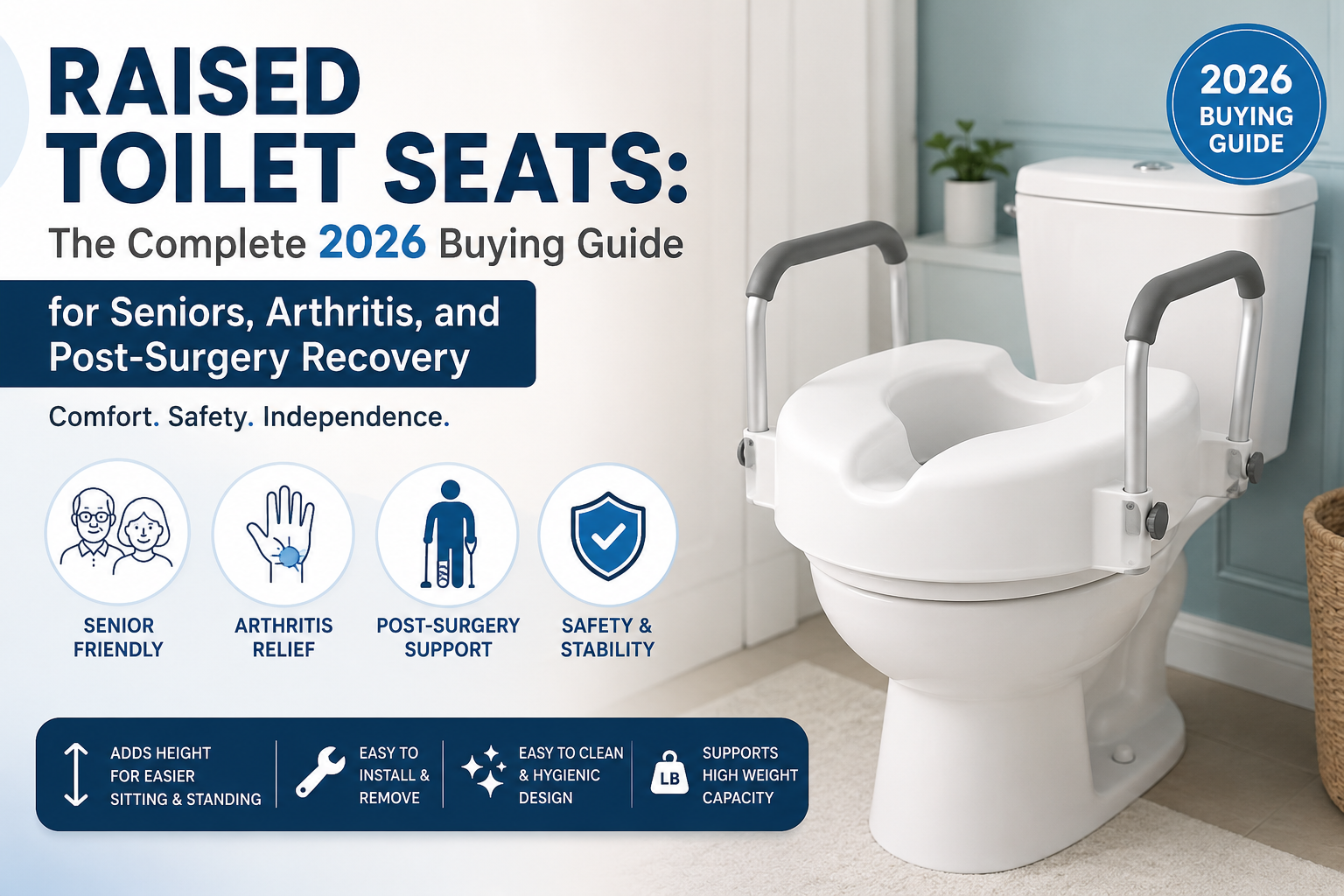
This is the category most seniors and post-surgery patients actually need. Built-in armrests give the upper body a way to help lower and lift the whole person, which is exactly what a rebuilt knee or hip, or weak quadriceps, cannot do alone. Many arm models also lock securely to the bowl and offer a taller five-inch lift.
Best for: arthritis, knee or hip replacement recovery, leg weakness, and anyone who needs to push up with their arms. The E-Z Lock Raised Toilet Seat with Arms and adjustable handle width (about $103.11) adds a secure five-inch lift with armrests that adjust to the user, and the Elevated Toilet Seat with Arms, Elongated 19 inch wide (about $131.53) suits a larger frame and an elongated bowl.

3. Padded and Soft Seats
A cushioned raised seat trades some firmness for comfort and is a real help for people who are thin, bruise easily, sit for longer, or have pressure-sensitive or fragile skin, common after surgery or with limited sensation. The soft surface reduces pressure points during each visit.
Best for: fragile or pressure-sensitive skin, thin frames, longer sitting times, and post-surgical comfort. The Blue Jay Raised Soft Toilet Seat Cushion with Secure Safety Straps (about $53.17 for the two-inch, $59.23 for the four-inch) straps firmly in place and cushions every visit.
4. Locking and Bolt-Down Seats
Stability is everything on a toilet, and the way a seat attaches matters as much as its height. Clamp-and-lock models grip the bowl rim with a front bracket and side wings; bolt-down models replace or mount under the existing seat and fasten with the toilet bolts for the most permanent, no-shift hold. If a seat rocks or slides even slightly, it is worse than no seat at all.
Best for: anyone who needs maximum stability, shared households, or a seat that will not shift under a transfer. The Raised Toilet Seat with Lid, Savannah style 4 inch (about $108.74) mounts securely and keeps the familiar look of a normal toilet, lid included.
5. Bariatric and Heavy-Duty Seats
Standard raised seats are generally rated to about 300 pounds. Heavier users need a bariatric model built with a wider, reinforced seat and a higher weight capacity, often up to 500 pounds, plus a mounting system engineered not to flex or shift under greater load.
Best for: users above standard weight limits who need a wider, stronger seat. The Bariatric Elevated Toilet Seat with Secure-Bolt mounting (about $150.11) bolts down for a rock-solid hold at a higher weight capacity, and a deluxe 500-pound version of the Carex elongated seat (about $71.63) is available for heavier users who prefer a clamp-on design.
6. When a Riser Is Not Enough: the 3-in-1 Commode
Sometimes the problem is not just seat height. If someone cannot safely walk to the bathroom at night, needs a wider seat with sturdy drop-down arms, or wants a single frame that works over the toilet and at the bedside, a three-in-one commode is the better tool. It functions as a bedside commode, a raised seat with a support frame over the existing toilet, and a safety frame, all in one.
Best for: nighttime safety, weak transfers, or the need for a supportive frame around the toilet. The Bariatric Drop-Arm Commode Deluxe (about $249.51) offers drop-away arms for side transfers and doubles as an over-toilet frame; browse the full range in the commode chairs and accessories collection.
Comparison at a Glance
| Type | Height Added | Best For | Typical Price |
|---|---|---|---|
| Standard clamp-on riser | 3.5 to 4 inches | Mild limits, good balance, tight budget | $40 to $60 |
| Seat with arms and handles | 4 to 5 inches | Arthritis, hip or knee recovery, leg weakness | $100 to $135 |
| Padded or soft seat | 2 to 4 inches | Fragile skin, thin frame, longer sitting | $50 to $65 |
| Locking or bolt-down seat | 3.5 to 5 inches | Maximum stability, no-shift hold, shared homes | $100 to $110 |
| Bariatric heavy-duty seat | 3.5 to 5 inches | Users above 300 lbs, wider reinforced seat | $70 to $150 |
| 3-in-1 commode frame | Adjustable frame | Nighttime safety, weak transfers, support frame | $150 to $300+ |
Browse the full selection in the toileting supplies collection and the bedroom and bathroom safety collection.
Match the Seat to the Situation
Here is the part most product pages skip. The most useful thing you can know is which seat goes with which need.
| Your Situation | Usual Seat Choice |
|---|---|
| Recovering from hip replacement | Tall seat with arms (keeps the hip under 90 degrees) |
| Recovering from knee replacement | Raised seat with arms to push up with |
| Arthritis in knees, hips, or hands | Seat with armrests to share the load |
| Generally steady, just needs a little height | Standard clamp-on riser, no arms |
| Fragile or pressure-sensitive skin | Padded or soft raised seat |
| Weight above 300 pounds | Bariatric heavy-duty seat |
| Unsafe walking to the bathroom at night | 3-in-1 commode at the bedside |
| Needs a support frame around the toilet | Toilet safety frame or 3-in-1 commode over the toilet |
If a person is at real risk of falling, is confused, or cannot bear weight on their legs, a raised seat alone is not enough, and an evaluation by a physical or occupational therapist is worth far more than any single product. They can assess transfers, recommend the exact setup, and often have it covered or partly covered through the right channels.
How Much Height Do You Actually Need?
More height is not automatically better. The goal is for the person to sit with hips level with or slightly higher than the knees, and with feet still reaching the floor for stability. A seat that is too tall leaves the feet dangling, which is unsafe and uncomfortable, and can make it harder, not easier, to control the sit and stand.
Most raised seats add three and a half to five inches. As a rough guide, a modest three-and-a-half to four-inch lift suits milder needs and shorter users, while a five-inch lift helps taller people, larger joints, or stricter hip precautions. If you are unsure, a shorter person often does better with less added height so their feet stay planted, and a taller person can usually take the full five inches. When strict hip precautions apply after surgery, follow the height your surgeon or therapist specifies.
Round or Elongated? Measure Before You Buy
The single most common ordering mistake is the bowl shape. Toilets come in two standard shapes, and a seat built for one will not fit the other well.
- Round bowls measure about sixteen and a half inches from the seat bolts to the front edge of the rim.
- Elongated bowls measure about eighteen to eighteen and a half inches, with a longer, more oval opening.
Measure your own bowl from the center of the seat mounting bolts straight to the front lip before choosing. Many clamp-on risers fit both shapes, but seats that mount with the bolts, and most models with a lid, are shape-specific. When in doubt, an elongated seat or a universal clamp-on riser is the safer pick, and our team can confirm fit before you order.
Installation and Safety: Getting It Rock Solid
A raised seat is only as safe as its grip on the bowl. However it attaches, the finished result must not rock, slide, or tip when someone leans on it or shifts to one side.
- Clamp-on models drop over or into the bowl and lock with a front bracket and side wings or a tightening knob. Tighten fully, then push the seat firmly from several angles to confirm it does not move.
- Bolt-down models use the toilet bolts for the most permanent hold and are the most stable choice for a heavier user or a strong side transfer.
- Test before trusting it. Press down hard on each side and the front, and simulate leaning on an armrest, before anyone relies on the seat. Re-check the tightness every couple of weeks, since fasteners can loosen with use.
- Pair it with handholds. A raised seat plus a grab bar or a toilet safety frame is far safer than either alone. See the grab bars and safety rails installation guide for placement that actually works.
- Mind the splash guard and cleaning. Most raised seats include or allow a splash guard and lift off easily for cleaning; wipe the seat and the bowl rim regularly, since the added surfaces can trap moisture.
How to Use It Well (and the Mistakes to Avoid)
- Do not skip measuring. Confirm round versus elongated and check the height against the user before ordering. A seat that does not fit the bowl or the body will not get used.
- Do not choose too much height. Feet must reach the floor. Dangling feet make transfers less safe, not more.
- Do not rely on a seat that shifts. Any rock or slide means it is not tightened or fitted correctly. Fix it before use.
- Add arms if the legs are weak. If the person cannot push up smoothly, a seat with armrests or a nearby grab bar is not optional, it is the safety feature.
- Keep the path clear and lit. Most bathroom falls happen on the way, not on the seat. A nightlight and a clutter-free floor matter as much as the seat.
- Clean it often. Remove and wash the seat regularly to keep it hygienic and to spot any loosening hardware early.
Beyond the Seat: Building a Safer Bathroom
A raised toilet seat is usually the first piece of a small, high-impact bathroom safety kit. The other pieces are inexpensive and work together.
- Grab bars and toilet safety frames give the arms something solid to pull and push against beside the toilet. Explore the bedroom and bathroom safety collection.
- Shower chairs and transfer benches bring the same sit-to-stand safety to bathing. See our shower chairs and bath benches guide and the bath care collection.
- Bedside commodes handle the nighttime trip when walking to the bathroom is the real risk. Browse the commode chairs and accessories collection.
- Non-slip mats and good lighting address the falls that happen on wet floors and in the dark, which no seat can prevent.
- Recovery aids after surgery. If a joint replacement is the reason for the seat, pair it with the rest of the recovery plan in our hip replacement recovery guide and knee replacement recovery guide.
When to Talk to a Doctor or Therapist First
A raised seat is a safe, sensible first step for most people who simply find a standard toilet too low. It is worth a professional conversation, before or alongside the purchase, when the situation is more complex:
- You are recovering from hip or spine surgery and have specific movement precautions to follow.
- The person has fallen recently, is unsteady even seated, or cannot reliably bear weight on their legs.
- There is confusion, dizziness on standing, or a medical condition that affects balance.
- You are unsure whether a raised seat, a toilet safety frame, or a full commode is the right level of support.
A physical or occupational therapist can assess the transfer, recommend the exact height and style, and set up the whole bathroom safely, and their guidance often prevents a costly fall down the line.
Why Shop Raised Toilet Seats and Bathroom Safety at AllCare Store
AllCare Store stocks the full range, from simple clamp-on risers and padded soft seats to locking and bolt-down models, seats with adjustable arms, bariatric heavy-duty seats rated to 500 pounds, and three-in-one commodes, alongside the grab bars, toilet safety frames, shower chairs, and non-slip mats that complete a safer bathroom. Everything ships free within the U.S. with 30-day returns.
Toilet safety is one of those categories where a quick phone call beats a guess, because the right answer depends on the person, the bowl shape, and the rest of the bathroom. Whether you need help measuring for round versus elongated, choosing between arms and a bolt-down hold, or deciding between a raised seat and a full commode, our team does exactly this every day. Start with the toileting supplies collection or the bedroom and bathroom safety collection.
Frequently Asked Questions
What is the best raised toilet seat for elderly people?
For most older adults, a raised seat with sturdy armrests is the best choice, because the arms let the upper body help with lowering and standing, which is where balance and leg strength most often fall short. A locking or bolt-down model that adds four to five inches, paired with a nearby grab bar, gives the safest, most confident result. Steadier users who only need a little height can use a simple clamp-on riser without arms.
How much height should a raised toilet seat add?
Most add three and a half to five inches. The right amount lets the person sit with hips level with or slightly above the knees while the feet still reach the floor. Shorter users usually do better with less added height so their feet stay planted; taller users and those with strict hip precautions often need the full five inches.
Do I need a round or elongated raised toilet seat?
Measure your bowl from the center of the seat bolts to the front rim. About sixteen and a half inches means a round bowl; about eighteen to eighteen and a half inches means elongated. Many clamp-on risers fit both, but bolt-down seats and most models with a lid are shape-specific, so confirm the shape before ordering.
Are raised toilet seats safe? Will they slip?
A properly fitted and tightened seat is very safe. The key is the attachment: clamp-on models must be locked down and pushed from several angles to confirm they do not move, and bolt-down models fasten to the toilet bolts for the most permanent hold. A seat that rocks or slides has not been installed correctly and should be adjusted before use.
Is a raised toilet seat good after hip replacement?
Yes. After hip replacement, surgeons commonly advise against bending the hip past ninety degrees, and a raised seat is one of the standard tools for keeping the hip within that safe range during toileting. Choose a taller seat with arms, follow the specific height and precautions your surgeon sets, and keep it in place for as long as they recommend.
What weight can a raised toilet seat hold?
Standard raised seats are typically rated to around 300 pounds. For heavier users, a bariatric model with a wider, reinforced seat and a bolt-down or heavy-duty clamp offers capacities up to about 500 pounds. Always check the stated weight limit and choose a bariatric seat if the user is near or above the standard rating.
How do you install a raised toilet seat?
Clamp-on models drop over or into the bowl and lock with a front bracket and side wings or a tightening knob; bolt-down models use the toilet bolts. In both cases, tighten fully, then press hard on the front and each side to confirm there is no movement before anyone uses it, and re-check the tightness every couple of weeks.
Can I use a raised toilet seat with a grab bar?
Yes, and it is the recommended setup for anyone with balance or strength concerns. The raised seat shortens the distance and a grab bar or toilet safety frame gives the arms a solid handhold. Together they are far safer than either one alone.
What is the difference between a raised toilet seat and a commode?
A raised toilet seat sits on your existing toilet to add height. A commode is a standalone chair with a bucket that can be used at the bedside, and a three-in-one commode can also serve as a raised seat and support frame over the toilet. Choose a raised seat when the toilet is simply too low, and a commode when getting to the bathroom, especially at night, is the harder problem.
Should the raised toilet seat have arms?
Add arms whenever the person struggles to lower or push up with their legs alone, which covers most people recovering from joint surgery or living with significant arthritis or leg weakness. Arms turn a simple height boost into a supported, controlled transfer. Steady users with good strength can do fine without them.
Does insurance or Medicare cover a raised toilet seat?
Coverage varies, and standard raised toilet seats are often considered convenience items that are purchased out of pocket, while some commodes and safety equipment may be covered with a physician order when medically necessary. Ask your provider and check your specific plan, and keep any prescription or documentation your clinician provides.
How do I keep a raised toilet seat clean?
Most seats lift off or unclamp easily for cleaning. Wipe the seat and the bowl rim regularly with a household disinfectant, since the extra surfaces and brackets can trap moisture, and check the hardware while you clean so you catch any loosening early.
The Takeaway: Small Change, Big Safety
A raised toilet seat is one of the least expensive and most effective changes you can make for an aging parent, a recovering patient, or yourself. It does not treat arthritis or rebuild a joint. What it does is shorten the distance, protect a healing hip, and, with arms or a grab bar, give the body something to push against, turning a risky drop into a controlled sit. Measure the bowl, match the height to the person so the feet stay planted, choose arms when the legs are weak, and make sure the seat is locked down solid.
Done right, it is the difference between dreading the bathroom and forgetting it was ever a problem, the reason Margaret got her mornings, and six inches of independence, back.
Not Sure Which Raised Toilet Seat You Need? Let Us Help.
AllCare Store carries clamp-on risers, padded soft seats, locking and bolt-down models, seats with adjustable arms, bariatric seats rated to 500 pounds, and three-in-one commodes, plus the grab bars, toilet safety frames, shower chairs, and non-slip mats that complete a safer bathroom. Browse the toileting supplies collection and the bedroom and bathroom safety collection to compare options.
Call 1-888-889-6260 to talk with a specialist about seat height, round versus elongated fit, weight capacity, and insurance documentation, or visit AllCareStore.com to browse the full selection. Free U.S. shipping and 30-day returns on every order.
This guide was written and reviewed by the AllCare Store editorial team. It is educational and not a substitute for individualized medical advice. Product availability and pricing change, so verify current details on each product page, and consult your physician, physical therapist, or occupational therapist about the right equipment for your needs.
MEDICAL DISCLAIMER: This article is for general information only and is not a substitute for a professional assessment by a physician, physical therapist, or occupational therapist. A raised toilet seat reduces the effort of toileting; it does not, on its own, make an unsteady person safe. Fall risk has many causes, and the right equipment for one person can be wrong for another. If there is a history of falls, confusion, dizziness on standing, an inability to bear weight, or specific post-surgical precautions, seek a professional evaluation before relying on any product. Prices mentioned were current at the time of writing and may change.