Medical Disclaimer: This article is for informational purposes only and is not a substitute for your surgical team's specific instructions. Hip replacement recovery protocols vary by surgeon technique (posterior vs. anterior approach), implant type, patient health, and other factors. Always follow your orthopedic surgeon's and physical therapist's instructions, which take precedence over any general guidance. Contact your surgical team immediately if you experience signs of infection, dislocation, DVT, or pulmonary embolism.
Hip Replacement Recovery Timeline: A Week-by-Week Guide
Margaret Decides She's Done Limping
Margaret, 68, had been compensating for her right hip for three years. The osteoarthritis had crept in gradually — first as stiffness in the morning, then as a limp that got worse as the day progressed, then as pain that woke her up at night. She'd tried cortisone injections, physical therapy, anti-inflammatory medications. They helped, then helped less, then stopped helping.
Her orthopedic surgeon had mentioned total hip replacement two years before she agreed to it. She'd been afraid of the surgery, afraid of the recovery, afraid of giving up six months of her life to rehabilitation. What finally changed her mind was her granddaughter's dance recital — one she couldn't attend because the auditorium had too many stairs.
"So I finally asked the real question," Margaret said. "Not 'what does recovery look like?' but 'how long until I feel better than I do right now?' The answer was: eight weeks."
She was right. By week eight post-surgery, Margaret was walking without a cane, sleeping through the night, and already planning the fall garden. By week twelve, she attended her granddaughter's next recital — standing ovation and all.
This guide walks through the hip replacement recovery timeline week by week, based on the typical progression for a primary total hip replacement (THR). If you or someone you care for is preparing for or recovering from hip replacement surgery, AllCare Store carries a full range of mobility aids, bathroom safety products, and recovery support equipment to help navigate every stage of rehabilitation.
Before Surgery: The Prehab Advantage
What you do in the weeks before surgery meaningfully affects how you recover after it. Many orthopedic programs now offer "prehabilitation" — supervised exercise and education before surgery — because the evidence shows it shortens hospital stays, reduces complications, and improves functional recovery speed.
Prehab priorities in the 4–8 weeks before surgery:
- Strengthen the muscles you'll need: Quadriceps, hip abductors, and core muscles are the workhorses of hip replacement recovery. The stronger they are going in, the faster they recover. A physical therapist can guide appropriate pre-surgery exercises.
- Prepare your home: Remove throw rugs and trip hazards; move commonly used items to waist height; install grab bars in shower/tub; secure a raised toilet seat and shower chair; ensure your bed height allows you to get in and out safely. You'll be returning home with limited hip range of motion — prepare for that reality in advance.
- Learn the hip precautions: If you're having a posterior approach surgery, your surgeon will give you specific hip precautions (generally: no hip flexion past 90°, no internal rotation, no crossing the legs). Knowing these before surgery helps you begin practicing modified movement patterns and positioning.
- Arrange support: You'll need a helper for at least the first 2 weeks at home, and assistance with driving for 4–6 weeks. Organize this in advance — a scramble to find help during recovery is stressful and may compromise your adherence to rehabilitation protocols.
The Hip Replacement Recovery Timeline
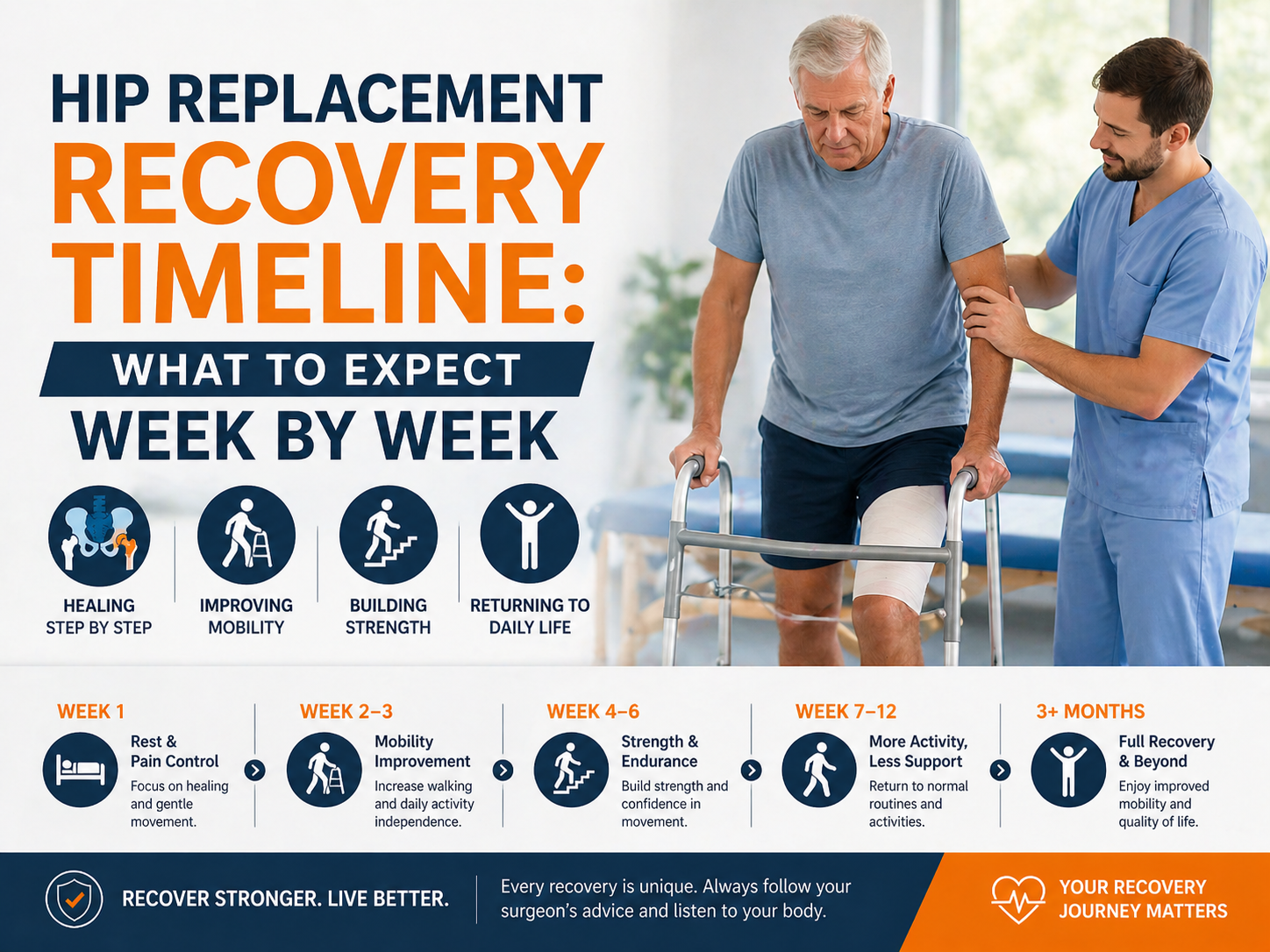
Hospital Stay: Days 1–3
Most patients undergoing primary total hip replacement are hospitalized for 1–3 days, though same-day or next-day discharge is increasingly common at high-volume centers for healthy patients. What happens during this period:
Day of surgery (Day 0): Recovery room monitoring, pain management initiation, potential same-day physical therapy (short sit-to-stand and first steps with walker). Blood clot prevention begins — usually with anticoagulant medication and compression devices on the lower legs.
Day 1: Physical and occupational therapy begins in earnest. Goal: demonstrate safe mobility with walker — walking to bathroom, short corridor walks, practicing stairs (if needed to access home). Surgical drain (if used) may be removed. Ice and elevation to manage swelling.
Day 2–3: Increasing walking distance, stair practice, review of hip precautions and activity restrictions. Transition from IV to oral pain medication. Discharge planning with home therapy or outpatient PT arranged.
What to expect on discharge: You'll be walking with a walker, able to manage stairs if your home requires them, and have pain managed with oral medication. You'll have a prescribed anticoagulant (blood thinner), specific activity restrictions, and a follow-up appointment typically 2 weeks post-surgery.
Weeks 1–2: The Foundation Phase
The first two weeks at home are often the hardest — not necessarily the most painful, but the most disorienting. You're limited in what you can do, dependent on others, and the gap between where you are and where you want to be feels large. This is normal and temporary.
Physical status: Walking with a walker; pain and swelling are present but should be progressively improving with medication. Surgical site has steri-strips or staples (removed around day 10–14). Sleep is often disrupted.
Activity goals: Walk 3–5 times per day in short increments (5–10 minutes), gradually increasing. Perform prescribed home exercises (ankle pumps, quad sets, heel slides, short arc quads) 2–3 times daily. Ice the hip for 15–20 minutes after activity and exercises.
Hip precautions (posterior approach): Do not flex the hip past 90°. Do not cross the operated leg over the other. Do not rotate the foot inward. These restrictions are typically maintained for 6–12 weeks depending on your surgeon's protocol. Anterior approach patients often have fewer or no precautions — confirm with your surgical team.
Daily living adaptations: Use a raised toilet seat (4–6 inch riser) to maintain safe hip angle when using the bathroom. Sit only in chairs with armrests that allow you to push to standing. Use a long-handled reacher, shoehorn, and sock aid to dress without violating hip precautions. Shower chair and handheld shower head for bathing. Do not drive.
Warning signs to report immediately: Increasing redness, warmth, or swelling at the incision site; fever over 101.5°F; sudden increased pain; calf pain or swelling (possible DVT); chest pain or shortness of breath (possible pulmonary embolism). These are medical emergencies — contact your surgeon or go to the emergency department.
Weeks 3–4: Building Momentum
The second half of the first month typically brings meaningful progress. Most patients transition from walker to cane (with physician approval) during this period, and outpatient physical therapy typically begins around week 3–4 if not already.
Physical status: Swelling persists but should be clearly reducing. Pain increasingly manageable with OTC analgesics (acetaminophen, NSAIDs as allowed by your surgeon). Sleep improving. Incision healing well.
Activity progression: Walking distance increasing to 20–30 minutes at a time. Physical therapy introducing more active strengthening exercises: standing hip abduction, standing hip extension, mini-squats (within hip precaution range), step-ups. Continue ice after activity.
Transition to cane: When you can walk with the walker without a significant limp and without bearing significant weight through the walker, your surgeon or PT will typically clear you to use a single cane. The cane goes in the hand opposite the operated hip — this is important and counterintuitive for many patients.
Daily living improvements: Most patients can manage most activities of daily living independently by week 4. Driving is sometimes cleared by week 4–6 for left hip replacements in automatic transmission vehicles (right hip typically requires 6 weeks due to brake pedal use) — confirm timing with your surgeon.
Weeks 5–6: Functional Independence
By weeks 5–6, most patients are functionally independent for daily activities, walking without a cane for shorter distances, and seeing clear improvement in strength and endurance.
Physical status: Most residual swelling gone or minimal. Pain substantially reduced — many patients are using pain medication only occasionally or not at all for routine daily activity. Some achiness or fatigue with increased activity remains normal.
Physical therapy focus: Progressive strengthening of hip abductors and extensors, balance training, gait normalization. Stair negotiation improving toward step-over-step (one foot per step) rather than step-to-step pattern. Increasing aerobic capacity through walking.
Returning to driving: Most patients cleared to drive by week 6 (right hip) or 4 (left hip) — confirm with your surgeon. Test in an empty parking lot first. Emergency braking reaction time should be verified before resuming regular driving.
Returning to work: Desk work often possible by weeks 4–6. Physical work requiring prolonged standing, walking, or lifting typically takes 8–12 weeks. Confirm timeline with your surgeon based on your specific job demands.
Weeks 7–12: Strength and Endurance Building
The weeks 7–12 period is often where patients notice the most dramatic functional improvement. The new joint is now well-integrated, precautions are typically lifted around week 6–8 (posterior approach), and physical therapy is focused on restoring full strength and endurance.
Physical status: Most patients walking without assistive device for normal daily activities by week 8. Hip precautions typically lifted (confirm with surgeon). Residual stiffness in the morning and after prolonged sitting is common and continues to improve.
Physical therapy focus: Full range of motion restoration, advanced strengthening (resisted exercises, increased loads), sport-specific or activity-specific training for those with recreational goals. Balance and proprioception training. Stationary bike often cleared by week 6–8 — excellent low-impact hip rehabilitation exercise.
Activities cleared during this period: Golf (walking) typically around week 8–12. Swimming (laps) often cleared by week 8. Low-impact aerobics, stationary cycling, walking for exercise — all typically progressing well. Higher-impact activities remain restricted.
Months 3–6: Return to Full Activity
From months 3 to 6, most patients achieve the major functional milestones they were hoping for when they elected surgery. Pain from osteoarthritis is gone — replaced by a joint that, while it has its own set of sensations (mild warmth after activity, occasional clicking that is normal for a prosthetic joint), no longer limits daily function the way the arthritic joint did.
Milestones typically achieved by month 3–6:
- Walking unlimited distances without fatigue or limp
- Climbing stairs step-over-step without holding railing
- Getting in and out of vehicles normally
- Returning to recreational activities (golf, hiking, cycling, swimming, dancing)
- Sleeping comfortably in all positions (side sleeping on operated side typically cleared by 6–8 weeks)
- Resuming sexual activity (typically cleared at 6–8 weeks with position guidance from surgeon)
Activities generally not recommended after hip replacement: High-impact activities — running, jogging, contact sports, racquet sports with high-impact movements — are generally discouraged because they accelerate implant wear. Many surgeons also discourage high-impact repetitive activities. Low-impact activities with high movement range (swimming, cycling, golf, walking, doubles tennis) are generally endorsed. Discuss your specific activity goals with your surgeon during follow-up.
Month 6–1 Year: Full Recovery
Complete healing — including full bone integration of the implant and complete muscle rehabilitation — takes approximately 12 months. Most patients don't notice a significant difference between month 6 and month 12 functionally, but bone continues remodeling around the implant during this period. Follow-up imaging at 6 and 12 months is standard to confirm integration and implant positioning.
By the one-year mark, the vast majority of total hip replacement patients report their hip as "not a factor" in daily life — exactly the outcome that made the surgery worth it.
Essential Equipment for Hip Replacement Recovery
The right home equipment significantly improves both safety and comfort during recovery. These items are worth having in place before you return home from the hospital:
- Raised toilet seat: A 4–6 inch riser maintains safe hip flexion angle (under 90°) during bathroom use. Essential for the first 6–8 weeks.
- Shower chair or transfer bench: Allows safe showering without standing on one leg or risking falls on wet surfaces.
- Grab bars: Installed in shower/tub and near toilet; provides stability during transfers.
- Walker and/or cane: You'll be discharged with a walker; a cane is the typical transition at weeks 3–4.
- Long-handled reacher: Allows picking up objects from the floor and managing items without bending hip past 90°.
- Sock aid and long-handled shoehorn: Allows dressing feet independently while maintaining hip precautions.
- Hip abductor pillow: A triangular pillow placed between legs when sleeping to prevent crossing legs during sleep — particularly important for posterior approach patients.
- Bed rail or bed assist handle: Provides support when getting in and out of bed during early recovery.
Browse AllCare Store's Bathroom Safety, Mobility Products, and Daily Living Aids collections for a complete range of post-surgical recovery equipment.
Frequently Asked Questions: Hip Replacement Recovery
How long does hip replacement recovery take?
Most people undergoing total hip replacement achieve functional independence (walking without aids, managing daily activities) by 6–8 weeks. Return to driving typically occurs at 4–6 weeks. Return to full recreational activities usually happens between 3 and 6 months. Complete bone healing and full muscle rehabilitation takes approximately 12 months. Recovery speed varies significantly based on age, fitness level before surgery, surgical approach, presence of other health conditions, and adherence to physical therapy protocols.
What are hip precautions after hip replacement, and how long do they last?
Hip precautions after posterior approach total hip replacement typically include: no hip flexion past 90° (no bending at the hip beyond a right angle), no adduction (no crossing the operated leg past the body's midline), and no internal rotation of the operated leg. These restrictions prevent dislocation of the new joint while the surrounding soft tissues heal and stabilize the implant. Most posterior approach precautions are lifted at 6–8 weeks post-surgery, though some surgeons extend them to 12 weeks. Patients having anterior approach hip replacement often have no or fewer precautions — confirm with your surgeon at the time of surgery planning.
When can I sleep on my side after hip replacement?
Most surgeons clear side sleeping at 6–8 weeks post-surgery, once the soft tissue healing is sufficient to reduce dislocation risk. For posterior approach patients, when side sleeping is first cleared, use an abductor pillow or regular pillow between the knees to prevent the operated leg from crossing the midline during sleep. Side sleeping on the non-operated side is usually cleared before the operated side. Confirm timing and positioning recommendations with your surgical team, as protocols vary.
What are signs of hip replacement dislocation?
Hip replacement dislocation — where the ball of the prosthesis pops out of the socket — is a medical emergency. Signs include: sudden severe hip pain (often during or after a movement that violated hip precautions); inability to bear weight on the operated leg; the operated leg appearing shorter than the non-operated leg or rotated outward or inward; a sensation or sound of something popping. If you experience these symptoms, do not attempt to move the joint back yourself — call 911 or go to the emergency department immediately. Dislocation requires urgent reduction (repositioning) under sedation.
How much walking should I do during hip replacement recovery?
Walking is the most important rehabilitation activity after hip replacement. The general principle: walk frequently and gradually increase distance. In weeks 1–2, aim for 5–10 minute walks 3–5 times per day. By weeks 3–4, gradually build to 20–30 continuous minutes. By weeks 6–8, many patients are walking 30–60 minutes without stopping. Your physical therapist will guide specific targets based on your progress. If pain is increasing during or after walking (beyond normal muscle tiredness), you are likely doing too much — scale back slightly and progress more gradually. Consistent short walks are more beneficial than occasional long ones early in recovery.
When can I go up and down stairs after hip replacement?
Most patients are practicing stair navigation before leaving the hospital if stairs are required for home access. Initially, the technique is "step-to" — leading with the non-operated leg going up ("up with the good"), and leading with the operated leg going down ("down with the bad"). Always use the handrail. By weeks 4–6, most patients are transitioning to a more normal step-over-step pattern as strength and confidence improve. If your home has stairs you must navigate, this will be specifically practiced and cleared by your physical therapist before hospital discharge.
Margaret's Recital
Margaret sat in the front row for her granddaughter's winter recital — no stairs, as it happened, but she'd walked from the parking lot, stood for the ovation, and driven herself home. Ten months after surgery, her right hip was the least interesting thing about her body. It did what she needed it to do, quietly, without announcing itself with pain every time she changed direction.
That's the goal of total hip replacement: a joint you forget about. For the vast majority of patients — over 90% report significant pain reduction and improved function at long-term follow-up — it delivers exactly that.
The recovery is real, the timeline is predictable, and the preparation matters. Show up to surgery as strong as you can be, follow your team's instructions, do the physical therapy work, and give it the time it needs. The other side is worth it.
Browse AllCare Store's Mobility Products, Bathroom Safety, Daily Living Aids, and Physical Therapy collections for everything you need to support a safe, comfortable recovery at home. Questions? Our team is available at 1-888-889-6260. Free shipping on qualifying orders, 30-day returns.
— The AllCare Store Team | AllCareStore.com