Ray is 81. He has congestive heart failure, and for about two years the disease had been a manageable background hum — a diuretic, a low-salt diet, a cardiologist appointment every few months. Then came the winter he couldn't lie flat.
His wife Ellen noticed it first as restlessness. Ray would go to bed at ten and be up by midnight, sitting on the edge of the mattress with his hands on his knees, breathing like he'd walked up a hill. By January he was sleeping in the recliner most nights. By February he was sleeping in the recliner every night, and the recliner was starting to leave marks on his heels and tailbone that the home health nurse did not like the look of at all.
Ellen, who is 78 and five foot two, was also quietly wrecking her back. Getting Ray out of a low, soft mattress meant hauling 190 pounds upward at an angle no physical therapist would ever endorse. She had already fallen once doing it. She hadn't told anyone.
The home health nurse ordered a hospital bed. Ellen resisted for a week — she said it would make the living room look like a hospital, that it would feel like giving up, that Ray would hate it. All of which was understandable, and most of which turned out to be wrong.
What actually happened: Ray could raise his own head to about 40 degrees with a hand control at two in the morning without waking anyone. His breathing settled. The bed's height adjusted so Ellen could transfer him at her own hip level instead of bending to a low frame, and her back stopped screaming. The pressure-redistributing mattress and a heel protector cleared up the marks on his skin within a few weeks. Ray slept in a bed again, which mattered to him more than he ever said out loud.
The living room did look different. Nobody, in the end, cared.
That trade — a room that looks a bit more clinical in exchange for a person who breathes better, heals better, and a caregiver whose back survives the year — is the actual decision in front of most families. This guide is about making it well.
What a Hospital Bed Actually Does (and Why a Regular Bed Can't)
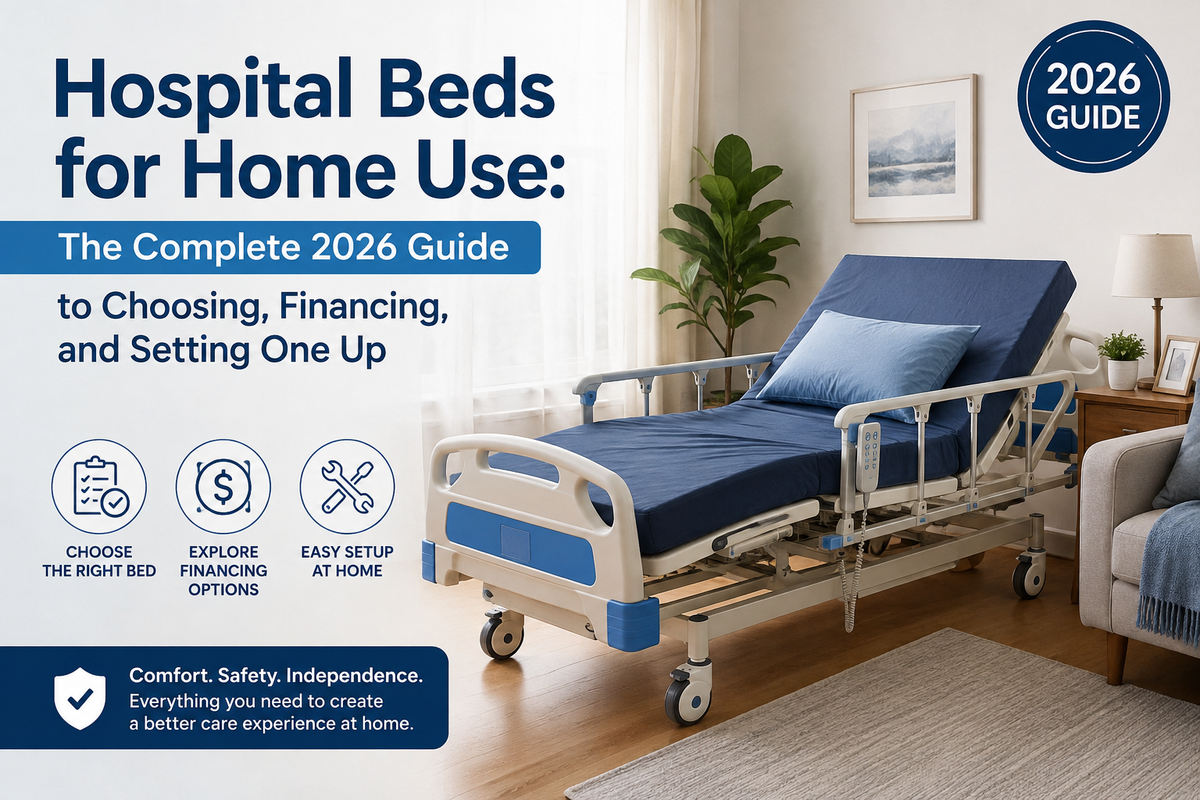
A home hospital bed — the industry term is homecare bed — is a medical bed frame designed for people who spend a large part of the day in bed, or who need help getting in and out of it. Three capabilities separate it from an ordinary bed:
- An articulating head section. Raising the upper body helps with breathing difficulty, heart failure, acid reflux, tube feeding, aspiration risk, eating, and simply being able to see the room and talk to people.
- An articulating knee/foot section. Bending the knees stops the person from sliding down the bed every time the head is raised — which is the main cause of shear injury to the sacrum — and helps with leg swelling when elevated.
- Adjustable frame height. This one is for the caregiver as much as the patient. Raising the bed to the helper's hip height converts a back-destroying lift into a controlled transfer. Lowering it to the floor at night reduces injury if the person rolls out.
Add to that a firm, flat, pressure-redistributing surface (soft mattresses are terrible for both skin and transfers), a frame that accepts rails and trapeze bars, and a size that lets a caregiver reach the person from both sides.
Signs It's Time to Consider One
- The person can't breathe comfortably lying flat, or has started sleeping in a chair
- Transfers in and out of bed have become unsafe for the person or the helper
- There's redness, blistering, or an open area over the tailbone, hips, or heels
- The person needs frequent repositioning — every two to four hours around the clock
- Legs need regular elevation for edema
- Tube feeding requires the head of the bed kept elevated
- Someone is being cared for at home after a stroke, major surgery, or in hospice
- The caregiver has hurt themselves, or nearly has
If the primary problem is getting up from an otherwise fine bed rather than positioning in it, a bed rail or bedside assist handle may solve the problem for a fraction of the cost. Start there before buying a bed.
The Three Types of Home Hospital Beds
1. Manual Beds
Head, foot, and height are all adjusted with hand cranks at the foot of the bed. There is no motor and nothing to plug in.
Pros: lowest purchase price, no power dependency, nothing electrical to fail.
Cons: every single adjustment requires a caregiver to walk to the foot of the bed and crank. The patient cannot change their own position at all. In practice this means positions get changed less often than they should, which is exactly the wrong outcome for skin.
Right for: short-term use, very rural settings with unreliable power, situations where a caregiver is always present and cost is the binding constraint.
2. Semi-Electric Beds
The head and foot sections are motorized and controlled by a hand pendant; the overall frame height is adjusted by a manual crank. This is the most commonly supplied configuration in home care, and the one Medicare most often approves.
Pros: the patient can independently raise their head and knees — the two adjustments that matter most for comfort, breathing, and dignity. Costs meaningfully less than full-electric.
Cons: height still requires cranking, so caregivers often leave the bed at one compromise height rather than optimizing per task.
Right for: most home care situations, especially where the patient has use of their hands and the caregiver is reasonably able-bodied.
The ProBasics Single Motor Semi-Electric Lightweight Bed Package ($722.66) is a representative example, built so one person can carry and set it up — the foot section weighs about 42 lbs. The Drive Medical Delta Ultra-Lite 1000 Semi-Electric Package ($944.37) bundles the frame with an innerspring mattress and full-length rails, and the Ultra-Lite Plus Semi-Electric Bed with Full-Length Side Rails ($775.45) covers the same ground in a frame-plus-rails configuration.
3. Full-Electric Beds
Head, foot, and height are all motorized from the hand control. Some models add a "low bed" capability that drops close to the floor for fall protection, and Trendelenburg positioning on higher-end frames.
Pros: the caregiver adjusts height instantly for every task — transfers at hip height, personal care at waist height, low position for sleeping. Over months of daily care this is the single biggest difference in caregiver injury risk. The patient gets maximum independence.
Cons: highest cost, and — this catches people out — Medicare generally does not cover the full-electric height feature (more on that below).
Right for: long-term care at home, heavy care needs, an older or smaller caregiver, anyone at real fall risk who benefits from a low bed position.
Options here include the ProBasics Lightweight Full-Electric Bed ($933.05), the Dynarex Full-Electric Homecare Bed (from $781.25, configurable with no rails, half rails, or full rails, and with or without a mattress), and the Drive Medical Homecare Full-Electric Bed Package with Half Rails ($1,095.48), which ships as a complete package with mattress.
Quick Comparison
| Feature | Manual | Semi-Electric | Full-Electric |
|---|---|---|---|
| Head section | Hand crank | Motorized | Motorized |
| Knee / foot section | Hand crank | Motorized | Motorized |
| Frame height | Hand crank | Hand crank | Motorized |
| Patient can self-adjust | No | Head and knees | Everything |
| Typical 2026 price | $450–$700 | $670–$950 | $780–$1,200+ |
| Typical Medicare stance | Covered if criteria met | Covered if criteria met | Height feature usually not covered |
What Medicare Actually Covers — and What Trips People Up
Hospital beds are one of the categories Medicare does treat as durable medical equipment, which makes them unusual among the items families shop for. But the details matter, and this is where most of the frustration happens.
The Basic Structure
Under Medicare Part B, a hospital bed is generally covered as DME when a treating physician documents that it is medically necessary — typically because the person needs positioning that an ordinary bed can't provide, needs the head elevated more than 30 degrees for a medical reason (heart failure, respiratory disease, aspiration risk), needs traction equipment that only attaches to a hospital bed, or needs frequent position changes that can't be managed otherwise. Medicare then pays its share (commonly 80% of the approved amount after the Part B deductible), with the beneficiary responsible for the remaining coinsurance, and the equipment is usually supplied as a capped rental through a Medicare-enrolled supplier rather than an outright purchase.
The Four Things That Catch Families Out
- Full-electric height is usually considered a convenience feature. Medicare typically approves a semi-electric bed. If the family wants full-electric, they generally pay the upgrade difference themselves — which is often why buying outright makes sense for people who specifically need powered height adjustment.
- Rental vs. purchase isn't your choice. Under the capped rental structure, Medicare pays a monthly rental for a set period. You do not own the bed during that time, you cannot modify it, and it goes back if the need ends. Families who want a permanent, specific bed in their home often buy outright for exactly this reason.
- The supplier has to be Medicare-enrolled and accept assignment. Buying a bed from a retailer and submitting a receipt afterward does not generally result in reimbursement. If you intend to use Medicare, arrange it through an enrolled DME supplier before you buy anything.
- Documentation is the whole ballgame. A written order plus supporting clinical notes establishing medical necessity is what determines approval. "The family thinks it would help" is not a covered indication, however true it is.
Medicare Advantage plans, Medicaid programs, VA benefits, and private insurance all set their own rules and can be more or less generous than traditional Medicare. Hospice patients are usually a different and simpler story — durable medical equipment related to the terminal diagnosis, including a hospital bed, is typically provided by the hospice agency at no cost to the family.
Coverage rules change and vary by plan and region. Call the number on the insurance card and ask specifically about hospital bed coverage, the required documentation, and whether the supplier you plan to use is in network — before you order. Many families end up buying outright not because coverage was denied, but because the rental process was slower than the need.
Sizing and Weight Capacity
Standard home hospital beds are roughly 36 inches wide by 80 inches long of sleeping surface — narrower than a twin bed, which is deliberate. A narrow bed lets a caregiver reach the middle of the mattress from either side without climbing on. Comfort is not the only design goal here.
| Bed Class | Typical Surface | Typical Weight Capacity | Notes |
|---|---|---|---|
| Standard homecare | 36 x 80 inches | 450 lbs total | Fits most rooms and doorways |
| Extended length | 36 x 84 inches | 450 lbs total | For users roughly 6 ft and taller |
| Bariatric | 42–54 inches wide | 600–1,000 lbs | Measure doorways and hallways first |
Two practical notes. First, weight capacity is the total load — the person plus the mattress plus anything else on the bed — not just body weight. Choose a frame with margin rather than one you're near the limit of. Second, if the person is tall, extend the bed rather than letting their feet hang off: a semi-electric bed extension kit ($349.69) lengthens compatible frames, and a 4-inch foam mattress extension ($188.84) closes the gap between an 80-inch mattress and an 84-inch frame. A gap at the foot of the bed is a pressure point and a fall hazard, not a minor annoyance.
Choosing the Mattress — This Matters More Than the Frame
Families spend weeks comparing frames and then take whatever mattress comes in the box. That's backwards. The frame determines position; the mattress determines skin, and pressure injuries are the complication that turns a manageable home care situation into a hospital admission.
Innerspring
The default in many bed packages. Fine for someone who moves themselves in bed, gets up during the day, and has healthy skin. Not adequate for anyone at meaningful pressure injury risk.
Foam / Pressure-Redistribution
High-density or multi-zone foam that spreads load across a wider surface area. This is the sensible baseline for anyone spending most of the day in bed. Many homecare bed packages — including the Dynarex full-electric bed — offer foam or multi-zone mattress options as a configuration choice, which is worth taking.
Alternating Pressure / Low Air Loss
A powered mattress with air cells that inflate and deflate in cycles, continuously shifting where the pressure falls, usually with airflow to manage moisture and heat. This is the category for someone with an existing pressure injury, a history of one, or high risk from immobility, poor nutrition, and moisture together. The McKesson Alternating Pressure / Low Air Loss Mattress ($588.99, 8 x 36 x 80 inches, 350 lb capacity) is a typical home-use system.
Whatever surface you choose, protect it. A zippered waterproof mattress protector (from $21.78) and a supply of underpads from the bed pads and bedding protection collection will outlast several rounds of laundry crises. Our underpad cost-per-use comparison covers where it's worth spending and where it isn't, and the skin barrier creams guide covers the other half of skin protection.
Rails, Entrapment, and Honest Safety Talk
Side rails are the most misunderstood part of a hospital bed. They are genuinely useful — as a handhold for repositioning, as a mounting point for a trapeze, as a reminder of the bed edge for someone with reduced awareness. They are also associated with a real risk of entrapment: a person becoming caught in the gap between the rail and the mattress, between rail bars, or between the rail and the headboard. The risk is highest for people who are confused, agitated, restless, or very frail and small.
Practical rules:
- Never use rails as a restraint. A determined person will climb over a rail, and falling from over the top of a rail is worse than falling from the mattress. If someone is trying to get out of bed, the answer is addressing why — pain, toileting, confusion, boredom — not a taller barrier.
- Match the mattress to the frame exactly. Most entrapment gaps come from a mattress that is too small, too soft, or too compressed for the rails on that bed. Replace a sagging mattress promptly.
- Half rails are often the better choice. They give a handhold for getting up while leaving the lower body free, which is why half-length no-gap style bed rails ($94.24) are a common configuration. Full rails make sense mainly for people who cannot get out of bed at all.
- Check the gaps regularly — head, neck, and chest should not be able to pass into any opening. Recheck after any mattress change.
- Pad what needs padding. Rail pads reduce bruising and limb trauma for restless sleepers.
- Consider a low bed instead. For a fall-risk patient, a bed that lowers close to the floor (plus a floor mat) is often safer than any rail configuration.
If the person gets up at night on their own, a bed alarm gives the caregiver warning without physically restricting anyone. A bed sensor pad alarm system ($75.99) or a replacement sensor pad ($38.99) for an existing monitor is a low-cost addition to the plan. For coverage away from the bed, see our medical alert systems guide.
Setting Up the Room
Measure Before You Order
A standard homecare bed frame arrives in two or three large, heavy pieces. Measure the doorway, any turns in the hallway, and the stairs if the bed is going to an upper floor. Bariatric frames in particular do not fit through every door.
Leave Working Room on Both Sides
Aim for at least two to three feet of clear floor on both long sides plus access at the foot. Care that has to be done entirely from one side is care that gets done badly. This is usually the constraint that decides which room the bed goes in — and it is why so many families end up converting a dining room or living room rather than using an existing bedroom.
Downstairs Is Usually the Answer
If the person can't manage stairs, the bed goes where the bathroom, the kitchen, and the people are. Isolating someone in an upstairs bedroom is bad for their mood and bad for the caregiver's step count. A bedside commode solves the overnight bathroom problem in a room with no en suite.
Power and Cords
An electric bed needs a dedicated, unobstructed outlet. Do not run the power cord under a rug or across a walkway, and don't rely on a daisy-chained power strip. If the person is on oxygen or a powered mattress, confirm the circuit can carry everything, and ask the supplier about battery backup for power outages.
Build the Zone Around the Bed
- An overbed table for meals, medications, and anything the person wants within reach
- Good task lighting and a light switch reachable from the mattress
- A bed caddie or sit-up assist strap ($24.99) for someone who can help themselves upright
- A bedside assist handle ($199.99) if transfers to a chair or commode are part of the daily routine
- A clear path to the bathroom with nothing to trip on
- A chair for visitors — people stay longer when there's somewhere to sit
Accessories That Earn Their Place
- Positioning wedges. A 30-degree positioning wedge pair ($127.52) holds a proper side-lying tilt without a caregiver rebuilding a pillow fort every two hours. Thirty degrees is the angle that keeps weight off the hip bone.
- Heel protectors. Heels are the second most common site of pressure injury after the sacrum, and they're easy to forget because they're at the far end of the bed. Eggcrate foam heel and ankle protectors ($29.99 a pair) are one of the highest-value items on this list.
- Underpads and a waterproof protector. Non-negotiable if there is any incontinence. Browse the bed pads and bedding protection collection.
- A bedpan or urinal for nights when getting up isn't realistic — a contoured bedpan ($21.99) is the standard shape for bedbound use.
- Rail pads for anyone restless enough to bruise against the bars.
- A transfer belt or slide sheet. If anyone is moving the person manually, they should not be doing it by pulling on an arm. See our patient transfer equipment guide and the transfer belts and boards collection.
- A trapeze bar for someone with upper body strength who can help reposition themselves — it makes them a participant rather than an object being moved.
Living With It: What Nobody Warns You About
The room feels different for about two weeks. Then it becomes normal. Almost every family reports the same arc: dread beforehand, adjustment for a fortnight, and then a quiet acknowledgment that they should have done it sooner. If you can, position the bed to face a window or a doorway with a view of household activity rather than a blank wall.
The head of the bed should not stay at 90 degrees all day. Sitting fully upright puts concentrated load on the tailbone and encourages sliding. Raise it for meals, breathing, and conversation; bring it back to around 30 degrees or lower the rest of the time, and raise the knee section whenever you raise the head so the person doesn't slide.
Repositioning is still required. Even the best mattress does not replace turning. The general standard in home care is a position change every two hours, and it is the single most effective thing anyone does for skin. Ask the home health nurse to teach the technique properly — done well it takes 30 seconds and no strength.
Check skin every single day. Sacrum, hips, heels, elbows, shoulder blades, the back of the head, and anywhere a tube or line rests. Redness that doesn't fade within about 20 minutes of pressure being relieved is the warning sign. Dry, fragile skin needs care too — see our guide to moisturizers for elderly dry skin.
Learn the controls before you need them at 3 a.m. Everyone in the household who might help should know how to raise the head, lower the bed, engage the wheel locks, and where the manual crank override is if the power fails.
Lock the casters. Always. A bed that rolls during a transfer is how people end up on the floor.
Plan for the exit. Beds get returned, sold, or donated. Keep the manual and the original hardware in a labeled bag taped to the frame — disassembly is far easier when you can find the pins.
Maintenance
- Weekly: wipe the frame and rails, check that all casters lock, and confirm the hand control cord isn't pinched in the mechanism.
- Monthly: tighten frame bolts, inspect the power cord for damage, check the mattress for sagging or compression at the edges, and run the bed through its full range of motion listening for anything grinding.
- After any mattress change: recheck all rail gaps for entrapment risk.
- Powered mattress systems: check the pump filter and tubing per the manufacturer's schedule; a kinked hose silently defeats the whole system.
- Immediately: stop using the bed and call the supplier if a motor stalls, a rail becomes loose, or the frame drops unexpectedly.
Why Shop Home Medical Beds at AllCare Store
AllCare Store carries manual, semi-electric, and full-electric homecare beds, therapeutic and alternating-pressure mattresses, rails, overbed tables, positioning equipment, and the replacement parts that keep it all working. Everything ships free within the U.S. in discreet packaging with 30-day returns.
Beds are one of the few purchases where a five-minute phone call genuinely saves money. Our team can walk through the room dimensions, the person's height and weight, the type of care being provided, and whether a rental through an insurance supplier or an outright purchase makes more sense for the situation.
Start with the hospital beds collection, the wider beds and bedding collection, the beds and accessories collection, or the bedroom and bathroom safety collection.
Frequently Asked Questions
Does Medicare pay for a hospital bed at home?
Often yes, when a physician documents medical necessity — for example a need for positioning an ordinary bed can't provide, or the head elevated beyond 30 degrees for a medical reason. It's usually supplied as a capped rental through a Medicare-enrolled DME supplier, with the beneficiary responsible for coinsurance after the deductible. The full-electric height feature is generally treated as a non-covered upgrade. Confirm specifics with your plan before ordering.
Semi-electric or full-electric — which should I get?
If a caregiver will be doing hands-on care every day, full-electric is worth the difference; adjustable height is what protects the caregiver's back. If the person mainly needs to sit up and elevate their knees and transfers are occasional, semi-electric covers it at a lower price.
Will a regular twin mattress fit a hospital bed?
No, and you shouldn't try. Standard homecare beds take a 36 x 80 inch mattress, narrower than a twin. Household mattresses are also too thick and too soft, which creates entrapment gaps at the rails and makes the bed dangerous.
How wide are hospital beds, and will one fit through my door?
Standard frames are about 36 inches of sleeping surface and typically arrive in sections, so most fit through a standard 30-inch door. Bariatric frames at 42 to 54 inches wide need measuring first — check the doorway, the hallway turn, and any stairs.
Can two people share a hospital bed?
No. They're single-occupancy by design and by weight rating. Couples who want to stay in the same room often place the hospital bed alongside the existing bed at a matched height — which is one of the underrated advantages of a full-electric frame.
Do I need side rails?
Not always, and they should never be used to keep someone in bed. Rails help as a handhold for repositioning and getting up. For a confused or restless person they carry entrapment risk, and a low bed with a floor mat is often the safer choice. Ask the home health nurse or therapist to advise on this specific person.
What mattress prevents bed sores?
No mattress prevents them on its own. A pressure-redistributing foam surface is the sensible baseline; alternating pressure or low air loss systems are for people with an existing pressure injury or high risk. All of them still require repositioning every couple of hours, daily skin checks, moisture management, and adequate nutrition.
How long does setup take?
A lightweight homecare bed is typically a 30 to 60 minute job for two people, and many modern frames are specifically designed for one-person setup — the ProBasics and Dynarex lightweight frames both split into sections a single adult can carry. Powered mattress systems add another 15 minutes for the pump and tubing.
Is a hospital bed the same as an adjustable bed from a mattress store?
No. Consumer adjustable beds raise the head and foot but don't adjust frame height, don't accept medical rails or a trapeze, aren't built to medical weight ratings, and aren't covered by insurance. They're comfort furniture; a homecare bed is care equipment.
Should I buy or rent?
Rent when the need is short-term and clearly temporary, or when insurance is covering it and the process is moving quickly. Buy when the need is long-term, when you want a specific configuration such as full-electric or low-bed capability, or when the rental process is slower than the situation allows. Many families do both — rent while waiting, then buy the bed they actually want.
What do I do with the bed afterward?
Rented equipment goes back to the supplier. Purchased beds are commonly sold on, donated to a local medical equipment loan closet or charity, or kept for the next family member who needs one. Keep the manual and hardware together and disassembly will be straightforward.
Can the bed be used with oxygen or a feeding pump?
Yes — this is standard practice. Confirm the outlet and circuit can handle everything you're plugging in, keep the head elevated as directed for tube feeding, and route all tubing so nothing gets caught in the bed's mechanism when it articulates.
The Takeaway: It's Equipment, Not a Verdict
Families hesitate over hospital beds for reasons that have nothing to do with specifications. Bringing one into the house feels like an admission — that things have changed, that they aren't changing back. That feeling is real and worth naming.
But the bed isn't what changed. The bed is the thing that lets someone breathe at night, keeps their skin intact, and keeps the person caring for them from becoming the next patient. Families who wait usually wait until after an injury — the caregiver's back, or a fall, or a pressure ulcer that takes months to heal.
Get the frame type right for who's doing the care. Spend properly on the mattress. Measure the room before you order. Ask a clinician about rails rather than guessing. And put the bed where the person can see the household, not where the room looks tidiest.
Need Help Choosing? Talk to a Specialist.
AllCare Store stocks manual, semi-electric, and full-electric homecare beds along with therapeutic mattresses, rails, overbed tables, and positioning equipment. Explore the hospital beds collection, the beds and bedding collection, and the beds and accessories collection to compare options.
Call 1-888-889-6260 to talk through room size, weight capacity, mattress choice, and insurance questions with a specialist, or visit AllCareStore.com to browse the full range. Free U.S. shipping, discreet packaging, and 30-day returns on every order.
This guide was written and reviewed by the AllCare Store editorial team. For personalized medical advice, consult the treating physician, home health nurse, or licensed therapist involved in this person's care
MEDICAL DISCLAIMER: This article is for informational purposes only and is not a substitute for professional medical advice or a home safety evaluation. Whether a hospital bed is appropriate — and which type — depends on the person's diagnosis, mobility, skin condition, and living situation. Always follow the instructions of the treating physician, home health nurse, or physical/occupational therapist, and have a professional assess the setup before daily use. Bed rails and positioning equipment carry real entrapment and fall risks when used incorrectly; read the manufacturer's instructions in full and ask your clinician whether rails are appropriate for this specific person.