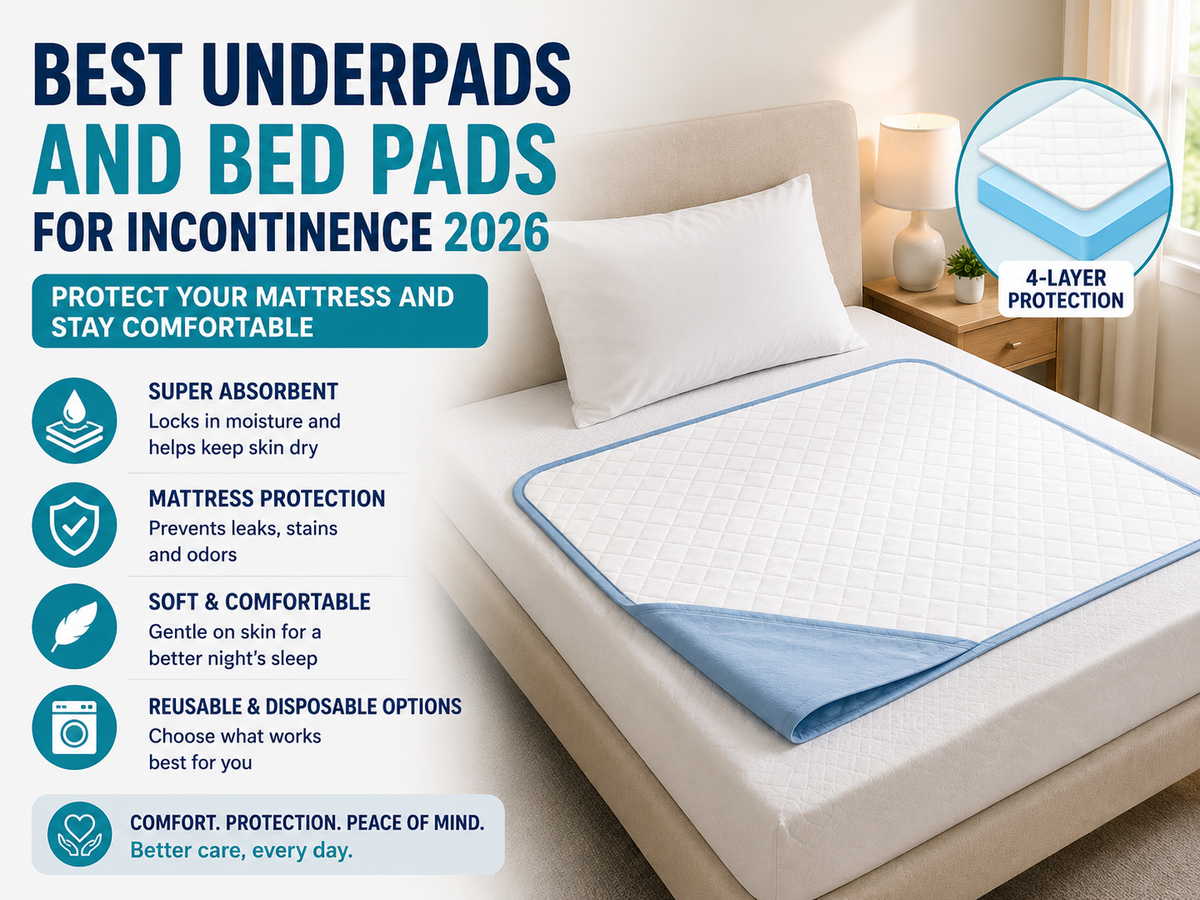
Best Underpads and Bed Pads for Incontinence 2026: Protect Your Mattress and Stay Comfortable

How the Right Underpad Changed Everything for Robert

Robert, 74, had managed his incontinence reasonably well during the day with disposable briefs. But nights were different. He slept deeply, didn't always wake in time, and twice in a month had soaked through his brief and into the mattress. The cleanup was exhausting — stripping the bed, washing everything at 2 a.m., hoping it would dry by morning. More than the inconvenience, it was the feeling of dread that settled in when he went to bed. Sleep was becoming anxious instead of restful.

His daughter suggested adding a washable underpad beneath his fitted sheet. The underpad absorbed the leakage that got past his brief, leaving the mattress dry. The first night he used it, he slept through without incident. The second time there was a leak, he woke to damp sheets but a dry mattress — something he could change easily and go back to sleep. "I actually look forward to bed again," he told his doctor.

Underpads are a straightforward, effective tool that many people managing incontinence overlook. This guide explains what they are, how to choose the right type and size, and how to use them effectively at home or in a care setting.

What Are Underpads?

Underpads — also called bed pads, chux pads, or incontinence pads — are absorbent sheets placed under a person's body (on a bed, chair, or wheelchair seat) to protect the surface beneath from moisture. They work as a secondary layer of protection when primary incontinence products (briefs, pull-ups, pads) are in use, or as primary protection during activities like dressing, transferring, or medical procedures.

Unlike body-worn incontinence products, underpads stay on the surface rather than the body. They protect:

  • Mattresses and box springs from moisture damage and odor
  • Chair and wheelchair cushions from soiling
  • Bedding and linens from saturation
  • Caregiver surfaces during dressing, bathing, or wound care

Disposable vs. Reusable Underpads

The most fundamental choice in underpads is whether to use disposable or reusable (washable) options. Both have clear use cases, and many people use both — disposables for travel and medical procedures, reusables for daily home use.

Disposable Underpads

Disposable underpads (sometimes called chux pads, after the Chux brand that popularized them) are single-use pads that are thrown away after use. They typically consist of a soft top layer, an absorbent core of fluff pulp and SAP (superabsorbent polymer), and a waterproof plastic backing.

Advantages:

  • No laundering required — simply fold and discard after use
  • Highly convenient for travel, hospital stays, and caregiver use
  • Available in a wide range of sizes and absorbency levels
  • Hygienic for wound care and medical procedures
  • Individually packaged for easy storage

Disadvantages:

  • Ongoing cost — multiple pads per day adds up quickly
  • Environmental impact from daily disposal
  • The plastic backing can feel warm and crinkly
  • Less comfortable than soft fabric washable pads for extended use

Best for: Travel, caregiver use during transfers and procedures, backup protection, hospital and skilled nursing settings, people who prefer not to launder incontinence products.

Reusable Underpads

Reusable underpads (also called washable bed pads or washable chux) are fabric pads that are laundered and reused — typically for 200–300 wash cycles before replacing. They usually have a soft quilted top layer, an absorbent middle layer, and a waterproof (polyurethane or PVC) backing that prevents moisture from passing through.

Advantages:

  • Lower cost over time — one washable pad replaces hundreds of disposables
  • Softer against skin than disposable plastic-backed pads
  • More environmentally sustainable
  • Often more absorbent than comparable disposable options
  • Available in larger sizes for full mattress protection

Disadvantages:

  • Requires laundering after each use
  • Higher upfront cost
  • May take time to dry fully (air drying preserves waterproofing longest)
  • Waterproof backing can degrade over time with repeated hot-water washing

Best for: Daily home use, nighttime protection, chair and wheelchair use, caregivers seeking to reduce ongoing supply costs.

Side-by-Side Comparison

Feature Disposable Reusable
Cost per use $0.25–$1.50 $0.05–$0.15 (amortized)
Comfort Varies; plastic backing can feel warm Softer, more fabric-like feel
Laundering None required After each use
Available sizes Standard to large (up to 30" x 36") Small to full bed (up to 34" x 54")
Absorbency Light to heavy (varies by brand) Generally heavier
Travel Ideal — no laundering needed Less convenient
Environment Daily waste Much lower waste

Understanding Absorbency Levels

Underpads come in light, moderate, heavy, and maximum absorbency levels. Choosing the right level depends on how much leakage you're protecting against.

  • Light/Regular (about 8–12 oz capacity): Appropriate when you're using a high-quality primary incontinence product and the underpad is purely secondary backup protection. Good for people with light to moderate incontinence who have a reliable brief or pull-up.
  • Heavy/Plus (about 18–24 oz capacity): A solid choice for most nighttime use — if your primary product leaks, the heavy underpad catches the overflow. Works well for moderate to heavy incontinence.
  • Maximum/Overnight (30+ oz capacity): For people with heavy or severe incontinence, or for situations where a caregiver can't change pads frequently. These are thick, highly absorbent pads that can manage significant volume.

A common mistake is choosing an underpad with too little absorbency to serve as meaningful backup. If you're relying on an underpad to protect your mattress through the night, choose at least heavy absorbency.

Sizing Guide

Underpads are typically described by their open, flat dimensions. The effective protection area is slightly smaller — the pad folds and tucks, so the area in direct contact with the body is the center portion.

Size Dimensions Best For
Small 17" x 24" Chair or wheelchair seat protection, travel
Standard 23" x 36" Most bed use, caregiver procedures
Large 30" x 36" People who move significantly during sleep, bariatric use
Extra Large / Bed Size 34" x 54" or larger Full mattress coverage for severe incontinence or heavy sleepers; reusable pads often available in these sizes

For most people sleeping in a standard twin or full bed, a 23" x 36" underpad placed under the hips and buttocks provides adequate coverage. People who move significantly during sleep or who have very heavy incontinence may benefit from a larger size.

Underpad Features to Compare

Top Sheet Material

The top sheet is what contacts the body or sheets. Disposable underpads typically use a nonwoven fabric or a "dry weave" top that pulls moisture away from the surface. Better-quality disposables have a softer top layer; budget versions can feel scratchy or papery. Reusable pads use quilted cotton or terry fabric, which is generally more comfortable for skin.

Waterproof Backing

All underpads have a waterproof backing that prevents moisture from passing through to the surface below. In disposables, this is usually polyethylene plastic — functional but can feel warm and crinkle noisily. In reusables, polyurethane laminate (PUL) is the standard — it's flexible, quieter, and more breathable than plastic. Some reusables use TPU (thermoplastic polyurethane), which is even more durable.

Tufted vs. Quilted Core

The absorbent core in disposable underpads is usually fluff pulp with superabsorbent polymer (SAP) crystals — the same technology in disposable diapers. SAP locks fluid into a gel, which is why good-quality disposables don't feel wet even after absorbing significant fluid. In reusable pads, the core is typically layers of cotton, microfiber, or other fabric that absorbs and holds fluid until laundering.

Odor Control

Many premium underpads include odor control features — baking soda, activated charcoal, or antimicrobial treatments in the core. These can meaningfully reduce odor, particularly in situations where frequent changes aren't possible. Look for this feature in underpads intended for overnight use or low-change-frequency situations.

How to Use Underpads Effectively

For Bed Use

Place the underpad beneath the fitted sheet for a tidier setup — this keeps the pad in place throughout the night and makes for a more normal-feeling sleep surface. Alternatively, place the underpad on top of the fitted sheet under the person's hips for easier changes without a full sheet change. The second method is common in caregiving settings.

For Chair and Wheelchair Use

Use smaller underpads on chair seats to protect cushions. In wheelchairs, a well-fitted waterproof cushion cover is often more practical than a pad — the pad can shift when the person moves. Ask a healthcare provider about wheelchair cushion options if moisture protection is a significant concern.

Changing Protocol

Change underpads promptly when wet. Prolonged skin contact with wet fabric — even with a dry-weave top layer — increases the risk of skin irritation, pressure injury, and fungal infections. In caregiving settings, routine check-and-change schedules (often every 2 hours during waking hours) help prevent problems. Use gentle cleanser and a barrier cream at each change to protect skin.

Washing Reusable Underpads

  • Rinse off excess waste before putting in laundry
  • Wash in warm or cool water with a standard detergent — avoid bleach, which degrades the waterproof backing over time
  • Tumble dry on low heat or air dry — high heat degrades polyurethane and PUL backing and shortens the pad's usable life
  • Do not use fabric softener, which coats fibers and reduces absorbency
  • Replace reusable pads when the backing shows cracking, peeling, or signs of delamination, or when absorbency noticeably declines

Underpads for Caregiver Use

In home caregiving, underpads serve double duty — protecting the person and making caregiver tasks more manageable. During personal care, dressing, repositioning, and wound care, disposable underpads provide a clean, waterproof surface and are simply discarded after the task. Keeping a box of standard-weight disposables on hand for these uses is practical even in households that primarily use reusable pads for sleep.

For people being repositioned in bed, underpads with tuck-in sides or with draw sheet handles simplify moving a person without skin friction. Some specialty underpads are designed specifically as repositioning aids with this feature.

Pairing Underpads with Other Incontinence Products

Underpads work best as part of a layered approach to incontinence management:

  • Primary protection: Disposable briefs, pull-up protective underwear, or fitted pads worn on the body
  • Secondary protection: Underpad on the bed or chair seat
  • Skin protection: Incontinence cleansers and barrier creams applied at each change
  • Odor management: Prompt changes, room deodorizers, laundry additives

Explore our full Incontinence collection for protective underwear, underpads, wipes, and skin care products from brands including Depends, Prevail, TENA, Attends, and more.

AllCare Store: Trusted Incontinence Products

At AllCare Store, we understand that incontinence products are essential daily necessities, not optional supplies. We carry a wide selection of underpads, protective underwear, wipes, and skin care — all available with free shipping and discreet packaging.

  • Free Shipping on every order — no minimum required
  • Discreet Packaging — plain, unmarked boxes on every shipment
  • 30-Day Returns — shop with confidence
  • Expert Help — call us at 1-888-889-6260

Visit our Incontinence collection at AllCare Store — reliable products, delivered with care.

Frequently Asked Questions: Underpads and Bed Pads

What is the difference between underpads and bed pads?

"Underpad" and "bed pad" are often used interchangeably. Both refer to absorbent, waterproof pads placed under a person on a bed, chair, or other surface to protect against leakage. "Chux" is another common name, originating from the brand Chux. "Bed pads" sometimes specifically refers to larger pads designed for full or half-mattress coverage, while "underpads" can also include smaller chair-sized versions.

How often should underpads be changed?

Change underpads whenever they are wet or soiled. Prolonged contact with moisture — even when a quality dry-weave top layer is present — can cause skin irritation and increase the risk of pressure injuries, particularly in people with limited mobility. In caregiving settings, checking and changing every 2 hours during waking hours is standard practice. Overnight, a high-absorbency underpad combined with a good primary product can typically last through the night, but should still be changed at the first morning opportunity.

Are reusable underpads as absorbent as disposable ones?

Quality reusable underpads are generally equal to or more absorbent than disposable underpads of comparable size. Reusable pads use multi-layer fabric cores that can hold significant fluid without releasing it back to the skin surface. However, unlike disposable pads that use superabsorbent polymer (SAP) to lock fluid into a gel, reusable pads hold fluid in the fabric itself — which means they feel wetter to the touch and should be changed and laundered promptly after use.

How do I keep an underpad from sliding on the bed?

The most reliable solution is to tuck the underpad under the fitted sheet — this keeps it firmly in place regardless of movement during sleep. Some underpads have tuck-in flaps or extensions specifically designed for this purpose. Alternatively, some reusable underpads have non-slip backing material that grips the sheet. For chair use, some underpads have corner straps or ties that anchor to the chair legs.

How many reusable underpads do I need?

A minimum of 3–4 reusable underpads is recommended for daily use — one in use, one in the laundry, and one or two as backup while the first is washing and drying. People who have multiple leakage events per day, or who can't do laundry daily, benefit from having 6–8 on hand. Reusable underpads typically take 1–2 hours in the dryer or overnight to air dry fully, so having enough in rotation to avoid running out is important for uninterrupted protection.

Newsletter

A short sentence describing what someone will receive by subscribing