Disclaimer: This guide is for informational purposes only and does not constitute medical advice. If you have balance problems, a recent fall, or recovering from surgery, please consult your physician or physical therapist before selecting a mobility aid.
Best Canes and Walking Sticks for Seniors in 2026
Margaret's First Step Back
Margaret, 74, had been telling herself for two years that she didn't need a cane. She was fiercely independent, had never broken a bone, and the idea of walking with a cane felt like admitting defeat. Then, on a rainy Tuesday morning, she slipped on her back porch and grabbed the railing just in time to avoid a fall that could have changed everything. Her daughter drove her to a physical therapist the next week. The PT spent forty-five minutes with her — assessing her gait, measuring her height, watching her walk — and then handed her a simple offset cane. Margaret took it home expecting to resent it.
Instead, she found herself walking to her mailbox without the cautious, shuffling steps she'd unconsciously adopted over the previous year. She walked to her neighbor's house. She went to her garden club meeting and didn't grip chairs and walls the whole time she was there. Three months later, she told her daughter that the cane was the best thing that had happened to her in years — not because she needed it desperately, but because it let her stop spending mental energy on not falling and start spending it on living.
Margaret's story is common. Studies show that appropriate cane use significantly reduces fall risk in older adults, improves gait confidence, and reduces the load on arthritic joints — yet fewer than half of older adults who would benefit from a mobility aid use one consistently. This guide exists to make the choice simple. When you're ready to find the right cane, AllCare Store's cane and mobility aid collection has a full range of options with free shipping on qualifying orders.
Do You Actually Need a Cane? Signs to Look For
A cane is appropriate when any of the following apply:
- You've had a fall or near-fall in the past 12 months
- You find yourself gripping furniture, walls, or other people's arms while walking
- You have pain in one hip, knee, or ankle that causes you to favor one side
- You feel unsteady on uneven surfaces, stairs, or outdoors
- You are recovering from lower extremity surgery (hip replacement, knee replacement, ankle repair)
- You have a neurological condition (Parkinson's disease, stroke, MS) that affects balance or gait
- You tire quickly when walking and need to rest more than you'd like
If you're uncertain, a physical therapist can do a brief gait assessment and recommend whether a cane, walker, or other aid would be most appropriate for your specific situation. Many insurance plans cover PT visits for fall risk evaluation.
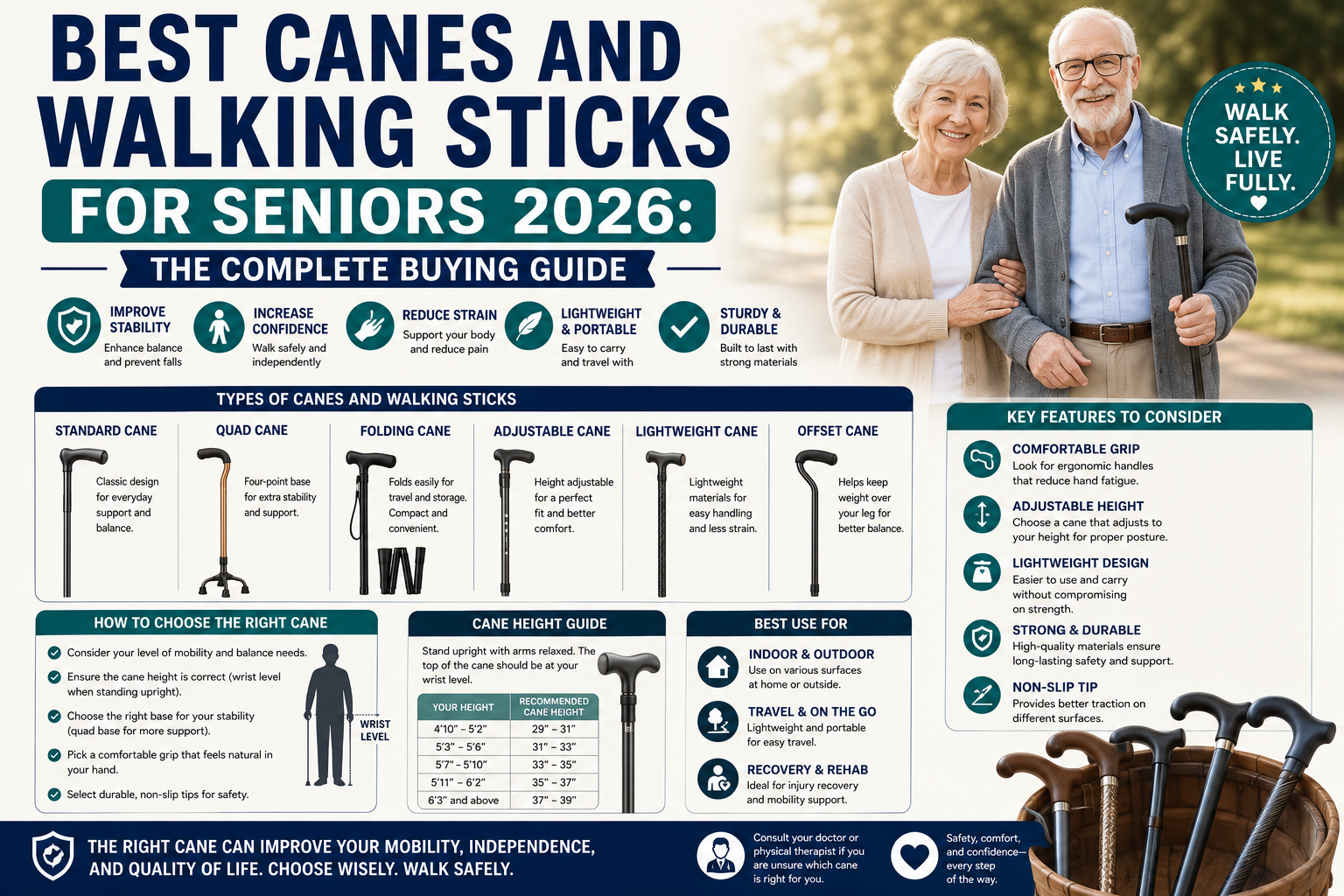
Types of Canes: Which One Is Right for You?
1. Standard Single-Point Cane
The classic cane — a single shaft with a curved or ergonomic handle and a rubber tip at the base. Best for people who need only minimal support and primarily want something to aid balance on uneven surfaces or reduce joint pain on one side.
Pros: Lightweight (typically 10–14 oz), easy to store, inconspicuous, widely available
Cons: Provides the least stability of any cane type; not appropriate for significant balance deficits or heavy weight-bearing needs
Best for: Mild balance issues, occasional joint pain relief, post-surgical recovery with good baseline strength
2. Offset (Functional Grip) Cane
The offset cane has a handle that positions the user's wrist directly over the shaft of the cane, distributing weight more efficiently than a standard curved handle. This is often the preferred cane type recommended by physical therapists for older adults because it allows more comfortable long-term use and better weight transfer.
Pros: Better weight distribution than curved-handle canes; reduces wrist and hand fatigue; more stable feel
Cons: Slightly more expensive than basic canes; the offset design can feel different initially
Best for: Regular daily use, arthritis in the wrist or hand, moderate balance issues
3. Quad Cane (Four-Point Cane)
A quad cane has a base with four small feet instead of a single tip, providing a significantly larger base of support. The wide-base version (also called a wide-quad or large-base quad) offers more stability than the narrow-base version.
Pros: Most stable of standard cane types; can stand upright on its own (very convenient); excellent for people who need to bear significant weight on the cane
Cons: Heavier (typically 1.5–2.5 lbs); the four-point base requires a specific cadence to use correctly; less practical on stairs; more conspicuous
Best for: Stroke recovery and hemiplegia, significant balance deficits, post-hip-replacement where weight-bearing is limited, people transitioning from a walker to a cane
4. Folding Cane
A folding cane collapses into three or four sections for easy storage in a bag, purse, or car door. They typically use the same tip and handle styles as standard canes but have hinged joints along the shaft.
Pros: Extremely portable; ideal for travel; can be kept in a bag for use only when needed
Cons: Slightly less rigid than one-piece canes; hinges add weight and potential failure points; some users find them less confidence-inspiring than solid-shaft canes
Best for: Travelers, people who only need a cane occasionally (outings, long walks), anyone who doesn't want to carry a cane visibly all the time
5. Seat Cane (Cane with Seat)
A seat cane (also called a walking stick with seat) has a built-in fold-out seat, allowing the user to sit down wherever they are — at events, in lines, in museums, in parks. They typically have three or four legs for stability when opened.
Pros: Provides resting option anywhere; reduces fatigue on long outings; helps people with low stamina remain more active
Cons: Heavier than standard canes; the fold-out seat mechanism adds complexity; requires user to learn opening/closing technique
Best for: People who tire on longer outings, outdoor events, travel, low stamina due to cardiac or respiratory conditions
6. Derby / Fritz Handle Cane
These canes have a rounded, ball-like (derby) or hook-shaped (Fritz) handle. They are classic in style and functional for those who prefer to hook the cane over their arm or hang it on a surface when not in use. They provide less ergonomic wrist support than offset handles but are widely used and comfortable for lighter use.
Best for: Occasional use, style preference, those who carry the cane as much as use it
How to Size a Cane Correctly
An improperly sized cane is almost as problematic as no cane at all. A cane that is too short causes you to stoop; too tall, and your elbow locks out, eliminating the shock-absorbing function of the arm. Here's how to get it right:
The Standard Method (Requires Measurement)
- Stand upright in the shoes you normally wear
- Let your arms hang naturally at your sides
- Measure from the floor to the crease of your wrist (the wrist break)
- This measurement in inches = your ideal cane height
For most adults, this falls between 30–40 inches. Most adjustable canes cover this range comfortably.
The Quick Check
Hold the cane in the hand opposite to the weaker leg or the side with more pain. With the cane tip on the floor next to your foot, your elbow should have a slight bend — approximately 15–20 degrees. If your elbow is straight, the cane is too tall. If your elbow is bent more than about 30 degrees, the cane is too short.
Adjustable vs. Fixed-Height Canes
Almost all modern aluminum canes are adjustable, typically in 1-inch increments via a push-button or twist-lock mechanism. Fixed-height wooden canes are traditional but require cutting to fit — not recommended unless you're certain of your measurement. If you're purchasing a first cane or are between sizes, always choose an adjustable model.
Cane Features That Matter
| Feature | What to Look For | Why It Matters |
|---|---|---|
| Handle material | Foam, gel, or contoured rubber grip | Reduces hand fatigue; critical for arthritis sufferers |
| Shaft material | Aluminum (most common), carbon fiber (lightest), wood (classic) | Aluminum balances weight and durability; carbon fiber best for portability |
| Tip | Large-diameter rubber tip; some use all-terrain or ice tips | Wider tip = more grip on floors; check tip wear regularly and replace when worn |
| Weight capacity | Standard: 250–300 lbs; bariatric: 500+ lbs | Always verify the cane's rated capacity exceeds your body weight for safety |
| Wrist strap | Optional but useful | Prevents dropping cane if hand loosens; keeps cane accessible when using hands |
| Reflective elements | Some models include reflective strips | Visibility when walking outdoors at dusk or dawn |
Handle Styles for Arthritic Hands
For people with arthritis, Parkinson's disease, or reduced grip strength, handle design is one of the most important factors in cane selection. The following handle types are generally better tolerated by people with hand and wrist issues:
- Ergonomic contoured handles: Molded to the natural shape of the hand; distribute pressure across the palm rather than concentrating at one point
- Foam-padded handles: Soft material reduces pressure points; comfortable for extended use
- T-handle (palm grip): The flat top of a T-handle allows the palm to rest on a broad surface, reducing finger and wrist strain — often recommended for rheumatoid arthritis
- Large-diameter handles: Easier to grip for those with reduced finger flexion; look for handles that are slightly oversized compared to a standard aluminum tube
Browse AllCare Store's cane collection for ergonomic, arthritis-friendly handle options. We carry standard aluminum adjustable canes, quad canes, folding travel canes, and specialty models.
How to Use a Cane Correctly
Using a cane on the wrong side, or with an incorrect gait pattern, reduces its effectiveness and can actually cause new problems. Here's the correct technique:
Which Hand to Use
Hold the cane in the hand opposite to the weaker or more painful leg. This mirrors the way the body naturally uses the opposite arm to support the opposite leg during walking, and distributes weight more effectively across the pelvis and spine. Exception: some post-surgical protocols specify which hand to use — follow your surgeon or PT's instruction in those cases.
The Correct Walking Pattern
- Move the cane forward simultaneously with the affected (weaker) leg
- Then step forward with the stronger leg, past the cane
- Repeat: cane + weak leg → strong leg → cane + weak leg…
This pattern is sometimes called the two-point gait. It may feel unnatural at first; a few sessions with a physical therapist can help establish correct muscle memory.
Stairs with a Cane
- Going up: Step up with the stronger leg first, then bring the weaker leg and cane up to the same step. ("Up with the good.")
- Going down: Place the cane down on the lower step first, then step down with the weaker leg, then bring the strong leg down. ("Down with the bad.")
- Always use a handrail when available, holding the cane in the other hand
Cane Maintenance and Safety
A well-maintained cane is a safe cane. Neglected canes — especially worn rubber tips — can slip and cause falls.
- Tip inspection: Check the rubber tip weekly. A worn, cracked, or smooth-bottomed tip provides no grip. Replace tips when the tread wears down — replacement tips are inexpensive and widely available
- Height adjustment locks: Periodically check that push-button or twist-lock height adjustments are secure. A cane that collapses under weight is dangerous
- Handle condition: Foam or rubber handles can degrade over time, especially with heavy use or heat exposure. A slipping or deteriorated grip reduces control
- Shaft integrity: Aluminum canes can dent; carbon fiber can crack. Inspect the shaft periodically, especially after any impacts
Replacement rubber cane tips are available at AllCare Store's Mobility Accessories collection — have a spare on hand so you're never caught with a worn tip.
Specialty Canes: When Standard Isn't Enough
All-Terrain / Outdoor Canes
Designed for hiking, outdoor walking, and uneven terrain. These typically feature a spiked or cleat tip for grip on dirt, grass, and gravel. Many use a trekking pole design with a wrist strap and may have shock-absorbing shafts. Best for active older adults who walk on varied surfaces.
Ice Tips and Winter Cane Accessories
A standard rubber tip provides no grip on ice or compacted snow. Slip-on ice tips (resembling tiny crampons) attach over the standard tip for winter walking and flip out of the way on indoor surfaces. Essential for seniors in cold climates.
Bariatric Canes
Standard canes are rated for 250–300 lbs. Bariatric models handle 500 lbs or more, with heavier-gauge shafts and larger base hardware. If your weight exceeds the standard capacity of a cane, a bariatric model is essential for safety.
Laser Canes for Parkinson's Disease
A specialized category: canes with a built-in laser that projects a line on the floor ahead of the user. This visual cue has been shown in research to help people with Parkinson's overcome freezing of gait — a common and disabling symptom. If you or a loved one has Parkinson's, ask a neurologist or Parkinson's-specialized PT about this option.
Cane vs. Walker: How to Decide
| Factor | Cane May Be Better | Walker May Be Better |
|---|---|---|
| Balance deficit | Mild to moderate | Moderate to severe |
| Weight bearing | One-sided unloading needed | Both sides need support |
| Endurance | Good baseline endurance | Low endurance; needs to lean |
| Portability | Higher (folds, one-handed) | Lower (bulkier) |
| Stairs | Manageable with technique | Standard walkers not suitable for stairs |
| Hands-free needs | One hand free for carrying | Both hands occupied |
If you're unsure whether a cane or walker is appropriate, a physical therapist evaluation is the most reliable path to the right answer. See also AllCare Store's walkers and rollators collection if you're considering both options.
Frequently Asked Questions
Which hand do you hold a cane in?
Hold the cane in the hand opposite to the weaker or more painful leg. This is counterintuitive but biomechanically correct — it mirrors how the body naturally uses the opposite arm and leg together during gait, and allows more effective weight transfer. For example, if your right knee is painful, hold the cane in your left hand.
How do I know what height to set my cane?
Stand upright in your normal shoes and let your arms hang naturally. Measure from the floor to the crease at your wrist — that measurement in inches is your ideal cane height. When holding the cane at the correct height, your elbow should have a slight bend of about 15–20 degrees. An elbow that is completely straight means the cane is too tall; an elbow bent more than 30 degrees means the cane is too short.
Does Medicare cover the cost of a cane?
Medicare Part B covers canes as Durable Medical Equipment (DME) when they are medically necessary and prescribed by a physician. To be covered, the cane must be prescribed, and you must purchase it from a Medicare-approved DME supplier. Standard single-tip canes are generally covered; quad canes are covered when medically indicated. Contact your Medicare plan or a DME supplier for specifics on coverage and out-of-pocket costs.
How often should I replace the rubber tip on my cane?
Replace the rubber tip when the tread wears smooth, when it shows cracking, or when it begins to slip on surfaces that it previously gripped. For daily cane users, this may be every 3–6 months. Check weekly by looking at the bottom of the tip — a flat, smooth, or cracked surface is a fall risk. Keep a spare tip on hand so you can replace it immediately when needed.
Is a quad cane better than a standard cane for Parkinson's disease?
Quad canes offer more stability and can stand upright on their own, which can be useful in some Parkinson's situations. However, the research on cane type in Parkinson's is nuanced — the four-point base requires a specific gait cadence that some Parkinson's patients find difficult. A Parkinson's-specialized physical therapist is the best resource for recommending the right mobility aid. Laser canes (which project a visual floor line to reduce freezing episodes) are also worth discussing with a neurologist.
Finding Your Perfect Cane
Margaret still uses her offset cane — three years on. She had it sized and fitted by a PT, uses it in the hand opposite her arthritic knee, and checks the rubber tip every week. She went back to hiking the local nature trail with her garden club. She travels. She moves through her world the way she wants to move through it.
A cane, chosen correctly and used with proper technique, doesn't limit independence — it restores it. The goal isn't to need the cane forever; for some people it's a transitional aid during recovery. For others it's a permanent tool that makes active living possible. Either way, the right cane is one that fits, that you'll actually use, and that gives you the confidence to keep moving.
Shop AllCare Store's Canes and Crutches collection for adjustable single-point canes, offset canes, quad canes, folding travel canes, and bariatric options. Free shipping on qualifying orders. Questions? Call us at 1-888-889-6260 or visit AllCareStore.com.
— The AllCare Store Team