Frank and the Sock Drawer Full of Good Intentions
Frank is 74, a retired mail carrier, which is a joke he makes himself: thirty-one years of walking eight miles a day, and the minute he stopped, his legs quit on him.
It started as an evening thing. By dinner his ankles would swell over the tops of his shoes, and the skin would hold a dent when he pressed it. His doctor called it venous insufficiency — the one-way valves in his leg veins had gotten leaky, and blood was pooling instead of returning uphill to his heart. Not dangerous yet, she said. But it was why his legs ached by afternoon, why the skin near his ankles was turning brownish, and why 'just put your feet up' had stopped being enough.
She told him to wear compression socks: 20-30 mmHg, knee-high, on before he got out of bed in the morning. Frank nodded, went home, and bought the wrong thing three times. First the drugstore 'energy socks' that were little more than snug athletic socks. Then a pair so hard to pull on that he wore them exactly once. Then a pair that fit his calf but cut into the skin below his knee because he'd sized them off his shoe size alone.
The sock drawer filled up. The swelling didn't change.
What finally worked wasn't willpower — it was information. Frank got measured properly (ankle and calf circumference, first thing in the morning), learned what the mmHg number on the package actually meant, bought one well-made pair in the right size, and picked up a $29 sock aid so his arthritic hands didn't have to fight the fabric. Within two weeks the evening swelling was visibly down, the ache was mostly gone, and the socks went on in about ninety seconds a day.
Most compression sock failures are exactly Frank's failures: wrong level, wrong size, wrong style, or a pair so hard to don that it lives in the drawer. This guide fixes all four.
What Compression Socks Actually Do
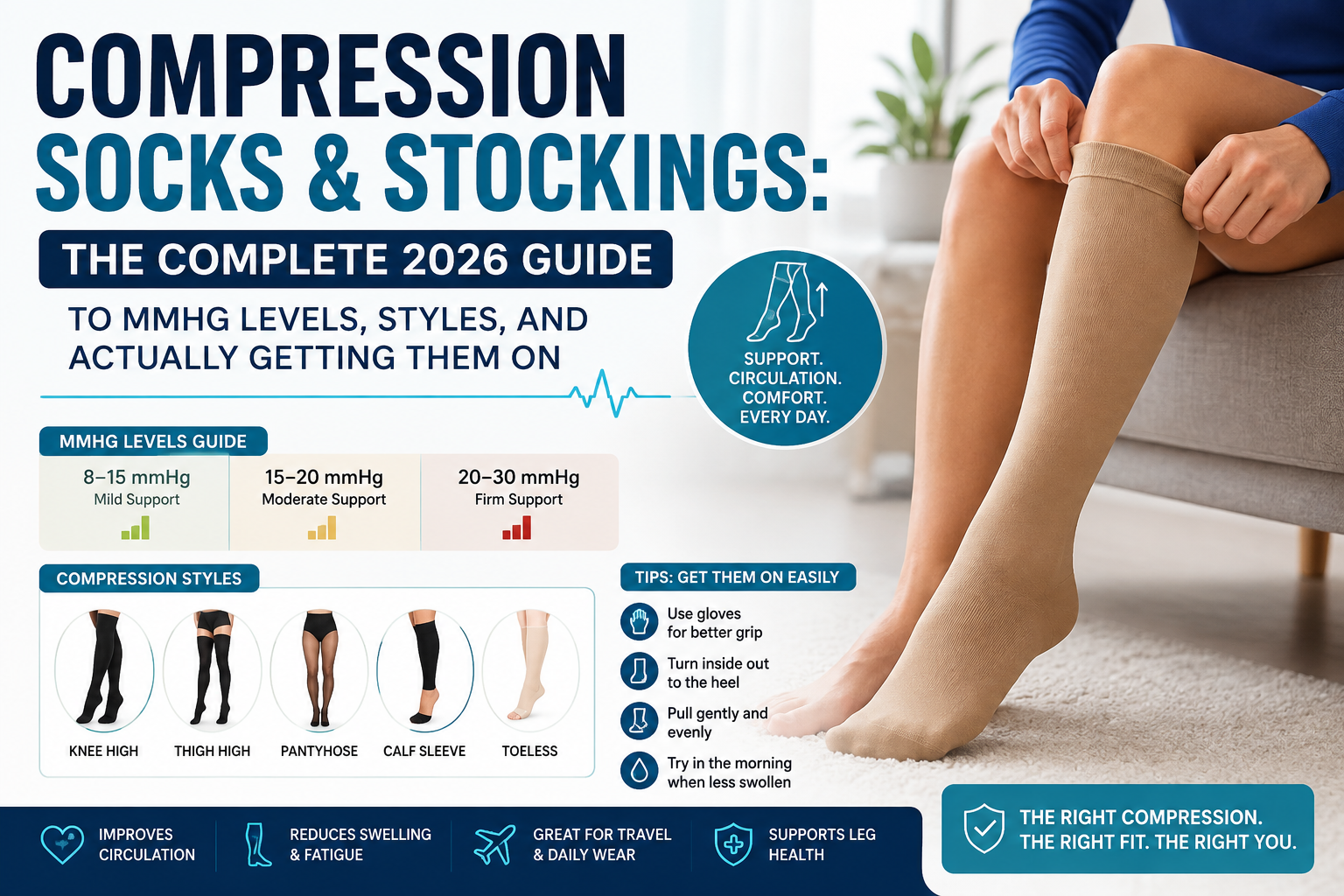
Graduated compression socks are knitted so they squeeze hardest at the ankle and progressively less as they move up the leg. That pressure gradient does three useful things:
- Helps veins move blood uphill. The gentle squeeze narrows the veins slightly, which makes the one-way valves inside them work better and speeds blood back toward the heart instead of letting it pool at the ankle.
- Limits fluid leaking into the tissue. Less pooling means less of the fluid seepage that becomes visible swelling (edema) by the end of the day.
- Supports the calf muscle pump. Every step you take, the calf muscle squeezes blood upward. Compression makes each contraction more efficient — which is why compression works best on legs that are moving, not just sitting.
The key word is graduated. A tight tube of fabric that squeezes evenly everywhere — which is what many cheap 'compression' socks are — can actually trap fluid rather than move it. Proper medical compression is measured, rated in millimeters of mercury (mmHg), and tightest at the ankle by design.
The mmHg Numbers, Decoded
Every legitimate compression garment is labeled with a pressure range — 15-20 mmHg, 20-30 mmHg, and so on. The range describes the pressure at the ankle. Here's what each class is actually for:
| Level | Class | Typical Uses | Prescription Needed? |
|---|---|---|---|
| 8-15 mmHg | Mild | Tired, achy legs from long days standing; minor end-of-day puffiness; everyday comfort | No |
| 15-20 mmHg | Moderate | Long flights and car trips, mild swelling, mild varicose veins, pregnancy leg fatigue, prolonged sitting or standing at work | No |
| 20-30 mmHg | Firm (Class I medical) | Moderate swelling and varicose veins, venous insufficiency, post-sclerotherapy, DVT history, moderate edema — the most commonly recommended medical level | Recommended with clinician guidance |
| 30-40 mmHg | Extra firm (Class II medical) | Severe venous insufficiency, significant edema, lymphedema, post-DVT syndrome, venous ulcer prevention | Yes — clinician-directed |
Two rules of thumb save most people from a bad purchase. First, more pressure is not more better — a 30-40 sock on a leg that needs 15-20 is painful, hard to don, and likelier to be abandoned or to cause skin trouble. Second, if a 'compression' product doesn't state an mmHg range at all, it isn't medical compression; it's a snug sock.
Graduated Compression vs. Anti-Embolism (TED) Stockings: Not the Same Thing
This is the single most common mix-up we see, and it matters.
Anti-embolism stockings — often called TED hose after the original brand — are designed for people who are lying down: recovering from surgery, confined to bed, or otherwise off their feet most of the day. They deliver a lower pressure (typically around 15-20 mmHg with a profile designed for a horizontal leg) and their job is preventing deep vein thrombosis, the dangerous clots that can form in immobile legs. Many have an inspection hole at the toe so nurses and caregivers can check circulation without removing the stocking. The Blue Jay Anti-Embolism Stockings 15-20 mmHg below-knee closed toe ($25.73) and the inspection-toe version ($26.59) are the standard recovery-care options, and the classic T.E.D. thigh-length open-toe pair ($45.99) covers thigh-length needs after hip or knee surgery.
Graduated compression stockings are designed for people who are upright and moving — that's Frank. The pressures are calibrated for a standing leg working against gravity.
The practical rule: bed rest and post-op recovery → anti-embolism; walking around and daily wear → graduated compression. If you were sent home from surgery with white TED hose, ask at your follow-up when to switch — they're not meant to be permanent daywear. And if you're recovering from foot or ankle surgery, they pair naturally with the equipment in our walking boots and post-op shoes guide and knee walker guide.
Knee-High, Thigh-High, or Pantyhose?
Knee-High (the default)
For most swelling, most varicose veins, most travel, and most tired legs, knee-high is the answer — the problems compression solves usually live below the knee, and knee-highs are dramatically easier to put on and keep up. For daily wear, the Blue Jay Men's Firm Support Socks 20-30 mmHg ($29.42) look like ordinary dress socks in black or brown, and the Jobst Ultrasheer 20-30 knee-highs ($95.99) are sheer enough that nobody in the room knows they're medical.
Thigh-High
Choose thigh-high when the problem extends above the knee — varicose veins in the thigh, swelling that doesn't stop at the calf, or post-surgical protocols that call for full-leg coverage. Silicone dot bands keep modern versions up without garters. Options run from the Jobst Opaque thigh-high 15-20 mmHg ($108.94, opaque enough to read as regular hosiery) to the Jobst Relief 20-30 thigh-high open-toe ($122.75), with the Jobst for Men ribbed thigh-high 20-30 ($200.01) styled for men. For clinician-directed extra-firm therapy, the Blue Jay extra-firm surgical-weight 30-40 mmHg thigh stockings with garter top ($45.01) are the workhorse option.
Pantyhose / Waist-High
For swelling or vein problems that involve the upper thigh, or simply for people who prefer hosiery that can't slide down. Harder to don, warmer to wear — usually a second garment, not a first.
Open Toe vs. Closed Toe
Open-toe versions suit long feet, wide feet, bunions, toe dressings, warm weather, and anyone who wants to wear them under regular socks. Closed toe is tidier under shoes and adds mild protection. Pressure therapy is identical either way.
Sizing: The Ten Minutes That Decide Everything
Compression sizing runs on leg circumference, not shoe size — this is where Frank went wrong on attempt number three. Measure:
- Ankle at the narrowest point, just above the ankle bone
- Calf at the widest point
- For thigh-highs: thigh circumference at the widest point, plus the length from floor to gluteal fold
- For knee-highs: some brands also use floor-to-bend-of-knee length (regular vs. long)
Measure first thing in the morning, before swelling builds — the sock needs to fit the leg it goes onto at 7 a.m., not the swollen version at 7 p.m. Then match your numbers to the specific brand's chart, because a Large in one brand is not a Large in another. If your measurements straddle two sizes, or your ankle and calf land in different size columns, call us — that's a two-minute conversation that prevents a returned pair.
A sock that's right will feel snug and supportive, tightest at the ankle, with no digging band at the top, no bunching behind the knee, and no numb toes. Rolling or folding the top down to loosen it doubles the pressure in a narrow band — if you're tempted to roll it, the size or length is wrong.
Getting Them On: The Part Nobody Warns You About
Good compression is, by definition, snug — and pulling a firm gradient garment over a heel is the step that defeats more users than anything else. The technique that works:
- Put them on first thing in the morning, before your feet hit the floor for long. Once a leg has swollen, everything is harder.
- Turn the sock inside out down to the heel pocket, fit it over your foot and heel first, then unroll it up the leg in stages. Never grab the top band and haul.
- Smooth, don't stretch. Work wrinkles flat with your palms — a wrinkle is a pressure line on your skin by afternoon.
- Dry skin, dry socks. Moisturize at night, not right before donning; damp skin grips fabric. If you use lotion in the morning, let it absorb fully first. (Dry, fragile legs still need moisture — see our guide to moisturizers for elderly dry skin.)
- Rubber dishwashing gloves give arthritic hands grip on the fabric and make smoothing wrinkles far easier.
- Use a donning aid. A frame-style aid like the Flexible Deluxe Sock Aid ($28.99) holds the sock open so you can slide your foot in without bending to your toes — the difference between wearing compression daily and abandoning it. After hip or knee surgery, when bending past 90 degrees is off-limits, a kit like the Blue Jay Hip Recovery Kit with reacher, sock aid, and dressing stick ($40.90) covers socks, shoes, and dropped objects in one box.
Take them off before bed unless your clinician says otherwise — legs lying flat overnight don't need daytime-grade compression, and skin benefits from the break.
Care and Replacement
Wash after every wear — hand wash or a lingerie bag on gentle, mild soap, air dry away from heat. Washing actually restores the elastic fibers; it's skipping the wash that kills them. Rotate two pairs so one is always dry.
Plan on replacing compression garments about every four to six months of regular wear. The fabric doesn't develop holes when it dies; it just quietly stops delivering the rated pressure. If a sock has become noticeably easier to put on, it isn't your technique improving — it's the compression giving out.
Who Should Check With a Doctor First
Compression is powerful and mostly safe — but it squeezes, and some legs shouldn't be squeezed:
- Peripheral arterial disease (PAD). If the arteries are already struggling to push blood into the leg, external pressure can make it worse. Signs include leg pain when walking that stops with rest, cold feet, and shiny hairless shins. This is the big one — get checked first.
- Diabetes with neuropathy. Reduced sensation means you can't feel a sock that's cutting in. Many people with diabetes do wear compression successfully, but the level and fit should be clinician-guided, and daily skin checks are non-negotiable. Our diabetic foot care guide covers the full routine, and lighter-touch diabetic socks are a different product for a different job.
- Active skin infection, weeping dermatitis, or unhealed wounds on the leg.
- Significant heart failure — moving a large fluid volume back into central circulation needs medical supervision.
- New, sudden, one-sided swelling is not a shopping trip — it's a same-day call to a doctor to rule out a clot, especially with warmth, redness, or calf pain.
For arm and leg swelling from lymphedema specifically — a related but distinct condition with its own garment types — see our lymphedema compression garments guide.
Quick Picks by Situation
| Situation | Sensible Starting Point | Example |
|---|---|---|
| Long flight or road trip | 15-20 mmHg knee-high | Compression socks & hosiery collection |
| Daily swelling, aching, varicose veins | 20-30 mmHg knee-high (with clinician OK) | Men's Firm Support 20-30 ($29.42) / Jobst Ultrasheer 20-30 ($95.99) |
| Recovering in bed after surgery | Anti-embolism stockings, per discharge instructions | Blue Jay anti-embolism ($25.73) / T.E.D. thigh-length ($45.99) |
| Veins or swelling above the knee | Thigh-high, level per clinician | Jobst Opaque 15-20 ($108.94) / Jobst Relief 20-30 ($122.75) |
| Severe edema, post-DVT, ulcer prevention | 30-40 mmHg, clinician-directed | Blue Jay X-Firm 30-40 thigh ($45.01) |
| Can't reach your feet | Add a donning aid | Flexible Deluxe Sock Aid ($28.99) |
Why Shop Compression Wear at AllCare Store
AllCare Store carries the full range — Jobst, Blue Jay, and T.E.D. graduated compression and anti-embolism stockings in knee-high, thigh-high, and waist-high styles from 8-15 through 30-40 mmHg, plus the sock aids and dressing tools that make daily wear realistic. Everything ships free within the U.S. in discreet packaging with 30-day returns.
Start with the compression socks & hosiery collection, browse the wider footwear & socks collection and stockings collection, or see compression bandages and wraps for wrap-based therapy.
Frequently Asked Questions
What level of compression socks do I need?
For general tired legs and travel, 15-20 mmHg is the usual over-the-counter choice. For diagnosed swelling, varicose veins, or venous insufficiency, clinicians most commonly recommend 20-30 mmHg. Levels of 30-40 mmHg are for clinician-directed therapy. When in doubt, ask your doctor — and never assume tighter is better.
How many hours a day should I wear them?
The standard pattern is on in the morning before swelling starts, off before bed. Compression works while you're upright; a horizontal sleeping leg doesn't usually need it unless your clinician says otherwise.
Are TED hose and compression socks the same?
No. TED (anti-embolism) hose are for people lying in bed, calibrated to prevent clots in an immobile leg. Graduated compression socks are for upright, mobile people. Wearing white TED hose as everyday walking-around socks gives you the wrong pressure profile for the job.
Can compression socks help varicose veins?
They can't erase existing veins, but they reliably reduce the aching, heaviness, and swelling those veins cause, and they slow progression. They're also standard after vein procedures like sclerotherapy — your provider will specify level and duration.
Should I wear compression socks on a plane?
Long immobile flights slow circulation in everyone, and 15-20 mmHg knee-highs are a reasonable, widely recommended precaution — combined with walking the aisle and ankle pumps in your seat. If you have a DVT history, ask your doctor about the right level before traveling.
Why do my compression socks hurt or leave deep marks?
Light knit lines are normal; pain, numbness, deep grooves, or a rolled top digging in are not. The usual culprits are wrong size (measure your ankle and calf, morning, in centimeters, against the brand chart), wrong length (a knee-high jammed into the bend of the knee), or a level higher than your leg needs. Take them off and re-check the fit — and if pain persists, involve your clinician.
Can people with diabetes wear compression socks?
Often yes, and sometimes they're specifically prescribed — but reduced sensation changes the safety math, so level and fit should be chosen with your care team, and feet need daily inspection. Note that cushioned, non-binding diabetic socks are the opposite of compression socks — they're designed not to squeeze — so know which one your clinician means.
How do I keep thigh-highs from sliding down?
Buy versions with a silicone band, make sure the length matches your leg (too long guarantees slippage), don them on dry skin without lotion at the band line, and replace them when the elastic ages out. Rolling the top to 'anchor' it creates a tourniquet — don't.
When should I replace my compression socks?
Roughly every four to six months of regular wear, or as soon as they become noticeably easier to put on — that ease is the compression wearing out. Keep two pairs in rotation and wash after every wear to protect the elastic.
The Takeaway: Get Measured, Get the Right Class, Get a Sock Aid
Compression therapy fails in drawers, not on legs. The pairs that get worn are the ones that fit — measured at the ankle and calf, matched to the right mmHg class for the actual problem, in a style the wearer can physically get on every single morning. Solve those three things and compression socks quietly become one of the highest-value pieces of medical equipment a person can own: no batteries, no maintenance, just legs that feel better at six in the evening than they used to.
Frank's sock drawer still holds the three failed pairs. He keeps them, he says, as a reminder that the fourth pair — the measured one — cost less than the first three combined.
Need Help Choosing? Talk to a Specialist.
AllCare Store stocks graduated compression and anti-embolism stockings from Jobst, Blue Jay, and T.E.D., plus sock aids, dressing tools, and the rest of the recovery equipment they work alongside. Explore the compression socks & hosiery collection to compare levels and styles.
MEDICAL DISCLAIMER: This article is for informational purposes only and is not a substitute for professional medical advice. Compression therapy is genuine medical treatment: the right level depends on your circulation, skin, and diagnosis, and the wrong level can cause harm. Compression at 20-30 mmHg and above should be used under the guidance of a clinician, and anyone with peripheral arterial disease, diabetes with reduced sensation, severe neuropathy, skin infection, or heart failure should ask their doctor before wearing any compression garment. If a sock causes numbness, tingling, color change, or new pain, take it off and call your provider.
Call 1-888-889-6260 to talk through sizing measurements, compression levels, and insurance questions with a specialist, or visit AllCareStore.com to browse the full range. Free U.S. shipping, discreet packaging, and 30-day returns on every order.
This guide was written and reviewed by the AllCare Store editorial team. For personalized medical advice, consult your physician, vascular specialist, or wound care clinician.