Linda's Story: The Strange Sandal They Hand You at Discharge
Linda is 58 and has been a florist for thirty years, which means thirty years of standing on concrete floors in whatever shoes could survive the water and the stems. The bunion on her right foot had been growing for a decade. Last fall it finally won: she couldn't get through a wedding setup without sitting down, and her regular shoes had become a daily negotiation. Her podiatrist scheduled a bunionectomy for January, her slow season.
The surgery went fine. What nobody had really explained was the footwear.
At discharge, a nurse strapped something onto her bandaged foot that looked like a sandal designed by a committee — flat, rigid, black, with a squared-off front and three wide straps. "Wear this every time your foot touches the ground," the nurse said. "Every time. Even the three steps to the bathroom at night."
Linda nodded, went home, and within a week had invented four reasons to skip it. It looked ridiculous. It caught on the carpet. Her foot was fine — it barely hurt, thanks to the nerve block and the ibuprofen. On day nine, she walked to the mailbox barefoot-in-a-sock because the shoe was all the way across the room.
At her two-week follow-up, her podiatrist looked at the swelling, looked at the X-ray, and asked one question: "How often are you actually wearing the shoe?" Then he explained what the strange sandal was actually doing — holding her freshly cut and pinned first metatarsal perfectly still while it knitted back together, and taking her body weight across the whole foot instead of letting it bend through the surgical site with every step. Skipping it wasn't a comfort choice. It was re-bending a healing bone dozens of times a day.
Linda wore the shoe religiously for the next four weeks. The bone healed on schedule. But she tells everyone the same thing now: nobody tells you the shoe is the treatment.
That's what this guide is about — the unglamorous, rigid, strappy footwear that does a surprising amount of the healing work after foot and ankle surgery or injury, and how to choose and use it properly.
What Recovery Footwear Actually Does
Post-op shoes and walking boots exist to control three things an ordinary shoe can't:
- Motion. Bones, tendons, and surgical repairs heal when they're held still. A rigid sole stops the foot from bending; a boot's shell stops the ankle from flexing. Every unwanted degree of motion is stress on the repair.
- Load. A rocker-shaped rigid sole rolls your body weight from heel to toe without concentrating it on the healing area. Specialized wedge shoes go further and shift weight almost entirely off the forefoot or heel.
- Protection and room. Surgical dressings, pins, swelling, and fragile skin need space and a shield. Recovery footwear opens wide, adjusts with straps rather than laces, and puts structure between your foot and the world.
The two main families — post-op shoes and walking boots — do these jobs at different intensities, and they are not interchangeable. Wearing a flat surgical shoe when your injury needs ankle immobilization is under-treatment; living in a tall boot when a rigid shoe would do adds weight, heat, and gait problems you don't need. Your surgeon picks the category. Your job is to understand it, fit it, and actually wear it.
Post-Op Shoe vs. Walking Boot: What's the Difference?
| Factor | Post-Op Shoe | Walking Boot (CAM Boot) |
|---|---|---|
| What it immobilizes | The foot — stops the sole from bending | The foot and ankle, sometimes the lower leg |
| Typical uses | Bunionectomy, toe surgery and fractures, forefoot procedures, protecting dressings | Ankle fractures and severe sprains, metatarsal fractures, Achilles injuries, post-op immobilization |
| Coverage | Below the ankle | Short boots to above the ankle; tall boots to below the knee |
| Weight and bulk | Light — similar to a sandal | 1.5–4+ lbs, noticeable height difference |
| Typical 2026 price | $19–$45 | $53–$115 standard; $375+ specialized |
One rule cuts through most of the confusion: the device has to immobilize the joint above the problem when the problem involves the ankle or hindfoot. That's why a broken toe gets a rigid shoe and a broken ankle gets a boot — and why "upgrading" or "downgrading" yourself without your surgeon's sign-off is a genuinely bad idea in either direction.
The Post-Op Shoe Family
The Standard Rigid-Sole Surgical Shoe
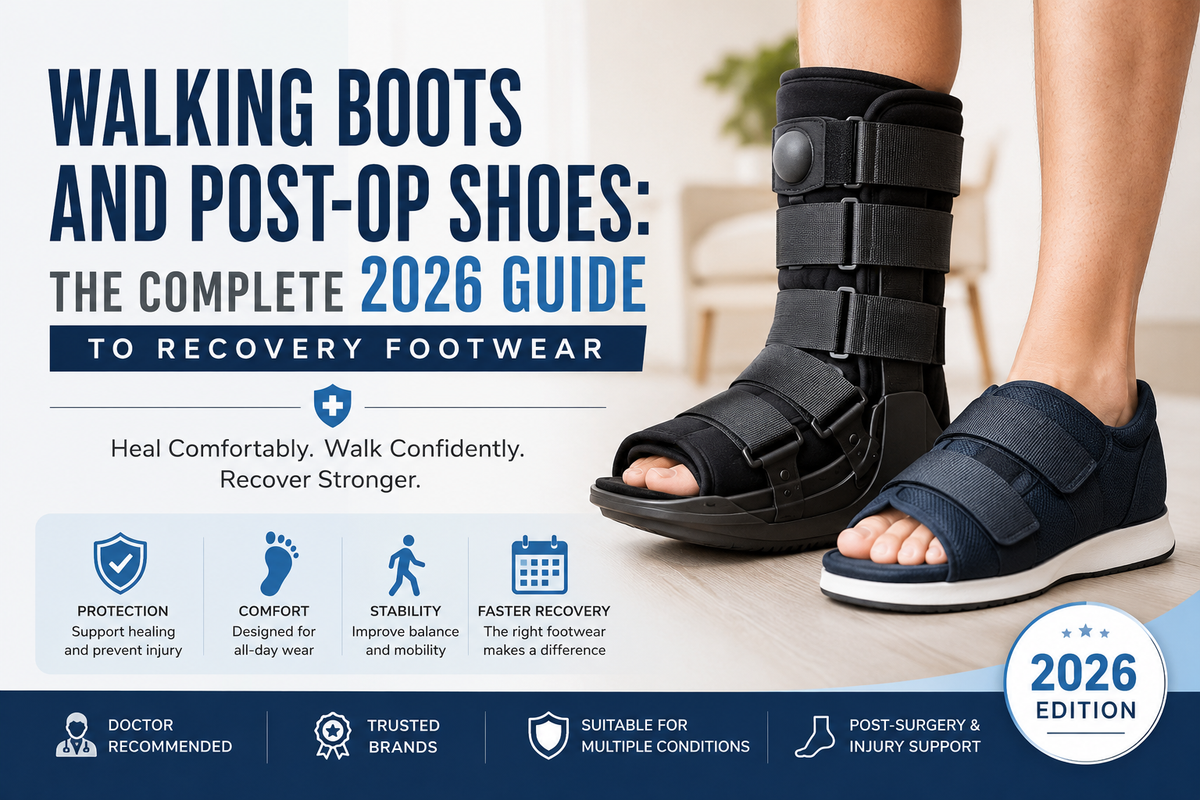
This is Linda's strange sandal: a stiff rocker sole, an open adjustable upper that fits over dressings, and wide hook-and-loop straps. It's the workhorse after bunion surgery, hammertoe correction, toe fractures, and most forefoot procedures. The Darco MedSurg Post-Operative Shoe ($19.56) is the classic version with a metatarsal shank for support, and the Darco MedSurg Square Toe Shoe ($20.48) adds a squared, reinforced front that protects pins and K-wires from bumps and bedsheets — worth the extra dollar for anyone whose repair includes hardware that exits the skin.
Wedge Shoes: Off-Loading Specialists
Sometimes the goal isn't just a stiff sole — it's keeping weight off one part of the foot entirely. Wedge shoes tilt the foot so weight lands where the tissue is healthy:
- The Darco OrthoWedge Off-Loading Healing Shoe ($39.47) angles weight onto the heel and midfoot, off-loading the forefoot — used after forefoot surgery and for diabetic forefoot ulcers.
- The Darco HeelWedge Healing Shoe ($44.15) does the opposite, shifting load forward and off the heel for heel surgery, heel trauma, and heel ulcerations.
Wedge shoes change how you stand and walk more than any other item in this guide, so use the stability aid your clinician recommends while you adjust — for many people that's a cane or knee walker for the first days.
Cast Boots and Closed-Toe Protection
If you're in a cast, the cast itself immobilizes — but it needs a protective, walkable outer layer. The Slimline Cast Boot ($23.30) wraps a rocker sole and square-toe shield around a cast or bulky dressing. For cold weather, uneven ground, or anyone whose toes need cover, the Darco All Purpose Boot ($27.88) offers closed-toe protection that keeps dressings secure and feet warm — a small thing that matters a lot from November to March.
Off-Loading Insoles for Wound Care
For diabetic plantar ulcers and localized wounds, precision matters. The Darco Peg-Assist Off-Loading Insole ($25.97) is a peg-board style insole where individual pegs are removed directly under the wound site, relieving pressure on exactly that spot while the rest of the foot bears weight normally. It pairs with the MedSurg shoe and is a standard tool in wound-care clinics.
The Walking Boot Family
Short (Low-Top) vs. Tall (High-Top)
Short boots end just above the ankle and suit forefoot and midfoot problems that need more control than a shoe — some metatarsal fractures, midfoot sprains, and late-stage transitions out of a tall boot. Tall boots extend up the calf, controlling both the ankle and the muscles that pull on it; they're the standard for ankle fractures, severe sprains, Achilles injuries, and most post-surgical immobilization. Taller means more control, but also more weight and heat — which is why the choice belongs to your surgeon, not to comfort.
Standard vs. Pneumatic (Air) Boots
A standard boot lines its plastic shell with foam. A pneumatic boot adds inflatable air cells you pump up after strapping in, so the fit hugs the leg evenly — and can be adjusted daily as swelling goes down. That matters, because a boot fitted over a swollen ankle in week one becomes a loose boot by week three, and a loose boot immobilizes nothing.
The Low Profile Walker Boot (from $53.20 standard, $65.36 with air cells, in low-top and high-top versions across sizes) is a representative line: rocker sole, cushioned heel, and a low-profile shell that reduces the height difference between your two legs. The XcelTrax Air Walker ($98.85, high and low versions in sizes from extra-small up) is a step up in pneumatic support with an inflatable liner for injury recovery.
Specialized Diabetic Off-Loading Boots
Diabetic foot ulcers are their own category: healing depends almost entirely on keeping pressure off the wound, week after week, without exception. The Aircast XP Diabetic Walker System ($376.93) is purpose-built for this, with aircell off-loading support designed to protect fragile tissue. If you're managing a diabetic ulcer, this is a decision to make with your podiatrist or wound-care team — the wrong boot on a neuropathic foot can create wounds instead of healing them.
Getting the Fit Right
An ill-fitting boot doesn't just slow healing — it manufactures new problems: hip pain, knee pain, and low back pain from walking lopsided for six weeks. Five checks:
- Size by shoe size, then verify. Recovery footwear is sized in ranges (men's and women's run differently — check the chart on each product). Your toes should reach near the end without hanging over; the heel should sit back in the shell.
- Wear a proper sock. A clean, snug, moisture-wicking sock under a boot prevents blisters and keeps the liner tolerable. Change it daily — the inside of a boot in week four is an environment you have to manage.
- Strap from the bottom up, snug but not numbing. If your toes tingle or go pale, loosen and re-strap. With a pneumatic boot, strap first, then inflate until supported — not until it throbs.
- Level your other side. Boots add height. Walking with one leg functionally longer for weeks is where the hip and back pain comes from. Wear your thickest-soled sneaker on the healthy foot, and ask your clinician about a sole leveler if the difference still bothers you.
- Re-check as swelling changes. Re-tighten straps and adjust air daily. If the boot feels loose in week three, it is.
Living in It: The Habits That Protect the Repair
- "Every step" means every step. The 2 a.m. bathroom walk is the classic failure point — and a fall risk. Keep the shoe or boot beside the bed where your foot lands, with a nightlight on the path.
- Follow your weight-bearing orders exactly. "Non-weight-bearing in the boot" and "walk in the boot" are completely different prescriptions that happen to use the same device. If you're non-weight-bearing, the boot protects; your knee walker or properly fitted crutches carry.
- Walk heel-to-toe and let the rocker work. Short steps, even rhythm. Don't vault over the stiff sole with your good leg — that's the lopsided gait that wrecks hips.
- Manage swelling on schedule. Elevation and cold therapy as directed do as much for comfort as any strap adjustment. Our cold therapy guide covers safe timing and application.
- Don't drive in a right-foot boot unless your surgeon and your common sense both clear it. Reaction times in a rigid boot are measurably worse, and many insurers take a dim view of it. Ask before you assume.
- Mind the floors. Rigid soles and smooth tile are a slippery combination, and rugs catch square toes. Clear the paths the way you would for any recovery-season bathroom setup.
- Bending rules still apply. If your procedure came with bending or reaching restrictions, a reacher and sock-aid kit ($40.90) saves the daily fight to get a sock over a healing foot.
What It Costs — and Whether Insurance Helps
Post-op shoes run $19–$45 and are often handed to you at the surgical center (and billed accordingly — buying a spare online is frequently cheaper than the facility charge). Standard walking boots run $53–$115; specialized diabetic systems considerably more.
On coverage: walking boots prescribed for a covered diagnosis are often reimbursable as orthotic devices under Medicare Part B and many private plans, but the rules hinge on diagnosis codes, supplier enrollment, and documentation — and plain post-op shoes are frequently not covered. Both are generally HSA/FSA eligible. Coverage rules change and vary by plan, so call the number on your insurance card before assuming either way, and keep your surgeon's written order and your receipt regardless.
One honest note: at these prices, many people simply buy outright rather than navigate a claim — especially for a second shoe or boot liner sock when the first one is perpetually damp from washing.
Transitioning Out
Coming out of a boot is a process, not an event. Most protocols step down gradually — boot outdoors and sneaker indoors, then a supportive sneaker full time, sometimes with an ankle brace bridging the gap while strength returns. Expect the newly freed ankle to feel stiff, weak, and oddly vulnerable for a few weeks; that's normal and it's what the physical therapy phase is for. What's not normal is sharp pain returning at the injury site when you shed the boot — that's a call to your surgeon, not something to push through.
Why Shop Recovery Footwear at AllCare Store
AllCare Store carries post-op shoes, wedge healing shoes, cast boots, walking boots, off-loading insoles, and the recovery aids that go with them — knee walkers, crutches, cold therapy, and adaptive dressing tools. Everything ships free within the U.S. in discreet packaging with 30-day returns.
Sizing questions are the most common reason recovery footwear gets abandoned in a closet, and they're exactly the kind of thing a five-minute phone call solves. Start with the post-op shoes and walker boots collection, or browse the wider mobility products collection, the knee scooters collection, and the crutches collection.
Frequently Asked Questions
What's the difference between a CAM boot and a walking boot?
Nothing — CAM (controlled ankle motion) boot, walking boot, moon boot, air boot, and fracture boot are all names for the same category of rigid, strap-on immobilizing boot.
Can I take my walking boot off to sleep?
Only if your surgeon says so — protocols differ by injury. Many ankle fracture and Achilles protocols require the boot in bed for the early weeks; many forefoot protocols don't. Ask specifically, and get the answer in writing on your discharge instructions.
Can I walk in a post-op shoe without crutches?
If your surgeon cleared you for weight-bearing as tolerated, usually yes — that's what the rigid rocker sole is for. If you're partial or non-weight-bearing, the shoe protects the foot but crutches or a knee walker do the carrying.
How long will I wear a walking boot?
Commonly two to eight weeks depending on the injury, with severe fractures and Achilles repairs running longer. The duration is driven by imaging and exam findings, not by how good the foot feels — feeling fine at week three is expected and is not clearance.
Why does my hip hurt since I started wearing the boot?
Almost always the height difference. The boot makes one leg longer, and your pelvis pays for it. Wear a thicker-soled shoe on the good foot, keep steps short and even, and ask your clinician about a sole leveler if it persists.
Do I wear a sock under the boot?
Yes — a snug, clean, moisture-wicking sock every day. It prevents blisters, manages sweat, and keeps the liner tolerable for the duration.
Can I drive with a walking boot on?
With a boot on the right foot, generally no — braking response is impaired, and many surgeons prohibit it outright. Left-foot boots with an automatic transmission are often permitted. Clear it with your surgeon first.
Are walking boots covered by Medicare?
Often, when prescribed for a covered diagnosis and supplied through an enrolled provider — they're generally classed as orthotic devices under Part B. Plain post-op shoes frequently aren't covered. Both are usually HSA/FSA eligible. Confirm with your plan before purchase.
What if my toes swell over the edge of the post-op shoe?
Some swelling is expected, but toes that balloon, darken, or go numb are a same-day call to your surgeon. In the meantime, elevate above heart level and re-check that straps aren't too tight.
My boot feels loose now that the swelling is down. Is that a problem?
Yes — a loose boot isn't immobilizing. Tighten the straps, add air if it's pneumatic, or add a second sock. If it's still sloppy, call your supplier about sizing down; you may be a size smaller than your swollen week-one foot was.
The Takeaway: The Shoe Is the Treatment
Recovery footwear is easy to under-rate because it's passive. It doesn't beep, it isn't high-tech, and by week two your foot usually feels better than the clunky thing strapped to it. That's the trap Linda fell into, and it's the most common way straightforward foot surgery turns into a delayed union, a re-operation, or a wound that won't close.
Get the right category for your injury. Get the size right and the straps snug. Level the other side. Wear it for every step, including the ones at 2 a.m. And keep wearing it until the person who saw your X-ray — not the foot that feels fine — says you're done.
Recovering From Foot or Ankle Surgery? We Can Help.
AllCare Store stocks post-op shoes, wedge healing shoes, cast boots, standard and pneumatic walking boots, and off-loading insoles, along with knee scooters, crutches, and the rest of the recovery toolkit. Explore the post-op shoes and walker boots collection and the mobility products collection to get started.
Call 1-888-889-6260 to talk through sizing, your weight-bearing status, and which device matches your surgeon's orders, or visit AllCareStore.com to browse the full range. Free U.S. shipping, discreet packaging, and 30-day returns on every order.
This guide was written and reviewed by the AllCare Store editorial team. For personalized medical advice, always follow your surgeon's written instructions and consult your physician or licensed physical therapist.
MEDICAL DISCLAIMER: This article is for informational purposes only and is not a substitute for professional medical advice or surgical aftercare instructions. Which device you need — a post-op shoe, a short boot, a tall boot, or something else entirely — and how long you wear it depends on your specific injury, your weight-bearing status, and your surgeon's protocol. Always follow the written instructions from your surgeon or physician, and ask before changing how, when, or whether you wear your prescribed footwear. If you experience new numbness, increasing pain, spreading redness, calf pain or swelling, or drainage through a dressing, contact your doctor promptly.