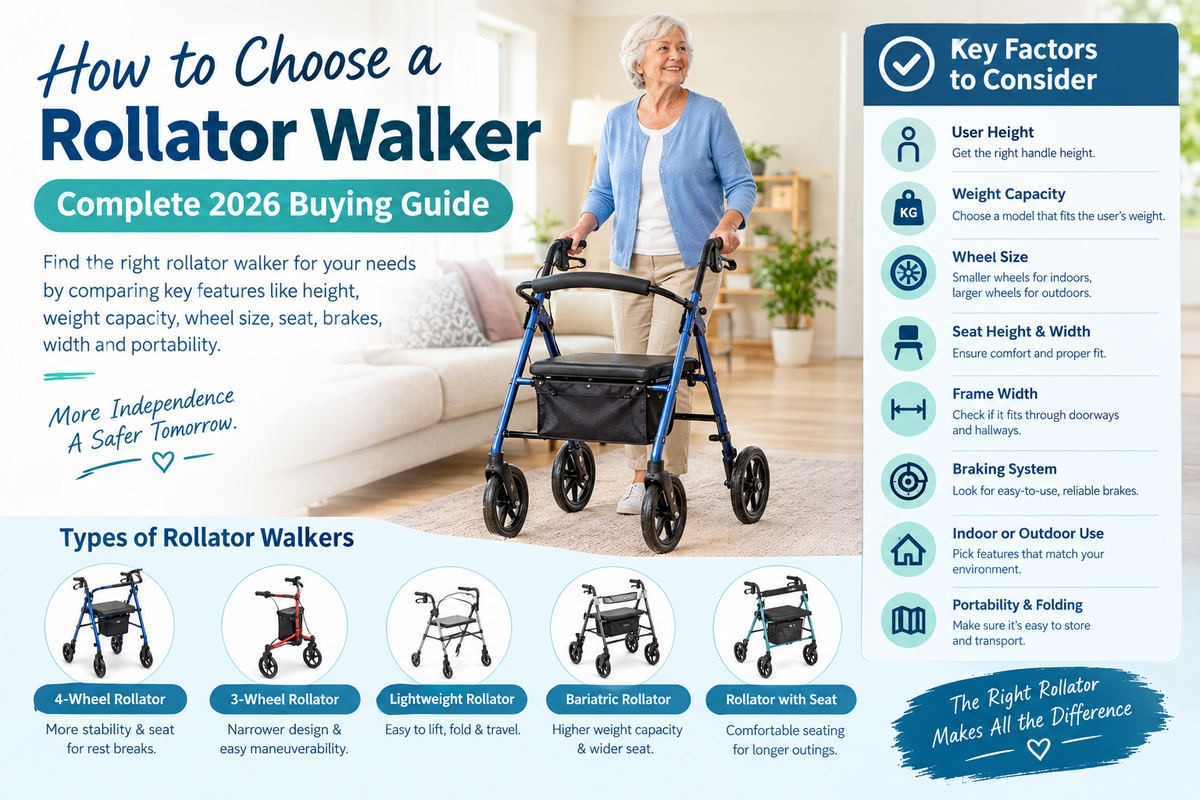
Choosing the right rollator walker can make everyday mobility more comfortable, convenient, and manageable. With many models available, it can be difficult to know which features actually matter.
Rollators come in different sizes, wheel configurations, weight capacities, frame designs, seat styles, and folding systems. The best choice depends on the user's height, weight, mobility needs, walking environment, and daily routine.
This guide explains how to choose a rollator walker and the key features to compare before buying one.
What Is a Rollator Walker?
A rollator walker is a wheeled mobility aid designed to provide support while walking. Unlike a traditional walker that usually needs to be lifted and moved, a rollator generally rolls forward on wheels.
Most rollators include:
- Three or four wheels
- Hand brakes
- Adjustable handles
- A lightweight or heavy-duty frame
- A storage bag or basket
- A built-in seat on many models
-
A folding mechanism
Final Thoughts
Knowing how to choose a rollator walker starts with understanding the user's individual needs. Instead of focusing on one feature, compare height, weight capacity, wheel size, seat dimensions, frame width, brakes, portability, and intended environment.
For indoor use, a compact and maneuverable rollator may be practical. For outdoor use, larger wheels and a durable frame may be more appropriate. Users who need frequent rest breaks may prefer a rollator with a seat, while those prioritizing portability may prefer a lightweight folding design.
Take measurements before buying, review the manufacturer's specifications, and select a rollator that fits both the user and the environment.
Explore AllCareStore's Walkers & Rollators collection to compare mobility options for different everyday needs.
A 4-wheel rollator walker is one of the most common options for everyday use because it provides continuous rolling support and often includes a comfortable seat.
How to Choose the Right Rollator Walker
Before purchasing a rollator, consider these seven key factors:
- User height
- Weight capacity
- Wheel size
- Seat height and width
- Frame width and overall dimensions
- Braking system
- Intended environment
Let's look at each factor in detail.
1. Choose the Right Rollator Height
Correct handle height is one of the most important considerations when choosing a rollator walker.
The handles should generally allow the user to stand upright with a comfortable elbow position while holding the grips.
A rollator that is too low may encourage excessive bending. A rollator that is too high can make the handles difficult to control comfortably.
Look for a model with adjustable handle height so it can be fitted to the user's body.
Rollator Height Tips
Before purchasing, check:
- User height
- Handle-height adjustment range
- Grip position
- Standing posture
- Handle comfort
If more than one person will use the rollator, an adjustable model may provide greater flexibility.
2. Check the Weight Capacity
Always check the manufacturer's listed rollator weight capacity before purchasing.
Standard rollators may support users around 250–300 pounds, while bariatric rollators and heavy-duty models can support substantially higher capacities.
For example, you may find rollators designed for:
- 250 lb capacity
- 300 lb capacity
- 350 lb capacity
- 400 lb capacity
- 500 lb capacity
- 700 lb capacity
Never choose a rollator based only on appearance. Verify the manufacturer's specifications.
Why Weight Capacity Matters
Weight capacity applies to the intended user and, depending on the manufacturer's instructions, may also be relevant when the user sits on the rollator seat.
If the user plans to sit on the rollator frequently, select a model whose specifications are appropriate for seated use.
3. Consider Wheel Size
Rollator wheel size can affect maneuverability and how easily the walker moves across different surfaces.
Common wheel sizes include:
- 6-inch wheels
- 7-inch wheels
- 8-inch wheels
- 10-inch wheels
- 12-inch wheels
Small Wheels
Smaller wheels may work well for smooth indoor surfaces and compact spaces.
Larger Wheels
Larger wheels can be useful when navigating uneven surfaces, thresholds, outdoor paths, or other challenging terrain.
If the rollator will be used both indoors and outdoors, consider an all-terrain rollator with larger wheels.
4. Decide Between 3-Wheel and 4-Wheel Rollators
Rollators are commonly available with three or four wheels.
3-Wheel Rollator
A 3-wheel rollator usually has a triangular frame and does not typically include a built-in seat.
Potential advantages include:
- Narrower design
- Easy maneuverability
- Smaller turning radius
- Useful in tight indoor spaces
- Often lightweight
A 3-wheel model may be worth considering for users who prioritize maneuverability and do not need a built-in seat.
4-Wheel Rollator
A 4-wheel rollator walker usually provides a broader base and commonly includes a seat.
Typical features include:
- Four wheels
- Hand brakes
- Built-in seat
- Storage compartment
- Folding frame
A 4-wheel rollator may be a practical option for people who want walking support along with the ability to sit periodically.
5. Look at the Seat Size and Height
Many rollator walkers with seats allow users to sit down when they need a break.
If a seat is important, don't look only at the overall rollator dimensions.
Check:
- Seat width
- Seat depth
- Seat height
- Weight capacity
- Backrest design
- Seat material
The seat should provide enough room for comfortable sitting while keeping the user properly positioned.
For taller or shorter users, seat height can be particularly important because it affects how easily the user can sit down and stand up.
6. Consider the Overall Width
A rollator may fit comfortably outdoors but be difficult to maneuver through narrow indoor spaces.
Before buying, measure:
- Doorways
- Hallways
- Bathroom entrances
- Bedroom entrances
- Storage areas
- Elevator doors if applicable
A narrow rollator walker may be more practical for homes with smaller doorways or limited floor space.
Remember to compare the rollator's overall width, not just the seat width.
7. Choose the Right Braking System
A rollator's brakes help the user control movement and secure the walker when stopping.
Common systems include:
- Loop brakes
- Hand brakes
- Locking brakes
- Push-down brakes on some models
Users should be able to comfortably reach and operate the brakes.
If hand strength or grip is limited, consider models with brake designs that are easier for the intended user to operate.
Rollator With Seat vs. Walker Without a Seat
One of the most common decisions is whether to choose a rollator with a seat or a traditional walker.
| Feature | Rollator With Seat | Traditional Walker |
|---|---|---|
| Wheels | Usually 3 or 4 | Usually none or 2 |
| Built-in seat | Usually yes | No |
| Folding | Common | Common |
| Continuous rolling | Yes | Usually no |
| Rest breaks | Convenient | Requires separate chair |
| Maneuverability | Generally easy | More controlled movement |
The appropriate choice depends on the user's mobility and ability to safely operate the equipment.
Indoor vs. Outdoor Rollator Walkers
Where the rollator will be used should influence your selection.
Best Features for Indoor Use
For indoor mobility, consider:
- Compact width
- Smaller turning radius
- Lightweight frame
- Smooth-rolling wheels
- Easy folding
- Maneuverability around furniture
Best Features for Outdoor Use
For outdoor mobility, consider:
- Larger wheels
- Durable frame
- Strong braking system
- Comfortable handles
- Higher ground clearance
- Stable construction
For mixed indoor and outdoor use, look for a versatile rollator walker that balances maneuverability with wheel size and durability.
Lightweight vs. Heavy-Duty Rollators
Another important decision is whether you need a lightweight or heavy-duty model.
Lightweight Rollator
A lightweight rollator can be easier to:
- Fold
- Lift
- Transport
- Store
- Maneuver
These models can be useful for users who frequently travel or need to place the rollator in a vehicle.
Heavy-Duty Rollator
A heavy-duty rollator may provide:
- Higher weight capacity
- Larger frame
- Stronger construction
- Wider seating
- Increased stability
Choose based on the user's requirements rather than simply selecting the strongest model available.
What Is a Bariatric Rollator?
A bariatric rollator is designed for users who require a higher weight capacity than many standard rollators provide.
When comparing bariatric models, check:
- Weight capacity
- Seat width
- Seat depth
- Frame width
- Handle adjustment range
- Wheel size
- Overall product weight
A higher-capacity rollator should still be appropriately sized for the user and the environment where it will be used.
Folding and Portability
If you plan to travel with the rollator, portability becomes especially important.
Look for:
- One-hand folding systems
- Compact folded dimensions
- Lightweight construction
- Locking mechanisms
- Easy-to-carry frames
Check the folded dimensions and product weight before purchasing to make sure the rollator can fit in your vehicle or storage area.
Storage and Accessories
Many rollators include storage features that make everyday use more convenient.
Common accessories include:
- Storage bags
- Baskets
- Pouches
- Canes holders
- Cup holders
- Backrests
- Trays
- Removable seats
Consider which accessories you actually need. Additional features can increase convenience but may also increase the rollator's overall weight or size.
How to Measure for a Rollator Walker
Before buying, gather a few basic measurements.
User Height
Measure the user's height while standing upright.
Handle Height
Check the manufacturer's adjustable handle range and compare it with the user's requirements.
Seat Height
If selecting a rollator with a seat, compare the seat height with the user's leg length and ability to sit and stand.
Doorway Width
Measure the narrowest doorway through which the rollator needs to pass.
Storage Space
Measure the available space where the rollator will be stored when folded or unfolded.
Common Rollator Buying Mistakes
Avoid these common mistakes when choosing a rollator walker.
Choosing Only by Price
The least expensive model may not have the features or dimensions needed for the user.
Ignoring Weight Capacity
Always verify the manufacturer's stated weight capacity.
Buying Without Measuring
A rollator that is too wide may not fit through important doorways.
Choosing Wheels Without Considering the Environment
Small wheels may be convenient indoors, while larger wheels can be useful for outdoor surfaces.
Forgetting the Seat Height
If the user plans to sit on the rollator, make sure the seat height and dimensions are appropriate.
Overlooking Brake Operation
The user should be able to comfortably operate the brakes.
Quick Rollator Buying Checklist
Before ordering a rollator, review this checklist:
☐ User height
☐ Handle-height range
☐ User weight
☐ Weight capacity
☐ Seat width and height
☐ Wheel size
☐ 3-wheel or 4-wheel design
☐ Overall width
☐ Folded dimensions
☐ Brake type
☐ Indoor or outdoor use
☐ Storage requirements
☐ Accessories
☐ Product weight
Rollator Buying Checklist
Before finalizing your choice, run through this quick evaluation checklist:
-
[ ] Doorway Clearance: Measure your narrowest home doorways (especially bathrooms). Standard rollators average 22 to 26 inches wide.
-
[ ] Hand Strength: Ensure the user can squeeze the loop brakes comfortably and push down to lock the parking brake.
-
[ ] Vehicle Storage: Verify the total folded weight and dimensions so you or a caregiver can lift it into a car.
-
[ ] Accessories Included: Check for essential extras like a front wire basket, under-seat pouch, cane holder, or cup holder.