In This Article
If gripping a walker handle sends pain shooting through your knuckles, the problem is not your determination. It is the design. Standard walkers ask your hands and wrists to carry a large share of your body weight, and for anyone with rheumatoid arthritis, severe osteoarthritis, a wrist fracture, or nerve damage, those are exactly the joints that cannot take it.
Forearm support solves this by moving the load somewhere stronger. Instead of squeezing handles, your forearms rest in padded troughs, and your arms carry the weight. This guide covers both routes to that support: platform attachments that convert the walker you already own, and forearm-level rollators built that way from the factory.
1. What Is a Forearm Walker?
A forearm walker, also called a platform walker or trough walker, is a mobility aid fitted with padded platforms that support your forearms rather than your hands. Your arm rests along the padded gutter, your elbow sits at roughly a 90-degree bend, and your body weight transfers through the forearm bones instead of through your fingers, palms, and wrist joints.
Quick distinction: a forearm walker is not the same as forearm crutches. Crutches are used in pairs and require good balance and upper body control. A forearm walker is a single frame that provides continuous, all-round support.
2. How It Helps Weak Grip and Arthritis
No gripping required
Your forearms simply rest on the padded platforms. There is no need to squeeze, clench, or hold anything, which removes the single most painful action for people with inflamed finger joints or severe hand weakness.
Direct pain reduction
Weight bearing through swollen knuckles and wrists is not just uncomfortable, it can accelerate joint damage over time. Shifting that load onto the broad surface of the forearm spreads pressure across a much larger area and keeps it away from the small joints entirely.
Secure, stable positioning
Platform designs include adjustable straps that hold the forearm gently in place. For users with tremors, limited arm control, or one-sided weakness after a stroke, that added security makes the difference between walking confidently and not walking at all.
Better posture, fewer falls
Because the platforms sit higher than standard handgrips, they naturally hold you upright instead of hunched over the frame. Your eyes stay forward where they can spot obstacles, your center of gravity stays over your feet, and your lower back stops absorbing the strain of a constant forward lean.
3. Platform Attachments: Turn Your Walker Into a Forearm Walker
Here is the good news most people do not realize: if your current walker is otherwise fine, you probably do not need a whole new device. Platform attachments clamp onto the frame you already own and convert it into a forearm walker for a fraction of the cost.
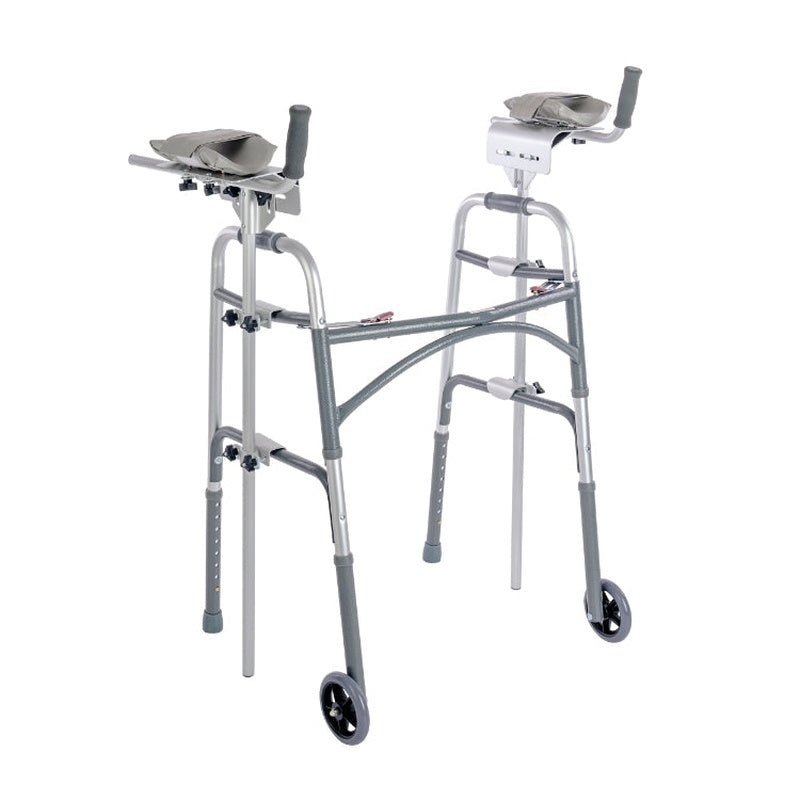
The Dynarex Forearm Platform Attachments are the standard choice for this. Each attachment gives you a contoured vinyl padded trough that cradles the forearm, an adjustable strap that holds the arm securely in position, and perspiration-resistant hand grips at the front that are easy to wipe clean. They support up to 350 pounds, fit most standard walker frames, and carry a limited lifetime warranty. You can buy a single unit if only one arm needs support, which is common after a stroke or a one-sided wrist injury, or a pair for bilateral use.

For larger users, the Dynarex Bariatric Platform Attachment from the Bari+Max line delivers the same contoured padding, adjustable arm strap, and hygienic grips with a reinforced build rated to 500 pounds. This matters more than it might appear. Platform attachments add leverage at the top of the frame, so a bariatric-rated attachment paired with a bariatric-rated walker is a genuine safety requirement rather than an upgrade.
Insurance note: platform attachments fall under HCPCS codes E0154 and E1054, which means Medicare Part B may cover them as durable medical equipment when your doctor documents the medical need. Ask your provider to include the code on the prescription.
4. The Forearm Rollator Option
The second route is a rollator built with forearm-level support from the start. Instead of low handgrips, padded armrests sit at roughly elbow height, so your weight travels through your forearms while you walk fully upright. You also get four wheels, hand brakes, and a seat, which a platform walker cannot offer.

The BreezeStride 4 Wheel Rolling Mobility Rollator is a solid example. Its adjustable handlebar moves up and down to fit users roughly from 5 feet to 6 feet 2 inches, so you can set the support exactly where your elbows want it. Padded hand grips and responsive hand brakes keep you in control while pushing, the 300-pound frame folds compactly for the car, and the non-pneumatic tires never go flat. For someone whose hands hurt but whose balance and stamina are reasonable, this covers far more of daily life than a platform frame.

If the sore spot is the bony point of your elbow rather than your hands, look at the VOCIC Z22 Upright Rollator Walker. Its GelCool armrests disperse elbow pressure and absorb shock while staying cool against the skin, and the reinforced triangular frame supports 300 pounds. The flip-out armrest design widens the seating area when you stop to rest, which is a small detail that matters a lot on longer outings.
5. Which Option Fits Your Situation?
| Feature | Platform Attachment | Forearm Rollator | Standard Walker |
|---|---|---|---|
| Weight bearing through | Forearms | Forearms | Hands and wrists |
| Grip strength needed | None | Light, for brakes | Moderate to high |
| Arm strap security | Yes | No | No |
| One arm only option | Yes, buy single | No | No |
| Built-in seat | No | Yes | Sometimes |
| Speed and range | Slow, deliberate | Fast, continuous | Moderate |
| Best for | Severe arthritis, stroke, wrist injury | Hand pain with decent balance | General support |
The short version: choose a platform attachment when the impairment is severe, one-sided, or when you need the arm physically strapped in place. Choose a forearm rollator when your hands are the problem, but your legs and balance still carry you reasonably well, and you want range, brakes, and a seat.
6. Who Actually Needs One
- Rheumatoid arthritis affecting the hands, wrists and fingers, where gripping causes pain and joint deformity risk
- Recent wrist or hand fracture where the surgeon has restricted weight bearing through that joint
- Stroke survivors with hemiplegia who cannot maintain grip on one side
- Cerebral palsy and neuromuscular conditions where hand control is limited but walking is still a goal
- Severe carpal tunnel or nerve damage where pressure on the palm causes numbness and pain
- Elbow or shoulder contractures that prevent the arm from straightening enough to reach standard handles
If none of these describe your situation and your main complaints are fatigue, balance, or back pain, a conventional model from our walkers and rollators collection will almost certainly serve you better and cost less.