DISCLAIMER: This article provides general product information and is not a substitute for medical advice. Incontinence is a medical condition with many possible causes — some of which are treatable. If you or someone you care for is experiencing new or worsening incontinence, please consult a healthcare provider for evaluation and a personalized management plan.
A Caregiver's Guide That Nobody Gives You
When Carol's mother moved in with her family after a stroke, Carol thought the hardest part would be the physical care — the medication schedules, the mobility equipment, the doctor's appointments. What she didn't expect was how much of her mental energy would go into something no one had warned her about: managing nighttime incontinence.
The first weeks were difficult. Her mother, a proud and independent woman, was embarrassed by the situation. Carol was overwhelmed trying to balance caregiving with her job and her children. Laundry became a daily crisis. Sheets needed changing in the middle of the night. The mattress, a new one they'd bought for the guest room conversion, was showing stains within the first month.
Everything changed when Carol discovered incontinence underpads — specifically, layering a quality waterproof mattress cover under a disposable underpad at her mother's hips and lower back. The system worked. Nighttime changes became quick, focused, and far less disruptive to her mother's sleep and dignity. The mattress was protected. Carol stopped dreading mornings.
It sounds like a small thing from the outside. But for millions of family caregivers and the people they care for, finding the right bed pads for incontinence is genuinely life-changing. This guide is written to help you find that solution faster than Carol did — with clear, practical information about every type of underpad, who each is for, and how to build a protection system that works for your specific situation.
Understanding Incontinence Underpads: What They Are and Why They Matter
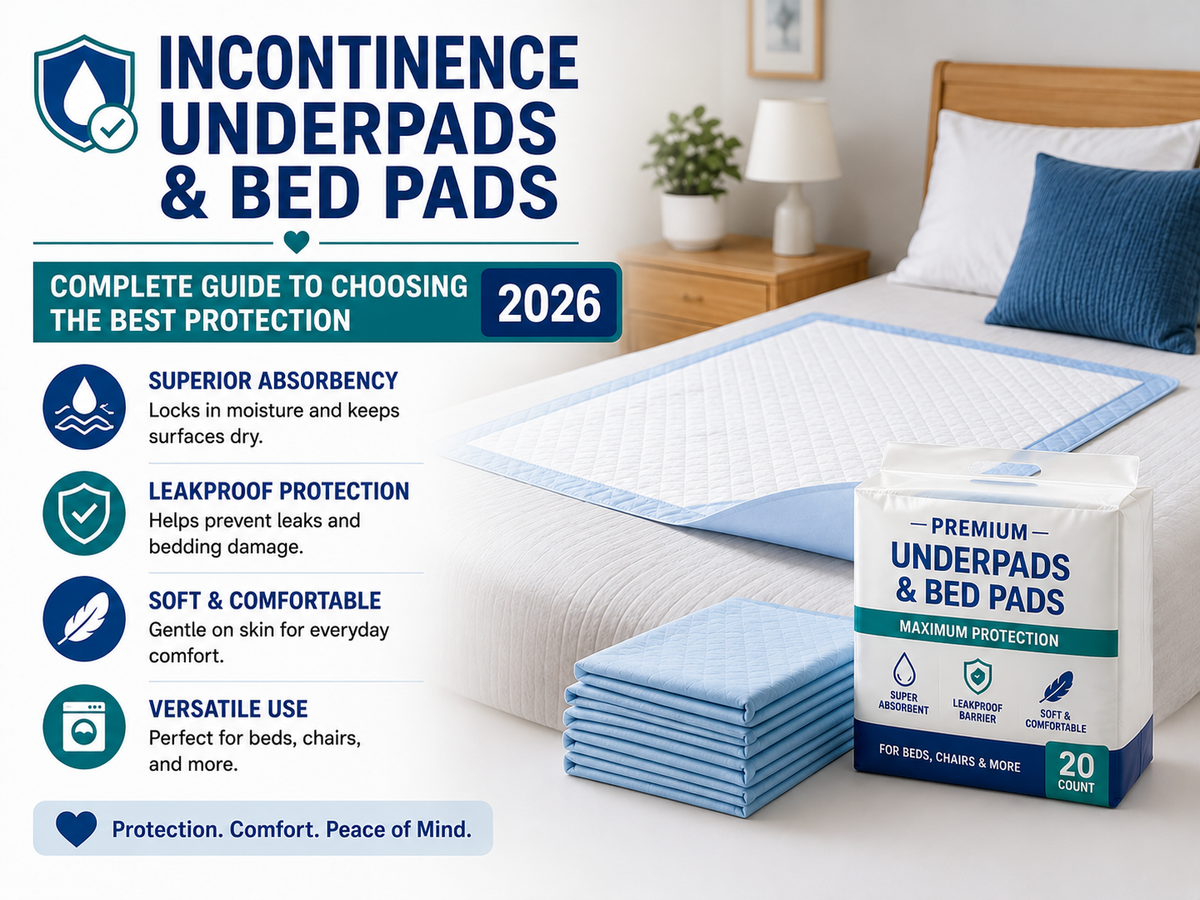
Incontinence underpads — also called bed pads, chux pads, or draw sheets — are protective layers placed on beds, chairs, wheelchairs, or other surfaces to absorb urine and prevent it from reaching the surface beneath. They are distinct from adult diapers or briefs (which are worn on the body) and from mattress protectors (which are fitted to the mattress itself). Underpads are positioned between the person and the mattress, creating an absorbent, quickly changeable barrier that can be replaced or laundered without disturbing bedding or the mattress.
The market divides into two primary categories: disposable underpads and reusable underpads. Each has distinct advantages, and most experienced caregivers use both in combination.
Disposable Underpads: Convenience When It Counts
Disposable underpads — often called "chux" (from the original Chux brand that popularized them in hospital use) — are single-use layered pads typically consisting of a soft top layer, an absorbent middle layer (usually fluff pulp and superabsorbent polymer), and a waterproof bottom layer.
How Absorbency Levels Work
Disposable underpads come in graduated absorbency levels — standard, moderate, heavy, and ultra/maximum. These correspond to roughly the following capacities:
- Standard (300–400 mL): Adequate for light urinary leakage; often used as a secondary layer or for minor dribbling episodes
- Moderate (400–600 mL): Appropriate for people with moderate incontinence, single overnight void episodes, or as a back-up to an adult brief
- Heavy (600–900 mL): For people with significant urinary incontinence who experience complete voids during sleep or rest
- Ultra/Maximum (900–1500+ mL): For heavy urinary incontinence, including people who may not wake during void episodes or for longer periods between changes; also appropriate for combined urinary and fecal incontinence
The most common mistake caregivers make is choosing underpads that are underpowered for the actual need — then experiencing leakage, which is both messier and more work than simply buying the correct absorbency from the start.
Standard vs. Premium Disposable Underpads
Economy disposable underpads (often sold as "Chux-style" in bulk) are significantly cheaper per pad but have thinner absorbent cores, less effective moisture locking, and may allow rewetting — meaning liquid can wick back through the top layer onto the skin, increasing risk of skin irritation and pressure injury. Premium disposable underpads use superabsorbent polymer (SAP) technology that converts liquid into a gel, locking it away from the surface and dramatically reducing rewetting. For people with sensitive skin or prolonged contact time (overnight), premium SAP underpads are worth the additional cost.
Size Matters: Getting Adequate Coverage
Disposable underpads come in several standard sizes:
- 17" x 24": Small/standard — adequate for chair or wheelchair use; limited coverage for bed use
- 23" x 36": Standard bed size — covers the hip and lower back area; minimum recommended for overnight bed use
- 30" x 36": Large — provides broad coverage across the full hip-to-mid-back zone; recommended for people who move significantly during sleep or have heavy incontinence
- 36" x 36" or larger: Extra-large/bariatric — for larger body frames or for people who require full-width bed coverage
For nighttime bed use, the 30" x 36" size is the practical minimum for most adults. Smaller pads frequently result in leakage around the edges.
Reusable Underpads: The Sustainable, Long-Term Solution
Reusable (washable) underpads — sometimes called reusable bed pads or draw sheets — are multi-layer fabric products designed to be laundered and reused hundreds of times. They represent a significant upfront investment but a much lower cost per use over time, and they generate substantially less waste than disposable alternatives.
Construction and Materials
Quality reusable underpads typically feature:
- Top layer: Soft, quick-wicking fabric (often a terry cotton, microfiber, or polyester-cotton blend) that pulls moisture away from skin
- Middle layer(s): Highly absorbent material — often multiple layers of cotton terry or a cotton/polyester blend — that holds a significant volume of liquid
- Bottom layer: Waterproof backing (typically TPU or PUL — thermoplastic polyurethane or polyurethane laminate) that prevents liquid from passing through to the mattress
The quality difference between budget and premium reusable underpads lies primarily in the waterproof layer's durability and the absorbency of the middle layers. Inferior products lose waterproofing after 20–30 washes; quality pads maintain performance for 200+ wash cycles.
Absorbency in Reusable Pads
Reusable underpads hold less liquid per pad than high-end disposables (typically 12–24 oz / 350–700 mL depending on pad thickness), but they are generally more appropriate for moderate incontinence as a primary bedding layer, or for mild incontinence as a sole protection layer. For heavy overnight incontinence, many caregivers use a reusable underpad as the base layer (protecting the mattress from anything that might bypass disposables) with a quality disposable underpad on top as the primary absorbing layer.
The Layering System
The most effective incontinence bed protection for significant or overnight incontinence is a three-layer system:
- Base layer: Waterproof mattress protector (fitted to the mattress) — protects the mattress from catastrophic failures
- Middle layer: Reusable underpad — provides substantial absorbency and a comfortable surface; stays on the bed for the week and is laundered on a schedule
- Top layer: Disposable underpad — the primary absorbent layer that is changed as needed without disturbing the bed; positioned under hips and lower back
This system means that routine incontinence episodes result only in changing the disposable underpad — a 30-second task that requires no sheet changes, no waking the person fully, and no laundry. The reusable underpad catches anything the disposable doesn't contain. The mattress protector ensures the mattress is never at risk.
Best Incontinence Underpads at AllCare Store
1. Medline Premium Disposable Underpads — Best Overall Disposable
Medline is one of the largest medical supply companies in North America and a trusted name in hospital and long-term care incontinence products. Their premium disposable underpads feature a superabsorbent polymer core that locks liquid away from skin, a soft quilted top layer, and a waterproof backing.
Key Features:
- Superabsorbent polymer (SAP) core prevents rewetting
- Soft, quilted top layer reduces skin irritation
- Available in multiple absorbency levels and sizes
- Strong waterproof backing
- Bulk packaging available for cost savings
- Hospital-grade quality at home-use pricing
Browse our Underpads & Bedding Protection collection for current availability and pricing.
2. Attends Dri-Sorb Underpads — Best Budget Disposable for Light-to-Moderate Use
Attends is a well-established incontinence brand with decades of experience in both institutional and consumer markets. Their Dri-Sorb underpads offer reliable absorbency at an accessible price point, making them a practical choice for daytime chair use or as secondary coverage layers.
Key Features:
- Polymer-enhanced absorbent core
- Moisture-control top layer
- Available in standard and heavy absorbency
- Multiple sizes including chair and bed configurations
- Good value for moderate incontinence needs
3. Dynarex Disposable Underpads — Best Hospital-Grade Bulk Option
Dynarex is a healthcare product manufacturer that supplies hospitals and long-term care facilities. Their disposable underpads are available at AllCare Store and offer professional-grade performance with reliable absorbency and waterproof backing — available in bulk quantities that significantly reduce per-unit cost for high-frequency users.
Key Features:
- Fluff pulp and SAP absorbent core
- Waterproof poly backing
- Soft non-woven top sheet
- Available in 23" x 36" and 30" x 36" sizes
- Cases of 100–150 pads available for volume purchasing
- Widely used in hospital and skilled nursing settings
4. McKesson Reusable Underpad — Best Washable Bed Pad
McKesson is one of the most trusted names in medical supply distribution. Their reusable underpads bring institutional-grade quality to home use — durable waterproof backing, thick absorbent middle layers, and soft top surfaces that wash repeatedly without degrading.
Key Features:
- Durable waterproof TPU backing rated for 200+ wash cycles
- Multiple absorbent layers hold 12–18 oz
- Soft polyester-cotton top layer
- Machine washable at warm temperature, tumble dry low
- Available in 34" x 36" and 34" x 52" sizes
- Cost-effective over time: cost per use drops to pennies after 50+ washes
View our full Underpads & Bedding Protection collection for all available options, including specialty sizes and bariatric-rated products.
Underpads for Chairs and Wheelchairs
Bed protection is only part of the picture. People with incontinence also need protection on chairs, recliners, sofas, and wheelchairs. Chair underpads — typically 17" x 24" or 17" x 28" — are designed to fit standard chair seats. For wheelchairs specifically, look for underpads with non-slip backing to prevent shifting, and with enough absorbency to handle the longer periods typically spent in a wheelchair during the day.
Some reusable chair pads feature tuck-in tails or tie straps that keep the pad anchored to the chair back — particularly useful for people who move during seated activity. Browse our Wheelchair Cushions & Accessories collection for seating protection options.
Skin Protection: Why Underpad Quality Directly Affects Skin Health
Moisture and incontinence are among the leading contributing factors to pressure injuries (bed sores) and incontinence-associated dermatitis (IAD) — two serious and painful skin conditions that disproportionately affect older adults and people with limited mobility. The connection to underpad quality is direct:
- Underpads that allow rewetting keep skin in contact with urine for extended periods, dramatically increasing risk of IAD
- Underpads with rough or non-wicking top surfaces can cause friction injury during repositioning
- Overly wet skin at pressure points (hips, sacrum, heels) is significantly more vulnerable to pressure injury than dry skin
For people at elevated skin risk — those with limited mobility, diabetes, vascular disease, or existing skin conditions — investing in premium SAP disposable underpads with soft quilted surfaces is not a luxury; it is a meaningful clinical decision. Pair underpad use with skin barrier creams and protective products available in our Skin Care collection.
How Many Underpads Do You Need? A Practical Planning Guide
One of the most common questions caregivers ask is how many underpads to keep on hand. Here's a practical guideline:
Disposable Underpads
- Mild incontinence (1–2 changes/day): 60–90 pads per month
- Moderate incontinence (3–4 changes/day): 90–120 pads per month
- Heavy incontinence (5+ changes/day): 150–200+ pads per month
- Always keep at least 2–3 weeks of supply on hand to avoid emergencies
Reusable Underpads
- For daily laundry routine: 4–6 reusable pads sufficient
- For every-other-day laundry: 6–8 pads recommended
- Reusable pads should be inspected every 3–6 months for waterproofing integrity — hold up to light and look for thin spots or delamination
Frequently Asked Questions: Incontinence Underpads
What is the difference between a disposable and reusable underpad?
Disposable underpads are single-use products — used once and discarded. They offer maximum hygiene and minimal laundry burden but have an ongoing cost and generate waste. Reusable underpads are laundered and reused many times — typically 200+ wash cycles with quality products. They require laundry management but have a much lower long-term cost. Most caregivers use both: a reusable pad as a base layer on the mattress and a disposable underpad on top as the primary absorbing layer that is changed as needed.
How do I choose the right absorbency level for an underpad?
Match the absorbency to the amount of leakage and how long the pad will be in use. For light daytime leakage used alongside an adult brief: standard absorbency is typically adequate. For overnight use or for people who may experience a full bladder void during sleep: heavy or ultra absorbency is recommended. When in doubt, choose a higher absorbency level — the cost difference is small, and the cost of inadequate protection (laundry, skin complications, sleep disruption) is much greater than the cost of over-buying absorbency.
Can underpads be used on chairs and recliners, not just beds?
Absolutely — chair use is one of the primary applications for underpads. Standard 17" x 24" underpads are sized for chair seats; larger sizes can be used for wider chairs or recliners. For wheelchair use, look for pads with non-slip or grippy backing, or use a reusable chair pad with tie straps that anchor it to the chair. Chair underpads protect upholstered furniture from damage and make cleanup much easier.
Are incontinence underpads covered by Medicare?
Standard Medicare (Parts A and B) generally does not cover routine incontinence supplies including underpads for home use. However, some Medicare Advantage plans include incontinence supply benefits — check your specific plan details. Medicaid programs in some states do cover incontinence supplies for eligible individuals. Some people also use Flexible Spending Accounts (FSA) or Health Savings Accounts (HSA) to purchase incontinence supplies tax-free — check with your plan administrator for eligibility.
What size underpad do I need for a hospital bed?
Standard hospital beds are typically 36" wide, but coverage across the full width is rarely necessary or practical. A 30" x 36" underpad provides adequate hip-to-lower-back coverage for most adults on a hospital bed. For people who move significantly during sleep, a larger pad (36" x 36") may reduce edge leakage. The pad should be positioned with its center under the person's hips — the area of highest risk for incontinence contact.
Related Products for Incontinence Management at AllCare Store
Underpads are one component of a complete incontinence management system. At AllCare Store, we carry everything you need:
- Adult Diapers & Briefs — disposable and reusable options for managing incontinence at the source
- Incontinence Pads & Liners — lighter protection for stress incontinence or as a back-up layer
- Skin Care & Barrier Products — moisture barriers, incontinence wipes, and skin protectants to prevent IAD
- Incontinence Wipes & Cleansing — disposable and reusable cleansing options for perineal care
Building the Right Protection System for Your Needs
Like Carol, the right incontinence protection system can transform caregiving from a crisis-driven cycle into a manageable routine. The key is understanding your specific situation — the person's level of incontinence, their mobility, their skin condition, your laundry capacity — and building a layered system that handles each component effectively.
Our team at AllCare Store has helped thousands of caregivers and individuals find the right incontinence supplies. Call us at 1-888-889-6260, Monday–Friday, 7:00 AM–4:00 PM CST, and we'll help you put together the right solution for your family's needs.
Browse our full Underpads & Bedding Protection collection at AllCare Store — with free shipping on qualifying orders.