Medical Disclaimer: This article is for informational and educational purposes only. Pressure ulcer prevention and treatment require individualized assessment by a licensed wound care nurse or physician. If a pressure ulcer has already developed, seek professional wound care guidance immediately.
When Robert's daughter brought him home from the rehabilitation hospital after his hip replacement, the discharge nurse handed her a single sheet of paper with instructions on repositioning and skin checks. Within two weeks, Robert had developed a stage 1 pressure ulcer on his tailbone — redness that had progressed while his daughter was following the instructions as best she could, but without the right equipment to actually reduce the pressure.
Pressure ulcers — also called pressure injuries, decubitus ulcers, or bedsores — develop when sustained pressure cuts off blood flow to tissue over bony prominences. They are among the most common and most preventable complications in immobile patients. Stage 1 looks like persistent redness; stage 4 involves full tissue breakdown down to bone. Prevention is dramatically easier and less costly than treatment, and the right products make prevention achievable at home.
Browse our Wound Care, Wheelchair Cushions, and Hospital Beds and Mattresses collections at AllCare Store.
Who Is at Risk for Pressure Ulcers?
Pressure ulcers develop when pressure, friction, or shear forces damage skin and underlying tissue. Risk is highest in people who:
- Are bedridden or spend extended hours in a wheelchair
- Have reduced sensation (spinal cord injury, diabetic neuropathy, stroke)
- Have difficulty repositioning themselves independently
- Have poor nutrition or are underweight
- Have moisture exposure (incontinence, perspiration)
- Are elderly (skin becomes thinner and less resilient with age)
- Are recovering from surgery, especially orthopedic or abdominal procedures
- Have circulatory conditions (peripheral artery disease, heart failure)
Formal risk assessment tools like the Braden Scale rate six factors: sensory perception, moisture, activity, mobility, nutrition, and friction/shear. A score below 18 indicates at-risk status that warrants proactive pressure relief measures.
High-Risk Pressure Points
Understanding where pressure ulcers develop helps caregivers target their prevention efforts:
For bed-bound patients: Sacrum/tailbone (most common), heels, hips (greater trochanters), shoulder blades, back of head, spine, elbows, ankles.
For wheelchair users: Ischial tuberosities (sitting bones), coccyx/tailbone, base of spine, posterior thighs, scapulae if leaning back.
Any area where bone is close to the surface and external pressure is applied is vulnerable.
Pressure-Relieving Mattresses and Overlays
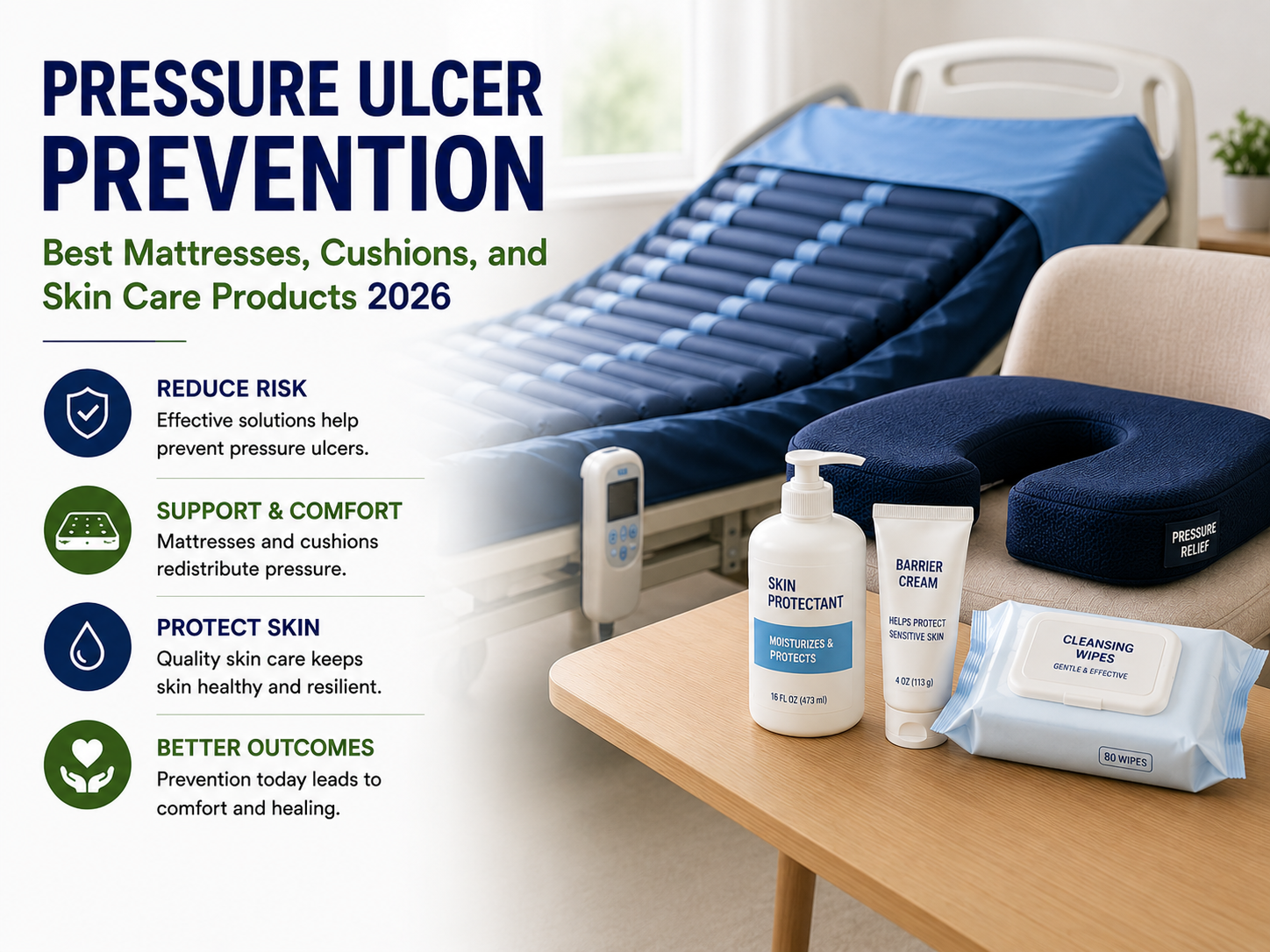
The single most impactful equipment choice for bed-bound patients is a pressure-reducing sleep surface. Options range from inexpensive foam overlays to sophisticated alternating pressure systems:
Foam Pressure Relief Mattresses and Overlays
High-density foam mattresses and overlays distribute weight more evenly than standard mattresses, reducing peak pressure at bony prominences. Egg crate (convoluted) foam overlays are a budget-friendly entry point but provide only modest pressure redistribution — appropriate for lower-risk patients or short-term recovery. Viscoelastic (memory foam) overlays and mattresses conform more closely to body contours, providing better pressure redistribution and are more appropriate for moderate-risk patients. Look for CertiPUR-US certified foam. Waterproof, washable covers are essential for patients with incontinence.
Alternating Pressure (AP) Mattresses
Alternating pressure systems use an electric pump to cyclically inflate and deflate air cells in the mattress, shifting the points of pressure every few minutes. This replicates the pressure relief that occurs naturally with repositioning, preventing any single area from sustaining continuous pressure. AP mattresses are considered the gold standard for high-risk patients. They're available as full mattress replacements or as overlays that go on top of an existing mattress. Most include adjustable pressure settings for patient weight and comfort. Look for low air loss features in AP systems for patients with moisture concerns, as these systems also circulate air to keep skin drier.
Lateral Rotation Mattresses
A subset of alternating pressure mattresses, lateral rotation systems gently tilt the patient side to side as well as cycling air pressure. Used primarily in acute care settings for high-risk patients, particularly those with pulmonary complications who benefit from position changes for respiratory function. Available for home use for patients with the highest prevention needs.
Shop pressure relief mattresses and overlays at AllCare Store.
Wheelchair Cushions for Pressure Relief
For wheelchair users, the cushion is as important as repositioning. Sitting generates significant pressure at the ischial tuberosities — a standard foam seat dramatically increases risk compared to a proper pressure-relief cushion.
Foam Wheelchair Cushions
Contoured foam cushions with cutouts under the ischial tuberosities and coccyx offload pressure from high-risk bony areas. Good entry-level option for lower-risk wheelchair users. Must be replaced when foam compresses and loses its shape (typically 1–2 years).
Gel Wheelchair Cushions
Gel layers conform to the body's contours and distribute pressure broadly, functioning similarly to high-density foam with added comfort. Gel cushions also have thermal properties, reducing heat buildup under the sitting surface. Combination gel-foam cushions balance pressure redistribution with postural support. Gel cushions are heavier than foam-only options and require occasional gel redistribution (kneading the cushion).
Air-Filled (ROHO-Style) Cushions
Interconnected air cells inflate independently under body weight, distributing pressure across a broad area and immersing bony prominences in a "floating" support. Air cushions can be custom-inflated (prescribed by a physical therapist) to optimize the immersion depth for each patient. They provide the highest level of pressure redistribution of any cushion type and are strongly recommended for patients with existing pressure injuries or high risk. Require proper inflation pressure maintenance — both over-inflation and under-inflation reduce effectiveness.
Alternating Pressure Wheelchair Cushions
Like AP mattresses, alternating pressure cushion systems cyclically change the pattern of support under the seated patient. Used for the highest-risk wheelchair users, particularly those who cannot perform pressure-relief lifts independently.
Browse wheelchair cushions at AllCare Store — including foam, gel, and air options with free shipping.
Positioning Aids
Even the best mattress cannot prevent pressure ulcers without proper repositioning. Positioning aids help maintain safe positions between caregiver-assisted turns:
Positioning wedges and bolsters: Used to maintain the patient in a 30-degree lateral tilt — the optimal angle for pressure redistribution that also prevents pressure on the hip (trochanter). Wedge-shaped foam bolsters are placed behind the patient's back to hold the tilted position. This avoids direct lateral positioning, which places pressure directly on the hip.
Heel protectors: Heels are the second most common site for pressure ulcers in bed-bound patients. Heel offloading boots or pillow-style heel protectors suspend the heel completely, eliminating pressure. Standard leg pillows reduce but do not eliminate heel pressure — true offloading devices are preferred for at-risk patients. Look for heel protectors that also prevent foot drop.
Foam elbow protectors: Padded sleeves protect the elbows during repositioning and in patients who use their elbows to shift positions.
Knee and ankle separators: Foam wedges or pillows placed between the knees and ankles prevent pressure injury from bony prominences pressing against each other in side-lying positions.
Turning sheets and slide sheets: Friction and shear during repositioning cause as much damage as sustained pressure. Silk or satin-finish turning/slide sheets allow caregivers to reposition patients with minimal friction, protecting fragile skin.
Skin Care: The Moisture Defense
Moisture from incontinence, perspiration, or wound drainage dramatically increases pressure ulcer risk by softening skin and increasing friction. A structured skin care routine is essential for at-risk patients:
Skin Cleansing
Use pH-balanced, no-rinse cleansing foams or wipes for incontinence care rather than soap and water, which can disrupt the skin's natural acid mantle. Aggressive wiping removes protective skin oils and traumatizes already-fragile tissue. Pat dry rather than rubbing.
Moisture Barriers
Moisture barrier creams and ointments containing petrolatum, dimethicone, or zinc oxide form a protective film between skin and moisture. Apply to the perianal, perineal, and sacral areas after each incontinence episode. Thick paste formulations (3M Cavilon paste, Desitin Maximum Strength, Calmoseptine) are recommended for patients with frequent incontinence. Thin barrier creams are appropriate for daily prophylactic use.
Skin Moisturizers
Dry, fragile skin is more susceptible to breakdown than well-hydrated skin. Daily application of fragrance-free body lotion to high-risk areas maintains skin integrity. Avoid alcohol-containing products, which dry skin further.
Incontinence Management
The most effective moisture management is removing the source. Structured incontinence management — prompted voiding schedules, appropriate absorbent products changed promptly, and catheter use when indicated — reduces moisture exposure dramatically. Highly absorbent incontinence briefs and underpads that pull moisture away from skin provide additional protection. See AllCare Store's Adult Diapers and Incontinence collection for premium products with excellent moisture management.
The Repositioning Schedule
Equipment reduces pressure — repositioning eliminates it periodically. Standard recommendations:
- Bed-bound patients: Reposition every 2 hours around the clock; 30-degree lateral tilt using wedge positioning between turns
- Wheelchair users: Perform pressure-relief lifts every 15–30 minutes (shift weight forward, side to side, or perform full lift off seat); if unable to perform independently, caregiver-assisted repositioning every hour
- Document repositioning on a turning chart to ensure consistency across caregivers and shifts
Nutrition for Pressure Ulcer Prevention
Malnutrition is a major risk factor for pressure ulcer development and impaired healing. The skin requires adequate protein, calories, vitamins, and minerals to maintain integrity. Key nutritional considerations:
Protein: Adequate protein intake (1.2–1.5 g/kg/day for at-risk patients) maintains skin structure and immune function. High-protein nutritional supplements (Ensure High Protein, Boost High Protein) can help meet needs in patients with reduced appetite. Browse nutritional drinks and supplements at AllCare Store.
Vitamin C: Essential for collagen synthesis; deficiency impairs skin integrity. Standard supplementation may be appropriate in malnourished patients.
Zinc: Supports skin integrity and wound healing; commonly supplemented in wound care protocols.
Hydration: Dehydrated patients have more fragile, less elastic skin. Encourage fluid intake unless medically restricted.
When Prevention Fails: Early Warning Signs
Catching pressure injury at Stage 1 is critical — at this point, the wound is still reversible with consistent off-loading and skin care:
- Stage 1: Non-blanchable redness over a bony prominence (press on the area — if redness doesn't turn white momentarily, it's stage 1 or beyond)
- Stage 2: Partial-thickness skin loss; shallow open ulcer or intact blister
- Stage 3: Full-thickness skin loss; may see fat tissue
- Stage 4: Full-thickness skin and tissue loss; bone, tendon, or muscle may be visible
- Unstageable: Wound base obscured by slough or eschar
- Deep tissue injury: Purple or maroon intact skin indicating underlying tissue damage
Stage 1 injuries can be managed with enhanced prevention protocols. Stage 2 and beyond require wound care assessment and treatment by a qualified clinician. Contact your patient's healthcare provider immediately if you observe Stage 2 or higher injury.
Shop Pressure Ulcer Prevention at AllCare Store
AllCare Store carries the full range of pressure ulcer prevention equipment — alternating pressure mattresses, foam and air wheelchair cushions, positioning aids, heel protectors, moisture barrier products, and incontinence care supplies. Everything for comprehensive skin and wound protection, with free shipping on every order.
Wound Care Products | Wheelchair Cushions | Pressure Relief Mattresses | AllCare Store
Questions? Call 1-888-889-6260 — our team can help match products to your patient's specific risk level and care needs.
Frequently Asked Questions: Pressure Ulcer Prevention
Does Medicare cover pressure relief mattresses at home?
Medicare Part B covers Group 1, 2, and 3 support surfaces (pressure-reducing mattresses and overlays) for home use when medically necessary. Group 1 devices (standard foam overlays and mattresses) are covered for patients who have a pressure ulcer or are at risk. Group 2 (powered air flotation beds and alternating pressure systems) require documentation of a Stage 2 or higher pressure ulcer plus failure to heal with a Group 1 surface. Group 3 (air-fluidized beds) require Stage 3 or Stage 4 ulcers and a physician's order with ongoing monitoring. A physician's prescription and certificate of medical necessity are required for all groups. Contact Medicare or your insurance provider to confirm your specific benefit before purchasing.
How long does it take for a pressure ulcer to develop?
Pressure ulcers can develop in as little as 1–2 hours of sustained pressure in vulnerable patients. Research shows that tissue damage begins at the cellular level long before it's visible at the skin surface. This is why repositioning every 2 hours is the standard for high-risk bed-bound patients. Deep tissue injuries can develop within a single episode of prolonged immobility — for example, during surgery or a fall where the patient was unable to be found quickly. The sacrum, heels, and hips are the most vulnerable areas and warrant the most vigilant monitoring.
What is the best wheelchair cushion to prevent pressure sores?
Air-cell cushions (often called ROHO-style cushions) are generally considered the gold standard for pressure ulcer prevention in high-risk wheelchair users because they provide the highest level of pressure redistribution and immersion. However, the best cushion for any individual depends on multiple factors including activity level, body type, skin integrity, postural needs, and functional capabilities. A physical therapist specializing in seating can perform a formal seating evaluation and recommend the appropriate cushion type and pressure settings. AllCare Store carries foam, gel, and air-cell wheelchair cushion options — call 1-888-889-6260 for guidance on selecting the right product.