Medical Disclaimer: This article is for informational purposes only and does not constitute medical advice. If skin breakdown, open wounds, or signs of infection are present, consult a physician or wound care nurse before beginning or changing a skin care regimen. People with diabetes or impaired circulation require especially close skin monitoring.
Among the many challenges caregivers manage for people with incontinence, skin health is one of the most critical — and most underestimated. The skin in the perineal region (the area between the thighs, including the genitals and buttocks) is constantly exposed to moisture, friction from briefs and pads, and the enzymatic irritants in urine and feces. Without a protective regimen, skin breakdown happens fast: within hours of sustained moisture contact, the outer skin barrier begins to weaken; within days, painful inflammation, redness, and open wounds can develop.
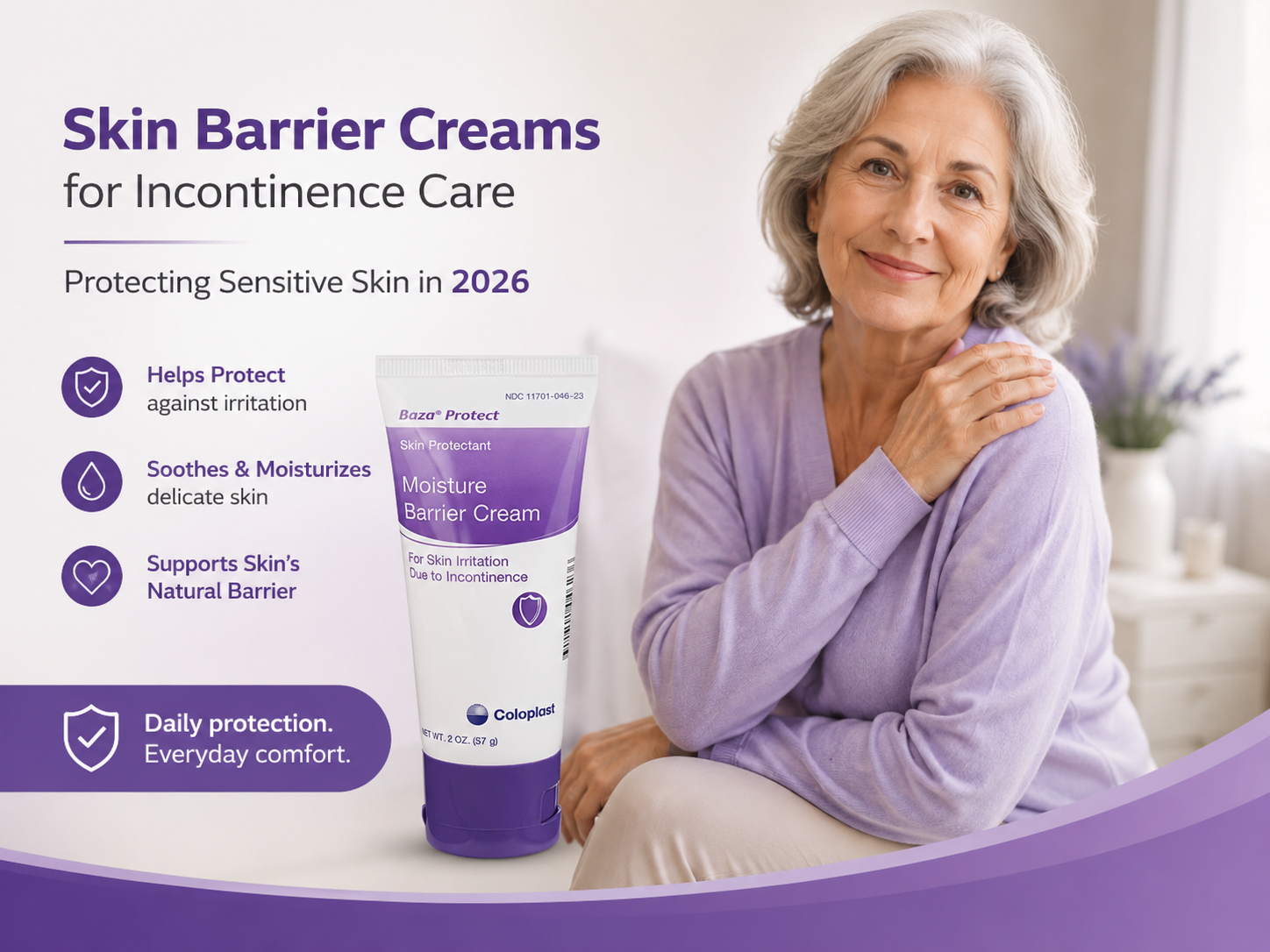
The good news is that incontinence-associated dermatitis (IAD) is largely preventable with the right products and routine. Skin barrier creams are the cornerstone of that prevention. At AllCare Store, we carry a complete selection of skin barrier creams, perineal cleansers, and incontinence skin care products.
What Is Incontinence-Associated Dermatitis (IAD)?
IAD is skin damage caused specifically by prolonged contact with urine or fecal matter — or both. It is distinct from pressure injuries (bedsores), though IAD and pressure injuries frequently co-occur in people with limited mobility. IAD presents as:
- Redness and warmth across the perineal area, buttocks, inner thighs, or groin folds
- Skin that appears shiny, wet, or eroded
- Pain, burning, or itching in the affected area
- In moderate to severe cases: skin loss, open erosions, and satellite lesions from secondary fungal infection (candidiasis)
IAD is painful and significantly affects quality of life. It is also a risk factor for pressure injuries — damaged, macerated skin has lower resistance to mechanical pressure and shear forces. Preventing IAD is always preferable to treating it.
How Skin Barrier Creams Work
Skin barrier creams (also called moisture barriers, perineal barrier products, or protective creams) work through one or more of three mechanisms:
1. Occlusion
Occlusive barriers physically coat the skin surface, preventing urine and feces from penetrating the outer skin layer. The most common occlusive agents are petrolatum (petroleum jelly) and zinc oxide. These create a water-repellent film that keeps irritants off the skin even during a leakage episode. Petrolatum is highly effective but very greasy and can interfere with the absorbency of incontinence briefs if applied heavily. Zinc oxide is less greasy and also has mild antimicrobial and anti-inflammatory properties.
2. Film-Forming Protection
Film-forming barriers — often described as "liquid skin" or "no-sting barriers" — apply as a liquid or spray and dry to form a clear, breathable protective film on the skin. They contain copolymers or acrylates that bond to the skin surface and resist moisture without the greasiness of petrolatum-based products. Film barriers are widely used in clinical settings because they don't interfere with incontinence product absorbency and work with adhesive wound dressings. Many can be applied over fragile, pre-damaged skin without causing pain (hence "no-sting").
3. Skin Conditioning / Moisturization
Humectants (glycerin, hyaluronic acid) and emollients (dimethicone, shea butter) help restore and maintain the skin's natural moisture balance. When the skin barrier is intact but dry or irritated, these ingredients prevent further damage. Conditioning agents are more important for general skin health maintenance than for acute barrier protection during active incontinence episodes.
Types of Skin Barrier Products
Zinc Oxide Creams and Pastes
Zinc oxide products are the workhorses of incontinence skin protection. Concentrations typically range from 10% (light cream) to 40% (thick paste). Higher zinc oxide concentrations provide stronger occlusive protection but are thicker, harder to apply, and must be completely removed (not simply wiped off) with each change, which can itself damage fragile skin if done roughly.
Best for: Prevention of IAD in people with regular incontinence, perineal redness and early-stage dermatitis, and diaper rash in infants (the same chemistry applies).
Not ideal for: People using adhesive wound dressings in the perineal area (zinc oxide can interfere with adhesion), or situations where the film barrier's thin, no-sting application is more appropriate.
Petrolatum-Based Ointments
Plain petrolatum (Vaseline) is an effective, inexpensive moisture barrier. It is extremely occlusive, hypoallergenic, and well-tolerated by nearly all skin types. However, it is very greasy, stains clothing and bedding, and should not be applied in large quantities over incontinence briefs because it can reduce the superabsorbent polymer's ability to wick moisture away from the skin — the opposite of what you want.
Many clinically formulated barrier ointments combine petrolatum with zinc oxide, dimethicone, or other active ingredients to balance protection with wearability.
Dimethicone-Based Creams
Dimethicone is a silicone-based occlusive agent widely used in skin barrier products because it is less greasy than petrolatum, does not stain, and does not interfere with incontinence product absorbency. Dimethicone concentrations of 1–3% are common in skin barrier creams. Products containing dimethicone + other emollients and humectants are often described as "all-in-one" cleansers and barriers in the perineal care category.
Best for: Routine prevention in ambulatory people with light to moderate incontinence, situations where product greasiness is a concern, or when the skin is not severely compromised.
Film-Forming Liquid Barriers
Available as wipes, sprays, or liquid applicators, film barriers dry in seconds and leave an invisible protective layer. They are especially useful for:
- Skin around ostomy sites and wound edges
- People with severely fragile or damaged periwound skin
- Clinical settings where rapid application and no-residue protection are priorities
- Over skin that has already experienced surface breakdown but where a thick cream would be difficult to apply without causing pain
Popular clinical film barrier products include 3M Cavilon No-Sting Barrier Film, Smith & Nephew Skin-Prep, and Coloplast Brava Barrier Film. These are available individually or in case quantities for caregivers managing high-frequency changes.
Comparing Key Products: What to Look For
| Product Type | Best Use | Pros | Cons |
|---|---|---|---|
| Zinc oxide cream (10–20%) | Routine prevention, mild redness | Strong barrier, anti-inflammatory, affordable | White residue, requires thorough removal |
| Zinc oxide paste (40%+) | Moderate to severe IAD, maceration | Maximum occlusion, stays in place | Very thick, removal requires oil-based cleanser |
| Petrolatum ointment | Dry, fragile skin; general protection | Hypoallergenic, very effective barrier, cheap | Greasy, stains, reduces brief absorbency |
| Dimethicone cream | Routine daily protection, ambulatory users | Non-greasy, no-stain, breathable | Less occlusive than petrolatum/zinc oxide at high moisture exposure |
| Film-forming liquid/wipe | Fragile skin, ostomy, periwound skin | No-sting, invisible, no residue, breathable | Higher cost per use, may need reapplication |
The Structured Skin Care Routine
Clinical evidence consistently supports a three-step structured skin care routine (cleanse, moisturize, protect) over unstructured or reactive approaches. Following this routine at every incontinence episode prevents IAD far more reliably than only treating skin when redness appears.
Step 1: Cleanse Gently
Use a pH-balanced perineal cleanser rather than standard soap and water. Skin in the perineal area has a natural acidic pH of approximately 4.5–5.5. Standard soap is alkaline (pH 9–11) and disrupts the skin's acid mantle, weakening the barrier. pH-balanced perineal cleansers (foam, spray, or washcloth-embedded) clean effectively without altering skin pH.
Pat skin dry rather than rubbing — friction on wet, irritated skin accelerates breakdown. "No-rinse" perineal cleansers eliminate the drying step entirely, which is especially valuable for people with fragile skin or in high-frequency care situations.
Step 2: Moisturize
After cleansing, apply a moisturizing product to restore the skin's lipid barrier. Many combination barrier creams handle steps 2 and 3 in a single product, which simplifies the routine in home care settings. If using separate products, apply the moisturizer first and allow it to absorb briefly before applying the barrier cream on top.
Step 3: Apply the Barrier
Apply the barrier cream or ointment in a thin, even layer over all skin surfaces exposed to incontinence — the perineum, inner thighs, groin folds, and buttocks. Apply enough to create a visible coating but not so thick that it pools. For zinc oxide products, allow 1–2 minutes for the product to set before applying a fresh incontinence brief or pad.
Do not apply barrier cream inside the brief's absorbent core — the barrier will interfere with moisture absorption. Apply to the skin only.
Managing Skin That Is Already Damaged
If skin breakdown (erosion, open areas, or frank wounds) has already occurred alongside incontinence, skin care becomes more complex. For Category 1 IAD (redness, no skin loss), the structured three-step routine with a quality barrier cream is usually sufficient to halt progression and allow healing. For Category 2 IAD (skin loss, erosion, or secondary infection), consult a wound care nurse or physician.
Key principles for damaged skin:
- Never rub damaged skin — use gentle blotting motions and very soft cloths or disposable washcloths
- Switch to a film-forming no-sting barrier if standard cream application is too painful
- Treat secondary fungal infection (candidiasis) with an antifungal powder or cream before applying barrier products — antifungal agents need contact with the skin surface, not coverage under a barrier
- Increase change frequency to reduce total skin exposure time — quality of incontinence product matters here
- Consider adding an absorbent pad liner inside the brief to keep moisture away from the skin surface
Choosing the Right Incontinence Product to Support Skin Health
Skin barrier creams don't work in isolation — the incontinence product itself plays a major role in skin health. Products with a fast-wicking top layer pull moisture away from the skin surface, while low-quality products may hold moisture against the skin for hours. Look for:
- Superabsorbent polymer (SAP) core: Locks in liquid and prevents re-wetting (moisture returning to the skin surface)
- Breathable outer cover: Allows air circulation to reduce heat and moisture buildup
- Correct sizing: A brief that is too large will bunch and create friction points; too small and it will leak at the edges
Browse our full selection of adult incontinence briefs, pull-ups, and underpads to find the right fit and absorbency level for your situation.
Shop Skin Barrier and Incontinence Care Products at AllCare Store
AllCare Store carries a complete perineal skin care selection including zinc oxide creams and pastes, pH-balanced no-rinse cleansers, film-forming barriers, dimethicone creams, and disposable washcloths. We also carry wound care supplies for more advanced skin breakdown management.
Shop Skin Care and Incontinence Products at AllCare Store. Free shipping on every order. For product recommendations, call our team at 1-888-889-6260.