Medical Disclaimer: This article is for informational purposes only and does not constitute medical advice. If you have recently had surgery or a significant injury, consult your physician or physical therapist before using crutches. Improper crutch use can worsen injury or cause new ones.
When Marcus came home from knee surgery, his discharge nurse handed him a pair of crutches and told him to "make sure they fit." Three days later, he was back in the ER — not for his knee, but for numbness in his hands and severe underarm bruising from crutches that were a full three inches too tall. Getting crutch sizing right isn't optional. An improperly fitted crutch transfers weight to the wrong places, causing axillary nerve damage, wrist strain, and instability that leads to falls.
At AllCare Store, we carry a full range of adjustable crutches and mobility aids to help you recover safely. This guide will walk you through everything you need to know about crutch selection, sizing, and safe use.
Types of Adjustable Crutches
Underarm (Axillary) Crutches
The most common type, these extend from the floor to just below your underarm. Despite the name, underarm crutches should never bear weight in the armpit — the padded top rests against the ribcage, about 1–2 inches below the armpit, while your hands on the grip bars carry your weight. Underarm crutches are best for short-term use (post-surgery, fracture recovery) and are typically the most affordable option at $20–$60 per pair.
Forearm (Lofstrand) Crutches
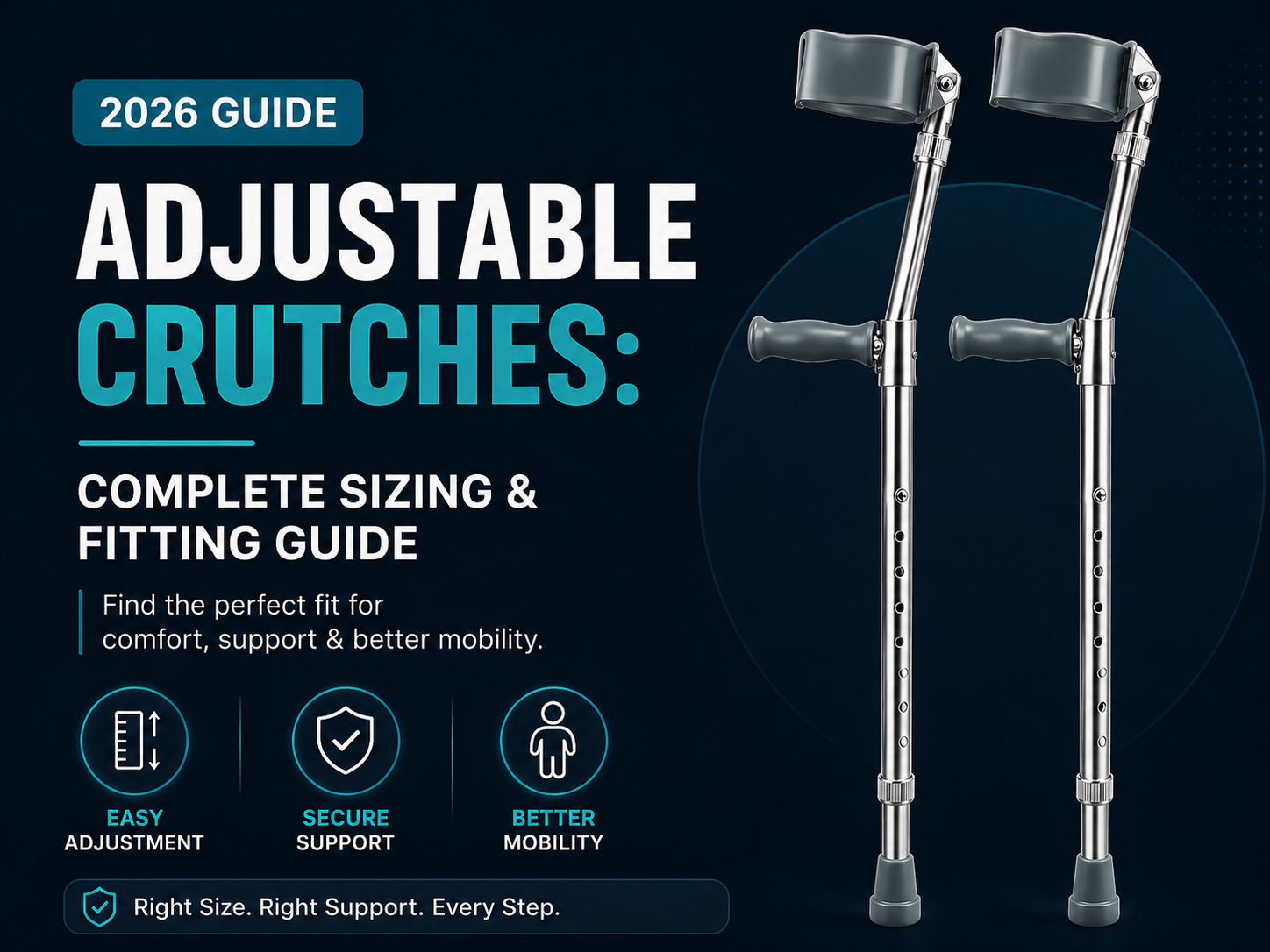
Also called Canadian crutches or elbow crutches, forearm crutches have a cuff that wraps around your forearm just below the elbow, with a handgrip below. Weight is borne through the handgrip, with the forearm cuff providing stability and preventing the crutch from falling when you open your hand. Forearm crutches are preferred for long-term use and by people with permanent mobility limitations — they allow freer hand use, are lighter, and cause less upper-body fatigue. Price range: $40–$150 per pair.
Platform Crutches
For users who cannot grip a standard crutch handle due to arthritis, weakness, or upper extremity injuries, platform (forearm trough) crutches provide a horizontal padded platform that the forearm rests on. Weight is distributed across the forearm rather than concentrated in the hand. These are specialty items typically recommended by occupational therapists.
How to Size Underarm Crutches
Proper fitting takes less than five minutes and prevents the most common crutch injuries. Follow these steps:
Step 1: Set Overall Height
Stand upright wearing your normal shoes. The top pad of the crutch should sit 1.5 to 2 inches (3–4 finger widths) below your armpit. This gap is critical — it ensures your body weight travels through your arms and hands to the grip, not through the armpit into the brachial plexus nerves.
If you cannot stand, use this formula: measure your height in inches and subtract 16. The result is your approximate crutch length in inches. For example, if you are 5'8" (68 inches tall): 68 − 16 = 52 inches. Most adjustable crutches are set in this range.
Step 2: Set Handgrip Height
Stand with your arms relaxed at your sides. The handgrip should align with the crease of your wrist (where your hand meets your forearm). When you hold the grip, your elbow should have a slight bend of 15 to 30 degrees — not straight, not significantly bent. This position maximizes weight-bearing capacity while protecting the elbow joint.
Step 3: Check Your Posture
Standing with crutches in position:
- Your shoulders should be relaxed and level — not hunched or elevated
- The crutch tips should be positioned about 6 inches in front of and 6 inches to the side of each foot
- Your back should be straight — crutches that are too short cause hunching
- You should be able to support your full body weight through the grips comfortably
Common Sizing Mistakes
| Mistake | What Happens | Fix |
|---|---|---|
| Crutch top in armpit | Axillary nerve damage, numbness in arm/hand | Maintain 1.5–2" gap; weight on grips only |
| Crutches too tall | Shoulder shrugging, axillary pressure, nerve damage | Lower the overall height |
| Crutches too short | Back pain, hunched posture, instability | Raise until 1.5–2" gap below armpit |
| Handgrip too high | Elbow over-flexion, shoulder strain | Lower grip to wrist crease level |
| Handgrip too low | Elbow hyperextension, wrist pain | Raise grip to wrist crease level |
| Tips worn or missing | Slipping, falls | Replace rubber tips every 3–6 months |
How to Size Forearm Crutches
For forearm crutches, overall height is set so that the handgrip aligns with your wrist crease — the same as underarm crutches. The forearm cuff should sit 1–1.5 inches below your elbow when your arm is bent at the grip. The cuff opening should face to the side (not directly forward) so you can release your hand without the crutch falling.
Gait Patterns: How to Walk with Crutches
Non-Weight-Bearing (NWB)
Your injured leg cannot touch the ground. Move both crutches forward together, swing your body through using your arms, then hop forward on your good leg. This is the most common post-surgical gait for knee, ankle, and foot procedures.
Partial Weight-Bearing (PWB)
Your doctor specifies a percentage of weight (often 25–50%) you can place on the injured leg. Move both crutches forward with your injured leg, place gentle weight as prescribed, then step through with the good leg.
Touch-Down Weight-Bearing (TDWB)
The injured foot can touch the ground for balance only — no significant weight. Similar to NWB movement but with light toe touch for stability.
Two-Point Gait
Move one crutch and the opposite foot forward together, then the other crutch and opposite foot. This mimics a natural walking pattern and is used when both legs can bear weight. It is faster but requires more coordination.
Stairs, Curbs, and Uneven Surfaces
Going Up Stairs
Remember: "Good goes up first." Step up with your good leg first, then bring the crutches and injured leg up to the same step. Use the handrail whenever available — hold both crutches in the hand away from the rail.
Going Down Stairs
"Bad goes down first." Lower the crutches and injured leg down to the next step first, then step down with your good leg. Take one step at a time.
Curbs
Treat a curb like a single stair step. Going up: good leg first, then crutches and injured leg. Going down: crutches and injured leg first, then good leg.
Wet and Slippery Surfaces
Crutch rubber tips lose traction on wet floors, ice, and polished tile. Take very short steps, keep your weight centered, and proceed slowly. Consider ice-tip attachments for winter use. Avoid crutching through puddles if possible.
Crutch Accessories and Upgrades
Several accessories can make crutch use more comfortable and safer:
- Padded underarm pads: Gel or memory foam covers for the axillary pad reduce pressure and friction. Particularly useful for extended use.
- Padded handgrip covers: Reduce hand fatigue and blistering during extended use. Essential for anyone using crutches for more than a few days.
- Crutch tips: Standard rubber tips should be replaced every 3–6 months or when worn smooth. Wide-base tips and ice-spike attachments are available for specific conditions.
- Crutch bag/pouch: Attaches to the crutch frame to carry a phone, water bottle, or other essentials, keeping both hands on the grips.
- Crutch stand: A free-standing holder keeps crutches upright and accessible when seated, preventing the falls that occur when leaning crutches against furniture.
When to Transition Off Crutches
Always follow your physician's or physical therapist's guidance on when to wean off crutches — do not reduce crutch use based on how you feel alone. Bone healing is not always painful, and premature full weight-bearing can disrupt healing tissue. Typical timelines vary widely by injury and procedure: simple ankle sprains may require 1–2 weeks; fractures and surgical repairs typically require 6–12 weeks of restricted weight-bearing.
When transitioning off crutches, many patients progress to a single cane (held on the strong side) for an intermediate period before walking unassisted. Browse our crutches and canes collection for options at every stage of recovery.
Shop Crutches and Mobility Aids at AllCare Store
AllCare Store carries adjustable underarm crutches, forearm crutches, platform crutches, replacement tips, padding kits, and accessories from trusted brands. We also carry canes, walkers and rollators, and a full range of post-surgical recovery aids.
Shop Crutches & Canes at AllCare Store. Free shipping on every order. Questions? Call us at 1-888-889-6260.
Frequently Asked Questions: Adjustable Crutches
How do I know what size crutches to get?
The easiest way is to measure while standing in your normal shoes: the crutch top should sit 1.5 to 2 inches below your armpit, and the handgrip should align with your wrist crease when your arm hangs at your side. Most adjustable crutches cover a height range (e.g., 5'0"–5'10"), so check the product's fit range before purchasing. If ordering online and you cannot measure in person, use the formula: your height in inches minus 16 equals your approximate crutch length in inches.
Can you bear weight on the armpit pad of underarm crutches?
No — this is one of the most dangerous crutch mistakes. Bearing weight in the armpit compresses the brachial plexus nerve bundle, causing a condition called "crutch palsy" or "Saturday night palsy" — numbness, tingling, and weakness in the arm and hand that can take weeks or months to resolve, and in severe cases can be permanent. All weight must be borne through the handgrips. The armpit pad exists only to prevent the crutch from swinging away from your body.
How long do crutch rubber tips last?
Rubber crutch tips typically last 3–6 months with regular use, and sooner if used frequently on abrasive surfaces like concrete. Check the tips weekly — when the tread pattern wears smooth or you see any cracking, replace them immediately. Worn tips are a major fall risk, especially on wet or polished floors. Replacement tips are inexpensive (usually under $5–$10 per pair) and widely available.
Are forearm crutches better than underarm crutches?
It depends on your situation. For short-term recovery (a few weeks), underarm crutches are typically fine and more affordable. For long-term or permanent use, forearm crutches are generally preferred because they reduce upper-body fatigue, allow freer hand use, and eliminate the risk of axillary nerve compression. Many people who need crutches permanently find forearm crutches more practical for daily activities like opening doors, carrying items, and using their hands while standing. Your physical therapist can recommend which type is right for your specific needs and activity level.