Disclaimer: This guide is for informational purposes only and does not constitute medical advice. If you are managing incontinence for yourself or a loved one, please consult a physician or continence nurse specialist for a full evaluation and personalized recommendations.

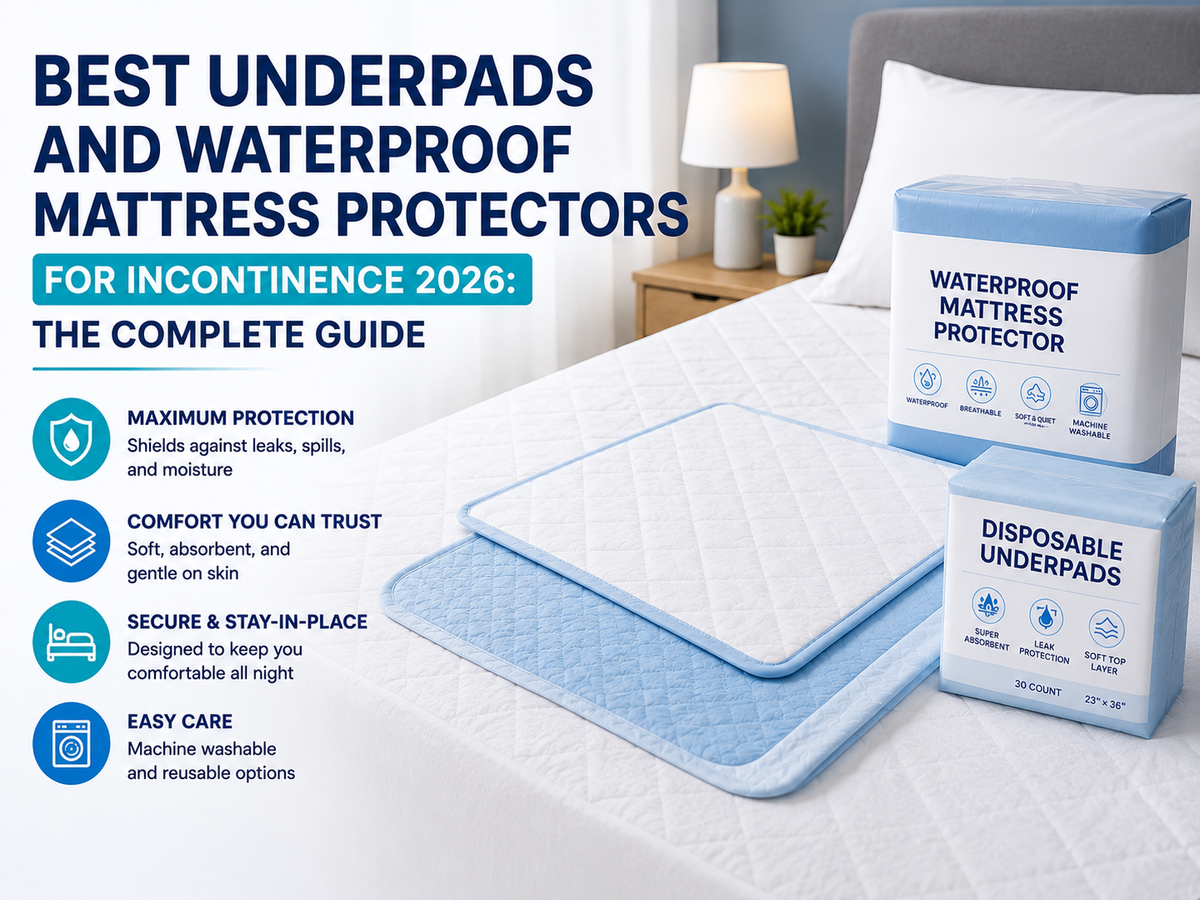
Best Underpads and Waterproof Mattress Protectors for Incontinence in 2026

A Night That Changed Everything — and the Solution That Followed

Carol, 71, had been caring for her husband Robert at home for nearly two years following his stroke. She had learned how to transfer him, how to help him bathe, how to manage his medications and therapy schedule. What she hadn't anticipated was the exhaustion of waking at 2 a.m. to a wet mattress, helping Robert change, stripping the bed in the dark, and trying to get both of them back to sleep before morning. By the time their home health aide mentioned bed underpads, Carol had already replaced their mattress once and was dreading another round of sleepless nights.

She ordered a pack of high-absorbency disposable underpads and a quilted reusable waterproof mattress pad. The first night, nothing leaked. The second night, same. Within a week, the laundry burden had dropped dramatically, Robert was more comfortable, and Carol was sleeping through the night more often than not. The underpad, she told her daughter, was the single most practical purchase she had made in two years of caregiving.

Carol's experience is shared by millions of caregivers and individuals managing incontinence at home, in skilled nursing, or in post-acute recovery settings. When you're ready to find the right solution, AllCare Store's underpads and bed protection collection offers a full range of disposable and reusable options with free shipping on qualifying orders.

Underpads vs. Mattress Protectors: Understanding the Difference

The terms are often used interchangeably, but they describe different products with different use cases:

Underpads (also called "chux," drawsheets, or soaker pads) are placed on top of the bottom sheet, directly under the person. They absorb leakage at the point of contact, protecting the sheet and mattress underneath. They are repositioned with the patient, meaning a soiled pad can be replaced without stripping the entire bed. They come in disposable and reusable versions.

Mattress protectors are fitted or flat covers placed over the entire mattress surface (between the mattress and the sheet). They provide a waterproof barrier for the full mattress and are not typically repositioned during patient care. They are usually reusable and designed to be laundered.

In most home care situations, the best system uses both: a fitted waterproof mattress protector as the base layer, then a high-absorbency underpad on top where the person lies. This combination protects the mattress completely while making daily pad changes fast and straightforward.

Disposable vs. Reusable Underpads: Which Is Right for You?

Factor Disposable Underpads Reusable Underpads
Initial cost Low per pad; ongoing supply cost Higher upfront; lower long-term cost
Convenience High — simply remove and discard Requires laundering between uses
Best for High-frequency changes, travel, post-surgery, facilities Home care with consistent laundry routine, cost-conscious caregivers
Absorbency range Light to heavy (choose by oz rating or tier) Usually high-absorbency by design
Environmental impact Higher waste generation Lower waste; some rated for 200+ washes
Skin contact Varies; some have soft-touch surface Typically soft quilted or cotton facing

Many families use both: disposables for convenience during acute illness, travel, or hospital stays, and reusables as the primary solution at home. Either way, the absorbency level matters more than the format — a light-absorbency pad of either type is inadequate for heavy incontinence.

Absorbency Levels: How to Choose the Right Protection

Underpad absorbency is rated in ounces (oz) of fluid held. The right level depends on the severity of incontinence and how often the pad is changed:

Absorbency Level Typical Fluid Capacity Best For
Light / Regular Up to 15 oz Light stress or urge incontinence; protecting against small leaks through an otherwise effective brief or pad
Moderate 15–25 oz Moderate incontinence; nighttime use with moderate leakage; post-surgical recovery
Heavy 25–40 oz Heavy or unmanaged incontinence; overnight use for heavy wetters; residents in long-term care
Extra / Maximum 40+ oz Severe incontinence; very limited pad-change frequency; bowel incontinence in addition to urinary

For overnight use, always choose at least one level higher absorbency than you think you need. A pad that is at capacity when the person wakes offers no margin — any movement can cause leakage onto the bed. Many experienced caregivers use maximum-absorbency pads at night regardless of the daytime level required.

Underpad Size Guide

Underpad size determines coverage area. A pad that is too small fails to catch leakage at the edges; too large becomes unwieldy to reposition during turns or pad changes.

  • Small (17" x 24"): Chair and wheelchair use; small adults with limited movement
  • Standard (23" x 24" or 23" x 36"): Most common size; covers the hip-to-mid-thigh zone for an average adult in bed
  • Large (30" x 30" or 30" x 36"): Larger adults; more restless sleepers; post-surgical patients who move frequently during position changes
  • Extra-Large (36" x 36"): Bariatric patients; full-width bed coverage; very restless sleepers

For bariatric patients or those who move significantly during sleep, choosing a size larger than standard is almost always worthwhile. A pad that doesn't cover the person's full hip-to-knee zone will be defeated by any shifting or turning.

Top Underpad Brands Available at AllCare Store

Medline Deluxe Underpads

One of the most widely used brands in both home and facility settings. Medline underpads feature a soft quilted top sheet, fluff pulp absorbent core, and moisture-proof backing. Available in regular and heavy absorbency, multiple sizes. The quilted surface is gentler on skin than standard tissue-top disposables — a meaningful difference for individuals who spend extended time in bed.

Shop Medline underpads at AllCare Store.

Prevail Fluff Underpads

Prevail's underpad line uses a fluff-core absorber with a soft, moisture-wicking top sheet and a leakproof back sheet. Widely used in post-acute and long-term care. Available in standard (23" x 36") and extra-large (30" x 36") sizes in moderate and heavy absorbency tiers.

Wings Premium Underpads

Wings (distributed by Medline) offers a hospital-grade underpad line with a triple-layer construction: soft top sheet, fluff pulp core, and reinforced waterproof back. The heavy-duty tier is rated for environments where pad changes may be less frequent — common in overnight home care settings with minimal staffing.

McKesson Reusable Underpads

McKesson's reusable underpad line uses a quilted polyester-cotton facing over a high-absorbency inner layer with a waterproof polyurethane back. Rated for 200+ machine washes. Available in multiple sizes. The reusable format is significantly more cost-effective per use than disposables for home caregivers doing regular laundry.

Mattress Protector Options for Incontinence

Not all waterproof mattress protectors are designed for incontinence. Standard mattress protectors may be lightly water-resistant but will not withstand repeated heavy leaks. Look for protectors explicitly rated for incontinence or medical use, with the following features:

  • Fully waterproof (not just water-resistant): The backing should be a laminated polyurethane or similar membrane, not simply a tight weave
  • Noise-free fabric: Early generations of waterproof protectors were notoriously crinkly. Modern options use stretch-knit or cotton-blend tops over a thin, silent waterproof membrane — a significant improvement for sleep quality
  • Fitted style: Fitted protectors cover the top and sides of the mattress and stay in place through movement; flat-sheet protectors migrate and are not recommended for incontinence use
  • Deep pocket sizing: Check that the pocket depth accommodates your mattress — most modern mattresses are 12–16" deep, and standard pocket depths (6–8") will not fit correctly
  • High-temperature laundry tolerance: Incontinence mattress protectors need to withstand hot-water washing and drying cycles for effective sanitation

Browse waterproof mattress protectors at AllCare Store for fitted covers designed specifically for incontinence management at home and in care facilities.

Underpads for Chairs and Wheelchairs

Bedding is the most common focus for underpads, but incontinence protection is equally important for seating. A person who sits in a recliner or wheelchair for several hours per day needs protection for those surfaces too. Smaller underpads (17" x 24") or chair-specific pads work for standard seating; wheelchair underpads are designed to conform to a seat and may have a non-slip backing to prevent shifting during transfers.

For individuals in wheelchairs, also consider a waterproof wheelchair seat cushion cover — these fit over pressure-relief cushions to provide a washable, waterproof barrier without compromising the cushion's pressure-distributing properties.

Care and Hygiene: Getting the Most from Reusable Pads

Reusable underpads and mattress protectors are only effective if properly laundered. Key guidelines:

  • Rinse immediately after use: Pre-rinsing in cold water before laundering reduces odor and staining significantly
  • Wash at the highest recommended temperature: Most reusable incontinence products are rated for 140°F (60°C) wash cycles, which is required for proper sanitation
  • Avoid fabric softener: Fabric softener reduces absorbency over time by coating the fibers; it also degrades the waterproof backing on mattress protectors
  • Tumble dry low to medium: High heat can damage the waterproof laminate over time; check the care label for specific guidance
  • Inspect the waterproof layer regularly: Reusable products do wear out; if you notice leaking through the pad onto the mattress, the waterproof layer has likely failed and the product should be replaced

Frequently Asked Questions

What is the difference between an underpad and a chux pad?

"Chux" is a brand-derived nickname (from Chux brand disposable pads) that has become a generic term for disposable underpads in clinical and caregiving settings. An underpad is the general category; a chux is a specific colloquial name for a disposable underpad. They are functionally the same product. Reusable underpads are typically called reusable underpads, washable bed pads, or quilted bed pads rather than chux, since the term is associated with disposables.

How often should underpads be changed?

Underpads should be changed whenever they become wet or soiled, or at minimum with each brief or incontinence product change. Leaving a saturated underpad in place creates skin moisture exposure that increases the risk of incontinence-associated dermatitis (IAD) — a painful and preventable skin condition. In overnight care situations, a high-absorbency underpad may remain in place for 6–8 hours if the person is not experiencing full incontinence episodes, but should always be changed at the morning care routine regardless of visible saturation.

Do underpads help with pressure injuries (bedsores)?

Underpads address moisture management, which is one contributing factor to pressure injuries — but they do not address the primary cause (prolonged pressure on tissue). A wet environment significantly increases skin vulnerability to breakdown, so using an appropriate underpad is an important part of pressure injury prevention for immobile patients. However, a pressure-redistributing mattress, regular repositioning schedule, and proper nutrition are the primary preventive measures. Use underpads as one component of a comprehensive skin care protocol, not as a substitute for other pressure injury prevention measures.

Are underpads covered by Medicare or insurance?

Medicare typically does not cover disposable underpads for home use under standard benefits. Some Medicare Advantage plans include a monthly incontinence supply allowance that may cover underpads. Medicaid coverage varies by state — some state Medicaid programs do cover underpads as part of a durable medical equipment or incontinence supply benefit. Check your specific plan's DME or incontinence supply benefit, or contact your state Medicaid office. Reusable underpads may qualify as DME in some cases if prescribed by a physician for medical necessity.

What size underpad should I use for an adult in bed?

The standard 23" x 36" underpad covers most adults from the waist to the mid-thigh, which is adequate for urinary incontinence in a relatively still sleeper. For individuals who move frequently during sleep, those with both urinary and bowel incontinence, or larger adults, a 30" x 36" or larger size provides more reliable coverage. When in doubt, sizing up is a better strategy than sizing down — a larger pad costs slightly more but is far less likely to fail by allowing leakage at the edges.

Building Your Complete Bedding Protection System

The most reliable approach to incontinence bedding protection combines three layers:

  1. Waterproof mattress protector — fitted, full-coverage, rated for incontinence use
  2. Bottom sheet — regular fitted sheet over the protector
  3. High-absorbency underpad — placed on the sheet under the person, covering the hip-to-knee zone

This three-layer system means that a leaking brief or pad is caught by the underpad first. If the underpad is at capacity, the sheet acts as a buffer. If the sheet is saturated, the mattress protector prevents penetration to the mattress. In practice, a properly sized, appropriate-absorbency underpad catches nearly all incontinence episodes — the sheet and mattress protector exist as insurance, not primary protection.

Carol and Robert still use this system three years into his home recovery. She changes the underpad with his morning care and again before bed. The mattress protector gets laundered weekly. The mattress — the same one they've had for eleven years — has remained dry. She told her support group it was the simplest thing that made the biggest difference in daily caregiving.

Shop the full range of underpads and waterproof mattress protectors at AllCare Store. We carry disposable and reusable options in every size and absorbency level, with free shipping on qualifying orders. Questions? Call us at 1-888-889-6260 or visit AllCareStore.com.

— The AllCare Store Team

Newsletter

A short sentence describing what someone will receive by subscribing