The hospital sent her home with crutches. She lasted nine days.
By day three, the muscles under her arms burned constantly. By day five, her palms were blistered and her wrists ached so badly she couldn't hold a coffee mug. By day seven, she had figured out that she could not carry a plate, a glass of water, or a stack of papers from one room to another — not without a plastic bag hanging off her wrist like a hobo bindle. She started eating standing at the kitchen counter because getting food to the table was a logistical problem she didn't have the energy to solve. On day nine, she wobbled at the top of the basement stairs, caught herself on the rail, and sat down shaking.
Her sister-in-law, a home-health nurse, came over that weekend, took one look, and said four words: "You need a knee scooter."
Maria was skeptical. It looked, in the photos, like a strange grown-up tricycle. But within about twenty minutes of her first afternoon on it, she had done three things she hadn't done in over a week: carried a full mug of tea from the kitchen to the couch, gotten the laundry out of the dryer, and gone out to the mailbox by herself. Her recovery didn't get shorter. It got livable.
That gap — between "medically survivable" and "actually livable" — is what this guide is about.
What a Knee Walker Actually Is
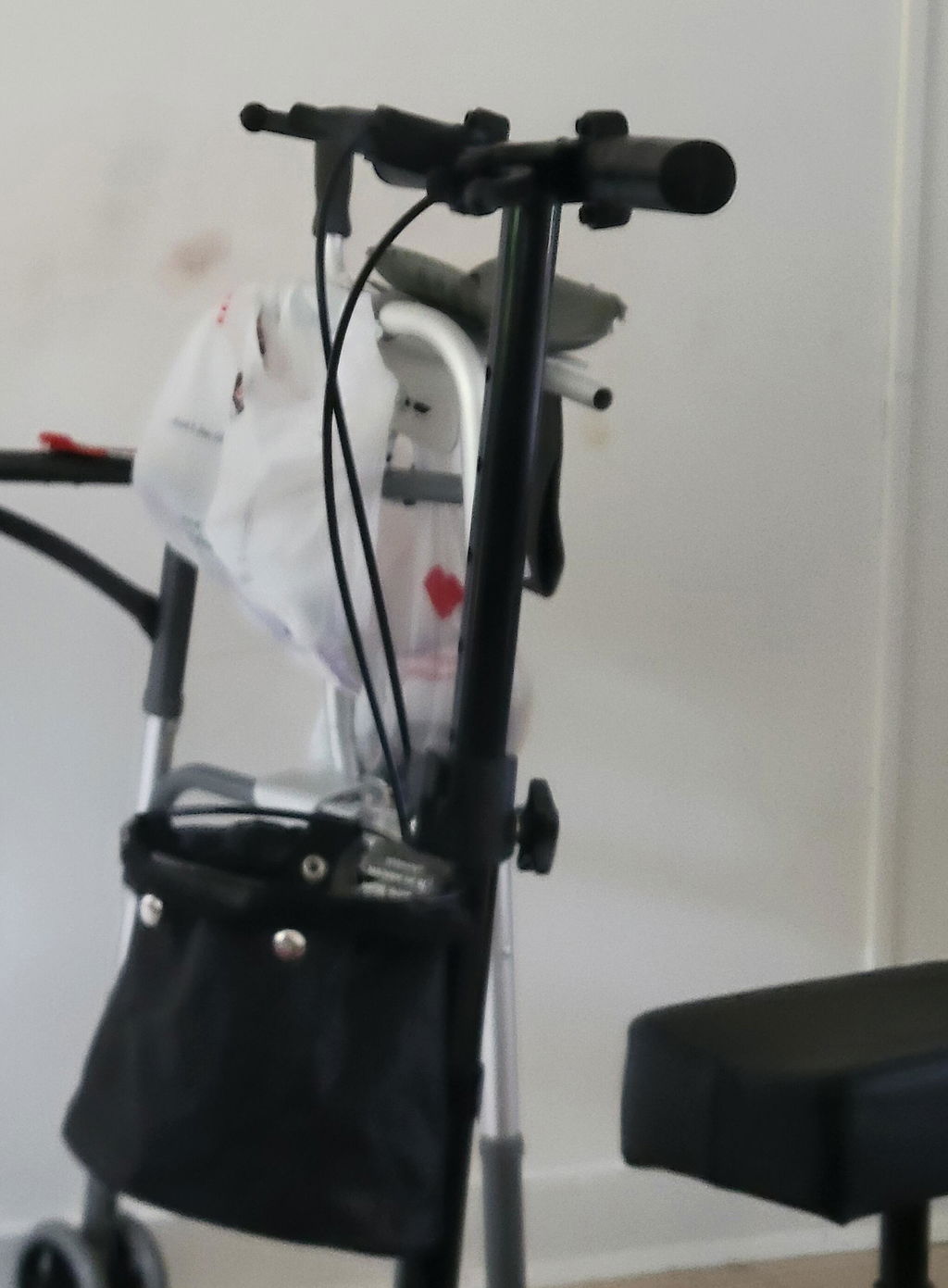
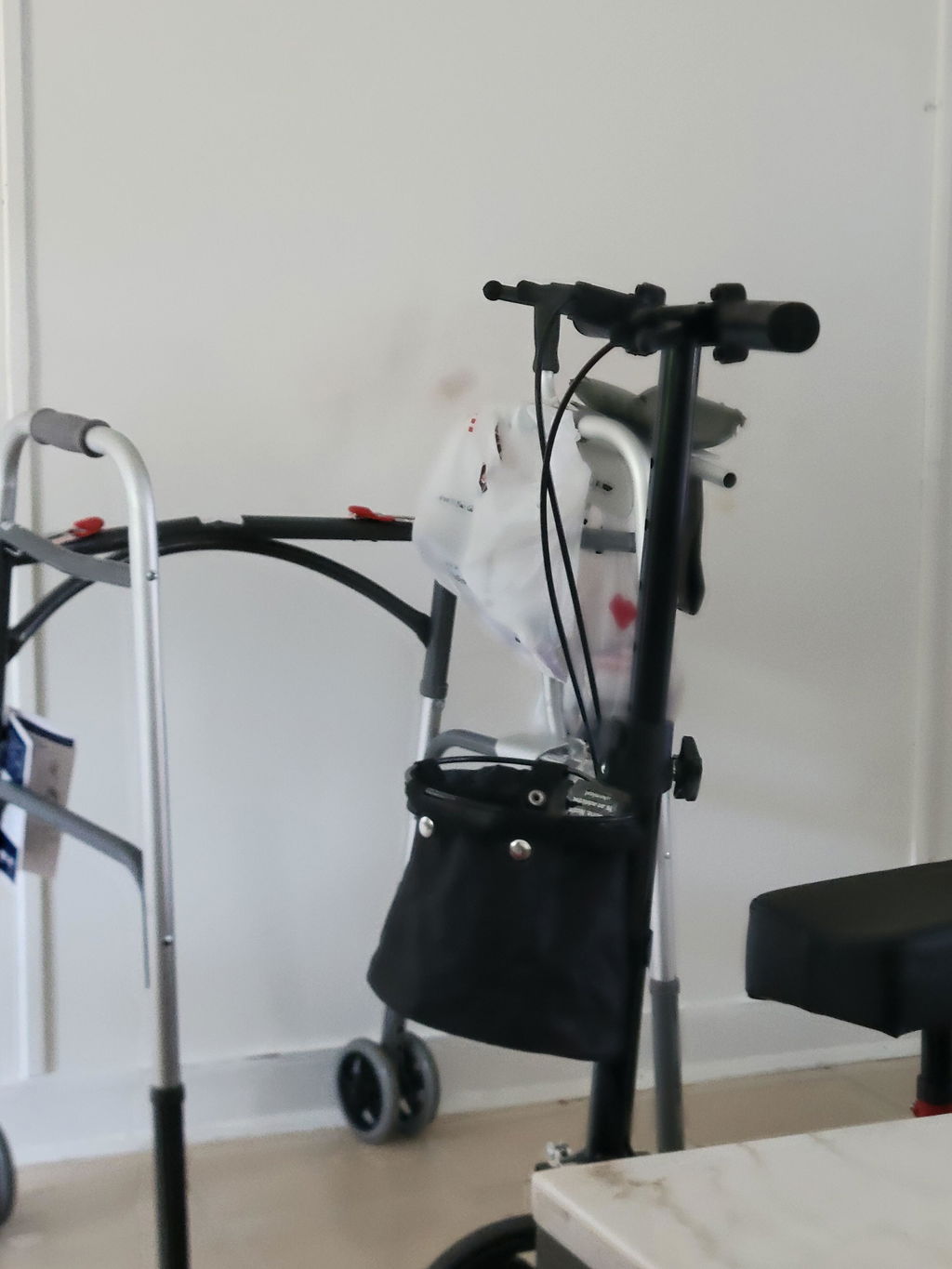
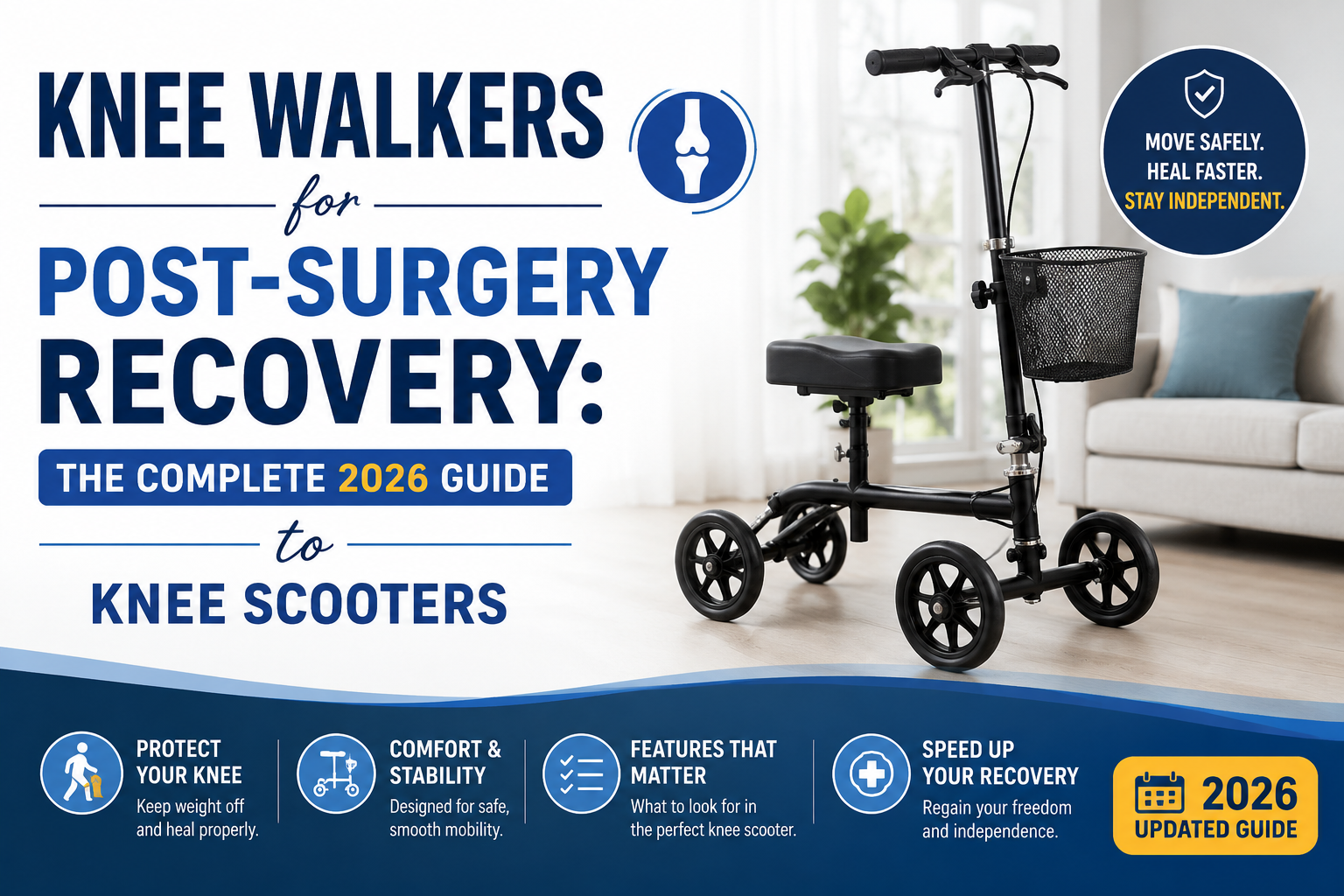
A knee walker (also called a knee scooter, knee cart, or leg caddy) is a wheeled mobility device built around one simple idea: instead of hopping on your good leg and hauling your body weight through your arms, you rest the shin of your injured leg on a padded platform and push yourself along with your healthy leg — like a child's scooter, but with four wheels, handlebars, and locking brakes.
The injured foot hangs freely behind the knee pad and never touches the ground. That satisfies a strict non-weight-bearing order while leaving both hands mostly free and your upper body completely out of the equation.
A typical knee walker has:
- A padded knee platform — height-adjustable, usually with a locking pin or knob, often tilting or offset for left/right leg use
- Four wheels — typically 7.5" to 8" indoors, 10" to 12" on all-terrain models
- Handlebars with hand brakes — usually a bicycle-style lever plus a parking brake that locks the rear wheels
- A steering column — either fixed (straight-line only) or steerable (turns like a scooter)
- A folding frame — most models fold flat for the car trunk or a closet
- A basket or bag — usually sold separately, and far more important than it sounds
Most weigh between 20 and 27 pounds and support 300 pounds of user weight, with bariatric models rated to 350–400 pounds. You can see the range across the scooters collection and the wider mobility products collection at AllCare Store.
Who a Knee Walker Is Right For
Knee walkers work when the injury is below the knee and the knee itself still bends comfortably to about 90 degrees. That covers a surprisingly large share of orthopedic recoveries:
- Foot and ankle fractures — metatarsal, calcaneus, Jones fracture, malleolar fractures
- Ankle surgery and ORIF (open reduction internal fixation) recovery
- Achilles tendon repair — one of the most common reasons people rent or buy one
- Bunionectomy and hammertoe correction
- Plantar fascia release and other forefoot procedures
- Severe sprains where the surgeon wants the joint fully offloaded
- Diabetic foot ulcers requiring strict offloading to allow healing
- Partial foot amputation recovery, in some cases
- Toe fractures and post-op toe procedures
Who Should Not Use One
This is the part people skip, and it's the part that sends people back to the emergency room. A knee walker is the wrong tool if:
- The injury is at or above the knee. Knee replacement, ACL repair, femur fracture, hip surgery — the device puts direct pressure on the exact structures that need protection. For those recoveries, see our knee replacement recovery guide instead.
- Both legs are affected. A knee walker requires one strong, reliable pushing leg.
- The knee won't bend to roughly 90 degrees comfortably, or bending it causes pain.
- Balance is significantly impaired — vertigo, uncorrected vision loss, Parkinson's-related instability, or a recent history of unexplained falls.
- Cognitive impairment makes it hard to remember to set the brake before mounting or dismounting. This is the single most common cause of knee-scooter falls.
- The home is all stairs. A knee walker cannot go up or down stairs, period.
- Upper-body strength is too limited to steer and brake safely with both hands.
If any of these apply, talk to your therapist about a walker or rollator, forearm crutches, or a wheelchair from the wheelchairs and accessories collection instead.
Knee Walker vs. Crutches: An Honest Comparison
Crutches are free at most hospitals and knee walkers are not, so the comparison deserves a straight answer rather than a sales pitch. Here is how they actually stack up in daily life:
| Factor | Knee Walker | Underarm Crutches |
|---|---|---|
| Upper-body strain | Minimal — legs do the work | High — shoulders, wrists, hands, armpits |
| Hands free to carry things | Yes, with a basket or bag | Essentially no |
| Energy cost of moving | Low — closer to normal walking | High — often several times normal walking |
| Stability | High on flat, smooth ground | Moderate; hopping is inherently unstable |
| Stairs | Cannot be used | Possible with training and a rail |
| Gravel, grass, uneven ground | Poor to fair (better on all-terrain models) | Fair |
| Narrow bathrooms and tight corners | Difficult — needs turning room | Easier |
| Nerve injury risk | Low | Real risk of "crutch palsy" if weight is borne in the armpit |
| Typical cost | $130–$400 to buy; $30–$60/week to rent | Often supplied free, or $25–$60 |
| Storage and transport | Folds, but bulky and 20–27 lbs | Light and easy to stash |
The honest verdict: most people recovering from a below-knee injury do better on a knee walker, and should keep a pair of crutches for the situations the scooter can't handle — stairs, tight bathrooms, a friend's house with a step at the front door. This is not an either/or decision. It's a primary tool and a backup tool.
If crutches are going to be your backup, it's worth setting them up properly. Our guide to adjustable crutches sizing and fitting covers the two-finger armpit gap rule that prevents most crutch-related nerve problems, and the crutches collection carries standard, bariatric, and youth sizes.
The Five Types of Knee Walkers
1. Standard Non-Steerable Knee Walkers
The front wheels are fixed, so the device only travels in a straight line — you turn by lifting and pivoting the front end. They are the least expensive option and perfectly adequate for a small apartment or a single floor of a house with wide, open pathways.
Best for: budget-conscious buyers, short recoveries, mostly-indoor use in open rooms.
Watch out for: frustration in kitchens, hallways, and anywhere you need to change direction repeatedly.
2. Steerable Knee Walkers
By far the most popular category and, for most people, the right one. The handlebars turn the front wheels, so you can navigate a hallway, curve around a kitchen island, or thread a doorway without stopping and repositioning. The Keep Me Moving Steerable Folding Knee Scooter by Blue Jay is a representative example — steerable, folding, with a locking brake system and adjustable knee platform.
Best for: almost everyone, especially anyone spending six weeks or more on the device.
Watch out for: a slightly higher price and a marginally larger folded footprint.
3. Economy and Value Models
Steerable function at a lower price point, usually by using lighter-gauge tubing, simpler brake hardware, and a basic knee pad. The Economy Steerable Knee Scooter sits in this bracket and is a sensible choice for a recovery measured in weeks rather than months.
Best for: four-to-eight week recoveries, lighter users, indoor-dominant use.
Watch out for: thinner knee padding — budget for an aftermarket pad if you'll be on it all day.
4. All-Terrain Knee Walkers
Larger 10"–12" pneumatic or semi-pneumatic tires, longer wheelbase, beefier suspension. These handle gravel driveways, packed dirt, grass, sidewalk cracks, and thresholds that would stop a standard model dead.
Best for: rural and suburban homes, anyone who works outdoors, dog owners, people with a long or uneven walk from the driveway.
Watch out for: weight (often 27+ lbs), a wider turning circle, and tires that may need occasional inflation.
5. Bariatric and Heavy-Duty Knee Walkers
Reinforced frames rated to 350–400 pounds, wider knee platforms, and stronger braking hardware. If you're near the 300-pound limit of a standard model, size up — an overloaded frame flexes under you exactly when you need it not to. The same logic we cover in our bariatric walker buying guide applies here.
How to Fit a Knee Walker Correctly
An incorrectly fitted knee walker doesn't just feel awkward — it produces hip pain, lower back pain, and a tilted gait that can leave you with a second problem after the first one heals. Fitting takes about five minutes.
Step 1: Set the Knee Platform Height
Stand next to the walker in the shoes you'll actually wear (or the surgical boot on the injured side — this matters, because a boot adds height). Place the injured shin on the pad. When you're set up correctly:
- Your hips are level — one is not visibly higher than the other
- Your thigh on the injured side hangs vertically, not angled forward or back
- Your knee is bent at roughly 90 degrees
- Your standing leg is flat on the floor without stretching or bending
- Your back is upright, not leaning forward or hunched to one side
If you find yourself tipping your pelvis to reach the ground with your good foot, the pad is too high. If your good knee is bent to reach the floor, it's too low.
Step 2: Set the Handlebar Height
Handlebars should sit around hip-to-waist height so your elbows have a slight, relaxed bend and your shoulders stay down. Bars set too low pull you into a forward hunch; too high and you lose leverage on the brakes.
Step 3: Check Knee Pad Position
Your kneecap should be behind the front edge of the pad, with the weight through your shin — not balanced on the kneecap itself. Many pads offset or tilt to accommodate left versus right leg use; take the time to set this before your first outing.
Step 4: Test the Brakes Before You Move
Squeeze the hand brake. Engage the parking brake and try to push the walker — it should not roll. Do this every single time before you mount or dismount. If you build only one habit from this article, build that one.
Safe Technique: The Habits That Prevent Falls
- Brake first, then mount. Lock the parking brake, place the injured shin on the pad, then take hold of the handlebars. Reverse the order to dismount.
- Push with the whole foot, not just the toes. Short, controlled pushes give better control than long powerful ones.
- Slow down before turning. Knee walkers can tip sideways on a fast turn, especially on a slope or a threshold.
- Approach thresholds and door sills straight on, never at an angle.
- Keep both hands on the bars while moving. Use the basket for anything you're carrying.
- Never use it on stairs, escalators, or steep ramps. Sit down and go up on your bottom if you must, or use crutches with a handrail.
- Watch for wet floors, loose rugs, and cords. Small front wheels stop hard on things a shoe would step over. Rolling up area rugs for the duration of your recovery is one of the highest-value ten-minute jobs you can do.
- Wear a non-slip sock or shoe on the pushing foot. The non-slip socks guide covers why grip on your one working foot matters more than usual right now.
What It Costs — and Whether Insurance Helps
| Option | Typical 2026 Cost | Makes Sense When |
|---|---|---|
| Economy steerable (buy) | $130–$170 | 4–8 week recovery, indoor use |
| Standard steerable (buy) | $180–$260 | Most recoveries — best overall value |
| All-terrain (buy) | $260–$400+ | Outdoor use, uneven ground, longer recoveries |
| Bariatric / heavy-duty (buy) | $250–$450 | User weight near or above 300 lbs |
| Rental | $30–$60/week or $100–$160/month | Recovery of 3 weeks or less |
The math is usually straightforward: if your non-weight-bearing period is longer than about four to five weeks, buying costs less than renting — and you keep the device, which matters more than people expect. Foot and ankle injuries recur, and adult children and neighbors borrow them constantly.
On insurance: Medicare generally classifies knee scooters as convenience items rather than covered durable medical equipment, so Part B typically will not pay for one, even though it does cover standard walkers and crutches. Some private insurance plans and workers' compensation claims do reimburse them, and knee walkers are usually an eligible expense under an HSA or FSA. Coverage rules change and vary by plan, so call the number on your insurance card and ask specifically about coverage for a knee walker before you assume either way. Keep your receipt and your surgeon's written order either way — you'll need both for any reimbursement route.
Accessories That Genuinely Change the Experience
Most knee walkers ship bare. These are the add-ons that regular users say they wouldn't go without:
- A basket or carry bag. This is the single highest-value accessory, full stop. Without it you cannot move a cup of coffee, a phone, a book, or a plate from one room to another, and the whole "hands free" advantage evaporates. The Hold My Stuff Personal Carry Bag for Knee Scooters is designed to attach to standard handlebars.
- A thicker knee pad or memory-foam cover. By week three, the stock pad on an economy model will start to feel like a park bench. A plush cover is the cheapest comfort upgrade available.
- A cup holder. Sounds trivial. Is not trivial.
- Replacement brake cables and hardware. Brake cables stretch with use. A replacement hand brake with cable for steerable knee walkers is an inexpensive fix that restores full braking rather than replacing the whole unit. Browse the mobility accessories and parts collection for wheels, tips, pins, and pads.
- A cast or boot cover for showering. Keeping the surgical site dry is non-negotiable, and a wet cast means an unplanned trip back to the clinic.
Setting Up Your Home Before Day One
The best time to prepare a house for a knee walker is before the surgery, not after. If you're reading this with a procedure on the calendar, this section is the most useful thing on the page.
Clear the Paths
Measure your narrowest doorway and tightest turn. Most knee walkers need roughly 24–28 inches of clearance and a bit of room to swing. Roll up throw rugs, move cords, relocate the coffee table, and clear a straight run from bed to bathroom to kitchen.
Solve the Bathroom Early
The bathroom is where knee-walker recoveries go wrong. It's tight, it's wet, and it's where you have to dismount. Plan for a transfer bench or shower chair, install grab bars if you don't have them, and add a non-slip mat. The bathing supplies collection and bedroom and bathroom safety collection cover most of what's needed.
Decide the Sleeping Question
If your bedroom is upstairs and your bathroom is downstairs, sort that out on day zero rather than day four. A temporary downstairs sleeping setup is far safer than nightly stair negotiations on one leg in the dark.
Stage Your Supplies
Put a water bottle, phone charger, medications, tissues, and a grabber tool at every place you'll sit for more than ten minutes. Every trip you don't have to make is a fall you don't have to risk.
Plan the Car
Practice folding the walker before you need to. Most fold in under thirty seconds once you've done it twice, and discovering the release mechanism for the first time in a parking lot in the rain is a bad experience.
Living With a Knee Walker: What Nobody Tells You
Your good leg will get tired — and then strong. The first three or four days, the pushing leg does unfamiliar work and complains about it. That fades. What doesn't fade is the muscle asymmetry that builds over six or eight weeks, which is one reason your therapist will want you doing seated exercises for the resting leg.
Your back may protest before your legs do. Almost always a fit problem. Revisit the knee pad height and handlebar height before you accept back pain as part of the deal.
Swelling is normal; sudden swelling is not. Elevation still matters even though you're mobile. Keep the injured leg up when you're seated, and use cold therapy as directed — our guide to cold therapy for swelling and inflammation covers timing and safe application. New one-sided calf pain, warmth, or dramatic swelling warrants a same-day call to your doctor.
Compression is often part of the plan. Many surgeons prescribe compression to manage swelling and reduce clot risk during a long non-weight-bearing period. See our compression stockings guide and ask your surgeon what level they want.
Dressing gets weirdly hard. Pulling on pants over a surgical boot while balanced on one leg is a genuine daily obstacle. Easy on/off shoes for the good foot and loose-legged pants remove a lot of daily friction.
The transition back is its own phase. When your surgeon clears partial weight-bearing, you don't step off the scooter and walk. Most people move to a walker or rollator for a few weeks, then to a cane, then to nothing. Planning that ladder in advance keeps you from improvising with furniture.
Maintenance: Ten Minutes a Week
- Wipe the wheels weekly. Hair, grit, and carpet fibers wrap around the axles and cause drag and pulling.
- Check the brake pull. If the lever comes closer to the grip than it did in week one, the cable has stretched and needs adjusting.
- Confirm the locking pins are fully seated after every height adjustment and every fold.
- Check tire pressure on pneumatic all-terrain models.
- Inspect the knee pad for tears or compressed foam, and replace it when it flattens out.
- Tighten the handlebar and steering column bolts monthly — vibration loosens them.
Why Shop Mobility Equipment at AllCare Store
AllCare Store carries knee scooters, walkers, rollators, crutches, canes, wheelchairs, and the replacement parts that keep all of them working — including the small pieces (brake cables, wheels, pins, tips, pads) that most retailers don't bother stocking. Everything ships free within the U.S. in discreet packaging, with 30-day returns.
If you're not sure which category fits your situation, the fastest route is a phone call. Our team talks to people in exactly this position every day and can tell you in a few minutes whether a knee walker, a rollator, or a transport chair is the right answer for your specific injury and home layout.
Start with the scooters collection, the walkers and rollators collection, the crutches and canes collection, or the post-op shoes and walker boots collection.
Frequently Asked Questions
Is a knee walker better than crutches?
For most below-knee injuries, yes — it's less tiring, easier on your hands and shoulders, more stable, and it lets you carry things. Crutches remain better for stairs, tight bathrooms, and very short distances, which is why many people keep both.
Can I use a knee walker after knee replacement surgery?
No. A knee walker puts direct pressure on the knee and shin, which is exactly what a replaced or repaired knee needs to avoid. Knee replacement recovery normally uses a walker, then a cane.
How long does it take to get comfortable on one?
Most people feel reasonably confident within 15–30 minutes and fully natural within two or three days. Practice indoors on a smooth floor with someone nearby before your first outing.
Can I use a knee walker on stairs?
Never. Have someone carry the walker up or down separately, or keep a second unit on each floor if you'll be moving between levels regularly. Many people sit and go up stairs on their bottom during recovery.
What weight can a knee walker hold?
Standard models are typically rated to 300 pounds. Bariatric and heavy-duty models generally support 350–400 pounds. Always check the specific model's stated capacity and choose one with margin rather than one you're near the limit of.
How tall do I need to be to use one?
Most adult knee walkers fit users roughly 4'8" to 6'6". Very tall and very short users should check the knee-pad adjustment range on the specific model, and shorter users may need a junior or petite frame.
Does Medicare pay for a knee scooter?
Generally no — Medicare typically treats knee scooters as convenience items rather than covered durable medical equipment, though it does cover standard walkers and crutches. Some private plans and workers' compensation claims do reimburse, and they're usually HSA/FSA eligible. Call your plan to confirm before purchasing.
Should I rent or buy?
Rent for recoveries under about three weeks; buy for anything longer. At typical rental rates, four to five weeks of renting costs about the same as buying a good steerable model outright.
Can I use a knee walker outside on grass or gravel?
Standard models with small wheels struggle badly on anything but pavement. If you need to cross grass, gravel, or broken sidewalk regularly, buy an all-terrain model with 10"–12" tires — retrofitting isn't practical.
Which leg goes on the pad?
The injured leg rests on the pad; the healthy leg does the pushing. Most quality models let you switch the pad's offset so it's comfortable for either a left or a right injury.
Can I take a knee walker on a plane?
Usually yes. Most airlines allow mobility devices to be gate-checked at no charge, and folding models fit standard checked-baggage handling. Call the airline in advance and ask about gate-checking so you can use it through the terminal.
My knee hurts after a few days on the scooter. Is that normal?
Mild pad soreness is common; sharp knee pain is not. Sharp pain usually means your kneecap is bearing weight instead of your shin, or the pad height is wrong. Recheck the fit, add a cushioned pad cover, and if it persists, call your therapist.
The Takeaway: The Right Tool Makes a Hard Six Weeks Survivable
A knee walker doesn't heal anything. Your bone, tendon, or surgical site will take exactly as long as it takes, and no piece of equipment changes that timeline.
What it changes is everything around the timeline — whether you can get your own breakfast, whether you can keep working from home, whether you spend six weeks feeling capable or six weeks feeling trapped in one room. For anyone facing a non-weight-bearing order below the knee, that's not a small thing.
Get the fit right on day one. Buy the basket. Clear the rugs. Keep the crutches for the stairs. And ask your surgeon or therapist to watch you use it once before you're on your own with it.
Ready to Get Moving Again? We Can Help.
AllCare Store stocks steerable, economy, all-terrain, and heavy-duty knee scooters along with the accessories and replacement parts that keep them rolling. Explore the scooters collection, the mobility products collection, and the mobility accessories and parts collection to get started.
MEDICAL DISCLAIMER: This article is for informational purposes only and is not a substitute for professional medical advice, surgical aftercare instructions, or a physical therapy evaluation. Whether a knee walker is safe for you depends on your specific injury, your weight-bearing status, your balance, and your surgeon's orders. Always follow the written instructions from your surgeon or physician, and ask your physical or occupational therapist to check your fit and technique before you rely on any mobility device. If you experience new numbness, increasing swelling, calf pain, fever, or a sudden change in your ability to move the injured limb, seek medical attention promptly.
Call 1-888-889-6260 to speak with a specialist about which model fits your injury, your height, and your home, or visit AllCareStore.com to browse the full product line. Free U.S. shipping, discreet packaging, and 30-day returns on every order.
This guide was written and reviewed by the AllCare Store editorial team. For personalized medical advice, always follow your surgeon's written instructions and consult your physician or licensed physical therapist.