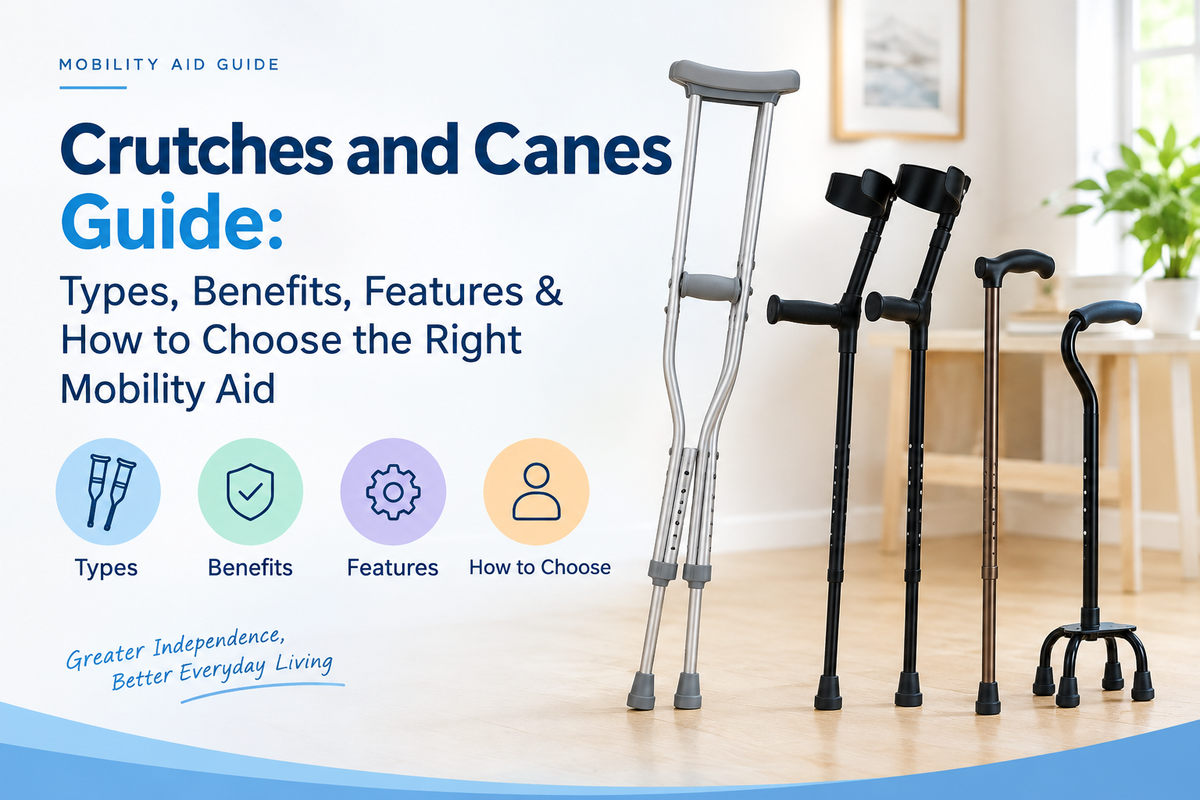
Choosing the right mobility aid can make everyday walking more manageable and provide additional support during recovery or when balance and mobility are limited. Crutches and canes are two common mobility aids, but they are designed for different levels and types of support.
A walking cane can provide an additional point of balance and stability, while crutches can be used when a person needs to reduce or avoid putting weight on a lower extremity. The right choice depends on factors such as walking ability, balance, strength, weight-bearing instructions, hand function, and where the device will be used.
This complete guide explains the different types of crutches and canes, important features to compare, fitting considerations, safety tips, and how to choose the right option for everyday mobility.
Crutches vs Canes: At a Glance
| Feature | Crutches | Canes |
|---|---|---|
| Primary purpose | Support during walking and weight-bearing limitations | Balance and walking support |
| Support level | Generally greater than a standard cane | Generally lighter support |
| Common types | Forearm crutches, underarm crutches | Single-point cane, quad cane, tripod cane |
| Weight distribution | Through hands/arms and crutch structure | Primarily through the hand and cane tip |
| Mobility requirements | Requires adequate upper-body control | Requires ability to grip and control the cane |
| Portability | Folding/adjustable models available | Many compact and folding models |
| Best for | Depending on clinical need and weight-bearing status | Balance support or mild mobility assistance |
| Fitting | Important | Important |
There is no single mobility aid that works for everyone. A healthcare professional or physical therapist can help determine which device and fit are appropriate for an individual's needs.
What Are Crutches?
Crutches are mobility aids designed to help support a person while walking. Depending on the type and the user's instructions, crutches can help reduce the amount of weight placed on one or both legs.
They are commonly used during temporary recovery periods as well as for longer-term mobility needs.
Common crutch types include:
- Forearm crutches
- Underarm crutches
- Adjustable crutches
- Bariatric crutches
- Pediatric crutches
- Folding or travel crutches
The appropriate crutch depends on the user's mobility requirements, body dimensions, weight-bearing instructions, strength, and intended duration of use.
What Are Forearm Crutches?
Forearm crutches, sometimes called elbow crutches, have a cuff that fits around the forearm and a handgrip for support.
Compared with traditional underarm crutches, the forearm design allows the user to hold the handgrip while the forearm cuff helps maintain the relationship between the arm and crutch.
They are available in adjustable configurations and can be used for different mobility requirements. Proper fitting remains important for comfort and safe operation.
What Are Underarm Crutches?
Underarm crutches, also known as axillary crutches, have a padded support positioned below the armpit and a handgrip.
These adjustable crutches are commonly associated with short-term mobility needs, including periods when a person has been instructed to limit weight-bearing on a leg.
Proper height adjustment and technique are important. The crutch should not simply be selected based on height alone; appropriate fitting should follow the manufacturer's instructions and professional guidance when needed.
What Is a Walking Cane?
A walking cane is a mobility aid that provides an additional point of support while walking.
Canes are available in several designs, including:
- Single-point cane
- Quad cane
- Tripod cane
- Adjustable cane
- Folding cane
- Offset cane
- Cane with seat
- Ergonomic-handle cane
- Bariatric cane
A cane can be useful when someone needs additional balance or walking support but does not require the broader support of a walker or wheelchair. Mayo Clinic notes that a single-tip cane works well for many users, while a quad cane provides a broader base but can be heavier and somewhat harder to handle.
Types of Canes
1. Single-Point Cane
A single-point cane has one tip at the bottom of the shaft.
It is a common choice for people who need a relatively small amount of additional support while walking.
Features may include:
- Adjustable height
- Rubber cane tip
- Contoured or ergonomic handle
- Lightweight shaft
- Different handle styles
2. Quad Cane
A quad cane has four contact points at its base, creating a broader support area than a single-point cane.
A four-point cane can provide additional stability, although the wider base may make it somewhat more difficult to maneuver in certain situations.
Quad canes may be available in:
- Small-base designs
- Large-base designs
- Adjustable-height models
- Offset-handle configurations
3. Tripod Cane
A tripod cane has three contact points at the base.
It can provide more support than a standard single-point cane while maintaining a relatively compact design.
4. Folding Cane
A folding cane is designed to collapse into a smaller size for storage and transportation.
A foldable walking cane may be useful for:
- Travel
- Shopping
- Keeping in a vehicle
- Occasional use
- Compact home storage
Some folding canes come with carrying cases.
5. Adjustable Cane
An adjustable cane allows the height to be modified to better fit the user.
Height adjustment is an important consideration because an improperly sized cane can affect posture, balance, and comfort. Mayo Clinic recommends checking wrist height and maintaining a comfortable elbow bend when fitting a cane.
6. Cane With Seat
A cane with seat combines walking support with a small fold-out seat.
This type of cane may be useful for people who want a place to sit during short rest breaks. Because the seat and base design vary by product, always follow the manufacturer's instructions regarding use and weight capacity.
7. Ergonomic Cane
An ergonomic cane features a handle designed to improve grip comfort and reduce pressure on the hand.
Handle styles can include:
- Contoured grips
- Offset handles
- Larger grips
- Soft-touch materials
A comfortable grip is especially important when the cane is used frequently. Mayo Clinic notes that grip shape and size should suit the user's hand.
Crutches vs Canes: Which Provides More Support?
Generally, crutches can provide more support than a basic single-point cane because they involve the upper limbs and can be used when a person needs to reduce weight placed on a lower extremity.
A cane generally provides a smaller amount of support and is commonly used for balance or mild walking assistance.
However, the right device is determined by the individual's mobility requirements rather than simply choosing the device with the most support.
MedlinePlus recommends considering factors such as the user's strength and balance when choosing mobility aids and notes that some devices require appropriate fitting.
How to Choose Between Crutches and Canes
Consider these questions before selecting a mobility aid.
1. How Much Support Do You Need?
If you need only an additional point of balance, a walking cane may be considered.
If you have specific weight-bearing restrictions or need more upper-body support, crutches may be appropriate when recommended for your situation.
2. Can You Grip and Control the Device?
Both canes and crutches require sufficient hand and arm control.
If gripping a conventional handle is difficult, specialized handle or forearm-support designs may be worth discussing with a healthcare professional.
3. Do You Need to Reduce Weight on a Leg?
If you have been instructed to avoid or limit weight on a leg, a cane may not provide the level of support you require.
In these situations, follow the weight-bearing instructions provided by your healthcare professional and use the prescribed mobility aid correctly.
4. How Long Will You Use the Device?
For short-term recovery, an adjustable device can provide flexibility as mobility changes.
For long-term use, comfort, grip design, durability, fit, and replacement components become increasingly important.
How to Choose the Right Cane
When comparing walking canes, consider the following:
Cane Height
The cane should be properly fitted to the user.
Mayo Clinic recommends that the top of the cane align around the wrist crease when the arm hangs naturally, with a comfortable bend at the elbow when holding the handle.
Handle Design
Compare:
- Standard handle
- Crook handle
- Ergonomic handle
- Offset handle
- Larger grip
Choose a handle that allows comfortable control.
Cane Base
Consider whether you need:
- Single tip
- Tripod base
- Quad base
A multi-point base can provide a broader support area but may be less convenient to maneuver than a single-point cane.
Cane Weight
A lightweight cane can be convenient for daily use and travel, but it should still have appropriate strength and weight capacity for the intended user.
Cane Tip
The cane tip is an important contact point with the floor.
Inspect it regularly for wear, cracking, stiffness, or loss of tread. Replace worn tips as recommended.
How to Choose the Right Crutches
When shopping for crutches, consider:
- Crutch height
- Handgrip height
- Forearm cuff position
- Weight capacity
- Adjustability
- Grip material
- Crutch tip design
- Overall weight
- Indoor/outdoor use
- Replacement parts
For forearm crutches, make sure the cuff and handgrip are appropriately positioned.
For underarm crutches, proper adjustment and technique are particularly important.
Crutch Tips: Why They Matter
Crutch tips provide the contact between the crutch and the walking surface.
A worn or damaged tip can affect traction and stability.
Check your crutch tips regularly for:
- Excessive wear
- Cracks
- Hardening
- Uneven surfaces
- Missing sections
Replace them when needed with compatible replacement tips.
The same principle applies to cane tips. Mayo Clinic describes the rubber tip as an important traction component and recommends checking it periodically.
Adjustable Crutches and Canes
Adjustable crutches and adjustable canes can be useful because they allow users to modify the device's height.
Benefits can include:
- Better fit
- Easier transportation
- Flexible positioning
- Accommodation for different users in some settings
- Convenient storage
However, adjustment should always follow the product's instructions. An incorrectly adjusted mobility aid may be uncomfortable or unsafe.
Crutches and Canes for Travel
If you plan to travel with a mobility aid, portability becomes important.
Look for:
- Folding cane
- Compact adjustable cane
- Lightweight crutches
- Collapsible designs
- Carrying cases
- Replaceable tips
Before flying, check the airline's current procedures for mobility equipment.
For car travel, compare the folded dimensions with your available storage space.
Crutches and Canes for Seniors
Canes for seniors can provide additional balance and walking support when appropriately fitted.
Common options include:
- Walking cane
- Quad cane
- Adjustable cane
- Ergonomic cane
- Cane with seat
The appropriate device depends on the person's strength, balance, walking ability, hand function, and environment.
If someone has significant balance problems or difficulty controlling a cane, a different mobility aid may be more appropriate. A healthcare professional can help assess the person's needs.
Cane Safety Tips
Using a cane correctly is important.
Use the Appropriate Side
For many users, a standard cane is held on the side opposite the affected leg. Mayo Clinic provides this as a general walking technique, while individual instructions may differ.
Check the Height
An improperly adjusted cane can affect posture and balance.
Inspect the Tip
Replace worn or damaged cane tips.
Use Handrails on Stairs
When available, use an appropriate handrail along with the cane according to your healthcare professional's instructions.
Keep the Path Clear
Remove obstacles such as loose rugs, clutter, and cords where possible.
Crutch Safety Tips
When using crutches:
- Make sure they are properly adjusted.
- Follow prescribed weight-bearing instructions.
- Keep crutch tips in good condition.
- Wear appropriate footwear.
- Take extra care on wet or uneven surfaces.
- Use handrails where available.
- Follow the walking technique taught by your healthcare professional.
- Inspect the frame, handgrips, cuffs, and tips regularly.
If you are unsure how to use your crutches, ask a physical therapist or other qualified healthcare professional for instruction.
Common Mistakes When Buying Canes and Crutches
Choosing the Wrong Height
An improperly fitted mobility aid can affect posture and comfort.
Selecting Based Only on Appearance
Features such as adjustability, grip design, base type, weight capacity, and tip construction are more important than appearance alone.
Ignoring Weight Capacity
Always verify the manufacturer's weight capacity.
Using a Worn Cane Tip
A damaged or worn tip should be replaced.
Choosing a Cane When More Support Is Needed
A single-point cane is not appropriate for every mobility situation. If more support is required, discuss other mobility options with a healthcare professional.
Not Considering the Environment
Think about whether the device will be used on:
- Hardwood
- Tile
- Carpet
- Concrete
- Sidewalks
- Ramps
- Stairs
- Outdoor surfaces
Frequently Asked Questions About Crutches and Canes
What is the difference between crutches and a cane?
Crutches generally provide more support and can be used to reduce weight placed on a lower extremity when appropriate. A cane generally provides an additional point of balance and walking support.
Which is better, crutches or a cane?
There is no single option that is appropriate for everyone. The choice depends on walking ability, balance, strength, weight-bearing requirements, hand function, and the intended environment.
What are forearm crutches?
Forearm crutches are crutches with cuffs that support the forearm along with handgrips. They are also commonly called elbow or Lofstrand-style crutches.
What are underarm crutches?
Underarm crutches have padded supports positioned below the armpit and handgrips for the user. They are commonly adjustable to accommodate different heights.
What is the most common type of walking cane?
A single-point cane is a common type of walking cane. It has one contact point at the bottom and is designed to provide an additional point of support while walking.
Are quad canes more stable than single-point canes?
A quad cane has four contact points and provides a broader base of support than a single-point cane. However, it can also be heavier and more difficult to maneuver.
What is an adjustable cane?
An adjustable cane allows the shaft height to be modified to fit the user. Proper height is important for comfortable and effective use.
Are folding canes good for travel?
A folding cane can be convenient for travel because it can collapse into a smaller size for storage. Check the product's weight capacity and folded dimensions before purchasing.
What is a cane with a seat?
A cane with seat combines a walking support with a small fold-out seat for resting. Always check the manufacturer's instructions and weight capacity before using the seat.
How high should a cane be?
A general fitting starting point is to position the cane handle around the wrist crease when standing naturally, with a comfortable slight bend in the elbow while holding it. Individual fitting may vary, so professional guidance can be useful.
How often should cane tips be replaced?
There is no universal replacement interval. Inspect the cane tip regularly and replace it when the tread is worn, cracked, hardened, or otherwise damaged.
Can I use crutches for long-term mobility?
Some people use forearm crutches for longer-term mobility, while others use crutches temporarily. The appropriate device depends on the individual's mobility requirements and ability to use the device safely.
Crutches and Canes Buying Checklist
Before purchasing, compare:
- Mobility needs
- Walking ability
- Balance support
- Weight-bearing requirements
- Crutch or cane height
- Weight capacity
- Handle design
- Grip comfort
- Cane base
- Forearm cuff
- Crutch tips
- Cane tips
- Adjustability
- Folding capability
- Product weight
- Intended environment
Final Thoughts
Choosing between crutches and canes starts with understanding the amount and type of support required. A walking cane, quad cane, or adjustable cane may provide useful balance and walking support, while forearm crutches and underarm crutches can provide a different level of assistance when weight-bearing needs require it.