DISCLAIMER: This article is for informational and educational purposes only and does not constitute medical advice. If you are experiencing significant difficulty walking, balance problems, or recovering from a stroke, fall, or orthopedic surgery, consult your physician or a physical therapist before selecting a mobility aid. A physical therapist can perform a formal gait assessment and recommend the right device for your specific condition.
Why the Right Cane Makes a Real Difference
A walking cane is one of the simplest, most cost-effective mobility aids available — and one of the most frequently misused. Many people pick up whatever cane is cheapest or most readily available without considering height, tip type, or handle design. The result is a device that offers little actual support and may even increase fall risk by encouraging an awkward, unbalanced gait.
Done right, a properly fitted cane can reduce the load on an arthritic or painful joint by 20–30%, meaningfully improve walking stability, extend independent living, and reduce fear of falling — a critical factor in senior quality of life. This guide covers everything you need to choose the right cane in 2026, from cane types and handle styles to proper height fitting and walking technique.
Who Needs a Cane — and When a Walker Might Be Better
A cane is appropriate when you need mild to moderate support on one side of the body. Common indications include mild arthritis in one hip, knee, or ankle; mild balance problems or occasional unsteadiness; recovery from a lower-limb injury or minor surgery; mild weakness on one side from a stroke or neurological condition; or general fatigue or confidence issues when walking on uneven surfaces or for extended distances.
A cane is generally not sufficient when you need support on both sides, have significant weakness or instability, have had multiple falls, or are recovering from major hip or knee replacement surgery. In those situations, a walker or rollator provides substantially more support and is the safer choice. If you are unsure which device is appropriate, a single session with a physical therapist can prevent months of using the wrong tool.
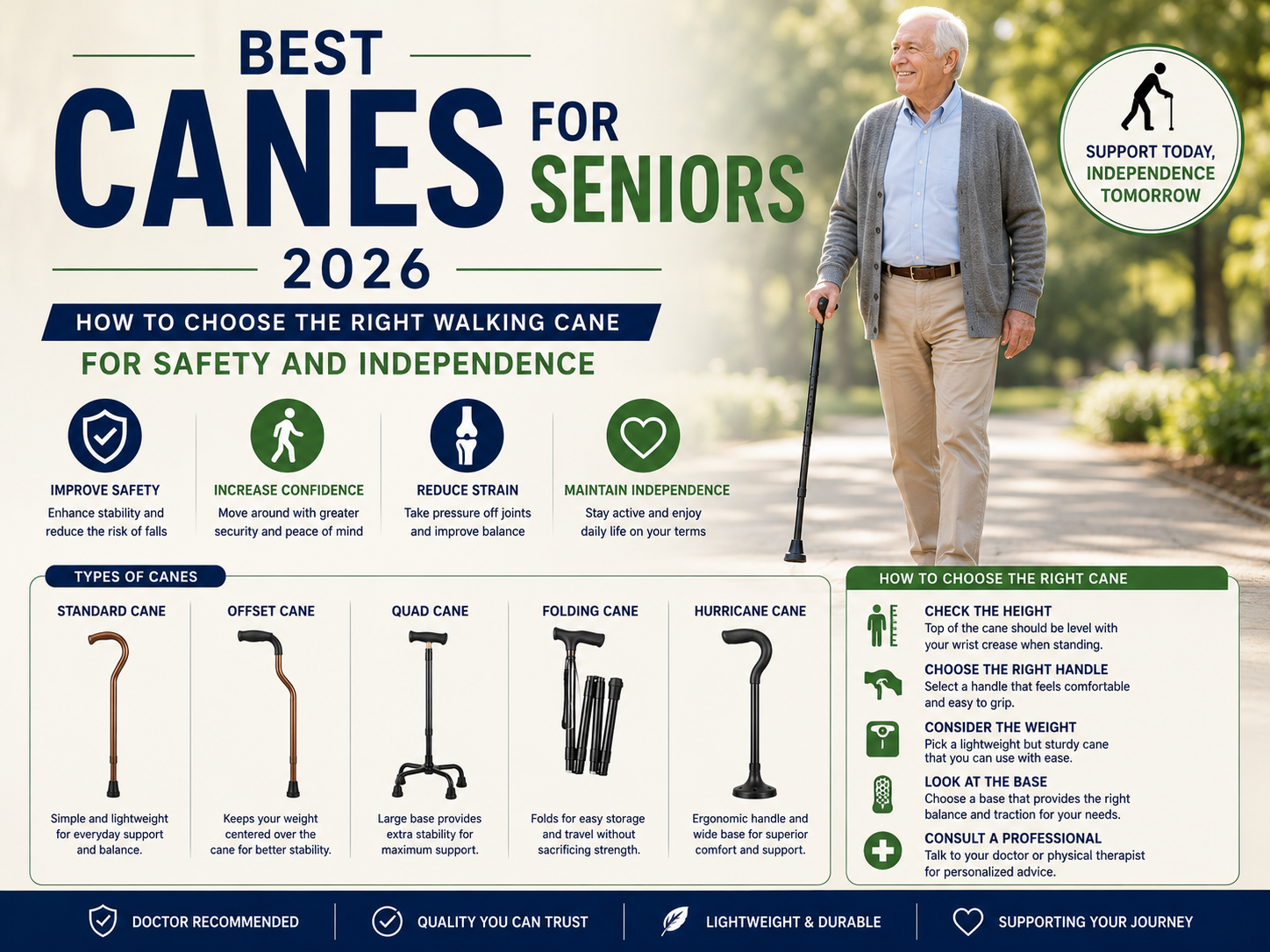
Types of Walking Canes: A Practical Guide
1. Standard Single-Tip Cane
The classic aluminum or wood single-tip cane is the lightest, most portable, and most widely used option. A rubber tip at the bottom provides grip and shock absorption. Standard canes are best for people who need minimal support — primarily for confidence, mild joint unloading, or occasional assistance on uneven terrain. They require good grip strength and upper body strength to use effectively.
Best for: Mild balance concerns, mild arthritis, confidence when walking outdoors, people who are active and need a lightweight option.
Limitations: Less stable than multi-tip options; requires grip strength; not suitable for significant weight-bearing support.
2. Offset Handle Cane
Offset canes (also called ergonomic or ortho canes) have a handle that is set slightly forward over the cane shaft rather than directly on top. This shifts your center of gravity over the cane's base of support, allowing you to put significantly more weight through the cane without strain on the wrist and forearm. The offset design also reduces wrist deviation, making them substantially more comfortable for people with arthritis in the hands or wrists who need to lean on the cane for real weight-bearing support.
Best for: People who need moderate weight-bearing support; arthritis in the hands, wrists, or thumb joints; anyone who experiences wrist discomfort with a standard cane.
3. Quad Cane (Four-Point Cane)
Quad canes have a base that splits into four small feet, providing a substantially larger footprint and the ability to stand independently without being held. This makes them significantly more stable than single-tip canes — a quad cane offers roughly 50% more base of support than a standard cane, making them appropriate for moderate to significant balance impairment, one-sided weakness after a stroke, or situations where you frequently need to pause and release the cane momentarily.
The tradeoff is weight (quad canes are heavier than single-tip) and gait rhythm — the wider base requires a slightly modified walking pattern that can slow pace. They are available in narrow-base (better for walking speed) and wide-base (maximum stability) configurations.
Best for: Stroke recovery with significant one-sided weakness, moderate balance impairment, situations where the cane needs to stand on its own, individuals transitioning from a walker back to a cane.
4. Folding / Collapsible Cane
Folding canes collapse into a compact size for easy storage in a bag or car. Most use an elastic cord system (similar to tent poles) that maintains rigidity when extended. They are highly convenient for travel, public transit, shopping, and any situation where the cane needs to be stowed intermittently. Most folding canes are single-tip, though quad folding canes also exist.
Best for: Travelers, people who only need the cane part-time, active seniors who want convenience; those who alternate between using and not using a cane throughout the day.
Note: Folding canes are slightly less rigid than non-folding models. They are not recommended as a primary weight-bearing aid for people who rely heavily on the cane for support.
5. Seat Cane (Cane with Built-In Seat)
Seat canes — also called shooting sticks or folding seat canes — incorporate a small fold-out seat into the cane's handle or base. This allows the user to rest briefly in situations where seating is unavailable: outdoor events, museum visits, long queues, or transit platforms. They are not suitable as a primary walking aid for anyone with significant balance problems (the seat adds weight and slightly reduces stability) but offer a meaningful quality-of-life benefit for people who tire easily or need frequent short rests.
6. Ice Cane Tips and All-Terrain Attachments
Standard rubber tips become dangerously slippery on ice, wet surfaces, and polished floors. Ice tips — which deploy retractable metal spikes similar to a trekking pole — are an essential seasonal accessory for anyone who walks outdoors in winter climates. Pirouette tips (multi-point tips that attach over a standard cane tip) increase grip on soft or uneven ground. These attachments can convert a standard cane into a safer multi-season tool without replacing the entire device.
Handle Types and Ergonomics
The handle is where all load transfer happens, and the wrong handle can cause or exacerbate hand, wrist, and shoulder pain.
| Handle Type | Best For | Notes |
|---|---|---|
| Derby / Crook handle | Light support, hanging on arm or over furniture | Classic look; poor ergonomics for heavy weight-bearing |
| T-handle | Moderate support, general use | Good balance between comfort and weight-bearing; widely available |
| Offset / Ergonomic handle | Moderate-heavy weight-bearing; arthritis in hand/wrist | Distributes weight best; reduces wrist strain significantly |
| Fritz / Palm-grip handle | Arthritis; weak grip; moderate support | Wide, flat surface distributes pressure across palm; very comfortable for arthritic hands |
| Gel-padded handle | Prolonged use; sensitive hands | Added cushioning reduces pressure points during extended walks |
How to Fit a Cane Correctly: Step-by-Step
An incorrectly fitted cane is at best ineffective and at worst actively harmful. The standard fitting method:
Step 1: Wear your everyday shoes (the ones you typically walk in). Cane height depends partly on shoe sole thickness.
Step 2: Stand up straight with your arms relaxed at your sides.
Step 3: Measure wrist height. The top of the cane handle should align with the crease of your wrist when your arm hangs naturally at your side. This usually corresponds to the level of the greater trochanter (hip bone prominence) on the outer thigh.
Step 4: Check elbow angle. When you hold the cane, your elbow should be slightly bent — approximately 15–20 degrees of flexion. A fully straight elbow provides no shock absorption and transfers all impact to the shoulder; a heavily bent elbow reduces leverage and support.
Step 5: Confirm tip position. When walking, the cane tip should strike the ground approximately 6 inches to the side and slightly in front of your foot — not directly beside it (too close) or far out (too far, which destabilizes).
Most aluminum canes are height-adjustable via a push-button or twist-lock mechanism, making fitting easy. Fixed-height wooden canes can be cut to length (typically done at a medical supply store) but cannot be adjusted afterward.
Which Hand to Hold the Cane In
This is one of the most commonly misunderstood aspects of cane use. The cane should almost always be held in the hand opposite the weak or painful leg — meaning if your right knee or hip is the problem, hold the cane in your left hand.
This mimics natural human gait: when you take a step with your right leg, your left arm swings forward. By holding the cane in the contralateral hand, it contacts the ground simultaneously with the affected leg and reduces the load on that side by transferring it through the cane and across the shoulder girdle. Holding the cane on the same side as the painful leg — a common mistake — actually increases loading on the affected joint.
The exception: some neurological conditions (certain stroke presentations) benefit from ipsilateral (same-side) cane use. If you have a neurological condition affecting gait, follow your physical therapist's specific guidance.
Materials: Aluminum vs. Wood vs. Carbon Fiber
Aluminum is the standard for most modern canes. It is lightweight (typically 1–1.5 lbs), durable, corrosion-resistant, and almost universally height-adjustable. The vast majority of canes sold today are aluminum.
Wood offers a classic aesthetic and a slightly different feel — wood absorbs vibration somewhat differently than metal and some users prefer the weight and texture. The downsides are that wood canes are usually fixed-height (requiring cutting to fit), are heavier than aluminum, and are less resistant to moisture. Derby, shepherd's crook, and traditional handle styles are most commonly found in wood.
Carbon fiber is the lightest option — some carbon canes weigh under 12 ounces — while being extremely strong. Carbon fiber canes are popular with younger users with temporary injuries and active adults who want maximum lightness. They are more expensive than aluminum, typically $60–$150+.
Weight Capacity: What to Check Before You Buy
Standard canes are typically rated for 250–300 lbs. Bariatric canes, designed for individuals above 300 lbs, are rated for 400–500 lbs and feature wider bases, reinforced shafts, and larger handles. Using a standard cane above its weight rating is a safety risk. If you weigh above 250 lbs, verify the weight rating before purchasing and consider a bariatric-rated model.
Cane Tips: The Most Overlooked Component
The rubber tip is the only part of the cane that contacts the ground, and its condition directly affects safety. Worn tips lose their grip and become dangerously slippery, particularly on smooth indoor floors. Tips should be inspected monthly and replaced when the rubber shows wear, cracking, or flattening — which typically occurs every 3–6 months with daily use. Replacement tips cost $3–$10 and are universally available. This is one of the highest-value maintenance actions any cane user can take.
Proper Cane Walking Technique
Even with the right cane, poor technique reduces its benefit and may cause falls. The correct walking pattern with a cane:
On flat ground: Move the cane and the affected (weak/painful) leg forward together simultaneously. Then step forward with the unaffected leg. The rhythm is: cane + affected leg → unaffected leg → cane + affected leg → repeat.
Going up stairs: Lead with the unaffected (good) leg going up. Use the handrail whenever available. Mnemonic: ‘Good leg goes to heaven (up first).’
Going down stairs: Lead with the affected (weaker/painful) leg going down, along with the cane. Use the handrail. Mnemonic: ‘Bad leg goes to the basement (down first).’ Or: ‘Up with the good, down with the bad.’
On ramps and slopes: Keep the cane on the downhill side for additional lateral stability.
Accessories That Improve Cane Safety and Usability
Several accessories can meaningfully improve cane performance and convenience. Wrist straps prevent dropping the cane if your grip slips. Cane holders and clips allow you to hang the cane from tables, counters, and wheelchair armrests when your hands are occupied. Reflective tape improves visibility for nighttime use. Cane bags attach near the handle to carry small items without needing a separate bag. For winter use, retractable ice tips are a critical safety add-on in snowy or icy climates.
When to Transition to a Walker
A cane provides support on one side only and requires good grip and upper body strength. Signs that you may need to transition to a walker include: needing to lean heavily on the cane with every step; using two canes; experiencing falls despite using the cane correctly; significant weakness or instability on both sides; post-surgery recovery where weight-bearing limits require more support. A physical therapist or physician can advise on the right transition timing based on your recovery progress and functional assessment.
Shop Walking Canes and Mobility Aids at AllCare Store
AllCare Store carries a full range of walking canes, quad canes, folding canes, and cane accessories for seniors and adults of all ages. Browse our walkers, rollators, and walking aids collection for canes, walkers, and rollators, or explore the full mobility aids collection for transfer belts, gait trainers, and accessories.
Shop at AllCare Store with free shipping on qualifying orders. Call our team at 1-888-889-6260, Monday–Friday, 7:00 AM–4:00 PM CST for personalized recommendations.
Frequently Asked Questions: Walking Canes for Seniors
How do I know if my cane is the right height?
Stand in your regular shoes with your arms hanging naturally at your sides. The top of the cane handle should align with the crease of your wrist. When you hold the cane, your elbow should be bent approximately 15–20 degrees — not fully straight and not significantly bent. Most aluminum canes are height-adjustable in half-inch increments via a push-button pin. If your cane doesn't have this adjustment or the range doesn't fit you, it's worth replacing — an incorrectly fitted cane provides poor support and increases fall risk.
Which hand should you hold a cane in?
For most people, the cane should be held in the hand opposite the weak, painful, or injured leg. If your right hip or knee is arthritic or post-surgical, hold the cane in your left hand. This mirrors natural arm-leg coordination in gait and allows the cane to offload the affected leg with each step. Holding the cane on the same side as the problem leg is a very common mistake that reduces effectiveness and can increase joint loading. The exception is certain neurological conditions — follow your physical therapist's guidance if you have a stroke or other neurological impairment affecting your gait.
What is the difference between a quad cane and a regular cane?
A quad cane has four small feet at the base instead of a single tip, giving it a larger contact area with the floor and significantly more lateral stability. Quad canes can also stand independently without being held, which is useful when you need to pause and use both hands. They provide more support than a standard cane and are most appropriate for people with moderate balance impairment, significant one-sided weakness (such as after a stroke), or those transitioning from a walker back to a cane. The tradeoff is extra weight and a slightly slower walking pace — the four-point base requires a modified gait pattern.
How often should cane tips be replaced?
Cane tips should be inspected monthly and replaced when the rubber shows signs of wear — flattening, cracking, or thinning of the tread. With daily use, most rubber tips need replacement every 3–6 months. A worn tip is slippery on smooth indoor floors and wet pavement and is one of the leading equipment-related causes of falls with canes. Replacement tips are inexpensive ($3–$10) and widely available — this is the single most important maintenance action for cane users. Tips are measured by the outer diameter of the cane shaft, most commonly 3/4 inch or 1 inch.
Is a cane or walker better for seniors?
The right choice depends on how much support you need. A cane is appropriate for mild one-sided weakness, mild balance problems, minor joint pain relief, and confidence during community ambulation. A walker (standard or rolling) is better when you need bilateral support, have significant balance impairment, have had multiple falls, or are in early post-surgical recovery from major hip or knee surgery. A rollator (wheeled walker with a seat) offers the most independence for people who need bilateral support but want to walk at a more natural pace. If you're unsure, consult a physical therapist — one assessment session can clarify the right device and prevent falls.
For walking canes, quad canes, folding canes, walkers, rollators, and mobility accessories, visit AllCare Store. Browse our walkers and rollators collection. Free shipping on qualifying orders. Call 1-888-889-6260 for personalized assistance, Monday–Friday 7 AM–4 PM CST.