Fitting Note: A cane must be the right height to work safely. If you are selecting a cane after a fall, injury, or new diagnosis, ask your doctor for a referral to a physical therapist who can assess your gait, recommend the right cane type, and teach you to use it correctly.

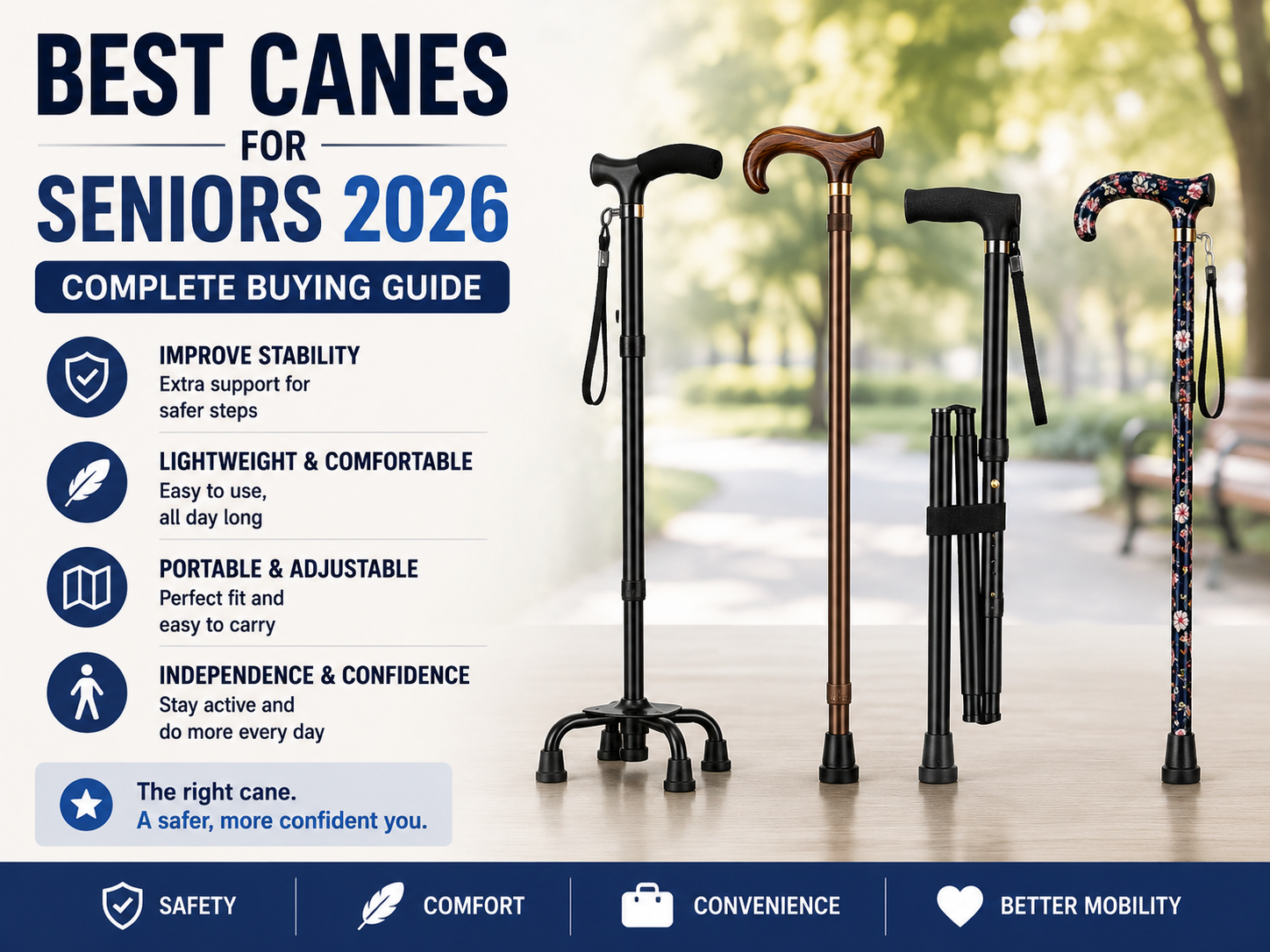
Best Canes for Seniors 2026: Complete Buying Guide

A cane is one of the simplest mobility aids available — and when it is the right type, the right height, and used correctly, it is one of the most effective. Canes reduce fall risk, offload weight from painful joints, extend the user's base of support, and provide the physical and psychological confidence that keeps older adults active and independent.

Yet many seniors use the wrong cane, the wrong size, or hold it incorrectly — reducing its benefit or creating new hazards. This guide covers everything needed to choose, fit, and use a cane safely in 2026. Browse our full selection at Canes & Walking Sticks at AllCare Store.

Who Benefits from a Cane?

Common reasons seniors use a cane include mild-to-moderate balance impairment from aging or vestibular conditions, arthritis in the hip or knee (the cane offloads the painful joint), post-surgical recovery from hip or knee replacement, weakness on one side from stroke, neuropathy in the feet, and general fall prevention for seniors who want an added safety margin.

A cane is not appropriate as the sole support for people who need significant bilateral weight-bearing assistance — those users typically need a walker or rollator. If you are unsure whether a cane is appropriate, ask your physician or physical therapist.

Types of Canes

Standard Single-Tip Canes

The most common design: a single shaft with a rubber tip and a handle at the top. Available in aluminum (lightweight, adjustable) and wood (traditional, non-adjustable). Standard canes suit users who need mild balance support or joint offloading on flat surfaces. They are the lightest and most portable option but provide the least stability.

Best for: Mild balance concerns; joint offloading (hip or knee pain); users who are largely independent and need minimal assistance
Not suitable for: Significant balance impairment; users who lean heavily on the cane

Offset / Hemi Canes

An offset cane has a curved shaft that positions the handle directly over the cane tip rather than behind it. This geometry puts the user's body weight directly over the point of ground contact, improving mechanical efficiency and reducing wrist strain. Offset canes are preferred by many physical therapists as the standard recommendation because they transmit force more efficiently than straight-shaft canes.

Best for: Most seniors needing a standard single-tip cane — this is the design physical therapists most commonly recommend for regular balance assistance and joint offloading

Quad Canes (Four-Point Canes)

A quad cane replaces the single rubber tip with a four-legged base, significantly increasing stability. It stands upright on its own and provides more support during weight transfer than any single-tip cane. Wide-base quad canes have the four feet spread further apart and are more stable than small-base (narrow) models.

Quad canes are heavier, slower to use (all four feet must contact the ground for full support), and awkward on stairs. They are most appropriate for users with significant balance impairment or one-sided weakness — particularly stroke survivors.

Best for: Significant one-sided weakness (hemiplegia/hemiparesis); severe balance impairment; users who need the cane to bear substantial weight
Not suitable for: Users who walk quickly; stairs without handrails

Folding Canes

A folding cane collapses into 3–5 sections connected by an elastic cord and compacts to fit in a bag, purse, or car door pocket. Popular for travel and intermittent use. Slightly less rigid than one-piece canes and the folding joints are a wear point — for heavy daily reliance, a one-piece adjustable aluminum cane is preferable. For occasional use and portability, a folding cane is excellent.

Best for: Travel; part-time cane users; backup canes kept in a car or bag
Not suitable for: Users who lean heavily on their cane; situations where maximum rigidity is important

Seat Canes (Cane Seats)

A seat cane integrates a small folding seat into the cane. When the user needs to rest, they flip out the seat and sit. Popular for users who can walk moderate distances but need frequent rest stops at outdoor events, museums, or shopping. Seat canes are heavier than standard canes and should be used on stable, level ground only.

Best for: Active seniors who tire standing but can walk; outdoor events; travel; shopping situations where rest stops are needed

Handle Styles and Ergonomics

T-Handle / Fritz Handle

A flat-topped T or Fritz-shaped handle (inverted T with a palm rest) provides a broad surface for the palm and distributes grip pressure well — comfortable for most users, particularly those with arthritis.

Ergonomic / Anatomical Handles

Contoured handles molded to fit the shape of the right or left hand (note: these are handed — buy the correct side). Reduce grip fatigue significantly for users who walk long distances with a cane. Often made from foam or soft-touch rubber over a rigid core.

Crook / Derby Handle

The classic curved handle. Comfortable for light use and visually appealing, but less efficient for transmitting force than a T or ergonomic handle. Not ideal for users who lean heavily on their cane.

How to Fit a Cane Correctly

Correct cane height is essential. An incorrectly sized cane is not just ineffective — it can worsen posture and increase fall risk.

The standard fitting method: Stand upright in your normal footwear with arms relaxed at your sides. The cane handle should be at the level of your wrist crease. With the cane in hand, your elbow should be bent at approximately 15–20 degrees — a slight bend, not fully extended and not deeply bent. If the elbow locks out straight, the cane is too short. If the elbow bends more than 30 degrees, the cane is too tall.

Most adjustable aluminum canes adjust in 1-inch increments. Adjust until you achieve the correct elbow bend during normal walking. When in doubt, a physical therapist can fit you precisely in five minutes.

Which Hand Should Hold the Cane?

Hold the cane in the hand opposite your weak or painful side. For example, if the right hip or knee is the affected side, hold the cane in the left hand. This is biomechanically correct: the opposite-side cane counterbalances the body during walking and offloads the affected joint most effectively — the same way the arm naturally swings opposite the leg during normal gait.

Many people intuitively reach for the cane on their painful side, but this is less effective and disrupts normal gait. Exception: certain post-surgical protocols specify same-side use during initial recovery — always follow your surgeon's specific instructions.

How to Walk Safely with a Cane

Correct gait on flat ground: advance the cane and the weaker leg forward together, then bring the stronger leg forward. The cane and weak leg move as a unit; the strong leg provides push-off.

On stairs: Up with the good, down with the bad. Going up, lead with the stronger leg, then bring the cane and weaker leg up. Going down, lead with the cane and weaker leg, then bring the stronger leg down. Always use a handrail when available — hold the rail with one hand and the cane with the other.

Cane Tips and Maintenance

The rubber tip is a wear item. A worn, smooth, or cracked tip reduces traction and can cause a fall as surely as no cane at all. Inspect the tip monthly and replace when the rubber wears flat or cracks — replacement tips are inexpensive and fit most standard shaft diameters.

For outdoor use on snow or ice, consider an ice tip attachment (a carbide spike that flips over the standard tip). Remove it before entering buildings with hard floors.

Cane Weight Capacity

Standard aluminum canes are rated for 250–300 lbs. Bariatric canes handle 400–500 lbs. Always confirm the weight rating before purchasing. Bariatric models have heavier-gauge shafts and stronger hardware throughout.

Shop Canes at AllCare Store

AllCare Store carries a full selection of standard, offset, quad, folding, and seat canes in a range of colors, handle styles, and weight capacities, with free shipping on every order. Need help choosing? Call us at 1-888-889-6260.

Canes & Walking Sticks | Walkers & Rollators | Mobility Aids | AllCare Store

Frequently Asked Questions: Canes for Seniors

What type of cane is best for seniors with balance problems?

For mild to moderate balance problems, an offset (hemi) cane is the most commonly recommended type — it is mechanically more efficient than a straight-shaft cane and the standard recommendation from physical therapists for general balance assistance. For more significant balance impairment, particularly one-sided weakness from stroke, a wide-base quad cane provides substantially more stability. If you are unsure which is right for your level of impairment, a single visit with a physical therapist can assess your gait and give a specific recommendation.

How do I know if my cane is the right height?

Stand upright in your normal shoes with arms relaxed at your sides. The cane handle should reach the level of your wrist crease. With the cane in hand, your elbow should bend at approximately 15–20 degrees — a gentle bend, not fully straight and not deeply flexed. If your elbow locks out straight, the cane is too short. If your elbow is bent more than 30 degrees, the cane is too tall. Most adjustable aluminum canes set in 1-inch increments.

Which hand should I hold my cane in?

Hold the cane in the hand opposite your weak or painful side. If your right hip or knee is the affected side, hold the cane in your left hand. This is biomechanically correct: the opposite-side cane counterbalances the body during walking and offloads the affected joint most effectively. Many people intuitively reach for the cane on their painful side, but this is less effective. The exception is certain post-surgical protocols that specify same-side use — always follow your surgeon's instructions after an operation.

Newsletter

A short sentence describing what someone will receive by subscribing