Medical Disclaimer: This article is for general informational purposes only and does not constitute medical advice. Ostomy care decisions — including product selection, skin care, and activity guidelines — should be made in collaboration with your surgeon, enterostomal therapy (ET) nurse, or wound ostomy continence (WOC) nurse, particularly in the early months following ostomy surgery.
Running a 5K With a Colostomy: David's Story
David was 52 when he had his colostomy surgery following a rectal cancer diagnosis. He'd been a recreational runner for fifteen years — nothing competitive, just three or four miles three times a week — and his biggest fear wasn't the surgery itself. It was whether he'd ever run again.
His ET nurse handed him a checklist of modifications to try and told him bluntly: "Most active people get back to their activities. The equipment has gotten very good." She wasn't wrong. Fourteen months after surgery, David finished his first post-surgery 5K. He now runs in an ostomy belt with a one-piece drainable pouch secured underneath, switches to a smaller mini-pouch for trail runs, and has a travel kit permanently packed in his gear bag.
"The learning curve is real," he said. "But once you find what works for your body and your activity level, it stops being the thing you think about every minute. It becomes just — part of getting ready."
That transition — from constant anxiety about the pouch to confident activity — is what good ostomy product selection enables. At AllCare Store, we've assembled this guide to help active ostomates find the products that fit their lifestyle, not just their anatomy.
Understanding the Types of Ostomy Pouching Systems
Before choosing a pouch for an active lifestyle, it helps to understand the fundamental differences in pouching system design.
One-Piece vs. Two-Piece Systems
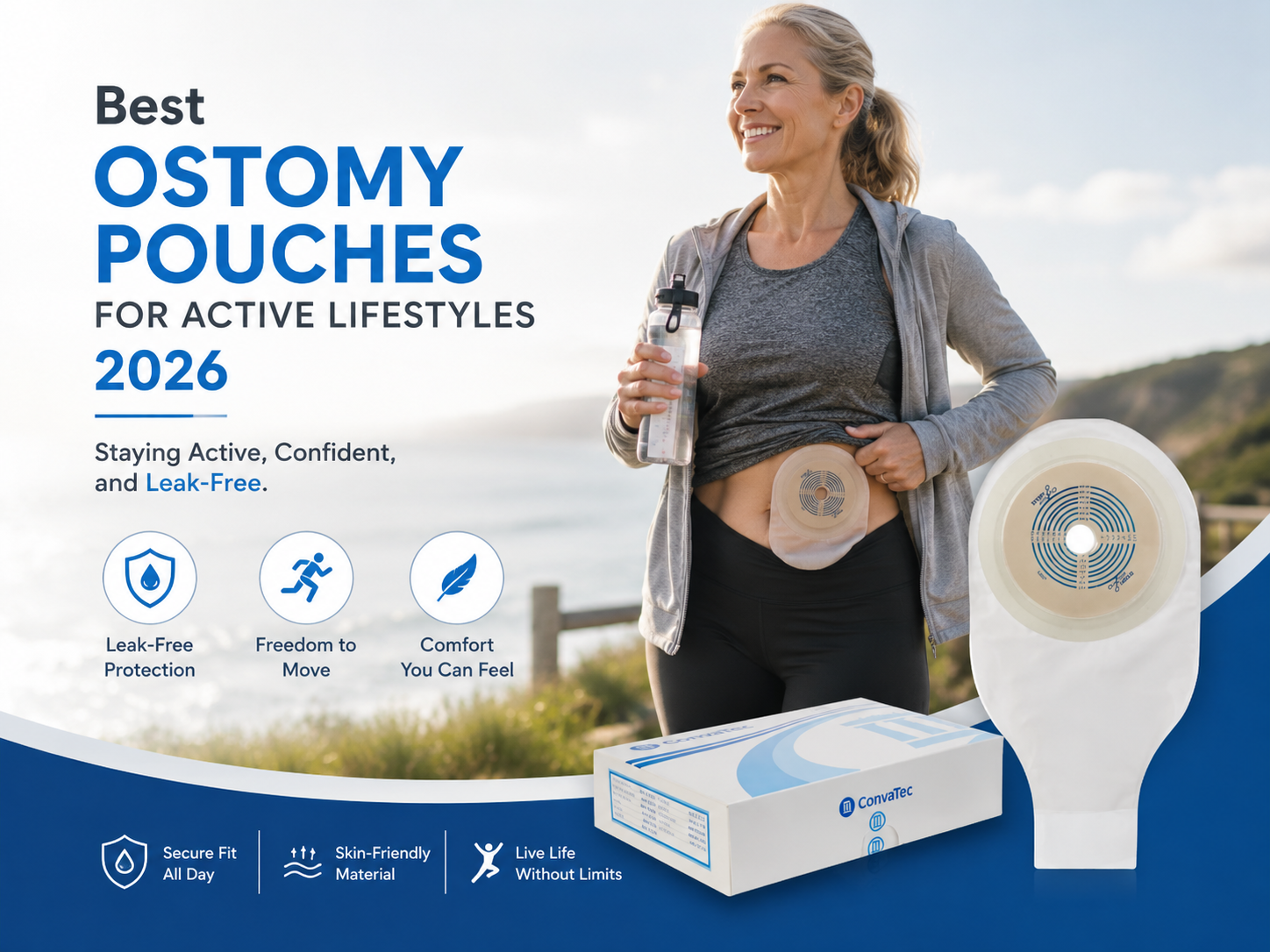
In a one-piece system, the skin barrier (wafer) and pouch are a single integrated unit. One-piece systems are generally lower-profile, more flexible, and more discreet under clothing — features that many active ostomates prefer. The tradeoff is that the entire system is changed at once, which is slightly less economical.
In a two-piece system, the skin barrier and pouch are separate components that connect via a coupling ring. This allows you to change the pouch without disturbing the skin barrier, which is useful for activity-specific swaps — for example, switching from a full drainable pouch to a smaller activity pouch without removing the barrier. Two-piece systems typically offer more flexibility in mixing and matching pouch styles.
Drainable vs. Closed-End Pouches
Drainable pouches can be emptied and reused for multiple days. They're the standard for ileostomates (whose output is liquid and frequent) and are also used by many colostomates. For active use, look for drainable pouches with secure, easy-open closures — especially clamp-style or integrated velcro/flip-top closures that are easier to manage in locker rooms or outdoor settings.
Closed-end pouches are sealed at the bottom and disposed of when full. They're commonly used by colostomates who irrigate and have more predictable, lower-volume output. Some active ostomates prefer closed-end mini-pouches for short activity windows because they're extremely low-profile and discreet.
Ostomy Type Matters
Product needs differ based on ostomy type. Colostomy output is typically formed or semi-formed, lower volume, and more predictable — allowing more flexibility in product choice. Ileostomy output is liquid, high-volume, and continuous, requiring higher-capacity drainable pouches and strong, skin-protecting barriers. Urostomy output is continuous urine, requiring pouches with anti-reflux valves and drainage spigots designed specifically for liquid output.
Browse our full Ostomy Supplies collection for pouches, barriers, accessories, and skin care products across all ostomy types.
What Makes a Pouch "Active Lifestyle" Ready
| Feature | Why It Matters for Activity |
|---|---|
| Extended-wear barrier | Resists perspiration, moisture, and movement without lifting; stays secure through workouts |
| Waterproof barrier and pouch | Essential for swimming and water sports; prevents barrier erosion from water exposure |
| Low-profile / mini pouch option | Reduces bulk under athletic clothing; less movement during exercise |
| Integrated filter (for gas) | Allows gas to escape without opening pouch; critical for activities where audible noise or ballooning is a concern |
| Flexible, soft backing | Moves with the body during exercise without creating pressure points or chafing |
| Ostomy belt compatibility | Adds security during high-impact activity; reduces pouch movement; many athletes wear belts during exercise |
| Secure drain closure | Clamp or integrated closure must remain secure during core exercise, bending, and high-impact activity |
Activity-Specific Guidance for Ostomates
Running, Cycling, and High-Impact Exercise
High-impact activities put the most stress on the barrier-to-skin seal through sweat and movement. A few strategies make a significant difference. Empty the pouch before exercise — a full pouch adds weight and increases the risk of pulling on the barrier. Wearing an ostomy belt or support garment holds the pouch close to the body and prevents the weight from stressing the seal. For extended runs or rides, a mini-pouch or high-output drainable pouch with a reliable closure is preferable to a full-size pouch. Moisture-resistant barrier extender tape around the edges of the wafer adds extra security against perspiration-induced lifting.
Swimming and Water Sports
Many ostomates swim regularly — the barrier and pouch are waterproof, and brief water exposure is generally fine. For longer swim sessions, extended-wear barriers perform significantly better than standard-wear barriers. Applying barrier extender strips and allowing the barrier to fully adhere (ideally 30 minutes) before swimming increases water resistance. After swimming, dry the outside of the pouch thoroughly, as extended moisture exposure on the barrier edges can eventually cause loosening. Some ostomates switch to a mini-pouch or empty/remove a drainable pouch (if output allows) for swimming and replace it after.
Contact Sports and Weightlifting
Contact sports require protecting the stoma from impact. Stoma guards — rigid or semi-rigid protective shields worn over the stoma — are available and recommended for contact sports, martial arts, and weightlifting where belt pressure or accidental contact is a risk. Ostomy support belts also help distribute abdominal pressure during heavy lifts. Discuss specific restrictions with your surgical team, particularly in the first 6–8 weeks after surgery when lifting restrictions are typically in place.
Travel
Travel introduces supply logistics, airport security, and access challenges. For air travel, carry all ostomy supplies in your carry-on luggage — never check them, as lost luggage would leave you without essential medical supplies. TSA allows ostomy supplies through security, and TSA Cares (1-855-787-2227) can arrange for discrete screening if needed. A travel-size supply kit with enough product for twice your planned trip length is the standard recommendation. Many ostomates also carry a brief written statement from their physician or ET nurse explaining their ostomy for situations requiring explanation.
Skin Care: The Foundation of Active Ostomy Management
Peristomal skin health — the skin around the stoma — is the most important factor in whether your pouching system stays secure during activity. Healthy, intact skin holds a barrier seal; irritated, broken, or moist skin doesn't.
For active ostomates who deal with more perspiration, here are the most important skin care practices. Cleanse peristomal skin with water only or an approved skin cleanser — avoid soaps with oils, lotions, or deodorants that leave residue and reduce barrier adhesion. Ensure the skin is completely dry before applying a new barrier — even light moisture significantly reduces adhesion. Size the barrier opening correctly — a gap of more than 2–3mm between the stoma and the barrier opening exposes skin to output and causes breakdown. And change the system on schedule rather than waiting until leakage occurs; a compromised barrier doesn't signal failure with a sudden leak — it degrades gradually.
Our Ostomy Skin Care collection includes barrier sprays, skin prep wipes, paste, powder, and accessories designed for active wear and skin protection.
Building Your Active Ostomate Kit
Active ostomates typically maintain two systems: their everyday pouching setup and an activity-specific setup or modification for workouts and sports. A practical activity kit includes your regular pouching system with an extended-wear barrier, an ostomy support belt sized for your wafer, barrier extender tape strips for extra adhesion during activity, a mini-pouch or small drainable pouch for activity windows, stoma powder and skin prep wipe for quick changes, and a compact change kit for locker rooms (gloves, disposal bag, fresh supplies).
Browse our Ostomy Accessories collection for belts, guards, adhesive accessories, and travel supplies.
Working With an ET Nurse: The Most Underused Resource
Enterostomal therapy (ET) nurses and wound ostomy continence (WOC) nurses are specialists in ostomy care who can troubleshoot pouching problems, recommend products based on your specific stoma characteristics and activity level, and connect you with manufacturer samples so you can try products before committing. Many insurance plans cover ET nurse consultations. If your current setup isn't performing the way you need it to for your activity level, an ET nurse appointment is typically more useful than trial-and-error product switching.
How AllCare Store Supports Active Ostomates
At AllCare Store, we stock a wide range of ostomy supplies from leading brands — one-piece and two-piece systems, drainable and closed-end pouches, extended-wear barriers, support belts, and skin care accessories. We're committed to providing quality products with full discretion.
- Free Shipping: Every order ships free — no minimum required
- Discreet Packaging: All orders arrive in plain, unmarked packaging
- 30-Day Returns: Shop with full confidence
- Wide Selection: One-piece, two-piece, drainable, closed, and activity-specific options
Browse our Ostomy Supplies collection. Our team is available to assist with product selection at 1-888-889-6260.
Visit AllCare Store — your trusted partner in home health and wellness.