Medical Disclaimer: This article is for informational and educational purposes only and does not constitute medical advice. If you are recovering from a stroke, injury, or surgery — or if you have significant balance or gait impairments — consult your physician or a physical therapist before selecting a mobility aid. A professional gait assessment can ensure you get the right cane type, height, and technique for your specific condition.
A Simple Choice That Makes a Real Difference
Margaret was 74 and recovering from a mild stroke that had left her with some weakness on her left side. Her daughter had picked up a standard single-point cane at the pharmacy. It helped — a little — but Margaret still felt unsteady, especially when she stood up from a chair or crossed a threshold. Her physical therapist took one look at the setup and switched her to a quad cane. "Night and day," Margaret said. "I actually feel like I can trust it now."
The difference between a quad cane and a single-point cane is straightforward, but the impact on safety and confidence is significant. At AllCare Store, we help people find the right mobility aid for their situation — and for canes, that conversation often starts with understanding what each type actually does differently.
What Is a Single Point Cane?
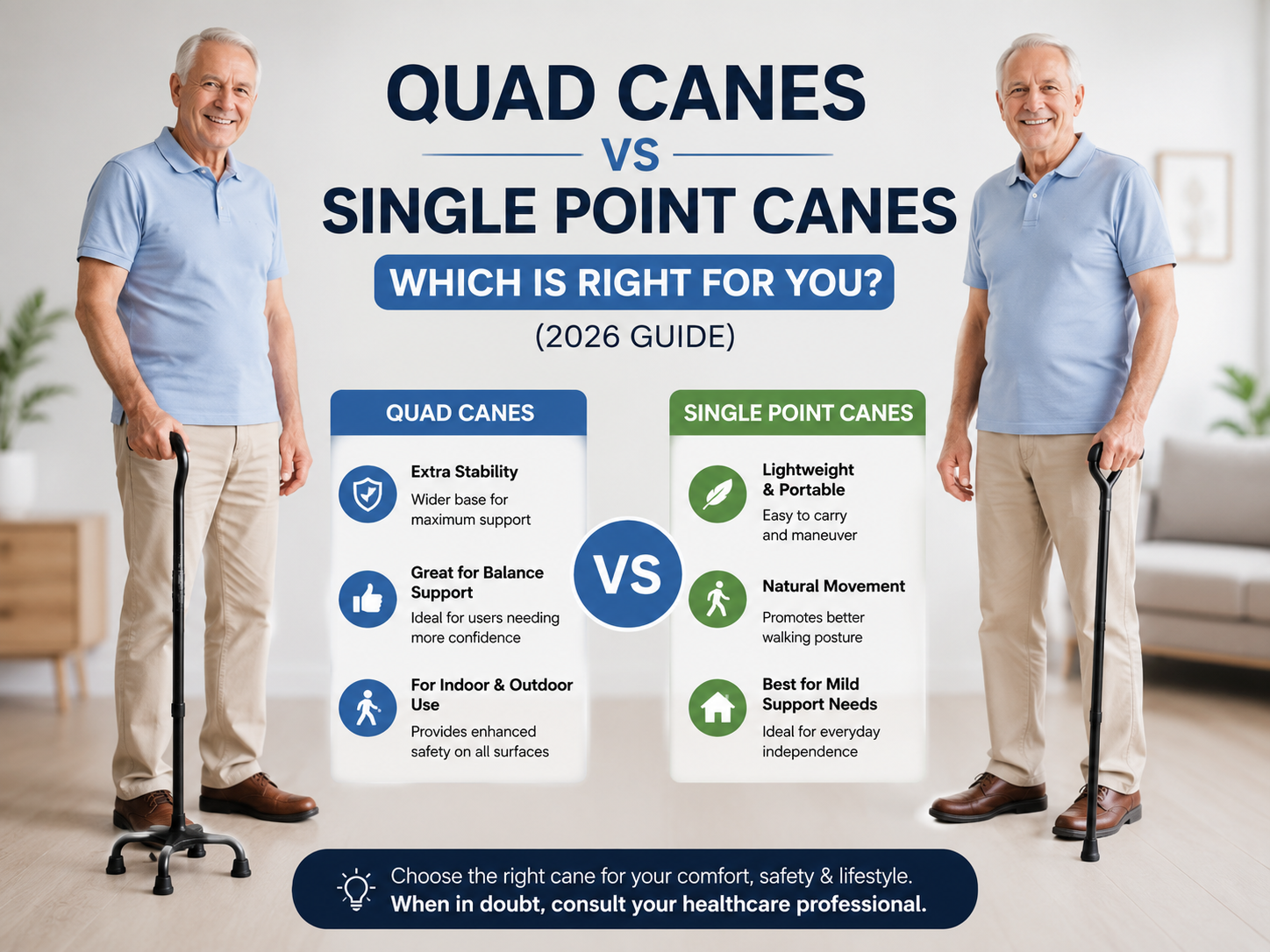
A single point cane (also called a standard cane or straight cane) has one tip at the bottom. It is the most common cane style and what most people picture when they think of a walking cane. Single point canes are lightweight, easy to use on stairs, and work well for people who need only minimal support for balance or mild joint pain relief.
They are available in fixed-length and adjustable models, in aluminum or wood, with a wide variety of handle styles including the classic crook handle, offset (functional) handle, and ergonomic pistol-grip handles.
What Is a Quad Cane?
A quad cane (also called a four-point cane) has a base with four small feet arranged in a rectangular pattern instead of a single tip. This design creates a much wider base of support and — crucially — allows the cane to stand upright on its own when you let go of it.
Quad canes come in two base widths: small-base quad canes (the four feet are closer together, allowing easier stair use) and large-base quad canes (wider stance for maximum stability). Large-base models provide significantly more support but are generally not recommended for stair climbing.
Key Differences at a Glance
| Feature | Single Point Cane | Quad Cane |
|---|---|---|
| Base contact | 1 tip | 4 feet |
| Stability | Moderate | High |
| Weight | Lighter | Heavier |
| Stands on its own | No | Yes |
| Stairs | Easy | Small-base only; large-base not recommended |
| Weight bearing | Up to ~25% body weight | Up to ~25% body weight (more stable under load) |
| Best for | Mild balance issues, joint pain, light support | One-sided weakness, stroke recovery, fall risk |
| Ease of use indoors | Very easy | Easy (large base may catch on carpet edges) |
When a Single Point Cane Is the Right Choice
A single point cane is appropriate when your balance is only mildly affected and your main need is a little extra reassurance, some offloading of an arthritic hip or knee, or the psychological security of having something to grip in unfamiliar settings. If you walk at a normal pace, navigate stairs regularly, and only need the cane part of the time, a single point cane is the right tool. It is lighter, easier to maneuver, and less cumbersome in tight spaces like restaurant restrooms or crowded hallways.
Good candidates for a single point cane include people with mild hip or knee osteoarthritis, those using a cane preventively in uneven outdoor terrain, individuals recovering from minor injuries, and people who use a cane only occasionally for longer walks or unfamiliar environments.
When a Quad Cane Is the Right Choice
A quad cane is indicated when you need significantly more lateral support than a single point cane can offer — particularly when one side of your body is weaker than the other or when you feel unstable in the moments of sitting down and standing up. The wider base of a quad cane provides support in multiple directions simultaneously, which a single-point tip cannot do. The ability to stand on its own is also a practical advantage: you can set it down when you reach a chair, and it will still be within reach when you stand up rather than having fallen to the floor.
Quad canes are particularly appropriate for stroke survivors with hemiplegia or hemiparesis (weakness on one side), people with Parkinson's disease experiencing balance issues, those recovering from hip replacement or lower-limb surgery, individuals with peripheral neuropathy affecting their gait, and anyone whose physical therapist has specifically recommended a quad cane based on a gait assessment.
The Right-Hand Rule: Which Side Does the Cane Go On?
Many people are unsure which hand to hold the cane in. The general rule: hold the cane in the hand opposite the weaker or painful leg. If your right hip is arthritic, hold the cane in your left hand. If you had a stroke affecting your right side, hold the cane in your unaffected left hand. This mirrors the natural arm-swing gait pattern and allows the cane to share the load during each step on the affected side.
There is an important exception: your physical therapist may give you different instructions based on your specific condition. Follow their guidance — these are general principles and individual situations vary.
Choosing the Right Height
An improperly fitted cane — whether quad or single point — can actually cause shoulder, back, or wrist problems. The correct cane height: stand upright in your normal shoes, arms relaxed at your sides. The cane handle should reach the crease of your wrist (roughly at the level of your greater trochanter — the bony prominence on the outer hip). Your elbow should bend approximately 20–30 degrees when you hold the cane and bear weight on it.
Most adjustable canes allow height setting in 1-inch increments. If you are between settings, it is generally better to err slightly shorter rather than longer. A cane that is too tall forces you to hike your shoulder; one that is too short makes you lean forward.
Handle Types Matter Too
Both quad and single point canes come in multiple handle styles, and the right handle can significantly affect comfort over long periods of use. The offset (functional) handle positions your hand directly over the cane shaft, which distributes weight more evenly and is generally preferred for people who need to put significant weight through the cane. The crook handle (the classic curved top) is fine for light use and easy to hang on a hook, but transfers weight less efficiently. Ergonomic pistol-grip handles are molded to the hand contours and reduce wrist fatigue — a good choice for people with arthritis in the hand or wrist.
Quad Cane Tips: Small Base vs Large Base
If you've decided a quad cane is right for you, the next choice is base size. Small-base quad canes have a narrower four-point configuration that fits more naturally within your stride width, navigates tighter spaces, and can be used on most staircases (one side at a time). They offer meaningfully more stability than a single-point cane without the bulk of a large base.
Large-base quad canes provide the highest level of support available in a cane — they are essentially a step down from a hemi-walker in terms of stability. However, the wide base can catch on carpet edges, thresholds, and stair nosings. Most physical therapists recommend large-base quad canes only for people who are not navigating stairs and who need the highest possible stability for standing transfers or significant one-sided weakness.
Quad Cane vs Walker: When to Upgrade
If you find yourself needing to put most or all of your weight through your upper body, a cane — even a large-base quad — is not the appropriate tool. At that level of dependence, a standard walker, rollator, or hemi-walker provides more surface area and a more stable frame. A physical therapist is the right person to make this call. The general transition point: if a quad cane feels insufficient and you are gripping it with effort just to maintain your balance, it is time for a different mobility device.
Browse our full Canes collection and our Walkers & Rollators collection to see all available options.
Shopping at AllCare Store
At AllCare Store, we carry a wide selection of single point canes, quad canes (small-base and large-base), and walking accessories to support safer mobility. Every order includes:
- Free Shipping on every order — no minimum
- 30-Day Returns for full peace of mind
- Wide Selection of adjustable and fixed-height models in multiple handle styles
Visit our Canes collection or call us at 1-888-889-6260 if you need help choosing the right cane.