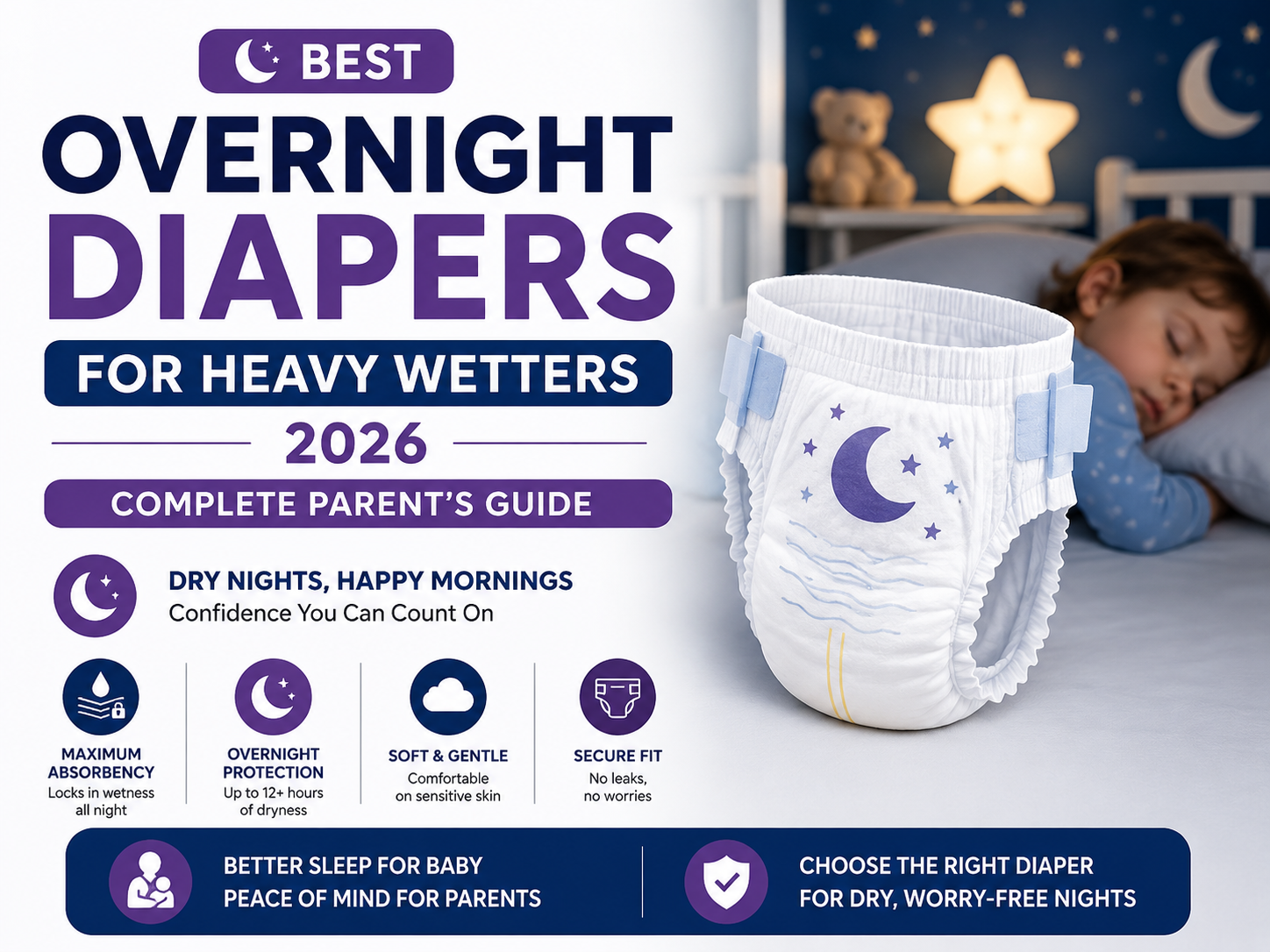
Few parenting frustrations match the 3 AM wake-up caused by a soaked onesie, wet sheets, and an unhappy baby. For parents of heavy wetters, overnight diaper leaks can happen every single night — disrupting the whole family's sleep and creating mountains of extra laundry. This guide explains the science behind overnight diaper performance, what separates overnight-specific diapers from regular diapers, and how to find the combination that finally keeps your heavy wetter dry through the night.
Why Regular Daytime Diapers Often Fail Overnight
A standard daytime diaper is designed to handle multiple moderate wettings over the course of a few hours before being changed. Overnight, a baby or toddler may go 10–12 hours without a diaper change, often producing significantly more urine than during a typical daytime interval. The cumulative volume can exceed a standard diaper's absorption capacity — especially for heavy wetters, who urinate more frequently or in larger volumes than average for their age.
Additionally, sleeping position matters in ways it doesn't during the day. A baby who sleeps on their back for hours concentrates urine at the back of the diaper; a stomach sleeper concentrates it at the front. Standard diapers distribute their absorbent core relatively evenly, which may not match where the heaviest wetting actually occurs during sleep.
Finally, overnight diapers must maintain performance under sustained compression from body weight and movement — a different stress than the intermittent brief pressure of daytime activity.
What Makes Overnight Diapers Different
Higher Total Absorbent Capacity
Overnight diapers contain more super-absorbent polymer (SAP) — the gel-forming material that locks liquid away — than comparable daytime diapers in the same size and brand. This increased SAP load allows the diaper to absorb and retain more total liquid before reaching saturation. The trade-off is slightly more bulk, which some parents notice as a wider fit through the legs.
Improved Stay-Dry Lining
The inner layer (top sheet) of a quality overnight diaper wicks moisture away from skin faster and keeps it locked lower in the core, even during prolonged contact. This is critical for preventing diaper rash during long overnight wears — a baby sleeping for 10 hours in a wet diaper where moisture is held against skin will develop rash; one where moisture is drawn away from the skin surface and locked into the core will be significantly better off.
Enhanced Leak Guards
Leg leak guards (the elasticized cuffs around the leg openings) on overnight diapers are typically taller and more elasticized than daytime versions, creating a more reliable seal against the varied sleeping positions a baby may occupy throughout the night. Look for cuffs that stand upright when the diaper is opened — those that lie flat often don't create an effective barrier during side sleeping.
Waistband Design
A snug back waistband is the primary defense against back blowouts — the nightmare scenario of containment failure at the diaper's upper rear edge. Premium overnight diapers often have a more substantial back waistband or a stretchy, form-fitting rear panel that maintains contact with the body during sleep movement.
Sizing: The Most Common Cause of Overnight Leaks
Before trying different brands or overnight-specific products, verify that the current diaper size is correct. This is the most frequently overlooked cause of overnight leaks — more so than any brand or product issue.
Signs the diaper is too small: red marks on the thighs or waist after removal, difficulty fastening tabs without overlapping the center panel, fabric bunching between the legs, leg leaks despite a properly applied diaper. Move up a size.
Signs the diaper is too large: visible gaps at the thigh openings even when properly applied, sagging in the front or back before a wetting, the waistband falling below the belly button. Move down a size.
For heavy wetters specifically, it is often beneficial to size up one size from the weight guidelines on the packaging — the additional material provides more coverage and more absorbent core. A baby at 21 lbs who is in size 3 but wetting through might do better in size 4 overnight, even if size 3 fits well during the day.
Application: How You Put the Diaper On Matters
Even the best overnight diaper will leak if applied incorrectly. Common application errors that cause leaks:
Not running a finger around the leg cuffs. The inner cuffs must be popped outward — they should be visible around the thigh, not tucked in. Tucked cuffs are the single most common cause of diaper leaks in babies who are not obviously oversaturating their diapers.
Applying too loosely. There should be no more than two finger widths of space at the waist. Loose application allows urine to pool in the gap between the diaper and the skin before reaching the absorbent core.
Applying too tightly around the legs. Leg tabs that are pulled too tight compress the cuffs against the thigh without leaving room for the cuffs to channel fluid inward. The diaper should be snug but not constricting.
Failing to center the diaper. The absorbent core should be centered front-to-back under the baby. An off-center diaper means one side has significantly less absorbency than the other.
Overnight Diaper Strategies for Heavy Wetters
Double-Diapering
Double-diapering — putting a second diaper over the first — is a practical approach some parents use for extreme heavy wetters. The outer diaper catches any overflow from the inner diaper. The technique works best with a snug inner diaper and a looser outer diaper one size up. It adds bulk and cost but can solve the overnight leak problem when no single diaper provides sufficient capacity.
Diaper Boosters / Inserts
Diaper booster pads are thin absorbent pads placed inside the diaper — not replacing the diaper, but supplementing its capacity. They add significant additional absorbency without the bulk of double-diapering. They work particularly well for heavy wetters whose leaks are due to volume rather than fit issues. Look for boosters compatible with disposable diapers (some are designed specifically for cloth diapering systems).
Last Feeding Timing
For breastfed or formula-fed infants, the timing of the last feeding before bed affects overnight wetting volume. This is not about restricting fluids — infant nutrition needs are paramount — but about awareness: a large feeding shortly before sleep increases overnight urinary output. For older infants and toddlers where fluid timing is more flexible, shifting the heaviest fluid intake earlier in the evening can reduce overnight wetting volume.
The Pre-Bed Change
For parents comfortable with a brief waking, changing to a fresh diaper just before going to bed yourself (typically 10–11 PM) resets the diaper clock and gives it a full, fresh capacity for the remaining sleep hours. This effectively converts an 11-hour overnight into two shorter intervals, which a standard high-capacity overnight diaper can handle. Many parents find this eliminates leaks entirely without changing brands or products.
Overnight Diapers by Age: What Changes
Newborns (0–3 Months)
Newborns urinate very frequently — up to 20 times per day — in small amounts. Newborn diapers are designed for high frequency, small-volume wetting. True newborn-specific overnight diapers are not widely available from most brands, and given the frequency of nighttime feeds and changes in the newborn period, overnight leaks are usually addressed by more frequent changes rather than diaper specialization.
Infants (3–12 Months)
As feeding stretches and sleep consolidates, overnight diaper demands increase. Size 2 and size 3 overnight diapers are widely available and generally effective for typical wetters. For heavy wetters in this age range, sizing up and using booster pads is often the most effective approach before moving to a specialty overnight product.
Toddlers (12 Months–Potty Training)
Toddlers produce larger volumes of urine and often sleep longer stretches than infants, making overnight diaper demands the highest of any stage. Overnight pull-up style diapers become available and practical at this age for children who can pull them up independently. For very heavy-wetting toddlers, many parents find overnight-specific diapers in size 5 or 6 combined with a booster pad provide the most reliable protection.
Night Training Transition
During the night training period — when a child can stay dry during the day but is not yet consistently dry overnight — overnight diapers or training pants remain appropriate. Bedwetting is developmentally normal through age 7 and is not a behavioral problem. Using a quality overnight diaper or training pant during this period protects the mattress and prevents sleep disruption while the child's bladder control continues to mature.
Dealing with Diaper Rash After Overnight Wear
Even with a quality overnight diaper, prolonged skin contact with any moisture — from even small amounts of urine that reach the skin surface — can cause diaper rash. Prevention during overnight wear:
Apply a generous layer of zinc oxide barrier cream (Desitin, Balmex, or a generic equivalent) at the evening diaper change. Zinc oxide creates a physical barrier between skin and moisture that does not wash away with urine. The cream should be thick enough to be visible — a thin layer does not provide meaningful protection.
Ensure the diaper's stay-dry lining is functioning properly — if the inner layer feels wet to the touch even when the diaper is not saturated, the lining is failing to wick moisture away from the skin, and a different product may perform better for your child's skin.
For persistent or severe diaper rash that doesn't respond to barrier cream in 2–3 days, consult your pediatrician — some rashes are fungal (yeast) rather than irritant-contact rashes and require antifungal treatment, not just barrier protection.
Baby and Toddler Care at AllCare Store
AllCare Store carries a wide selection of baby care products including diapers, diaper rash creams, and skin care essentials for infants and toddlers. Browse our mom and baby care collection for diapers, wipes, barrier creams, and nursing supplies. For skin care and personal care products, visit our personal care collection.
Our team is available at 1-888-889-6260, Monday–Friday 7:00 AM–4:00 PM CST. Free shipping on qualifying orders.
Frequently Asked Questions: Overnight Diapers for Heavy Wetters
What is the difference between overnight diapers and regular diapers?
Overnight diapers contain more super-absorbent polymer (SAP) for greater total absorption capacity, have a more effective stay-dry inner lining designed for prolonged wear, and feature taller leg cuffs and more secure waistbands for leak protection during varied sleeping positions. Regular daytime diapers are designed to be changed every 2–3 hours and are not engineered for the 10–12 hour demands of overnight wear. For heavy wetters, the capacity difference between a premium overnight diaper and a regular diaper of the same size can be significant — often 30–50% more absorbency in overnight-specific formulations.
My baby keeps leaking out the side of their diaper at night. What's causing it?
Side leaks almost always indicate one of three issues: the leg cuffs are tucked in rather than popped outward (the most common cause — run your finger around the inner leg cuffs to ensure they're standing up), the diaper is too small and the cuffs can't create a proper seal, or the diaper has reached its saturation capacity and is overflowing. Check the cuffs first — this corrects the problem in the majority of cases. If the cuffs are properly positioned, try sizing up and switching to an overnight-specific diaper with higher capacity.
Should I size up for overnight diapers?
For heavy wetters, yes — sizing up one size for overnight use is a widely used and effective strategy. A larger size provides more absorbent material and more coverage, even if the daytime size fits well. The diaper will be slightly bulkier but should still close securely with the tabs overlapping the front landing zone. Test with a few nights before committing to a full package. If the larger size creates gapping at the thighs or the tabs reach the sides of the diaper rather than the center panel, the size may be too large — try the overnight-specific version of the current size with a booster insert instead.
What are diaper booster pads and do they work?
Diaper booster pads are thin absorbent inserts placed inside a diaper to supplement its capacity. They work by adding extra absorbent material in the area of heaviest wetting without requiring a size change or double-diapering. They are particularly effective for heavy wetters who are already using the correct size and overnight-specific products but still saturating through. Place the booster pad flat inside the diaper, centered over the absorbent core, before putting the diaper on. Most booster pads are designed to work with disposable diapers and add 4–8 oz of additional capacity.
Is it normal for my toddler to be a heavy wetter at night?
Yes — significant variation in overnight urine production is completely normal among toddlers. Some toddlers produce two to three times more urine at night than others of the same age and weight, for reasons that include individual physiology, antidiuretic hormone (ADH) levels (which suppress urine production during sleep), fluid intake patterns, and bladder capacity. Heavy overnight wetting in toddlers who are dry during the day is not a sign of a medical problem in most cases — it is simply a normal variation in development. Night bladder control typically develops gradually between ages 2 and 7, and bedwetting is considered normal through age 7. If a child who was previously dry overnight begins wetting again, consult your pediatrician to rule out a UTI or other treatable cause.
For baby and toddler care essentials including diapers, wipes, and diaper rash products, visit AllCare Store. Browse our mom and baby care collection. Free shipping on qualifying orders. Call 1-888-889-6260, Monday–Friday 7 AM–4 PM CST.